


12 Aug Yashwant Varma Cash Probe Report Tabled in Lok Sabha: Key Facts for UPSC
✎ The Judges (Inquiry) Act, 1968, is the constitutional mechanism for investigating allegations of misbehaviour or incapacity against Supreme Court and High Court judges, involving a three-member committee and parliamentary…
Subject Relevance — Where This Topic Fits
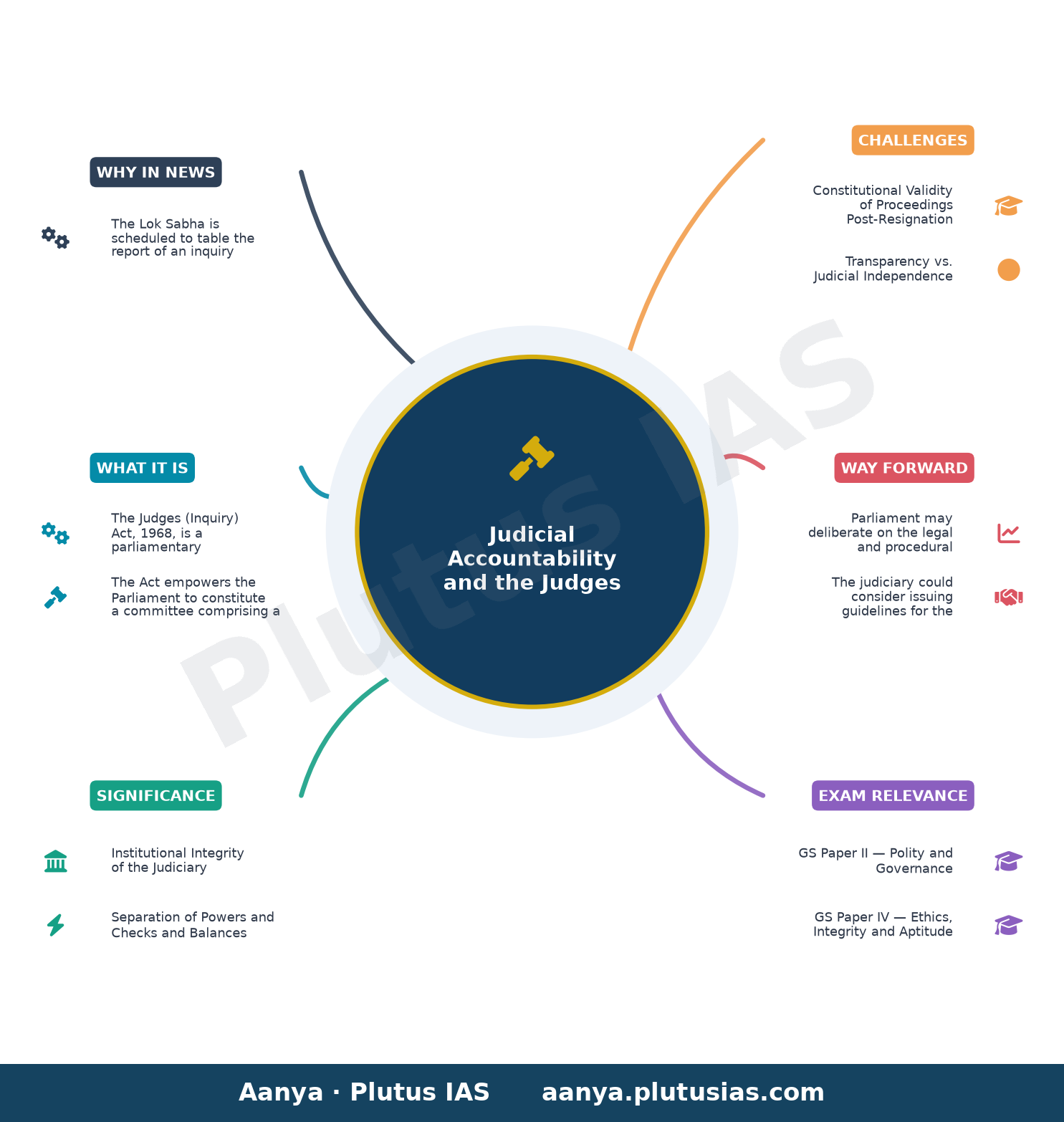
- GS Paper II — Polity and Governance | GS Paper IV — Ethics, Integrity and Aptitude
- Prelims: Judges (Inquiry) Act, 1968, Judicial accountability, Judicial standards, Constitutional provisions related to removal of judges, Parliamentary procedures for judicial inquiries
- Essay: Judicial accountability as a cornerstone of democratic governance, Balancing judicial independence and accountability in India
Quick Revision: The Judges (Inquiry) Act, 1968, is the constitutional mechanism for investigating allegations of misbehaviour or incapacity against Supreme Court and High Court judges, involving a three-member committee and parliamentary oversight, culminating in a removal process if necessary.
Why is this in the news?
The Lok Sabha is scheduled to table the report of an inquiry committee constituted under the Judges (Inquiry) Act, 1968, concerning allegations of financial irregularities against a former Allahabad High Court judge, Yashwant Varma. The case involves the discovery of unaccounted cash during a fire incident at his residence, raising questions about judicial probity, the procedural framework for judicial accountability, and the constitutional mechanisms for addressing misconduct by judges.
Background
- The Judges (Inquiry) Act, 1968, provides the legal framework for the investigation and removal of judges of the Supreme Court and High Courts for misbehaviour or incapacity.
- The case originated from a fire incident in March 2025 at the residence of Yashwant Varma, where a large amount of unaccounted and partially burnt cash was recovered from an outhouse, sparking public scrutiny and allegations of financial impropriety.
- An in-house probe by the Supreme Court of India initially indicted Varma, leading to the constitution of a three-member inquiry committee under the Judges (Inquiry) Act, 1968, headed by a sitting Supreme Court judge, to examine the allegations.
- Varma resigned from his judicial position during the inquiry, raising legal and procedural questions about the continuation of the inquiry and the applicability of the Act post-resignation.
- The inquiry committee submitted its report to the Lok Sabha Speaker, who has now listed it for tabling in the Lok Sabha, marking a significant procedural step in the process of judicial accountability.
- The case underscores the tension between judicial independence and the need for accountability, as well as the procedural complexities involved in addressing allegations against judges.
What is the Judges (Inquiry) Act, 1968, and how does it function?
- The Judges (Inquiry) Act, 1968, is a parliamentary legislation enacted to provide a mechanism for the investigation of allegations of misbehaviour or incapacity against judges of the Supreme Court and High Courts, as envisaged under Article 124(4) of the Constitution of India.
- The Act empowers the Parliament to constitute a committee comprising a Supreme Court judge, a Chief Justice of a High Court, and a distinguished jurist to inquire into such allegations.
- The inquiry process is quasi-judicial in nature, involving the examination of oral and documentary evidence, and the committee submits its findings to the Parliament.
- If the inquiry finds the judge guilty of misbehaviour or incapacity, the Parliament may, by a resolution supported by a special majority, recommend the removal of the judge to the President of India.
- The Act ensures that the process is transparent and participatory, with the involvement of both Houses of Parliament in the decision-making process.
- The inquiry committee operates independently of the executive and the judiciary, ensuring impartiality and adherence to constitutional principles.
- The Act also provides for the protection of the judge’s rights during the inquiry, including the right to legal representation and a fair hearing.
- The procedural framework under the Act is designed to balance judicial independence with the need for accountability, ensuring that the dignity and authority of the judiciary are not compromised.
Key Features
| Feature | Significance |
|---|---|
| Judges (Inquiry) Act, 1968 | Provides the legal framework for the constitution of inquiry committees against judges of the Supreme Court and High Courts for allegations of misbehaviour or incapacity. |
| In-house inquiry by Chief Justice of India (CJI) | A preliminary mechanism within the judiciary to assess allegations against judges before escalation to parliamentary processes. |
| Parliamentary inquiry under the Judges (Inquiry) Act | Empowers the Speaker of the Lok Sabha to constitute an inquiry committee with a Supreme Court judge as chairperson, ensuring judicial oversight of judicial conduct. |
| Resignation of the judge during inquiry | Demonstrates the procedural independence of the judiciary, though it raises questions about the continuation of proceedings post-resignation. |
| Tabling of inquiry report in Lok Sabha | Ensures transparency and accountability by making the findings of the inquiry committee available to the legislature and the public. |
Why it Matters
Institutional Integrity of the Judiciary
- The case underscores the judiciary’s commitment to self-regulation through in-house inquiries and parliamentary oversight mechanisms.
- It highlights the procedural safeguards embedded in the Judges (Inquiry) Act to address allegations of judicial misconduct.
- The resignation of the judge during the inquiry reflects the gravity with which such allegations are treated within the judicial system.
Separation of Powers and Checks and Balances
- The involvement of the Lok Sabha in tabling the inquiry report exemplifies the constitutional principle of checks and balances between the judiciary and the legislature.
- The process ensures that allegations against a judge are not handled in isolation but subjected to multi-layered scrutiny.
Public Trust and Judicial Accountability
- The discovery of unaccounted cash during a fire incident at the judge’s residence eroded public trust, necessitating a transparent inquiry.
- The tabling of the report in Parliament is a step toward restoring confidence in the judiciary’s accountability mechanisms.
Legal and Procedural Precedents
- The case sets a precedent for the application of the Judges (Inquiry) Act in instances where a judge resigns mid-inquiry, raising questions about the legal status of the proceedings.
- It reinforces the importance of documentary and oral evidence in establishing the veracity of allegations.
Challenges
1. Constitutional Validity of Proceedings Post-Resignation
- The Judges (Inquiry) Act, 1968, is framed for serving judges, creating ambiguity about the continuation of proceedings after resignation.
- Parliament may face legal and procedural hurdles in acting on the findings if the judge is no longer in office.
UPSC Link: Article 124(4) – Removal of Judges
2. Transparency vs. Judicial Independence
- Balancing the need for transparency with the protection of judicial independence remains a persistent challenge in such inquiries.
- Public disclosure of evidence and findings must not compromise the confidentiality required for judicial deliberations.
UPSC Link: Article 21 – Right to Fair Trial
3. Public Perception and Judicial Credibility
- Allegations of financial impropriety, even if unproven, can significantly damage public trust in the judiciary.
- The media’s role in shaping public opinion necessitates careful handling of such cases to avoid prejudicial reporting.
UPSC Link: Article 19(1)(a) – Freedom of Speech
4. Inter-Institutional Coordination
- Effective coordination between the judiciary, legislature, and executive is critical to ensure timely and fair resolution of such cases.
- Delays in the inquiry process can undermine public confidence in the justice delivery system.
UPSC Link: Article 50 – Separation of Judiciary
5. Legal Ambiguity in Evidence Handling
- The admissibility and weight of partially-burnt cash as evidence pose challenges in establishing financial impropriety.
- Forensic and documentary evidence must meet stringent standards to be considered valid in judicial proceedings.
UPSC Link: Indian Evidence Act, 1872
6. Ethical Dilemmas in Judicial Conduct
- The case raises questions about the ethical standards expected of judges beyond legal technicalities.
- Judicial conduct must align with societal expectations of probity and integrity.
UPSC Link: Code of Conduct for Judges
Challenges — UPSC Perspective
| Issue | Concern |
|---|---|
| Ambiguity in the Judges (Inquiry) Act | Lack of clarity on the continuation of proceedings after a judge’s resignation. |
| Public Trust Erosion | Allegations of financial impropriety can undermine confidence in the judiciary. |
| Evidence Admissibility | Partially-burnt cash as evidence may not meet legal standards for proving financial irregularities. |
| Inter-Institutional Coordination | Delays or misalignment between the judiciary and legislature can hinder timely resolution. |
| Media and Public Scrutiny | Sensationalised reporting can prejudice public opinion and judicial proceedings. |
| Ethical Expectations | Societal expectations of judicial conduct may exceed legal definitions of misbehaviour. |
Way Forward
- Parliament may deliberate on the legal and procedural implications of continuing the inquiry post-resignation, ensuring alignment with constitutional provisions.
- The judiciary could consider issuing guidelines for the handling of evidence in cases involving financial irregularities to ensure consistency.
- Strengthen inter-institutional mechanisms to expedite inquiries without compromising due process or judicial independence.
- Enhance transparency in the inquiry process while safeguarding the confidentiality of judicial deliberations and sensitive evidence.
- Conduct periodic reviews of the Judges (Inquiry) Act to address ambiguities and ensure its relevance in contemporary judicial contexts.
- Promote ethical training for judges to reinforce expectations of probity and integrity beyond legal compliance.
- Establish a dedicated mechanism within the judiciary to address public grievances related to judicial conduct in a timely manner.
- Encourage public awareness campaigns to educate citizens about the judicial accountability processes and their rights.
UPSC Value Addition
Keywords for Mains Answer-Writing
Judicial accountability · Judges (Inquiry) Act, 1968 · Constitutional provisions for judicial misconduct · Parliamentary oversight of judiciary · Judicial independence vs accountability · Institutional integrity of higher judiciary · Constitutional morality · Procedural safeguards in judicial inquiries · Role of Speaker of Lok Sabha · Judicial ethics and probity · Constitutional bodies under Article 124(4) · Mechanisms for removal of judges · Separation of powers · Judicial corruption and public trust · Constitutional governance and checks and balances
Constitutional & Policy Linkages
- Article 124(4) – Procedure for removal of a judge of the Supreme Court or High Court
Concept Flow
Allegations of financial irregularities against a High Court judge emerge → In-house inquiry by the Chief Justice of India is initiated → Unaccounted cash is discovered during a fire incident at the judge’s residence → Public outrage and demand for accountability intensify → Lok Sabha Speaker constitutes an inquiry committee under the Judges (Inquiry) Act → The judge resigns during the inquiry → The inquiry committee submits its report to the Lok Sabha → Parliament deliberates on the findings and legal implications → Procedural and constitutional ambiguities regarding post-resignation proceedings are addressed → Judicial accountability mechanisms are reinforced or reformed based on outcomes.
Prelims Practice Questions
Q1. Consider the following statements regarding the Judges (Inquiry) Act, 1968:
1. It empowers Parliament to constitute an inquiry committee against a serving judge of the Supreme Court or High Court.
2. The inquiry committee must include a sitting judge of the Supreme Court.
3. The Act applies to judges only while they are in office and not after their resignation.
4. The findings of the inquiry committee are binding on the President for removal proceedings.
How many of the above statements are correct?
- Only one
- Only two
- Only three
- All four
Answer: Only three — Statements 1 and 2 are correct as per the Act. Statement 3 is correct because the Act applies only to serving judges. Statement 4 is incorrect as the findings are recommendatory, not binding.
Q2. Assertion (A): The Speaker of the Lok Sabha has the constitutional authority to constitute an inquiry committee against a judge of the High Court under the Judges (Inquiry) Act, 1968.
Reason (R): The Speaker acts on a motion supported by members from different political parties.
Options:
A. Both A and R are true, and R is the correct explanation of A.
B. Both A and R are true, but R is not the correct explanation of A.
C. A is true, but R is false.
D. A is false, but R is true.
- A
- B
- C
- D
Answer: C — Assertion (A) is true as the Speaker can constitute such a committee under the Act. Reason (R) is also true but does not explain the constitutional authority of the Speaker.
Mains Practice Question
✍ The resignation of a judge during an inquiry into allegations of financial impropriety raises critical questions about the effectiveness of institutional mechanisms for judicial accountability in India. Critically examine the constitutional and legal framework governing judicial accountability, with particular reference to the Judges (Inquiry) Act, 1968. Also, analyse the implications of such resignations for the balance between judicial independence and public accountability. (15 Marks)
Approach: MODEL-ANSWER SKELETON:
1. **Constitutional Provisions**:
– Article 124(4) and 217(1)(b) of the Constitution: Grounds for removal of judges.
– Judges (Inquiry) Act, 1968: Composition, powers, and procedural safeguards of inquiry committees.
– Role of the Speaker of Lok Sabha in constituting such committees.
2. **Institutional Framework**:
– In-house procedure under the Supreme Court’s ‘Restatement of Values of Judicial Life’ (1997).
– Role of the Chief Justice of India (CJI) in initiating suo motu inquiries.
– Parliamentary oversight: Motion for removal under Article 124(4)(b).
3. **Judicial Independence vs Accountability**:
– Doctrine of separation of powers and judicial independence (Supreme Court Advocates-on-Record Association v. Union of India, 1993).
– Need for accountability to maintain public trust (e.g., cases of judicial corruption or misconduct).
– Tension between institutional integrity and individual accountability.
4. **Implications of Resignation During Inquiry**:
– Legal ambiguity: Does resignation absolve the judge of liability?
– Precedents: Cases where judges resigned during inquiries (e.g., Justice V. Ramaswami, 1993).
– Impact on public perception and institutional credibility.
5. **Reforms and Recommendations**:
– Strengthening transparency in financial disclosures by judges.
– Role of the proposed National Judicial Commission (NJC) for holistic accountability.
– Balancing privacy rights of judges with public interest in transparency.
6. **Conclusion**:
– Judicial accountability must be robust yet fair, ensuring independence is not undermined. Resignations during inquiries highlight gaps in the current framework, necessitating legislative and institutional reforms.
Source: Times of India
Generated by AanyaAi for educational purpose.


No Comments