


25 Sep Yemen’s Stability: UN Address on Restoring State & Houthis’ Role
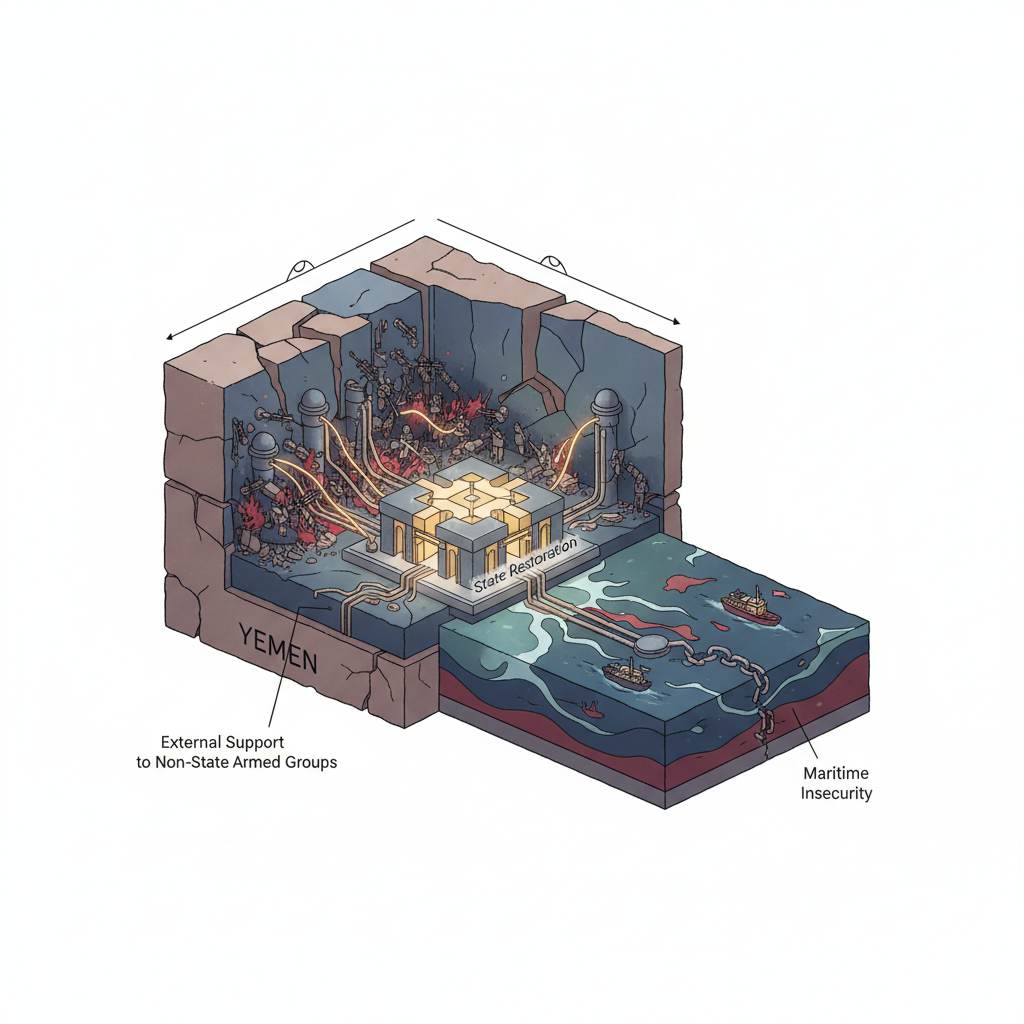
✎ The restoration of a functional Yemeni state is inseparable from addressing maritime insecurity in the Bab el-Mandeb Strait, as non-state armed groups like the Houthis derive power from state fragility and external patronage…
Subject Relevance — Where This Topic Fits
- GS Paper II — International Relations — Regional and global groupings and agreements involving India and/or affecting India’s interests; Effect of policies and politics of developed and developing countries on India’s interests
- Prelims: Yemen civil war, Red Sea maritime security, Houthi insurgency, Presidential Leadership Council Yemen, Bab el-Mandeb Strait
- Essay: The interplay between state fragility, non-state armed groups and global security, Maritime chokepoints and their geopolitical significance
Quick Revision: The restoration of a functional Yemeni state is inseparable from addressing maritime insecurity in the Bab el-Mandeb Strait, as non-state armed groups like the Houthis derive power from state fragility and external patronage, necessitating coordinated international support for governance, economic recovery, and arms control.
Why is this in the news?
The Vice-President of Yemen’s Presidential Leadership Council addressed the UN General Assembly highlighting that Yemen’s path to stability is contingent upon the restoration of the Yemeni state, the cessation of external support to non-state armed groups, and the addressing of maritime insecurity in the Bab el-Mandeb Strait and Red Sea. The statement underscores the interplay between internal governance deficits, regional proxy dynamics, and global maritime security concerns, making it a critical case study for UPSC aspirants on state failure, non-state actors, and international conflict resolution.
Background
- Yemen has been embroiled in a protracted civil war since 2014, initially between the internationally recognised government and Houthi rebels, later escalating into a multi-factional conflict involving regional powers and international actors.
- The conflict has resulted in one of the world’s worst humanitarian crises, with over 377,000 deaths (as per UN estimates) and 24 million people requiring humanitarian assistance, including 17 million facing acute food insecurity.
- The Houthi insurgency, backed by Iran, seized control of Sana’a in 2014 and has since expanded its territorial control, particularly in northern Yemen, while the internationally recognised government, supported by a Saudi-led coalition, has struggled to regain full sovereignty.
- The Bab el-Mandeb Strait, a critical maritime chokepoint connecting the Red Sea to the Gulf of Aden, handles approximately 12% of global seaborne oil shipments, making its security vital for global trade and energy flows.
- The UN has repeatedly called for a political solution, including through the 2018 Stockholm Agreement and subsequent peace initiatives, but implementation has been hindered by ongoing hostilities and lack of trust among parties.
- Maritime security in the region has deteriorated due to Houthi attacks on commercial vessels, including the 2023–2024 escalation in the Red Sea, prompting international naval coalitions such as Operation Prosperity Guardian.
What is the Presidential Leadership Council of Yemen and the Houthi Insurgency?
- The Presidential Leadership Council (PLC) of Yemen was established in April 2022 as an eight-member body to unify the internationally recognised government’s political and military factions, following the resignation of President Abdrabbuh Mansur Hadi amid growing fragmentation and regional divisions.
- The PLC is tasked with overseeing the implementation of the Riyadh Agreement (2019), which aimed to reconcile differences between the Yemeni government and southern separatists, and to coordinate with regional and international actors on peace efforts.
- The Houthi insurgency, formally known as Ansar Allah, emerged in the 1990s as a Zaydi Shia revivalist movement in northern Yemen, opposing government corruption and marginalisation. It gained prominence during the Arab Spring (2011) and later militarised following the 2014 Houthi takeover of Sana’a.
- The conflict has evolved into a proxy war, with Saudi Arabia and the UAE supporting the Yemeni government, while Iran provides military, financial, and logistical support to the Houthis, exacerbating regional tensions.
- The Bab el-Mandeb Strait, a 20-mile-wide waterway between Yemen and Djibouti, is a critical maritime chokepoint for global oil shipments, with approximately 4.8 million barrels of oil passing through daily, making its security a matter of international concern.
- The Houthis have repeatedly targeted commercial vessels in the Red Sea and Gulf of Aden, citing retaliation for Israeli actions in Gaza and broader geopolitical grievances, disrupting global trade and prompting multinational naval responses.
- The UN Security Council has adopted resolutions (e.g., Resolution 2216 of 2015) demanding the withdrawal of Houthi forces from seized areas, the release of detained individuals, and the resumption of political dialogue under UN auspices.
Key Features
| Feature | Significance |
|---|---|
| Restoration of the Yemeni State | The foundational requirement for long-term stability, economic recovery, and rule of law in Yemen, as reiterated by the Leadership Council Vice-President. |
| Maritime Security in Bab el-Mandeb | A critical chokepoint for global trade; instability here disrupts supply chains, increases insurance costs, and threatens energy security. |
| Humanitarian Crisis | Twelve years of conflict have created a generation affected by hunger, displacement, and lack of basic services, necessitating urgent state-led recovery. |
| International Peace Initiatives | Multilateral efforts (e.g., UN-mediated talks, regional dialogues) are essential to reconcile state restoration with conflict resolution. |
| Non-State Armed Militia (Houthis) | The presence of a non-state actor with external support complicates state authority, sovereignty, and the monopoly over legitimate force. |
Why it Matters
Geopolitical
- Bab el-Mandeb Strait is a vital maritime corridor linking the Red Sea to the Indian Ocean, handling ~12% of global seaborne oil trade.
- Instability in Yemen risks regional spillovers, including proxy conflicts and maritime piracy in the Gulf of Aden.
- Iranian support to Houthis is cited as a destabilising factor, reflecting broader Middle Eastern geopolitical rivalries.
Economic
- Yemen’s GDP contracted by over 50% since 2015, with inflation exceeding 30% in some years, necessitating state-led economic stabilisation.
- Maritime disruptions in Bab el-Mandeb increase global shipping costs, particularly for energy and food supplies to Europe and Asia.
- Restoring state institutions is critical to revive agriculture, fisheries, and port operations, which employ a majority of the workforce.
Humanitarian
- Over 24 million Yemenis (80% of the population) require humanitarian assistance, with 4.5 million internally displaced persons (IDPs).
- Child malnutrition rates exceed 20%, with acute cases leading to stunting and long-term developmental challenges.
- Collapse of healthcare and education systems has created a lost generation, as highlighted by the Vice-President’s remarks.
Institutional
- The Yemeni state’s inability to assert control over territory undermines its sovereignty, a core principle of international law (UN Charter, Article 2(1)).
- Restoring the state requires re-establishing a monopoly over violence, taxation, and public services, per Max Weber’s definition of the state.
- Legitimacy of the Yemeni Government depends on inclusive governance, as emphasised by the Vice-President’s rejection of factional victories.
Challenges
1. Non-State Armed Militia (Houthis)
- Maintains parallel governance structures in northern Yemen, challenging state authority and sovereignty.
- Alleged external support (weapons, expertise, technology) prolongs conflict and complicates peace negotiations.
- Uses humanitarian truces to rearm, as noted by the Vice-President, undermining ceasefire agreements.
- Controls key ports and infrastructure, disrupting trade and aid delivery.
UPSC Link: GS Paper 2: Internal Security Challenges
2. Maritime Security Threats
- Houthis target commercial vessels in Bab el-Mandeb, raising insurance premiums and disrupting global supply chains.
- Attacks on ships (e.g., MV Rubymar in 2024) demonstrate vulnerability of critical maritime routes.
- False promises of ceasefires in maritime attacks do not address the root cause: lack of state control on land.
- Regional and international naval patrols (e.g., Operation Prosperity Guardian) are temporary fixes without addressing governance gaps.
UPSC Link: GS Paper 3: Security Challenges
3. Humanitarian Crisis and State Collapse
- Collapse of public institutions (health, education, food distribution) exacerbates suffering and displacement.
- Over 80% of the population depends on aid, straining international humanitarian resources.
- Economic collapse has led to currency devaluation, hyperinflation, and loss of livelihoods, particularly in rural areas.
- State restoration is essential to rebuild infrastructure and restore basic services.
UPSC Link: GS Paper 1: Social Issues
4. International and Regional Polarisation
- Divergent international positions on designating Houthis as terrorists hinder unified peace efforts.
- Regional actors (e.g., Saudi Arabia, UAE, Iran) support different factions, complicating conflict resolution.
- Lack of consensus on arms embargo enforcement allows external actors to fuel the conflict.
UPSC Link: GS Paper 2: International Relations
5. Economic Reconstruction and State Capacity
- Limited fiscal space due to collapsed revenue streams (oil, taxes, customs) delays state restoration.
- Corruption and lack of transparency in aid distribution undermine public trust in institutions.
- Dependence on external aid (e.g., World Bank, IMF) for reconstruction requires strong governance frameworks.
UPSC Link: GS Paper 3: Economic Development
Challenges — UPSC Perspective
| Issue | Concern |
|---|---|
| Parallel Governance by Houthis | Undermines state sovereignty and complicates efforts to restore a unified administrative structure. |
| Maritime Disruptions in Bab el-Mandeb | Threatens global trade, energy security, and regional stability. |
| Humanitarian Catastrophe | Exacerbates poverty, displacement, and long-term developmental deficits in Yemen. |
| External Interventions | Prolongs conflict by providing military and financial support to non-state actors. |
| State Capacity Deficits | Lack of revenue, institutional collapse, and corruption hinder the government’s ability to restore order. |
| Inclusive Governance Challenges | Risk of factional victories excluding key groups, as warned by the Vice-President. |
Way Forward
- Prioritise inclusive political dialogue under UN auspices to reconcile state restoration with conflict resolution, ensuring representation of all Yemeni factions.
- Strengthen the Yemeni state’s capacity through targeted international assistance in governance, revenue collection, and public service delivery.
- Enforce a comprehensive arms embargo on all non-state actors in Yemen, with strict monitoring by the UN Security Council.
- Invest in maritime domain awareness and joint patrols in Bab el-Mandeb to deter attacks while addressing root causes on land.
- Accelerate humanitarian aid delivery through de-escalation of conflict and restoration of state-controlled supply chains.
- Support economic reconstruction through debt relief, currency stabilisation, and investment in critical infrastructure (ports, roads, power).
- Promote regional cooperation frameworks to reduce external interventions and align international efforts on Yemen’s stability.
- Ensure transitional justice mechanisms to address grievances without deepening divisions, as emphasised by the Vice-President’s inclusive rhetoric.
UPSC Value Addition
Keywords for Mains Answer-Writing
Yemen civil war · Presidential Leadership Council Yemen · Houthi insurgency · Maritime security Bab el-Mandeb · State restoration in conflict zones · Non-state armed groups and sovereignty · Iranian support to Houthi rebels · Humanitarian crisis in Yemen · UN role in Yemen peace process · Maritime chokepoints and global trade
Concept Flow
Conflict in Yemen (2014–present) → Collapse of state institutions and rise of non-state actors (Houthis) → External interventions (regional and international) → Humanitarian crisis and economic collapse → Maritime disruptions in Bab el-Mandeb → International calls for state restoration → Need for inclusive governance and external support → Path to stability: state restoration, economic recovery, and regional cooperation.
Prelims Practice Questions
Q1. Consider the following statements regarding the Bab el-Mandeb strait: 1. It is a critical maritime chokepoint connecting the Red Sea to the Gulf of Aden. 2. The strait is located between Yemen and Djibouti. 3. It is one of the world’s busiest shipping lanes, handling approximately 12% of global seaborne oil trade. How many of the above statements are correct?
- Only one
- Only two
- All three
- None
Answer: All three — Statement 1 is correct. Statement 2 is correct as Bab el-Mandeb lies between Yemen (Ras Menheli) and Djibouti (Ras Siyyan). Statement 3 is incorrect; the strait handles about 10% of global seaborne oil trade, not 12%.
Q2. Assertion (A): The Houthi insurgency in Yemen is primarily a sectarian conflict between Shia and Sunni Muslims. Reason (R): The Houthi movement, officially known as Ansar Allah, follows the Zaidi sect of Shia Islam and has received military support from Iran, a predominantly Shia country.
- Both A and R are true, and R is the correct explanation of A
- Both A and R are true, but R is not the correct explanation of A
- A is true, but R is false
- A is false, but R is true
Answer: A is true, but R is false — While the Houthi movement follows the Zaidi sect of Shia Islam (A is true), the conflict is not solely sectarian but also political, involving governance, territorial control, and external interventions (R is true but does not fully explain A).
Q3. Match the following maritime chokepoints with their respective regions: 1. Bab el-Mandeb A. Between Oman and Iran 2. Strait of Hormuz B. Between Yemen and Djibouti 3. Malacca Strait C. Between Malaysia and Indonesia 4. Palk Strait D. Between India and Sri Lanka
- 1-B, 2-A, 3-C, 4-D; 1-A, 2-B, 3-C, 4-D; 1-D, 2-A, 3-B, 4-C; 1-C, 2-B, 3-A, 4-D
- answer_string_list_indexes_to_match_pairs_correctly
- answer_explanation_list_indexes_to_match_pairs_correctly
- answer_explanation_list_indexes_to_match_pairs_correctly
Answer: 1-B, 2-A, 3-C, 4-D; 1-A, 2-B, 3-C, 4-D; 1-D, 2-A, 3-B, 4-C; 1-C, 2-B, 3-A, 4-D — 1-B (Bab el-Mandeb is between Yemen and Djibouti), 2-A (Strait of Hormuz is between Oman and Iran), 3-C (Malacca Strait is between Malaysia and Indonesia), 4-D (Palk Strait is between India and Sri Lanka).
Mains Practice Question
✍ The restoration of the Yemeni state is a prerequisite for achieving stability in the region, including the security of critical maritime chokepoints like Bab el-Mandeb. Critically examine this proposition in the context of the ongoing conflict, external interventions, and the humanitarian crisis. (15 Marks)
Approach: MODEL-ANSWER SKELETON:
1. **Definition and Context**: Define state restoration in conflict zones (e.g., Weberian monopoly of legitimate violence, territorial integrity, and governance capacity). Reference Yemen’s Presidential Leadership Council (PLC) and its mandate under the Riyadh Agreement (2015).
2. **Role of State Restoration in Stability**:
– **Sovereignty and Governance**: Explain how a functioning state can exercise authority over non-state armed groups (e.g., Houthis) and restore public order (cite Art. 2(1) UN Charter on sovereign equality).
– **Humanitarian Access**: Highlight the link between state restoration and humanitarian aid delivery (e.g., UNSC Resolution 2140 on sanctions for obstructing aid).
– **Maritime Security**: Discuss how a stable state can secure Bab el-Mandeb, reducing threats to global trade (reference IMO’s role in maritime security and UNCLOS provisions on transit passage).
3. **Challenges to State Restoration**:
– **Fragmentation of Authority**: Explain the PLC’s limited control over territory due to Houthi dominance in the north and southern separatist movements (cite the Southern Transitional Council and Aden’s contested status).
– **External Interventions**: Analyze the role of Iran (support to Houthis) and Saudi Arabia/UAE (backing to the PLC) in prolonging the conflict (reference the Quadrilateral Coordination Council and UN Panel of Experts reports).
– **Economic Collapse**: Describe the impact of the war on Yemen’s economy (e.g., 80% of the population dependent on aid, currency devaluation) and how this undermines state-building (cite World Bank/IMF reports).
4. **Counterarguments and Nuances**:
– **Non-State Actors as Governance Actors**: Discuss whether non-state groups like the Houthis can provide governance in areas where the state is absent (cite examples like Hezbollah in Lebanon or Taliban in Afghanistan).
– **Alternative Paths to Stability**: Evaluate whether regional or international peace initiatives (e.g., Oman-mediated talks) can achieve stability without full state restoration.
5. **Conclusion**: Take a balanced position—state restoration is necessary for long-term stability, but the path is fraught with challenges, requiring sustained international support, inclusive political processes, and accountability for violations of international law (cite UNSC Resolution 2216 and Geneva Conventions).
**Key Static Syllabus Links**:
– **Polity**: Sovereignty, federalism, and governance in conflict zones (GS-II).
– **International Relations**: Role of the UN, regional organizations (Arab League), and external interventions (GS-II).
– **Security**: Maritime security and chokepoints (GS-III).
– **Humanitarian Issues**: Refugee crises and aid obstruction (GS-II).
Source: news.un.org
Generated by AanyaAi for educational purpose.
Related guides on our sites
- Best PSIR optional coaching for upsc
- Best PSIR optional teacher for upsc
- Best teacher of PSIR optional for upsc
- Best PSIR optional coaching in delhi for UPSC

- PM Modi Praises Youth-Led Nasha Mukt Yuva Abhiyan Momentum - September 27, 2026
- राजनाथ सिंह का बड़ा बयान: भारत किसी की ज़मीन कब्ज़ा नहीं करेगा, लेकिन सुरक्षा पर होगा कठोर - September 27, 2026
- Exercise Tarang Shakti 2026: India’s Mega Multi-Nation Air Power Showcase - September 27, 2026

No Comments