


06 Aug केन-बेतवा लिंक परियोजना: जनजातीय पुनर्वासन नीति और चुनौतियाँ
✎ The Ken-Betwa Link Project’s tribal rehabilitation framework is anchored in the FRA 2006, which mandates prior recognition of forest rights and consent mechanisms before land diversion, and the RFCTLARR Act 2013, which provides…
 Ken-Betwa Link ProjectScheduled TribesRehabilitation and Resettlement
Subject Relevance — Where This Topic Fits
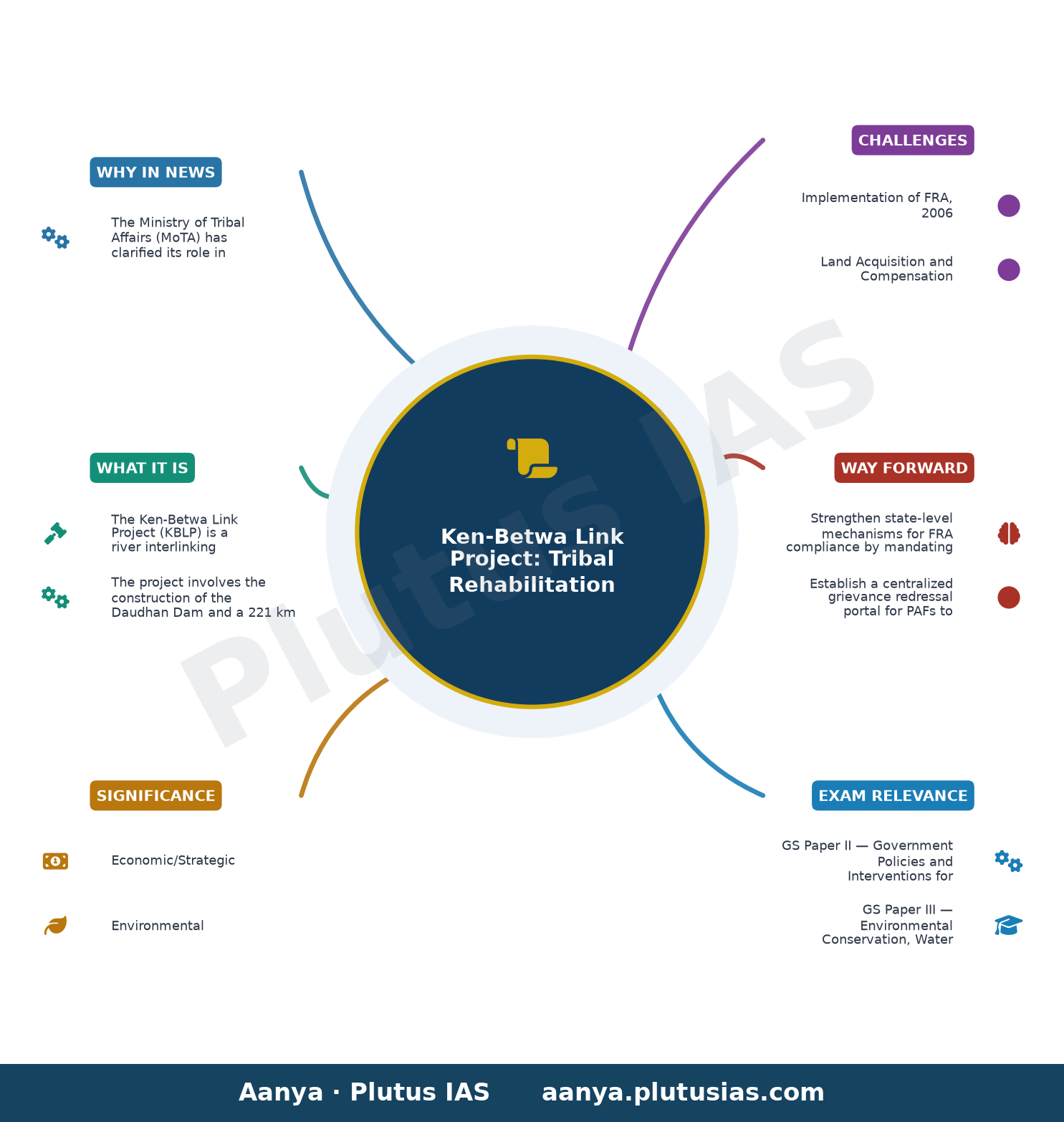
- GS Paper II — Government Policies and Interventions for Development in various sectors | GS Paper III — Environmental Conservation, Water Resources, and Disaster Management
- Prelims: Ken-Betwa Link Project, Forest Rights Act (FRA) 2006, National Rehabilitation and Resettlement Policy (NRRP) 2007, Forest (Conservation) Rules 2023, Scheduled Tribes and Other Traditional Forest Dwellers (Recognition of Forest Rights) Act, 2006, Environment Impact Assessment (EIA) Notification 2006, Wildlife (Protection) Act 1972
- Essay: Balancing Development and Tribal Rights: The Ken-Betwa Link Project Dilemma, Environmental Governance and Judicial Safeguards in India
Quick Revision: The Ken-Betwa Link Project’s tribal rehabilitation framework is anchored in the FRA 2006, which mandates prior recognition of forest rights and consent mechanisms before land diversion, and the RFCTLARR Act 2013, which provides legal safeguards for fair compensation and resettlement of project-affected families.
Why is this in the news?
The Ministry of Tribal Affairs (MoTA) has clarified its role in monitoring the rehabilitation and resettlement (R&R) of Scheduled Tribes (STs) displaced by the Ken-Betwa Link Project (KBLP), a river interlinking initiative under the National Perspective Plan for Water Resources Development. While the Ministry has not received complaints regarding non-disbursement of compensation, it has forwarded grievances related to displacement to state authorities under the FRA 2006, highlighting the decentralized implementation of tribal rights and the need for robust compliance with environmental and forest governance frameworks.
Background
- The Ken-Betwa Link Project (KBLP) is a flagship river interlinking initiative under the National Perspective Plan for Water Resources Development, aimed at transferring surplus water from the Ken River basin to the Betwa River basin to address water scarcity in drought-prone regions of Madhya Pradesh and Uttar Pradesh.
- The project is being implemented by the Ken-Betwa Link Project Authority (KBLPA), a special purpose vehicle under the Ministry of Jal Shakti, Government of India, with Phase-I involving the construction of the Daudhan Dam and a 221 km long canal system.
- The project has been identified as a ‘National Project’ for funding by the Central Government, with significant financial outlay and multi-stakeholder coordination requirements.
- The Ken-Betwa Link Project has faced environmental and social scrutiny due to its potential impact on forest ecosystems, wildlife habitats, and tribal communities residing in the project-affected areas, particularly in the Panna Tiger Reserve and surrounding regions.
- The Forest Rights Act (FRA) 2006 and the Forest (Conservation) Rules 2023 are critical legal frameworks governing the rights of Scheduled Tribes and Other Traditional Forest Dwellers (OTFDs) in project-affected areas, mandating prior recognition of rights and consent mechanisms before land diversion or forest clearance.
- The National Rehabilitation and Resettlement Policy (NRRP) 2007 and the Right to Fair Compensation and Transparency in Land Acquisition, Rehabilitation and Resettlement (RFCTLARR) Act 2013 provide the policy and legal framework for the rehabilitation and resettlement of project-affected families (PAFs), including STs.
What is the Ken-Betwa Link Project and its Tribal Rehabilitation Framework?
- The Ken-Betwa Link Project (KBLP) is a river interlinking initiative designed to transfer 1.02 billion cubic meters of surplus water annually from the Ken River basin to the Betwa River basin, benefiting drought-prone districts in Madhya Pradesh and Uttar Pradesh.
- The project involves the construction of the Daudhan Dam and a 221 km long canal system, with an estimated total cost of ₹44,605 crore (as per 2021 estimates).
- The project is being implemented in two phases, with Phase-I covering the Daudhan Dam and associated infrastructure, and Phase-II involving the construction of the Bina Barrage and the Lower Orr Project.
- The project is located in the catchment areas of the Panna Tiger Reserve and the Ken Gharial Sanctuary, necessitating strict compliance with the Wildlife (Protection) Act 1972 and the Forest (Conservation) Rules 2023.
- The Ken-Betwa Link Project Authority (KBLPA) is responsible for land acquisition, rehabilitation, and resettlement activities, in coordination with state governments and the Ministry of Tribal Affairs (MoTA).
- The rehabilitation and resettlement (R&R) framework for the project is governed by the National Rehabilitation and Resettlement Policy (NRRP) 2007 and the RFCTLARR Act 2013, which mandate the formulation of a comprehensive R&R plan for project-affected families (PAFs), including Scheduled Tribes (STs).
- The Forest Rights Act (FRA) 2006 is a critical legal safeguard for tribal communities, requiring the recognition of forest rights, including individual and community rights, prior to any land diversion or forest clearance under the project.
- The Ministry of Tribal Affairs (MoTA) serves as a member of the KBLP’s monitoring and implementation committees, ensuring that the R&R plans for STs are implemented in compliance with the FRA 2006 and other relevant legal frameworks.
- The project has identified 1,913 PAFs (population 8,339) for displacement in Phase-I, of which 648 are STs, necessitating tailored R&R measures to address their socio-economic and cultural needs.
Key Features
| Feature | Significance |
|---|---|
| Ken-Betwa Link Project (KBLP) | A river interlinking project aimed at transferring surplus water from the Ken river basin to the Betwa river basin to address water scarcity in Uttar Pradesh and Madhya Pradesh. |
| Project-Affected Families (PAFs) | Includes 1,913 families (population 8,339) displaced in Phase-I, of which 648 belong to Scheduled Tribes (ST). |
| Rehabilitation and Resettlement (R&R) Plan | Approved by the Ministry of Tribal Affairs (MoTA) for ST PAFs, ensuring compliance with the Forest Rights Act (FRA), 2006, and the National Rehabilitation and Resettlement Policy (NRRP), 2007. |
| Monitoring Mechanism | The Tribal Affairs Ministry is part of the operational and monitoring committees, overseeing the implementation of R&R plans for project-affected families. |
| Forest Rights Act (FRA), 2006 | Ensures that ST and other traditional forest dwellers are not displaced until their rights are recognized and verified, as per Section 4(5). |
Why it Matters
Economic/Strategic
- Water security enhancement in drought-prone regions of Bundelkhand by augmenting irrigation potential and drinking water supply.
- Boost to agricultural productivity through improved water availability, potentially increasing GDP contribution from the agriculture sector.
- Inter-basin water transfer may mitigate flood risks in surplus basins while addressing deficits in deficit basins.
Environmental
- Potential ecological disruption due to river diversion, including impacts on aquatic biodiversity and sediment flow.
- Greenhouse gas emissions from reservoir creation and altered land use patterns.
- Compliance with environmental safeguards under the Environment Impact Assessment (EIA) Notification, 2006, and the Forest (Conservation) Act, 1980.
Social
- Upholding constitutional rights of Scheduled Tribes (STs) under Article 29 and 30, ensuring their cultural and livelihood continuity.
- Preventing forced displacement without due process, as mandated by the FRA, 2006, and the National Rehabilitation and Resettlement Policy (NRRP), 2007.
- Ensuring equitable compensation and resettlement for displaced communities, including land-for-land provisions where applicable.
Governance
- Multi-stakeholder coordination between the Ministry of Tribal Affairs, Ministry of Jal Shakti, and state governments (Madhya Pradesh and Uttar Pradesh).
- Role of the Ken-Betwa Link Project Authority in implementing R&R plans and ensuring transparency in fund disbursement.
- Role of the Ministry of Environment, Forest and Climate Change (MoEFCC) in granting approvals under the Forest (Conservation) Act, 1980.
Challenges
1. Implementation of FRA, 2006
- State governments are responsible for FRA implementation, leading to variability in compliance across regions.
- Delays in recognition and verification of forest rights may result in illegal displacement of ST communities.
- Lack of centralized data on FRA compliance, as per the Ministry of Tribal Affairs’ response.
UPSC Link: GS-II: Governance, GS-III: Environment
2. Land Acquisition and Compensation
- Risk of inadequate or delayed compensation to PAFs, particularly in cases where land records are disputed or incomplete.
- Potential for corruption in fund disbursement, despite assurances of no complaints regarding amounts.
UPSC Link: GS-II: Governance, GS-III: Economy
3. Ecological and Hydrological Risks
- Alteration of river flow dynamics may disrupt aquatic ecosystems and dependent livelihoods.
- Sediment deposition changes could affect downstream areas, including the Ken and Betwa river basins.
UPSC Link: GS-III: Environment, GS-III: Disaster Management
4. Inter-State Coordination
- Coordination challenges between Madhya Pradesh and Uttar Pradesh regarding water sharing, land use, and compensation mechanisms.
- Disparities in R&R policies and implementation between states may lead to inequities among PAFs.
UPSC Link: GS-II: Federalism, GS-II: Governance
5. Monitoring and Accountability
- Limited transparency in the monitoring of R&R plan implementation by state governments and project authorities.
- Inadequate grievance redressal mechanisms for PAFs, particularly those from marginalized communities.
UPSC Link: GS-II: Governance
Challenges — UPSC Perspective
| Issue | Concern |
|---|---|
| FRA Compliance | State-level variability in recognizing and verifying forest rights may lead to illegal displacement. |
| Compensation Delays | Risk of inadequate or delayed payments to PAFs, particularly in cases of land disputes. |
| Ecological Impact | River diversion may disrupt sediment flow and aquatic biodiversity. |
| Inter-State Coordination | Disparities in R&R policies between Madhya Pradesh and Uttar Pradesh may create inequities. |
| Grievance Redressal | Limited mechanisms for PAFs to address grievances regarding compensation or resettlement. |
| Monitoring Gaps | Lack of centralized data on FRA compliance and R&R progress hinders accountability. |
Way Forward
- Strengthen state-level mechanisms for FRA compliance by mandating real-time tracking of forest rights recognition and verification.
- Establish a centralized grievance redressal portal for PAFs to report delays or inadequacies in compensation and resettlement.
- Conduct third-party audits of R&R fund disbursement to ensure transparency and prevent corruption.
- Enhance inter-state coordination through joint monitoring committees comprising representatives from Madhya Pradesh, Uttar Pradesh, and the Ken-Betwa Link Project Authority.
- Implement ecological mitigation measures, such as sediment traps and fish ladders, to minimize adverse impacts on river ecosystems.
- Mandate public hearings in project-affected areas to ensure community participation in R&R planning and implementation.
- Develop a standardized R&R policy framework for inter-state river projects to ensure equity among PAFs.
- Leverage remote sensing and GIS technologies to monitor land use changes and displacement patterns in real time.
UPSC Value Addition
Keywords for Mains Answer-Writing
Ken-Betwa Link Project · Tribal Rehabilitation · Forest Rights Act, 2006 · National Rehabilitation and Resettlement Policy · Scheduled Tribes and Other Traditional Forest Dwellers (Recognition of Forest Rights) Act, 2006 · Ken-Betwa Link Authority · Tribal Sub-Plan · Environmental Clearance · Displacement and Rehabilitation · River Linking Projects · Forest Conservation Rules, 2023 · National Water Development Agency
Constitutional & Policy Linkages
- [‘Seventh Schedule: State List (Entry 17 – Water)’, ‘Empowers states to legislate on water resources, including inter-state river projects.’]
- [‘Seventh Schedule: Concurrent List (Entry 17A – Forests)’, ‘Provides shared jurisdiction over forest conservation and tribal rights.’]
Concept Flow
Ken-Betwa Link Project (KBLP) proposed to address water scarcity in Bundelkhand. → Project requires land acquisition and displacement of 1,913 families (8,339 individuals), including 648 ST families. → R&R plans approved under FRA, 2006 and NRRP, 2007, mandating recognition of forest rights before displacement. → State governments (MP and UP) responsible for FRA implementation and R&R execution, leading to variability in compliance. → Monitoring by MoTA and MoEFCC to ensure adherence to environmental and tribal rights safeguards. → Potential risks: ecological disruption, delayed compensation, and inter-state coordination challenges. → Way forward: Strengthen governance mechanisms, enhance transparency, and ensure community participation in R&R.
Prelims Practice Questions
Q1. Consider the following statements regarding the Ken-Betwa Link Project:
1. The project is being implemented under the aegis of the Ken-Betwa Link Authority, which operates under the Ministry of Jal Shakti.
2. The project involves the diversion of forest land and requires compliance with the Forest Rights Act, 2006.
3. The Tribal Affairs Ministry is solely responsible for the rehabilitation of project-affected families.
4. The project has been approved by the Ministry of Environment, Forest and Climate Change without any conditions.
How many of the above statements are correct?
- Only one
- Only two
- Only three
- All
Answer: Only three — Statements 1 and 2 are correct. The Ken-Betwa Link Project is implemented by the Ken-Betwa Link Authority under the Ministry of Jal Shakti, and it involves forest land diversion requiring compliance with the Forest Rights Act, 2006. Statement 3 is incorrect as the Tribal Affairs Ministry shares responsibility with state governments. Statement 4 is incorrect as the project approval is subject to specific conditions.
Q2. Assertion (A): The Forest Rights Act, 2006, mandates that no eviction of forest dwellers can occur until their rights are recognized and verified.
Reason (R): The Act under Section 4(5) explicitly prohibits the eviction of claimants from forest land until the process of recognition and verification of their rights is completed.
Options:
A. Both A and R are true, and R is the correct explanation of A.
B. Both A and R are true, but R is not the correct explanation of A.
C. A is true, but R is false.
D. A is false, but R is true.
- A
- B
- C
- D
Answer: A — Both the Assertion (A) and Reason (R) are true, and R correctly explains A. The Forest Rights Act, 2006, under Section 4(5), explicitly prohibits eviction until rights are recognized and verified.
Q3. Match the following provisions with their respective legal frameworks:
Column I (Provision)
1. Final approval for diversion of forest land under the Forest (Conservation) Act, 1980.
2. Recognition of forest rights of Scheduled Tribes and other traditional forest dwellers.
3. Rehabilitation and resettlement policy for project-affected families.
4. Diversion of forest land for non-forest purposes under the Forest Rights Act, 2006.
Column II (Legal Framework)
a. Forest (Conservation) Act, 1980
b. Scheduled Tribes and Other Traditional Forest Dwellers (Recognition of Forest Rights) Act, 2006
c. National Rehabilitation and Resettlement Policy, 2007
d. Forest Rights Act, 2006
Options:
A. 1-a, 2-b, 3-c, 4-d
B. 1-a, 2-b, 3-d, 4-c
C. 1-b, 2-a, 3-c, 4-d
D. 1-c, 2-d, 3-a, 4-b
- A
- B
- C
- D
Answer: A — 1-a: Final approval for diversion of forest land is under the Forest (Conservation) Act, 1980. 2-b: Recognition of forest rights is under the Scheduled Tribes and Other Traditional Forest Dwellers (Recognition of Forest Rights) Act, 2006. 3-c: Rehabilitation and resettlement policy is under the National Rehabilitation and Resettlement Policy, 2007. 4-d: Diversion of forest land for non-forest purposes under the Forest Rights Act, 2006 is governed by its provisions.
Mains Practice Question
✍ The Ken-Betwa Link Project, a river interlinking initiative, has raised significant concerns regarding the displacement and rehabilitation of Scheduled Tribes and other traditional forest dwellers. Critically examine the legal and institutional frameworks governing their rehabilitation, with particular reference to the Forest Rights Act, 2006, and the National Rehabilitation and Resettlement Policy, 2007. Also, assess the role of the Tribal Affairs Ministry and state governments in ensuring compliance with these frameworks. (15 Marks)
Approach: MODEL-ANSWER SKELETON:
1. **Introduction**: Briefly introduce the Ken-Betwa Link Project, its objectives, and the estimated displacement of 1,913 families, including 648 Scheduled Tribes (STs). Highlight the legal and policy frameworks governing rehabilitation.
2. **Legal Frameworks**:
– **Forest Rights Act (FRA), 2006**: Explain key provisions such as Section 4(5) (prohibition of eviction until rights are recognized), Section 5 (duties of Gram Sabhas), and Section 6 (recognition of rights). Discuss the role of Gram Sabhas in verifying claims and the prohibition on eviction until recognition is complete.
– **National Rehabilitation and Resettlement Policy (NRRP), 2007**: Outline its objectives, including fair compensation, livelihood restoration, and resettlement. Discuss the role of the Ken-Betwa Link Authority and state governments in implementing the policy.
– **Forest (Conservation) Act, 1980 and Forest (Conservation) Rules, 2023**: Explain the requirement for final approval from the central government for forest land diversion and compliance with FRA provisions.
3. **Institutional Frameworks**:
– **Tribal Affairs Ministry (MoTA)**: Discuss its role in monitoring the rehabilitation of ST project-affected families (PAPs), approving rehabilitation plans, and addressing grievances. Highlight the absence of centralised data on FRA implementation, which is managed by state governments.
– **State Governments**: Discuss their responsibility in implementing FRA, NRRP, and ensuring compliance with environmental clearances. Mention the role of district administrations in addressing grievances and monitoring rehabilitation.
– **Ken-Betwa Link Authority**: Explain its role in coordinating with state governments and ensuring compliance with rehabilitation plans.
4. **Challenges and Gaps**:
– **Implementation Gaps**: Discuss issues such as delayed recognition of forest rights, inadequate compensation, and lack of livelihood restoration. Highlight the absence of centralised data on FRA implementation, which may lead to gaps in monitoring.
– **Grievance Redressal**: Discuss the role of MoTA in addressing grievances and the need for transparent mechanisms to ensure benefits reach intended beneficiaries.
– **Environmental Clearances**: Discuss the conditions imposed by the Ministry of Environment, Forest and Climate Change (MoEFCC) for project approval, including compliance with FRA and NRRP.
5. **Conclusion**: Summarise the effectiveness of the legal and institutional frameworks in protecting the rights of STs and traditional forest dwellers. Highlight the need for stronger monitoring, transparency, and accountability to ensure compliance with FRA and NRRP. Conclude with a balanced view on the project’s impact on tribal communities.
Source: PIB (Press Information Bureau)
Generated by AanyaAi for educational purpose.

- महिलाओं के पास डिग्रियाँ, गोल्ड मेडल, फिर भी नौकरी में क्यों नहीं? राष्ट्रपति मुर्मू का सवाल - September 23, 2026
- President Murmu Highlights Women’s Workforce Gap Despite Academic Success - September 23, 2026
- ओडिशा में विवाह रिकॉर्ड में हेराफेरी: निर्माण श्रमिक कल्याण योजना का दुरुपयोग - September 23, 2026

No Comments