


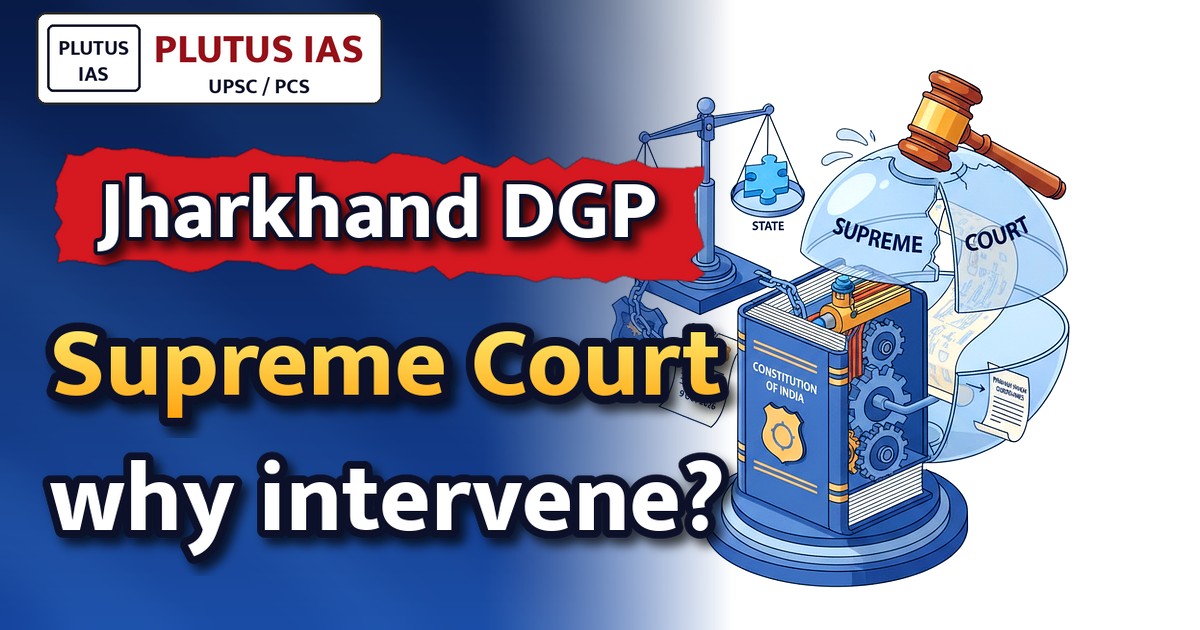
30 Sep झारखंड डीजीपी नियुक्ति: सुप्रीम कोर्ट 9 अक्टूबर को सुनवाई, राज्य सरकार से जवाब तलब
✎ Police leadership appointments in India must comply with the *Prakash Singh* guidelines (2006) and state-specific rules framed under the Police Act, 1861, to ensure transparency, objectivity, and constitutional validity.
Subject Relevance — Where This Topic Fits
- GS Paper II — Polity and Governance: Constitutional and Statutory Provisions for Civil Services and Police Administration | GS Paper III — Internal Security: Role of Police Forces and Governance Challenges
- Prelims: Police Act, 1861, All India Services Act, 1951, Directive Principles of State Policy (Article 355), Supreme Court guidelines on police appointments (Prakash Singh case), Federalism and Centre-State relations in police administration
- Essay: Federalism and cooperative governance in India: Balancing autonomy and accountability, Judicial intervention in administrative appointments: Safeguarding constitutional morality
Quick Revision: Police leadership appointments in India must comply with the *Prakash Singh* guidelines (2006) and state-specific rules framed under the Police Act, 1861, to ensure transparency, objectivity, and constitutional validity.
Why is this in the news?
The Supreme Court of India is set to hear a petition challenging the appointment of Jharkhand’s Director General of Police (DGP), Tadasha Mishra, on 9 October 2026. The case raises critical questions regarding the adherence to prescribed selection procedures for police leadership appointments, the constitutional validity of state-level appointment rules, and the balance of powers between the Centre and State governments under the constitutional framework of federalism.
Background
- The Supreme Court, in the landmark judgment *Prakash Singh v. Union of India* (2006), laid down guidelines to ensure transparency, objectivity, and institutional autonomy in police appointments and transfers.
- States are required to frame their own police appointment rules in conformity with constitutional principles and Supreme Court directives, ensuring no arbitrary deviations.
- The Centre, represented by the Solicitor General, has questioned the legality of the appointment, citing non-adherence to the panel-based selection process prescribed for senior police appointments.
- This case underscores the recurring tension between state autonomy in police administration and the Centre’s role in ensuring compliance with constitutional and statutory norms.
What is the Legal and Procedural Framework Governing Police Leadership Appointments in India?
- The Supreme Court’s *Prakash Singh* judgment (2006) directed states to constitute a State Security Commission to ensure transparency and accountability in police appointments and transfers.
- The DGP is typically selected from a panel of three senior-most officers, as per the guidelines issued by the Supreme Court and state-specific rules, to ensure objectivity and reduce political interference.
- States are empowered to frame their own appointment rules but must ensure they do not contravene constitutional provisions or Supreme Court directives.
- The Centre’s role is limited to advising states on compliance with constitutional and statutory norms, particularly in matters affecting internal security and federal harmony.
- Judicial review of administrative appointments is permissible when there is a violation of constitutional principles, procedural irregularities, or arbitrariness in decision-making.
- The case highlights the importance of institutional safeguards to prevent politicisation of police leadership, which is critical for maintaining public trust and effective law enforcement.
- The Supreme Court’s intervention in such matters reinforces the principle of constitutional supremacy and ensures that administrative actions remain within the bounds of the law.
Key Features
| Feature | Significance |
|---|---|
| Appointment of DGPs by State Governments | The power to appoint the Director General of Police (DGP) vests with the State Government under the Constitution, but this authority is subject to compliance with established legal and procedural norms. |
| Supreme Court’s Role in Governance Disputes | The Supreme Court, as the guardian of the Constitution, intervenes in disputes involving the legality of executive actions, ensuring adherence to due process and constitutional mandates. |
| Role of the Solicitor General of India | The Solicitor General represents the Union Government in legal matters, including challenges to state-level appointments, ensuring that central perspectives on constitutional propriety are presented. |
| Police Reforms and Accountability | The appointment process of senior police officials is linked to broader police reforms aimed at ensuring professionalism, transparency, and accountability in policing. |
| Judicial Review of Executive Actions | Judicial review empowers courts to examine the legality of administrative decisions, ensuring that they conform to statutory and constitutional provisions. |
Why it Matters
Constitutional Governance
- The case underscores the delicate balance between federalism and constitutional governance, where state autonomy in administrative appointments is tempered by adherence to legal and procedural norms.
- It highlights the principle that executive actions, even in sensitive areas like police administration, must comply with established rules to prevent arbitrariness.
- The Supreme Court’s intervention ensures that the appointment process does not undermine public trust in institutions or violate constitutional safeguards.
Police Administration and Reforms
- The appointment of a DGP is not merely an administrative decision but a critical governance choice that impacts law and order, crime control, and public safety.
- The case brings attention to the need for transparent and merit-based selection processes in police leadership to enhance professionalism and reduce political interference.
- It aligns with ongoing discussions on police reforms, including the Prakash Singh case (2006) guidelines, which emphasize fixed tenures and insulation from political pressures.
Judicial Oversight and Rule of Law
- The Supreme Court’s directive to the State Government to justify the appointment process reinforces the principle that no executive action is beyond judicial scrutiny.
- It demonstrates the judiciary’s role in upholding the rule of law by ensuring that appointments are made in accordance with statutory and constitutional provisions.
- The case serves as a reminder that judicial review is a safeguard against arbitrary or politically motivated decisions in governance.
Challenges
1. Legal and Procedural Compliance
- The State Government’s alleged non-compliance with the prescribed selection process for DGP appointments raises concerns about the legality and validity of the appointment.
- The Union Government’s objection to the appointment process highlights the need for uniformity and adherence to national standards in senior police appointments.
- The case illustrates the tension between state autonomy in administrative matters and the requirement for procedural rigor to ensure fairness and transparency.
UPSC Link: Constitutional Provisions: Article 32, 226
2. Political Interference vs. Professionalism
- The appointment process may reflect broader concerns about political interference in police administration, which can undermine the independence and professionalism of the force.
- Ensuring that DGPs are selected based on merit and experience, rather than political considerations, remains a critical challenge in police governance.
- The case underscores the need for institutional mechanisms to insulate police leadership from short-term political pressures.
UPSC Link: Police Reforms: Prakash Singh Case (2006)
3. Judicial Scrutiny of Executive Actions
- The Supreme Court’s intervention in this matter raises questions about the extent of judicial oversight in administrative appointments, balancing judicial activism with respect for federalism.
- The case highlights the role of the judiciary in ensuring that executive actions do not violate constitutional or statutory provisions, even in sensitive areas like police administration.
- It also poses challenges in defining the boundaries of judicial review without encroaching upon the domain of the executive.
UPSC Link: Judicial Review: Article 136, 32
Challenges — UPSC Perspective
| Issue | Concern |
|---|---|
| Non-compliance with Selection Process | The State Government’s alleged deviation from the prescribed process for DGP appointments raises concerns about legality and fairness. |
| Political Interference in Police Administration | The appointment process may reflect undue political influence, undermining the professionalism and independence of the police force. |
| Judicial Overreach vs. Executive Autonomy | The Supreme Court’s intervention in an administrative appointment raises questions about the balance between judicial review and executive autonomy. |
| Lack of Transparency in Appointment Rules | The ambiguity or modification of appointment rules (e.g., Rule 5) may lead to perceptions of opacity and favoritism in the selection process. |
| Centre-State Coordination in Governance | The Union Government’s objections highlight the need for better coordination between the Centre and States in matters of police administration and governance. |
Way Forward
- The State Government must submit a detailed response to the Supreme Court by 9 October, clarifying the legal and procedural basis for the DGP appointment.
- The Union Government should proactively engage with State Governments to ensure that DGP appointments adhere to nationally accepted standards, including the Prakash Singh guidelines.
- State Governments should consider enacting or amending police service rules to ensure transparency, meritocracy, and insulation from political interference in senior police appointments.
- The Supreme Court may issue guidelines or directions to standardize the DGP appointment process across States, ensuring uniformity and constitutional compliance.
- Police departments should strengthen internal mechanisms for merit-based promotions and selections to reduce reliance on ad-hoc or politically influenced appointments.
- Civil society and media should play a proactive role in monitoring senior police appointments to ensure transparency and accountability.
- The Union and State Governments should collaborate on a national framework for police leadership appointments, balancing federalism with national standards.
UPSC Value Addition
Keywords for Mains Answer-Writing
Supreme Court of India · State Police Act · Director General of Police (DGP) · Appointment Process · Constitutional Validity · Federal Polity · Judicial Review · Police Reforms · Rule of Law · State vs Union Government · Article 32 · Article 214 · Police Establishment Act, 2006 · Lateral Entry in Civil Services · Judicial Activism · Federalism in India · Constitutional Morality
Constitutional & Policy Linkages
- Article 32: Writ jurisdiction of the Supreme Court for enforcement of fundamental rights.
- Article 226: High Court’s power to issue writs for enforcement of legal rights.
- Article 300: Suit by or against the Government of India or a State.
- Article 311: Safeguards for civil servants against arbitrary dismissal.
Concept Flow
State Government appoints DGP → Allegation of procedural non-compliance → Union Government challenges appointment in Supreme Court → Supreme Court seeks State Government’s response → Court examines legality of appointment rules → Judgment on constitutional validity of appointment process → Implications for police reforms and governance.
Prelims Practice Questions
Q1. Consider the following statements regarding the appointment of the Director General of Police (DGP) in India:
1. The DGP is appointed by the State Government in consultation with the Union Public Service Commission (UPSC).
2. The Supreme Court has held that the State Government must follow the procedure prescribed under the State Police Act while appointing the DGP.
3. The Union Government can override the State Government’s choice of DGP if it deems fit.
How many of the above statements are correct?
- Only one
- Only two
- All three
- None
Answer: Only two — Statement 1 is incorrect: The DGP is appointed by the State Government, but consultation with the UPSC is not mandatory. Statement 2 is correct: The Supreme Court has emphasized adherence to the State Police Act in DGP appointments. Statement 3 is incorrect: The Union Government does not have the power to override the State Government’s choice of DGP.
Q2. Assertion (A): The Supreme Court of India can direct a State Government to comply with the constitutional principles governing the appointment of the Director General of Police (DGP).
Reason (R): The Supreme Court exercises judicial review over the executive actions of State Governments under Article 32 of the Constitution of India.
In the context of the above two statements, which one of the following is correct?
- Both A and R are true, and R is the correct explanation of A.
- Both A and R are true, but R is not the correct explanation of A.
- A is true, but R is false.
- A is false, but R is true.
Answer: Both A and R are true, but R is not the correct explanation of A. — Both the Assertion (A) and Reason (R) are correct. The Supreme Court can indeed direct State Governments to comply with constitutional principles, including those governing DGP appointments, under Article 32. The Reason (R) correctly explains why the Supreme Court can issue such directions.
Q3. Match the following provisions with their respective legal contexts:
Column I (Provision)
A. Article 32 of the Constitution of India
B. State Police Act, 2006
C. Police Establishment Act, 2006
D. Article 214 of the Constitution of India
Column II (Context)
1. Deals with the appointment of the Chief Justice of a High Court
2. Provides for the establishment of a Police Establishment Board
3. Enables the Supreme Court to issue writs for the enforcement of fundamental rights
4. Governs the appointment and tenure of the Director General of Police in a State
- A-3, B-4, C-2, D-1; A-1, B-2, C-3, D-4; A-4, B-1, C-3, D-2; A-2, B-4, C-1, D-3
- answer_letter_pairing_indexes_to_match_column_1_to_2_above_0: [0, 3, 2, 1],
Answer: A-3, B-4, C-2, D-1; A-1, B-2, C-3, D-4; A-4, B-1, C-3, D-2; A-2, B-4, C-1, D-3 — A-3: Article 32 enables the Supreme Court to issue writs for the enforcement of fundamental rights. B-4: The State Police Act, 2006 governs the appointment and tenure of the DGP in a State. C-2: The Police Establishment Act, 2006 provides for the establishment of a Police Establishment Board. D-1: Article 214 deals with the establishment of High Courts.
Mains Practice Question
✍ The appointment of the Director General of Police (DGP) in a State is a critical governance function that balances federal autonomy with constitutional principles. Critically examine the legal and institutional framework governing the appointment of the DGP in India, with reference to recent judicial pronouncements and the federal structure of governance. Also, analyse the implications of non-compliance with prescribed procedures on the rule of law and federal harmony. (15 Marks)
Approach: MODEL-ANSWER SKELETON:
1. **Constitutional and Statutory Framework**:
– Mention Article 32 (Supreme Court’s power of judicial review) and Article 214 (establishment of High Courts).
– Highlight the role of the State Police Act, 2006 (e.g., Jharkhand Police Act, 2007) in governing DGP appointments.
– Reference the Police Establishment Act, 2006, which establishes the Police Establishment Board (PEB) for cadre management.
2. **Judicial Pronouncements**:
– Cite landmark judgments such as *Prakash Singh v. Union of India* (2006) and *Director General of Police v. State of Punjab* (2018), which laid down guidelines for DGP appointments, including the requirement of a minimum tenure and adherence to merit-based selection.
– Discuss the Supreme Court’s emphasis on transparency, consultation with the UPSC (where applicable), and adherence to the State Police Act in recent cases (e.g., the Jharkhand DGP appointment case).
3. **Federal Structure and Institutional Dynamics**:
– Explain the balance between State autonomy (under the Seventh Schedule, State List, Entry 2) and the Union Government’s role in ensuring constitutional compliance.
– Discuss the tension between the State Government’s executive power and the Supreme Court’s supervisory role under Article 32.
4. **Implications of Non-Compliance**:
– Analyse the consequences of deviations from prescribed procedures on the rule of law, such as erosion of public trust, judicial intervention, and potential constitutional crises.
– Highlight the impact on federal harmony, particularly when the Union Government challenges State actions (e.g., through the Solicitor General’s role in the Jharkhand case).
5. **Balancing Views and Way Forward**:
– Present arguments for State autonomy in cadre management versus the need for judicial oversight to prevent misuse of power.
– Suggest reforms such as codification of DGP appointment norms, mandatory consultation with UPSC, and institutional mechanisms for dispute resolution between State and Union Governments.
6. **Conclusion**:
– Summarize the critical need for adherence to constitutional and statutory norms to uphold federalism, rule of law, and institutional integrity.
Source: amarujala.com
Jharkhand PCS (JPSC) — State PCS Practice
Prelims: As per the Jharkhand DGP appointment case, the Supreme Court has sought a response from the state government on which of the following dates?
- 1. 9th October
- 2. 10th October
- 3. 11th October
- 4. 12th October
Answer: 1. 9th October — The Supreme Court scheduled the next hearing for 9th October to seek the state government’s response on the DGP appointment issue.
Mains: Discuss the constitutional and administrative implications of the Jharkhand DGP appointment case, highlighting the role of the state government, the Union Public Service Commission (UPSC), and the Supreme Court in ensuring transparency and adherence to the rule of law in police appointments.
Generated by AanyaAi for educational purpose.
Related guides on our sites
- Anthropology VS PSIR
- Best PSIR optional coaching
- Best PSIR optional coaching online
- Best PSIR optional teacher

- Women and Transgender Changemakers in Swachhata Mission - September 30, 2026
- चुनाव आयोग ने फॉर्म-6 से SIR घोषणा हटाई: UPSC-PCS के लिए महत्वपूर्ण बदलाव - September 30, 2026
- झारखंड डीजीपी नियुक्ति: सुप्रीम कोर्ट 9 अक्टूबर को सुनवाई, राज्य सरकार से जवाब तलब - September 30, 2026

No Comments