


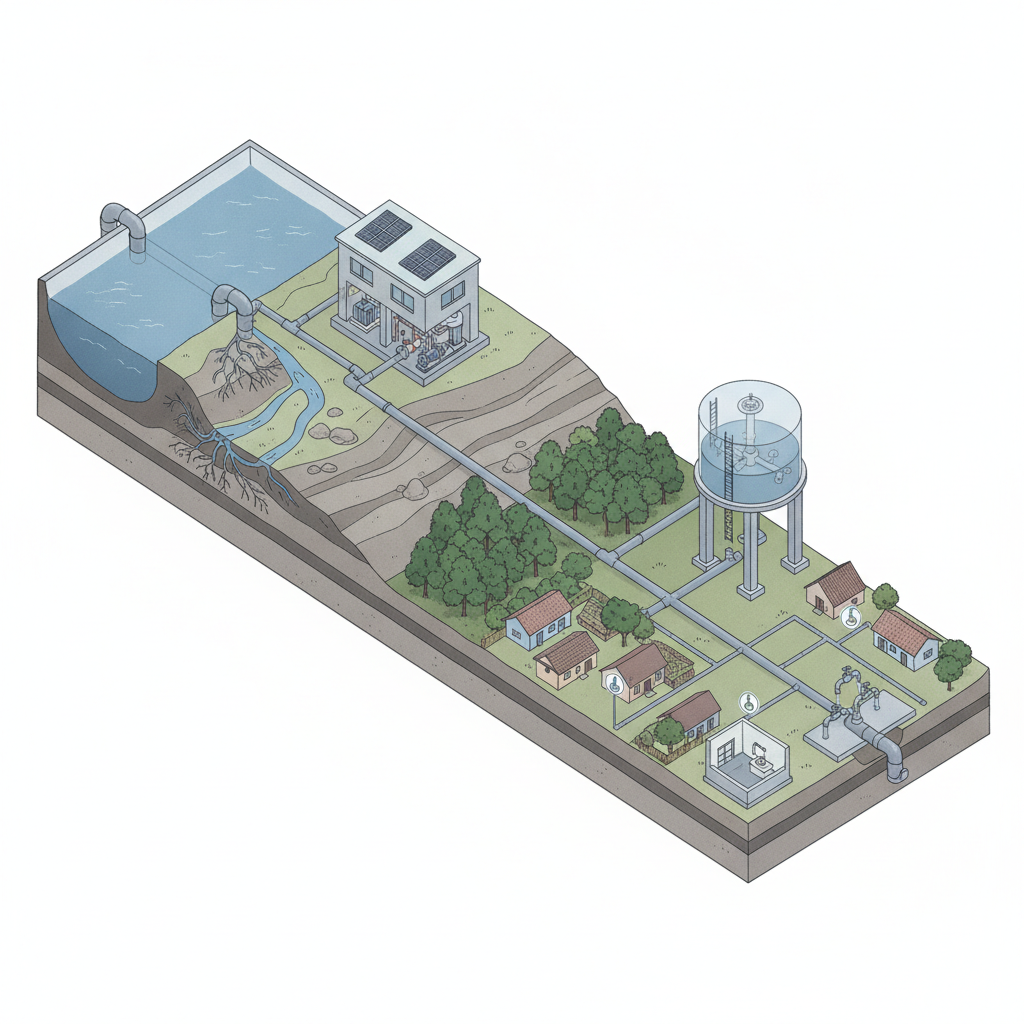
01 Sep झारखंड ने केंद्र से 6500 करोड़ रुपये की मांग, जल जीवन मिशन की रुकी योजनाओं को गति देने हेतु
✎ Jal Jeevan Mission seeks to provide 55 litres of safe drinking water per capita per day to every rural household by 2024 through a community-driven, source-sustainable, and fiscally coordinated approach.
Subject Relevance — Where This Topic Fits
- GS Paper II — Governance, Constitution, Polity, Social Justice and International Relations (Centre-State Relations, Schemes) | GS Paper III — Environment, Water Resources and Disaster Management (Water Supply, Rural Infrastructure)
- Prelims: Jal Jeevan Mission, Har Ghar Jal, Jal Shakti Mantralaya, Rural Water Supply, Centre-State Financial Transfers, National Rural Drinking Water Programme, Water Quality Monitoring, Sustainable Water Resource Management
- Essay: Role of Centre-State cooperation in achieving Sustainable Development Goals, Water security as a prerequisite for inclusive development
Quick Revision: Jal Jeevan Mission seeks to provide 55 litres of safe drinking water per capita per day to every rural household by 2024 through a community-driven, source-sustainable, and fiscally coordinated approach.
Why is this in the news?
Jharkhand has requested the release of ₹6,500 crore in pending funds from the Centre under the Jal Jeevan Mission (JJM) to expedite stalled rural water supply projects. The state government asserts that timely financial support will enable the completion of critical infrastructure, ensuring 100% piped water supply to rural households and addressing persistent challenges in water-scarce regions.
Background
- The Jal Jeevan Mission (JJM), launched in 2019, aims to provide Functional Household Tap Connection (FHTC) to every rural household by 2024, ensuring safe and adequate drinking water supply.
- Jharkhand, with its undulating terrain, dense forests, and high seasonal variability in water availability, faces significant challenges in rural water supply, necessitating targeted interventions under JJM.
- The state has reported delays in project execution due to pending central funds, leading to stalled pipelines and incomplete water supply schemes in rural areas.
- The Ministry of Jal Shakti, through its annual departmental summit, facilitates dialogue between states and the Centre to address bottlenecks in scheme implementation and fund disbursement.
- Sustainable water resource management, including rainwater harvesting and aquifer recharge, has been emphasized in JJM 2.0 to ensure long-term water security beyond infrastructure provision.
What is the Jal Jeevan Mission?
- A centrally sponsored scheme under the Department of Drinking Water and Sanitation, Ministry of Jal Shakti, launched on 15th August 2019 with a target to provide 55 litres of potable water per capita per day to every rural household by 2024.
- Key components include source sustainability (rainwater harvesting, groundwater recharge), grey water management, and water quality monitoring through field testing kits and accredited laboratories.
- The mission is aligned with Sustainable Development Goal 6 (Clean Water and Sanitation) and is implemented through convergence with other schemes like MGNREGS, PMKSY, and NRDWP.
- Institutional mechanisms include the National Jal Jeevan Mission (NJJM) at the Centre, State Water and Sanitation Missions (SWSM), and District Water and Sanitation Committees (DWSCs) for decentralized planning and monitoring.
Key Features
| Feature | Significance |
|---|---|
| Jal Jeevan Mission (JJM) | A centrally sponsored scheme aimed at providing functional household tap connections to every rural household in India by 2024, now extended to 2026-27. |
| Central-State Fiscal Transfer | Timely release of central funds to states is critical for uninterrupted implementation of centrally sponsored schemes like JJM. |
| Functional Household Tap Connections (FHTC) | Ensures piped water supply on a regular and long-term basis, reducing dependence on unreliable sources. |
| Catch the Rain Campaign | A nationwide initiative to promote rainwater harvesting, groundwater recharge, and water conservation, aligned with JJM objectives. |
| Water Source Sustainability | Focus on long-term viability of water sources, including recharge mechanisms and community-based management, to ensure perennial supply. |
Why it Matters
Social Development
- Direct impact on public health by reducing waterborne diseases through access to safe drinking water.
- Empowerment of women and girls, who traditionally bear the burden of water collection, enabling them to pursue education and livelihoods.
- Enhancement of rural livelihoods by reducing time spent on water collection, thereby increasing productivity.
- Contribution to the achievement of Sustainable Development Goal (SDG) 6: Clean Water and Sanitation.
Economic Implications
- Reduction in healthcare expenditure due to lower incidence of water-related diseases.
- Increased agricultural productivity through reliable water supply for irrigation and livestock.
- Creation of employment opportunities in water infrastructure development and maintenance sectors.
- Potential for secondary economic activities in water-scarce regions due to improved water availability.
Institutional and Governance
- Strengthening of Centre-State coordination mechanisms for effective implementation of centrally sponsored schemes.
- Enhancement of local governance through decentralized planning and execution of water supply projects.
- Promotion of community participation in water resource management and conservation.
- Accountability and transparency in fund utilization through robust monitoring and evaluation frameworks.
Challenges
1. Fiscal Federalism and Fund Disbursement
- Delay in release of central funds to states disrupts project timelines and increases cost overruns due to inflation.
- States with challenging terrain (e.g., hilly and forested areas like Jharkhand) face higher implementation costs, exacerbating funding gaps.
- Inadequate state-level co-financing capacity in some cases, leading to stalled projects.
- Lack of predictability in fund flow hampers long-term planning and resource mobilization at the state level.
UPSC Link: Federalism – Centre-State relations
2. Geographical and Topographical Constraints
- Hilly and forested regions face higher costs for water supply infrastructure due to difficult terrain.
- Limited availability of perennial water sources necessitates innovative solutions like rainwater harvesting and groundwater recharge.
- High evaporation rates and seasonal variability in water availability pose challenges for sustainable supply.
- Geological constraints, such as hard rock formations, limit the feasibility of conventional water extraction methods.
UPSC Link: Geographical diversity and resource management
3. Technical and Operational Challenges
- Ensuring long-term functionality of water supply systems post-commissioning, including maintenance and repairs.
- Integration of traditional and modern water management practices to ensure sustainability.
- Lack of skilled manpower at the grassroots level for operation and maintenance of water infrastructure.
- Data gaps in water resource assessment and demand forecasting hinder effective planning.
UPSC Link: Water resource management and infrastructure
4. Community Participation and Behavioural Change
- Low awareness among rural communities about the importance of water conservation and efficient usage.
- Resistance to behavioral changes, such as adopting water-saving practices or participating in maintenance activities.
- Ensuring equitable access to water across different social and economic groups within communities.
- Lack of ownership among beneficiaries, leading to neglect or misuse of water infrastructure.
UPSC Link: Community participation in governance
Challenges — UPSC Perspective
| Issue | Concern |
|---|---|
| Fund Disbursement Delays | Disruption in project timelines and increased costs due to inflation. |
| Terrain-Specific Challenges | Higher infrastructure costs and logistical difficulties in hilly/forested regions. |
| Water Source Sustainability | Risk of depletion of groundwater and surface water sources over time. |
| Maintenance and O&M | Long-term functionality of systems post-commissioning without adequate maintenance. |
| Community Engagement | Low participation in conservation efforts and resistance to behavioral changes. |
| Data and Planning Gaps | Inadequate water resource assessment and demand forecasting for effective planning. |
Government Initiatives — Must-Memorise for Prelims
- Jal Jeevan Mission (JJM)
- Catch the Rain Campaign
Way Forward
- Ensure timely release of central funds to states by streamlining the disbursement process and enhancing predictability.
- Strengthen Centre-State coordination through regular reviews and joint monitoring of project progress.
- Promote innovative financing models, including public-private partnerships (PPPs), for high-cost projects in difficult terrains.
- Enhance capacity building at the grassroots level for operation, maintenance, and community engagement.
- Integrate traditional water conservation practices with modern technologies to ensure sustainability.
- Conduct comprehensive water resource assessments and demand forecasting to inform project planning.
- Foster community participation through awareness campaigns and incentivizing local ownership of water infrastructure.
- Leverage technology for real-time monitoring of water supply systems and early detection of issues.
UPSC Value Addition
Keywords for Mains Answer-Writing
Jal Jeevan Mission · JJM implementation challenges · Centre-State financial relations · Rural water supply infrastructure · Drinking water security · Public finance and devolution · Convergence of schemes · Water governance · Sustainable water resource management · Fiscal federalism in India
Concept Flow
Delay in central fund disbursement → Stalled water supply projects → Incomplete Functional Household Tap Connections (FHTC) → Incomplete FHTC → Persistent reliance on unreliable water sources → Higher incidence of waterborne diseases → Geographical constraints (hilly/forested terrain) → Increased project costs → Funding gaps and project delays → Lack of community participation → Poor maintenance of infrastructure → Unsustainable water supply systems → Ineffective water conservation measures → Depletion of groundwater and surface water sources → Long-term water scarcity → Inadequate planning and data gaps → Inefficient project design → Suboptimal resource utilization → Timely fund release and robust implementation → Completion of FHTC → Sustainable rural water supply and improved public health
Prelims Practice Questions
Q1. Consider the following statements regarding the Jal Jeevan Mission (JJM):
1. JJM aims to provide tap water connection to every rural household in India by 2024.
2. The mission is implemented by the Ministry of Jal Shakti in collaboration with state governments.
3. The mission includes components for source sustainability, grey water management, and operation & maintenance.
4. The funding pattern under JJM is 100% centrally funded with no state contribution.
How many of the above statements are correct?
- Only one
- Only two
- Only three
- All four
Answer: Only three — Statements 1, 2, and 3 are correct. Statement 4 is incorrect as JJM follows a 50:50 funding pattern between the Centre and states for Himalayan and North-Eastern states, and 90:10 for other states.
Q2. Assertion (A): The Jal Jeevan Mission (JJM) is a centrally sponsored scheme with a focus on providing piped water supply to rural households.
Reason (R): The mission mandates 100% coverage of rural households with functional tap connections by 2024, irrespective of local water resource constraints.
In the context of the above two statements, which one of the following is correct?
- Both A and R are true and R is the correct explanation of A
- Both A and R are true but R is NOT the correct explanation of A
- A is true but R is false
- A is false but R is true
Answer: A is true but R is false — Assertion (A) is true as JJM is a centrally sponsored scheme. Reason (R) is also true but is not the correct explanation of A, as JJM does not mandate 100% coverage by 2024; the target year is 2024-25, and coverage is subject to local water resource sustainability.
Q3. Match the following components of the Jal Jeevan Mission (JJM) with their respective descriptions:
Column I (Component) | Column II (Description)
— | —
A. In-Village Water Supply Infrastructure | 1. Ensuring long-term availability of water sources through recharge and conservation
B. Grey Water Management | 2. Provision of tap connections, pipelines, and storage infrastructure within villages
C. Source Sustainability | 3. Treatment and reuse of wastewater from kitchens and bathrooms
D. Operation & Maintenance | 4. Ensuring functional tap connections and regular upkeep of infrastructure
Select the correct match:
- A-2, B-3, C-1, D-4
- A-1, B-2, C-3, D-4
- A-4, B-1, C-2, D-3
- A-3, B-4, C-2, D-1
Answer: A-2, B-3, C-1, D-4 — Correct matching: A-2 (In-Village Water Supply Infrastructure involves tap connections and pipelines), B-3 (Grey Water Management involves treatment and reuse of wastewater), C-1 (Source Sustainability involves recharge and conservation), D-4 (Operation & Maintenance involves upkeep of infrastructure).
Mains Practice Question
✍ The Jal Jeevan Mission (JJM) represents a paradigm shift in India’s approach to rural water supply by integrating infrastructure development with sustainable water resource management. Critically examine the challenges in the implementation of JJM, with particular reference to Centre-State financial relations and the need for convergence with other water-related schemes. (15 Marks)
Approach: MODEL-ANSWER SKELETON:
1. **Introduction (2 marks)**
– Brief overview of JJM: launched in 2019, aims to provide functional household tap connections to all rural households by 2024-25.
– Key objectives: in-village infrastructure, source sustainability, grey water management, and operation & maintenance.
2. **Challenges in Implementation (6 marks)**
– **Centre-State Financial Relations**:
– Delayed release of central funds (e.g., Jharkhand’s demand for ₹6,500 crore) disrupts project timelines.
– Fiscal federalism issues: mismatch between central allocations and state capacities (e.g., 90:10 funding for general states vs. 50:50 for Himalayan/North-Eastern states).
– Bureaucratic delays in fund disbursement and utilisation certificates.
– **Sustainable Water Resource Management**:
– Overemphasis on piped supply without ensuring long-term source sustainability (e.g., groundwater depletion in Jharkhand).
– Lack of convergence with schemes like MGNREGS (for water conservation) and Atal Mission for Rejuvenation and Urban Transformation (AMRUT) (for integrated urban-rural water planning).
– **Operational Challenges**:
– Geographical constraints (e.g., hilly and forested regions in Jharkhand) increase costs and complexity.
– Limited community participation in planning and maintenance.
3. **Need for Convergence (4 marks)**
– **Integration with Other Schemes**:
– MGNREGS: Can be leveraged for water conservation works (e.g., check dams, farm ponds).
– AMRUT 2.0: Ensures urban-rural water security through regional planning.
– National Rural Livelihood Mission (NRLM): Promotes women-led water management (e.g., SHG-based O&M).
– **Policy Coordination**:
– Need for a unified water governance framework (e.g., National Water Policy 2020) to avoid duplication and ensure synergy.
4. **Way Forward (3 marks)**
– **Strengthening Centre-State Coordination**:
– Timely release of funds with pre-defined milestones.
– State-specific financial mechanisms (e.g., dedicated water funds).
– **Sustainability Focus**:
– Mandatory source sustainability plans (e.g., rainwater harvesting, aquifer recharge).
– Community-based O&M models (e.g., Pani Samitis under JJM).
– **Data-Driven Monitoring**:
– Use of GIS and remote sensing for real-time project tracking.
– Third-party audits to ensure accountability.
Source: amarujala.com
Jharkhand PCS (JPSC) — State PCS Practice
Prelims: As per recent developments in Jharkhand, the state government has demanded the release of ₹6500 crore from the central government under which centrally sponsored scheme to expedite stalled water supply projects?
- A. Jal Jeevan Mission
- B. Swachh Bharat Mission
- C. National Rural Livelihood Mission
- D. Pradhan Mantri Awas Yojana
Answer: A. Jal Jeevan Mission — The demand for ₹6500 crore pertains to expediting stalled water supply projects under the Jal Jeevan Mission, which aims to provide tap water connections to rural households.
Mains: Critically analyze the challenges faced by Jharkhand in implementing the Jal Jeevan Mission, particularly in tribal-dominated regions like the Munda and Nagvanshi areas. Suggest policy measures to overcome these hurdles while ensuring community participation and sustainable water resource management.
Generated by AanyaAi for educational purpose.
Related guides on our sites
- Current affairs for upsc 2026
- Best PSIR optional coaching for upsc
- Best PSIR optional teacher for upsc
- Best teacher of PSIR optional for upsc

- Shivraj Singh Chouhan launches ‘Khet Bachao Abhiyan’ to save farmland - October 23, 2026
- उत्तराखंड राज्यपाल की पीएम मोदी से महत्वपूर्ण बैठक: जानिए मुख्य बिंदु - October 23, 2026
- How India’s Rs 20,000 Cr CCUS Budget Can Drive Net-Zero Goals - October 23, 2026

No Comments