


01 Sep झारखंड ने केंद्र से 6,500 करोड़ रुपये की मांग: जल जीवन मिशन की रुकी योजनाओं को गति देने हेतु
✎ Jal Jeevan Mission seeks 100% rural household tap connections by 2024 through a demand-driven, community-led model, integrating source sustainability, water quality monitoring, and convergence with rural development programmes.
Subject Relevance — Where This Topic Fits
- GS Paper II — Governance, Transparency and Accountability | GS Paper III — Environment and Water Resources
- Prelims: Jal Jeevan Mission, National Rural Drinking Water Programme, Hydrogeological challenges in hilly regions, Convergence of schemes, Water Quality Monitoring and Surveillance, Community participation in water management
- Essay: Water Security: A Prerequisite for Sustainable Development, Balancing Development and Environmental Conservation in Resource-Constrained Regions
Quick Revision: Jal Jeevan Mission seeks 100% rural household tap connections by 2024 through a demand-driven, community-led model, integrating source sustainability, water quality monitoring, and convergence with rural development programmes.
Why is this in the news?
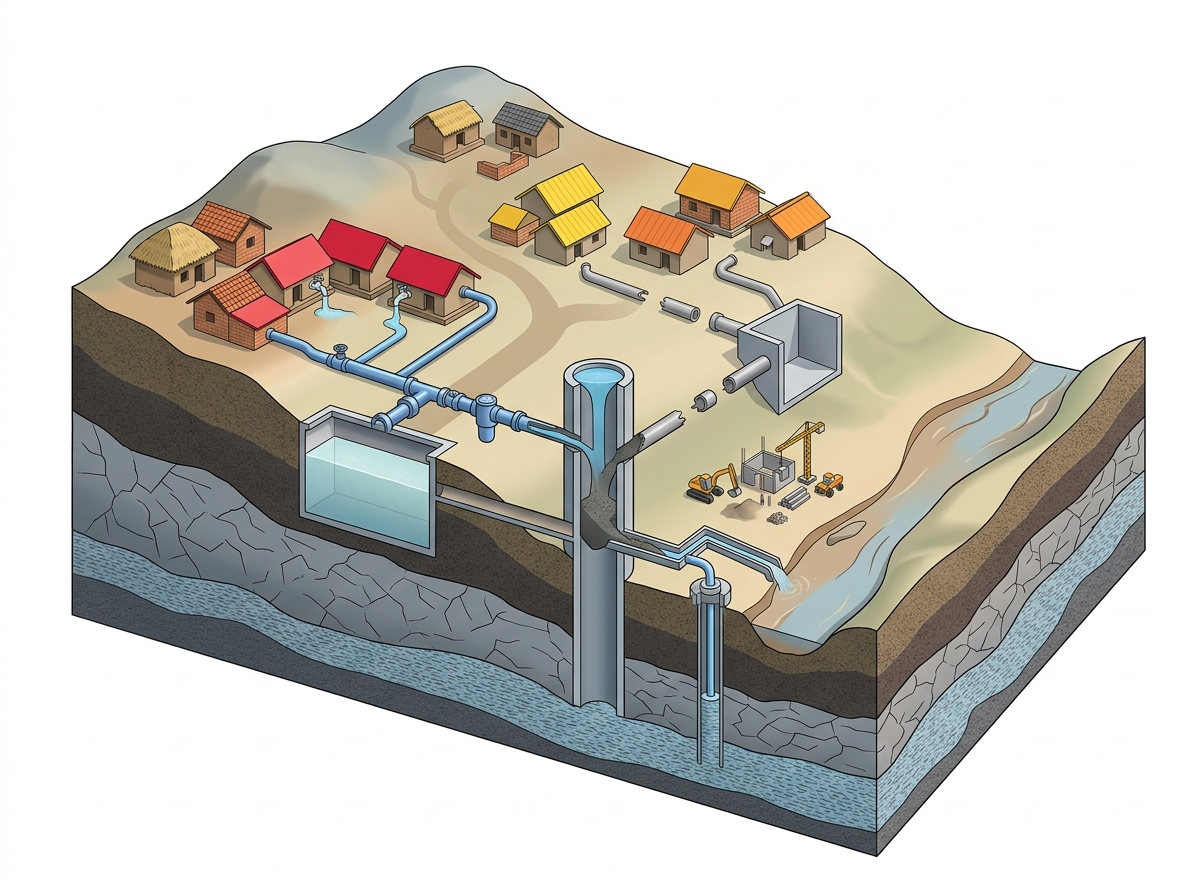
The Government of Jharkhand has urgently requested the release of approximately ₹6,500 crore in pending funds from the central government under the Jal Jeevan Mission (JJM) to expedite stalled rural drinking water supply projects. The demand was highlighted during a two-day departmental conclave organised by the Union Ministry of Jal Shakti, underscoring the criticality of timely financial flows to achieve the mission’s objective of 100% coverage of piped water supply in rural households.
Background
- The Jal Jeevan Mission (JJM), launched in August 2019, aims to provide Functional Household Tap Connection (FHTC) to every rural household by 2024, with a focus on sustainability, source sustainability, and community participation.
- Jharkhand, a predominantly tribal state with significant hilly and forested terrain, faces unique hydrogeological challenges, including low water table, seasonal scarcity, and high fluoride/arsenic contamination in groundwater, necessitating integrated planning.
- The Union Ministry of Jal Shakti operates JJM as a Centrally Sponsored Scheme (CSS), with funding shared between the Centre (90%) and states (10%), though state-specific allocations are subject to performance and utilisation certifications.
- Pending funds often stem from procedural delays in utilisation certificates, audit clearances, or state-level bottlenecks in project approvals, impeding timely disbursement.
- The mission’s second phase (JJM 2.0) introduces a ‘whole of government’ approach, integrating water conservation, rainwater harvesting, and convergence with MGNREGS and other rural development programmes.
What is the Jal Jeevan Mission?
- Launched on 15th August 2019 by the Ministry of Jal Shakti, JJM is a flagship programme to provide 55 litres per capita per day (lpcd) of potable water through individual household tap connections to all rural households by 2024.
- The mission adopts a demand-driven, community-centric approach, with Gram Panchayats and local communities playing a pivotal role in planning, implementation, and maintenance of water supply systems.
- Key components include source sustainability (rainwater harvesting, groundwater recharge), water quality monitoring and surveillance, grey water management, and convergence with other schemes like MGNREGS for infrastructure creation.
- JJM mandates the establishment of Village Water and Sanitation Committees (VWSCs) for decentralised governance, ensuring ownership and sustainability of water supply systems.
- The mission integrates technology through the ‘Jal Jeevan Mission Dashboard’ for real-time monitoring of progress, fund utilisation, and water quality parameters across districts.
- The mission’s success hinges on multi-stakeholder coordination among central ministries (Jal Shakti, Rural Development), state governments, local bodies, and communities to ensure inclusive and sustainable outcomes.
Key Features
| Feature | Significance |
|---|---|
| Jal Jeevan Mission (JJM) | A centrally sponsored scheme aimed at ensuring 100% functional household tap water connections in rural areas by 2024, with a focus on sustainable water supply and community participation. |
| Central Fund Release Mechanism | The Centre releases funds to states based on approved annual action plans, performance, and utilisation certificates, ensuring accountability in fund utilisation. |
| State-Level Coordination | State governments must align their water supply strategies with JJM guidelines, ensuring integration of local water sources, infrastructure, and maintenance protocols. |
| Rainwater Harvesting (Jal Shakti Abhiyan) | A complementary initiative under JJM to promote decentralised water conservation, reducing dependency on groundwater and enhancing long-term water security. |
| Community Participation | Mandatory involvement of Gram Panchayats and local communities in planning, implementation, and maintenance of water supply systems to ensure sustainability. |
Why it Matters
Policy & Governance
- Demonstrates the Centre-State fiscal federalism model in implementing flagship schemes, where timely fund disbursal is critical for achieving national targets.
- Highlights the operational challenges in executing rural water supply projects in geographically complex regions like Jharkhand, necessitating tailored interventions.
- Emphasises the shift from mere infrastructure creation to sustainable water resource management, aligning with SDG 6 (Clean Water and Sanitation).
Economic
- Accelerated fund release can stimulate local employment in water infrastructure projects, particularly in rural Jharkhand, contributing to economic activity.
- Prevents cost overruns due to delayed projects, ensuring optimal utilisation of allocated budgets under JJM.
- Enhances agricultural productivity by ensuring reliable water supply for irrigation and livestock, indirectly supporting rural livelihoods.
Social
- Ensuring 100% household tap water connections directly improves public health by reducing waterborne diseases and time spent on water collection, especially for women and children.
- Promotes gender equity by reducing the burden of water fetching on women, enabling their participation in education and economic activities.
- Strengthens local governance through decentralised planning and execution, fostering community ownership of water resources.
Challenges
1. Geographical Constraints in Water Supply
- Jharkhand’s hilly and forested terrain complicates the laying of pipelines and maintenance of water supply systems, increasing project costs and timelines.
- Limited availability of perennial water sources in certain districts necessitates innovative solutions like rainwater harvesting and groundwater recharge.
- Topographical challenges delay project approvals and land acquisition, leading to cost escalations.
UPSC Link: Geography of India: Resource Distribution
2. Fund Disbursement Delays
- States often face delays in receiving central funds due to procedural bottlenecks, performance audits, or discrepancies in utilisation certificates.
- Delayed funds disrupt project timelines, leading to stalled work and increased maintenance costs for incomplete infrastructure.
- States with weaker administrative capacities struggle to meet reporting requirements, further delaying fund releases.
UPSC Link: Public Finance: Centre-State Financial Relations
3. Sustainable Water Resource Management
- Over-extraction of groundwater for piped supply risks depleting aquifers, threatening long-term water security.
- Inadequate focus on source sustainability and maintenance leads to system failures post-completion, defeating the purpose of JJM.
- Climate change-induced erratic rainfall patterns exacerbate water scarcity, requiring adaptive planning.
UPSC Link: Environmental Governance: Water Conservation
4. Institutional Coordination Gaps
- Poor coordination between central ministries (e.g., Jal Shakti, Rural Development) and state agencies delays project approvals and fund releases.
- Lack of synergy between Gram Panchayats, local bodies, and implementing agencies results in poor project planning and community resistance.
- Weak monitoring mechanisms fail to identify bottlenecks early, leading to prolonged project delays.
UPSC Link: Public Administration: Inter-Governmental Relations
5. Community Engagement and Behavioural Challenges
- Low awareness among rural communities about water conservation and system maintenance leads to misuse of infrastructure.
- Resistance to user charges for water supply, despite improved service quality, hampers cost recovery and system upkeep.
- Caste and gender dynamics in rural areas may limit equitable access to water, requiring targeted interventions.
UPSC Link: Social Justice: Inclusive Development
Challenges — UPSC Perspective
| Issue | Concern |
|---|---|
| Topographical Challenges | Increased project costs and delays due to hilly terrain and forested areas. |
| Fund Disbursement Delays | Stalled projects and cost overruns due to untimely central fund releases. |
| Groundwater Depletion | Risk of long-term water scarcity due to over-reliance on groundwater for piped supply. |
| Institutional Coordination Gaps | Delays in project approvals and poor implementation due to inter-agency misalignment. |
| Community Participation Deficit | Poor maintenance and misuse of water infrastructure due to lack of awareness and ownership. |
Government Initiatives — Must-Memorise for Prelims
- Jal Jeevan Mission (JJM)
- Jal Shakti Abhiyan (Rainwater Harvesting Component)
Way Forward
- Accelerate the disbursal of pending central funds to Jharkhand under JJM, ensuring timely completion of stalled projects.
- Strengthen inter-departmental coordination at the state and central levels to streamline approvals and fund releases.
- Prioritise water source sustainability by integrating rainwater harvesting, groundwater recharge, and watershed management into project designs.
- Enhance community engagement through awareness campaigns and capacity-building programs to foster ownership and maintenance of water systems.
- Implement performance-based funding mechanisms to incentivise states and districts for timely project completion and utilisation.
- Develop a robust monitoring framework with real-time tracking of project progress and fund utilisation to identify bottlenecks early.
- Invest in local technical capacity-building to address geographical challenges and improve maintenance of water infrastructure.
- Promote convergence with other rural development schemes (e.g., MGNREGA) to leverage resources for water conservation and infrastructure creation.
UPSC Value Addition
Keywords for Mains Answer-Writing
Jal Jeevan Mission · Drinking Water Supply · Central-State Financial Relations · Convergence of Schemes · Rural Infrastructure Development · Water Resource Management · National Rural Drinking Water Programme · Union Budget Allocations · Public Goods Delivery · Sustainable Water Governance · Institutional Coordination · Fiscal Federalism · Water Security · Panchayati Raj Institutions
Concept Flow
Jal Jeevan Mission (JJM) is launched with the objective of providing 100% functional household tap water connections in rural areas. → States submit annual action plans, including geographical and hydrological assessments, for central approval and fund allocation. → Central funds are released to states based on approved plans, performance audits, and utilisation certificates. → States face delays in fund disbursement due to procedural bottlenecks, leading to stalled projects in challenging terrains like Jharkhand. → Delayed projects disrupt water supply targets, necessitating urgent intervention to accelerate fund release and project completion. → Sustainable water management practices (e.g., rainwater harvesting) are integrated to ensure long-term water security and reduce dependency on groundwater. → Community participation and local governance mechanisms are strengthened to ensure equitable access and system maintenance.
Prelims Practice Questions
Q1. Consider the following statements regarding the Jal Jeevan Mission (JJM):
1. It aims to provide 55 litres of potable water per capita per day to all rural households.
2. The mission is a centrally sponsored scheme with 100% funding by the Union Government.
3. The mission includes the revival of traditional water bodies and rainwater harvesting structures.
4. The implementation of JJM is monitored through a dashboard managed by the Ministry of Jal Shakti.
How many of the above statements are correct?
- Only one
- Only two
- Only three
- All four
Answer: Only three — Statement 1 is correct: JJM targets 55 litres per capita per day. Statement 2 is incorrect: JJM has a 50:50 funding pattern between the Centre and States except for Union Territories. Statement 3 is correct: Traditional water body revival is part of JJM. Statement 4 is correct: The JJM dashboard is used for real-time monitoring of progress.
Q2. Assertion (A): The Jal Jeevan Mission is implemented through a decentralised approach involving local governance institutions.
Reason (R): The mission mandates that at least 60% of the funds flow directly to the Gram Panchayats for planning and execution.
In the context of the above two statements, which one of the following is correct?
- Both A and R are true and R is the correct explanation of A
- Both A and R are true but R is NOT the correct explanation of A
- A is true but R is false
- A is false but R is true
Answer: Both A and R are true but R is NOT the correct explanation of A — Assertion (A) is true: JJM is implemented through decentralised governance involving Gram Panchayats. Reason (R) is also true and correctly explains (A): The mission requires at least 60% of funds to be devolved to Gram Panchayats for local planning and execution.
Q3. Match the following schemes with their primary objectives:
Column I (Scheme) | Column II (Objective)
— | —
A. Jal Jeevan Mission | 1. Provision of piped water supply to all rural households
B. National Rural Drinking Water Programme | 2. Revival of traditional water bodies and rainwater harvesting
C. Atal Mission for Rejuvenation and Urban Transformation | 3. Provision of safe and adequate drinking water to rural areas
D. Mahatma Gandhi National Rural Employment Guarantee Scheme | 4. Creation of durable assets and infrastructure in rural areas
Select the correct match:
- A-1, B-3, C-2, D-4
- A-1, B-3, C-4, D-2
- A-2, B-3, C-4, D-1
- A-3, B-1, C-2, D-4
Answer: A-1, B-3, C-4, D-2 — Correct matches: A (Jal Jeevan Mission) → 1 (Piped water supply), B (NRDWP) → 3 (Safe drinking water in rural areas), C (AMRUT) → 4 (Urban infrastructure), D (MGNREGS) → 2 (Asset creation; though MGNREGS is not water-specific, it supports water-related works).
Mains Practice Question
✍ The Jal Jeevan Mission (JJM) represents a paradigm shift in India’s approach to rural water supply by prioritising decentralised governance, community participation, and long-term water security. In this context, critically examine the challenges faced in the implementation of JJM, with particular reference to the financial and institutional bottlenecks highlighted in the recent developments from Jharkhand. Also, analyse how the mission aligns with the principles of fiscal federalism in India. (15 Marks)
Approach: MODEL-ANSWER SKELETON:
1. Introduction (2 marks):
– Define Jal Jeevan Mission (JJM) and its objectives (55 litres per capita per day, 100% coverage).
– Mention its status as a Centrally Sponsored Scheme (CSS) with 50:50 funding (except UTs).
– Highlight the recent Jharkhand case as a contextual anchor.
2. Challenges in Implementation (6 marks):
– Financial Bottlenecks:
– Delayed release of central funds (e.g., Jharkhand’s demand for ₹6,500 crore).
– State-level resource constraints and fiscal imbalances.
– Underutilisation of funds due to procedural delays.
– Institutional Bottlenecks:
– Weak convergence with other schemes (e.g., MGNREGS, NRDWP).
– Limited capacity of Gram Panchayats in planning and execution.
– Lack of long-term sustainability mechanisms for water sources.
– Geographical and Socio-Economic Factors:
– Topographical challenges in states like Jharkhand (hilly and forested terrain).
– Low community participation due to lack of awareness or trust.
3. Alignment with Fiscal Federalism (4 marks):
– Principles of Fiscal Federalism:
– Division of financial responsibilities between Centre and States.
– Role of Finance Commission in resource allocation.
– JJM as a CSS:
– Shared funding model (50:50) ensures equitable burden-sharing.
– Flexibility for states to prioritise local needs within national guidelines.
– However, delayed releases and rigid fund-flow mechanisms undermine federal flexibility.
– Recommendations for Improvement:
– Timely release of funds with performance-based incentives.
– Strengthening institutional capacity at the state and local levels.
– Promoting convergence with other water-related schemes (e.g., ‘Catch the Rain’).
4. Conclusion (3 marks):
– Reiterate the need for a balanced approach combining financial support, institutional strengthening, and community engagement.
– Emphasise the role of JJM in achieving Sustainable Development Goal 6 (Clean Water and Sanitation).
– Highlight the importance of learning from state-specific challenges (e.g., Jharkhand) to improve implementation nationwide.
Source: amarujala.com
Jharkhand PCS (JPSC) — State PCS Practice
Prelims: Under the ‘Jal Jeevan Mission’ in Jharkhand, the state government has recently demanded the release of ₹6,500 crore from the Centre to expedite stalled schemes. Which of the following is the primary objective of this demand?
- A. To provide piped water supply to all rural households in Jharkhand by 2024
- B. To construct new dams across major rivers in the state
- C. To promote groundwater recharge through artificial methods
- D. To establish water treatment plants in urban areas only
Answer: A. To provide piped water supply to all rural households in Jharkhand by 2024 — The primary objective of the ‘Jal Jeevan Mission’ is to provide piped water supply to all rural households in India by 2024, including Jharkhand.
Mains: Discuss the significance of the ‘Jal Jeevan Mission’ for Jharkhand, highlighting the challenges faced in its implementation and the role of tribal communities in ensuring its success. Suggest measures to accelerate the mission’s progress in the state.
Generated by AanyaAi for educational purpose.
Related guides on our sites
- Current affairs for upsc 2026
- Best PSIR optional coaching for upsc
- Best PSIR optional teacher for upsc
- Best teacher of PSIR optional for upsc

- Shivraj Singh Chouhan launches ‘Khet Bachao Abhiyan’ to save farmland - October 23, 2026
- उत्तराखंड राज्यपाल की पीएम मोदी से महत्वपूर्ण बैठक: जानिए मुख्य बिंदु - October 23, 2026
- How India’s Rs 20,000 Cr CCUS Budget Can Drive Net-Zero Goals - October 23, 2026

No Comments