


04 Aug वन संरक्षण में सामुदायिक भूमिका: सरकारी योजनाएं एवं कानूनी ढांचा
✎ The Forest Rights Act, 2006, is pivotal in India’s conservation strategy as it legally empowers forest-dwelling communities to manage forest resources sustainably while balancing ecological integrity with livelihood needs.
Subject Relevance — Where This Topic Fits
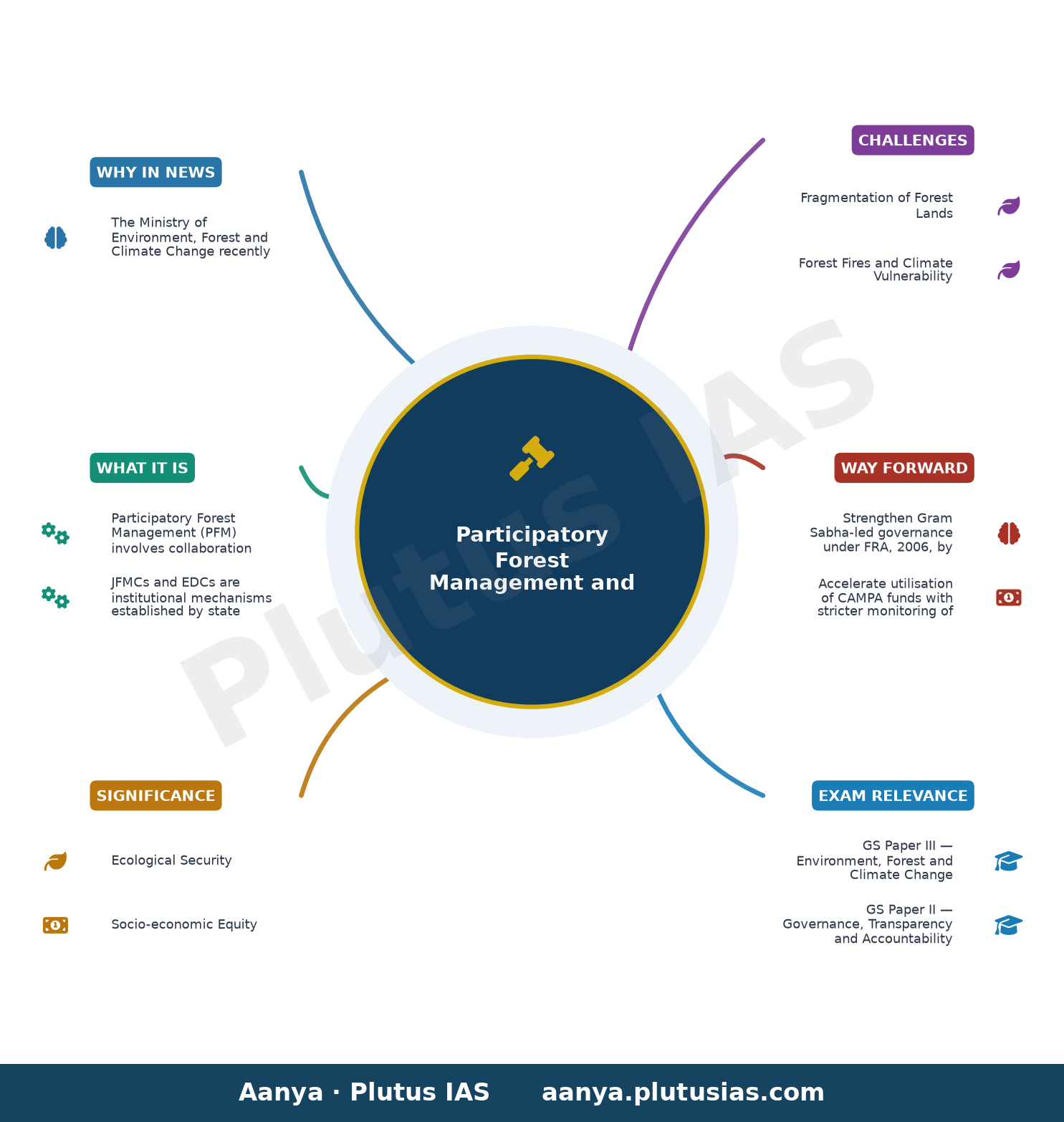
- GS Paper III — Environment, Forest and Climate Change | GS Paper II — Governance, Transparency and Accountability
- Prelims: Forest Conservation Act, 1980, Compensatory Afforestation Fund Management and Planning Authority (CAMPA), National Green India Mission (GIM), Scheduled Tribes and Other Traditional Forest Dwellers (Recognition of Forest Rights) Act, 2006, National Action Plan on Forest Fires, 2018
- Essay: Ethical dimensions of conservation: Balancing development and environmental justice, Community-led conservation: A model for sustainable governance
Quick Revision: The Forest Rights Act, 2006, is pivotal in India’s conservation strategy as it legally empowers forest-dwelling communities to manage forest resources sustainably while balancing ecological integrity with livelihood needs.
Why is this in the news?
The Ministry of Environment, Forest and Climate Change recently provided a detailed written response in Parliament on India’s forest conservation initiatives, highlighting the role of participatory institutions, statutory frameworks, and centrally sponsored schemes in enhancing forest cover and mitigating ecological degradation. This response underscores the integration of legal provisions, technological interventions, and community participation in forest management, reflecting India’s commitment to sustainable development and biodiversity conservation under constitutional and statutory mandates.
Background
- India’s forest cover, as per the India State of Forest Report (ISFR) 2023, stands at 827,356.95 sq km, constituting 25.17% of the country’s geographical area, with a marginal increase of 1,445.81 sq km since ISFR 2021.
- The Forest (Conservation) Act, 1980, regulates diversion of forest land for non-forest purposes, requiring prior approval from the central government to prevent indiscriminate land use changes.
- The Scheduled Tribes and Other Traditional Forest Dwellers (Recognition of Forest Rights) Act, 2006, empowers forest-dwelling communities by recognizing individual and community forest rights, enabling sustainable management of forest resources.
- The National Green India Mission (GIM) and Compensatory Afforestation Fund Management and Planning Authority (CAMPA) are flagship schemes aimed at afforestation, restoration of degraded forests, and compensatory afforestation to offset forest land diversion.
What is Participatory Forest Management and How Does India Implement It?
- Participatory Forest Management (PFM) involves collaboration between government agencies and local communities to manage forest resources sustainably, primarily through Joint Forest Management Committees (JFMCs) and Eco-Development Committees (EDCs).
- JFMCs and EDCs are institutional mechanisms established by state governments to engage local stakeholders in activities such as afforestation, forest fire management, prevention of illegal felling, and restoration of degraded forests.
- The Forest Rights Act, 2006, is a landmark legislation that recognizes the rights of forest-dwelling communities, including Scheduled Tribes and other traditional forest dwellers, over forest land and resources, thereby strengthening their role in conservation.
- Community forest rights under the Forest Rights Act empower Gram Sabhas to protect, regenerate, conserve, and manage community forest resources for sustainable use, aligning conservation with livelihood security.
- India’s forest conservation framework integrates statutory provisions (e.g., Forest Conservation Act, 1980; Wildlife Protection Act, 1972) with centrally sponsored schemes (e.g., GIM, CAMPA) to address ecological degradation while promoting socio-economic development.
- The CAMPA scheme, operationalized through the Compensatory Afforestation Fund Act, 2016, ensures that funds collected from forest land diversion are utilized for afforestation and restoration activities, with strict monitoring by the National CAMPA Advisory Council.
- Protected Area networks, including National Parks, Wildlife Sanctuaries, Conservation Reserves, and Community Reserves, are designated under the Wildlife Protection Act, 1972, to conserve critical wildlife habitats and ecological corridors.
Key Features
| Feature | Significance |
|---|---|
| Joint Forest Management Committees (JFMCs) & Environment Development Committees (EDCs) | Institutionalise participatory forest governance by integrating local communities into conservation, afforestation, and fire management activities. |
| Scheduled Tribes and Other Traditional Forest Dwellers (Recognition of Forest Rights) Act, 2006 | Empowers forest-dwelling communities with individual and community forest rights, enabling sustainable utilisation and conservation of forest resources through Gram Sabhas. |
| National Green India Mission (GIM) | Aims to enhance forest and tree cover by 5 million hectares and improve ecosystem services through afforestation, restoration, and livelihood diversification in degraded forest landscapes. |
| Compensatory Afforestation Fund Management and Planning Authority (CAMPA) | Utilises funds from compensatory afforestation to restore degraded forests, promote afforestation, and support forest-dependent communities in sustainable management. |
| National Action Plan on Forest Fires (NAPFF), 2018 | Provides a comprehensive framework for forest fire prevention, detection, control, and management through capacity building, technology adoption, and community participation. |
Why it Matters
Ecological Security
- Maintains biodiversity by protecting critical habitats under Wildlife (Protection) Act, 1972, including 1,134 notified protected areas and 58 Tiger Reserves.
- Ensures ecological connectivity through 32 Tiger Corridors and 150 Elephant Corridors, mitigating habitat fragmentation.
- Supports climate regulation via carbon sequestration in 8,27,356.95 sq km of forest and tree cover (25.17% of geographical area).
Socio-economic Equity
- Strengthens forest-dependent communities’ livelihoods through rights-based access under FRA, 2006, reducing dependency on exploitative forest resource extraction.
- Enhances rural incomes via participatory forest management, afforestation, and sustainable utilisation of non-timber forest products.
- Promotes gender-inclusive governance through Gram Sabha-led decision-making in forest management.
Legal and Institutional Framework
- Regulates forest land diversion under Forest (Conservation) Act, 1980, ensuring ecological safeguards for infrastructure projects.
- Mandates statutory environmental impact assessments for mining in forest areas under EIA Notification, 2006 and Forest (Conservation) Act, 1980.
- Establishes statutory bodies like CAMPA and NAPFF to institutionalise conservation efforts.
Strategic Resource Management
- Ensures sustainable utilisation of forest resources through community-based institutions (JFMCs, EDCs) and scientific afforestation programmes.
- Mitigates risks of forest degradation and climate-induced disasters (e.g., forest fires) through proactive management frameworks.
Challenges
1. Fragmentation of Forest Lands
- Linear infrastructure projects (roads, railways) and mining activities lead to habitat fragmentation, disrupting ecological connectivity.
- Forest (Conservation) Act, 1980, while stringent, faces implementation challenges in balancing development and conservation.
UPSC Link: GS3: Conservation, Environmental Pollution
2. Forest Fires and Climate Vulnerability
- Increasing frequency and intensity of forest fires due to climate change and anthropogenic pressures (e.g., shifting cultivation, encroachments).
- Limited technological adoption in early warning systems and community-based fire management in remote forest areas.
UPSC Link: GS3: Disaster Management
3. Implementation Gaps in Forest Rights
- Delayed recognition and settlement of forest rights under FRA, 2006, disenfranchising forest-dwelling communities.
- Lack of convergence between Gram Sabhas and forest department in participatory forest governance.
UPSC Link: GS2: Governance, GS3: Environment
4. Compensatory Afforestation Challenges
- Delays in utilisation of CAMPA funds due to bureaucratic hurdles and land acquisition issues.
- Quality of compensatory afforestation often compromised due to selection of non-forest lands or poor post-plantation maintenance.
UPSC Link: GS3: Environment
5. Mining in Forest Areas
- Ecological and social costs of mining in forest-rich regions (e.g., coal, bauxite) outweigh economic benefits due to irreversible habitat loss.
- Statutory environmental clearances often face delays or are granted without adequate site-specific ecological impact assessments.
UPSC Link: GS3: Environment, GS2: Governance
Challenges — UPSC Perspective
| Issue | Concern |
|---|---|
| Forest Land Diversion | Habitat fragmentation and loss of biodiversity due to infrastructure and mining projects. |
| Forest Fires | Increased frequency and intensity threaten forest cover and carbon sequestration. |
| Forest Rights Recognition | Delays in FRA implementation disenfranchise forest-dwelling communities. |
| Compensatory Afforestation | Fund utilisation delays and poor post-plantation outcomes undermine restoration goals. |
| Mining in Forests | Ecological degradation and social conflicts due to unregulated mining activities. |
| Technological Adoption | Limited use of remote sensing, GIS, and early warning systems in forest management. |
Government Initiatives — Must-Memorise for Prelims
- National Green India Mission (GIM)
- Compensatory Afforestation Fund Management and Planning Authority (CAMPA)
- MISHTI (Mangrove Initiative for Shoreline Habitats & Tangible Incomes)
- Nagar Van Yojana
Way Forward
- Strengthen Gram Sabha-led governance under FRA, 2006, by expediting forest rights recognition and convergence with forest department initiatives.
- Accelerate utilisation of CAMPA funds with stricter monitoring of afforestation quality and post-plantation maintenance.
- Enhance community-based forest fire management through capacity building, early warning systems, and technology adoption (e.g., drones, satellite imagery).
- Integrate climate resilience into forest management plans, including adaptation strategies for vulnerable species and habitats.
- Streamline forest land diversion processes under Forest (Conservation) Act, 1980, with stricter adherence to ecological safeguards and site-specific impact assessments.
- Promote agroforestry and non-timber forest product-based livelihoods to reduce pressure on natural forests.
- Expand mangrove and coastal forest restoration under MISHTI to enhance blue carbon sequestration and coastal resilience.
UPSC Value Addition
Keywords for Mains Answer-Writing
Forest Conservation Schemes · Joint Forest Management Committees (JFMC) · Compensatory Afforestation Fund Management and Planning Authority (CAMPA) · Scheduled Tribes and Other Traditional Forest Dwellers (Recognition of Forest Rights) Act, 2006 · National Green India Mission (GIM) · Forest (Conservation & Promotion) Act, 1980 · Wildlife (Protection) Act, 1972 · Forest Fire Prevention and Management · Community Forest Resources · Ecological Restoration · Protected Areas Network · Mangrove Initiative for Shoreline Habitats & Tangible Incomes (MISHTI) · Forest Rights Act, 2006 · Forest Cover Assessment (ISFR 2023) · Tiger and Elephant Reserves · Wildlife Corridors
Concept Flow
Forest-dependent communities → FRA, 2006 → Community Forest Rights → Participatory Forest Management (JFMCs/EDCs) → Sustainable Utilisation & Conservation → Forest Conservation Act, 1980 → Statutory Regulation of Forest Land Diversion → Environmental Impact Assessments → Mitigation Measures → National Green India Mission → Afforestation & Restoration → Carbon Sequestration → Climate Regulation → Forest Fires → National Action Plan on Forest Fires → Early Warning Systems → Community Participation → Fire Management → CAMPA → Compensatory Afforestation Funds → Restoration of Degraded Forests → Biodiversity Conservation → Mining in Forest Areas → Environmental Clearances → Ecological Impact Assessment → Habitat Fragmentation
Prelims Practice Questions
Q1. Consider the following statements regarding the Scheduled Tribes and Other Traditional Forest Dwellers (Recognition of Forest Rights) Act, 2006:
1. The Act provides for the recognition of forest rights of forest-dwelling Scheduled Tribes and other traditional forest dwellers.
2. It empowers Gram Sabhas to protect, regenerate, conserve, and manage community forest resources.
3. The Act mandates the establishment of Joint Forest Management Committees (JFMC) in all forest areas.
How many of the above statements are correct?
- Only one
- Only two
- All three
- None
Answer: Only two — Statement 1 and 2 are correct as per the Act. Statement 3 is incorrect because the Act does not mandate the establishment of JFMCs in all forest areas; it encourages participatory forest management through Gram Sabhas and other mechanisms.
Q2. Assertion (A): The Compensatory Afforestation Fund Management and Planning Authority (CAMPA) is responsible for the management of funds collected under the Compensatory Afforestation Fund Act, 2016.
Reason (R): CAMPA funds are utilised exclusively for afforestation activities in areas where forest land has been diverted for non-forest purposes.
- Both A and R are true, and R is the correct explanation of A.
- Both A and R are true, but R is not the correct explanation of A.
- A is true, but R is false.
- A is false, but R is true.
Answer: A is true, but R is false. — Assertion (A) is true as CAMPA manages funds collected under the Compensatory Afforestation Fund Act, 2016. Reason (R) is partially true but misleading because CAMPA funds are utilised not only for afforestation but also for compensatory afforestation, wildlife conservation, and other related activities as per the Act.
Q3. Match the following initiatives with their respective objectives:
Column I (Initiative) | Column II (Objective)
———————————————–|———————————————–
A. National Green India Mission (GIM) | 1. Enhancing forest and tree cover in degraded forest areas
B. Mangrove Initiative for Shoreline Habitats & Tangible Incomes (MISHTI) | 2. Conservation of mangrove ecosystems and coastal livelihoods
C. Forest Fire Prevention and Management | 3. Prevention, control, and management of forest fires
D. Compensatory Afforestation Fund Management and Planning Authority (CAMPA) | 4. Management of funds for afforestation and wildlife conservation
- A-1, B-2, C-3, D-4
- A-2, B-1, C-4, D-3
- A-3, B-4, C-1, D-2
- A-4, B-3, C-2, D-1
Answer: A-1, B-2, C-3, D-4 — The correct matching is: A-1 (GIM aims to enhance forest and tree cover), B-2 (MISHTI focuses on mangrove conservation and coastal livelihoods), C-3 (Forest Fire Prevention and Management addresses forest fire control), D-4 (CAMPA manages funds for afforestation and wildlife conservation).
Mains Practice Question
✍ ‘Participatory forest governance through institutions like Joint Forest Management Committees (JFMCs) and Gram Sabhas under the Forest Rights Act, 2006, has emerged as a cornerstone of India’s forest conservation strategy.’ Critically examine this statement with reference to statutory frameworks, institutional mechanisms, and contemporary challenges. Also, assess the role of CAMPA and the National Green India Mission (GIM) in complementing these efforts. (15 Marks)
Approach: MODEL-ANSWER SKELETON:
1. **Introduction (2 marks)**
– Briefly define participatory forest governance and its significance in India’s forest conservation strategy.
– Mention the Forest Rights Act, 2006, as a statutory foundation for community participation.
2. **Statutory Frameworks (3 marks)**
– Forest (Conservation & Promotion) Act, 1980: Regulates diversion of forest land for non-forest purposes.
– Scheduled Tribes and Other Traditional Forest Dwellers (Recognition of Forest Rights) Act, 2006: Legal recognition of forest rights and empowerment of Gram Sabhas.
– Wildlife (Protection) Act, 1972: Provides for protected areas and wildlife conservation.
– Compensatory Afforestation Fund Act, 2016: Establishes CAMPA for managing compensatory afforestation funds.
3. **Institutional Mechanisms (4 marks)**
– Joint Forest Management Committees (JFMCs): Role in participatory forest management, conflict resolution, and sustainable use.
– Gram Sabhas: Powers under FRA, 2006, for protecting and managing community forest resources.
– Environmental Development Committees (EDCs): Involvement in forest fire management, afforestation, and illegal logging prevention.
– State Forest Departments: Collaborative role with local institutions.
4. **Contemporary Challenges (3 marks)**
– Implementation gaps in FRA, 2006: Delays in recognition of rights, bureaucratic hurdles.
– Conflicts between conservation goals and developmental pressures (e.g., mining, infrastructure projects).
– Limited capacity of Gram Sabhas and JFMCs in technical and financial management.
– Climate change impacts: Increased frequency of forest fires and degradation.
5. **Role of CAMPA and GIM (3 marks)**
– CAMPA: Funds utilisation for compensatory afforestation, wildlife conservation, and restoration of degraded forests. Critique: Funds often diverted or underutilised due to procedural delays.
– National Green India Mission (GIM): Aims to enhance forest cover and improve ecosystem services. Critique: Limited convergence with local institutions like Gram Sabhas.
6. **Conclusion (2 marks)**
– Participatory governance is a necessary but not sufficient condition for sustainable forest management.
– Need for stronger convergence between statutory frameworks, institutional mechanisms, and financial schemes like CAMPA and GIM.
– Emphasise the role of technology (e.g., GIS, remote sensing) and capacity-building for effective implementation.
Source: PIB (Press Information Bureau)
Generated by AanyaAi for educational purpose.

- मैसूर को वैश्विक पर्यटन मिशन में शामिल करने के लिए केंद्र से मांग - August 4, 2026
- Mysuru’s Bid for Global Tourism Mission: Centre’s Nod Sought - August 4, 2026
- लोकसभा में कराधान विधेयक पेश करेगी सीतारमण; कांग्रेस ने दलबदल कानून पर बहस की मांग की - August 4, 2026

No Comments