


13 Sep अमित शाह होंगे मुंबई में हिंदी दिवस 2026 एवं राजभाषा सम्मेलन का उद्घाटन
✎ The Sixth All-India Official Language Conference and Hindi Diwas 2026 in Mumbai will felicitate linguistic excellence through Rajbhasha Kirti and Rajbhasha Gaurav awards, while promoting constitutional provisions for Hindi and…
Subject Relevance — Where This Topic Fits
- GS Paper II — Polity and Governance (Constitutional Provisions, Official Language Policy) | GS Paper II — Social Justice and Governance (Cultural and Linguistic Diversity)
- Prelims: Official Languages Act, 1963, Constitution of India: Articles 343–351 (Official Language), Hindi Divas, Rajbhasha Kirti Puraskar, Rajbhasha Gaurav Puraskar, Nagar Rajbhasha Karyanvayan Samitis (NARACAS), Constitutional provisions for linguistic minorities
- Essay: Linguistic unity and cultural diversity in India: Balancing national integration and regional identities, Role of language in nation-building and inclusive governance
Quick Revision: The Sixth All-India Official Language Conference and Hindi Diwas 2026 in Mumbai will felicitate linguistic excellence through Rajbhasha Kirti and Rajbhasha Gaurav awards, while promoting constitutional provisions for Hindi and all Indian languages under Articles 343–351 of the Constitution.
Why is this in the news?
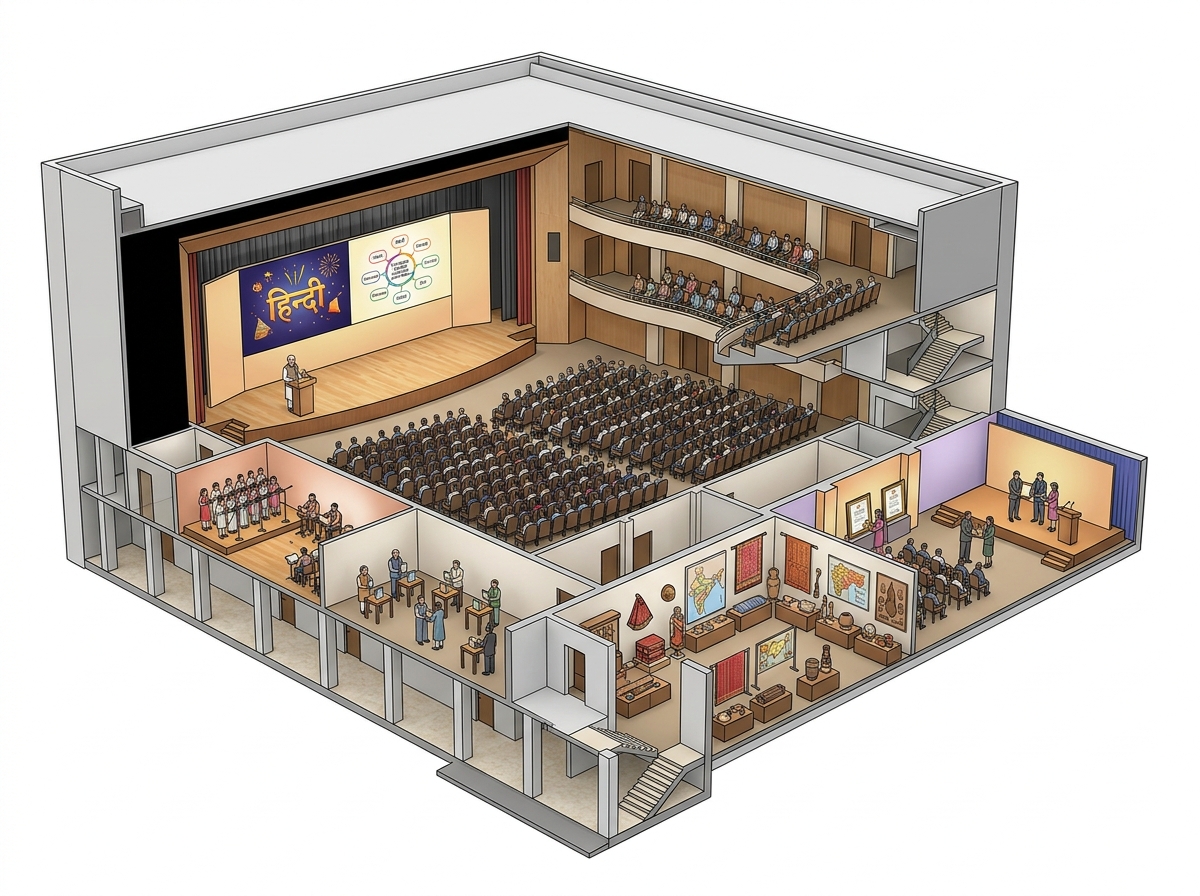
On 14 September 2026, the Union Home and Cooperation Minister will inaugurate the sixth All-India Official Language Conference and preside over the Hindi Diwas 2026 celebrations in Mumbai. The event, organised by the Department of Official Language under the Ministry of Home Affairs, will felicitate institutions and individuals for outstanding contributions to Hindi and other Indian languages through the Rajbhasha Kirti and Rajbhasha Gaurav awards. The conference will also feature thematic sessions on the national song ‘Vande Mataram’, book releases, and exhibitions highlighting the linguistic and cultural heritage of Maharashtra and the nation.
Background
- The Department of Official Language, Ministry of Home Affairs, has been organising annual All-India Official Language Conferences since 2021 under the guidance of the Union Home Minister, inspired by the Prime Minister’s vision for linguistic harmony.
- The conferences trace a thematic journey across Indian cities—Varanasi, Surat, Pune, New Delhi, and Gandhinagar—before culminating in Maharashtra in 2026, underscoring the federal and inclusive nature of the initiative.
- Hindi Diwas is observed annually on 14 September to commemorate the adoption of Hindi in the Devanagari script as one of the official languages of the Union of India under Article 343(1) of the Constitution.
- The Official Languages Act, 1963, and subsequent rules govern the progressive use of Hindi and other scheduled languages in official communication, with provisions for voluntary adoption of Hindi in states where it is not the dominant language.
- The Rajbhasha Kirti and Rajbhasha Gaurav awards were instituted to recognise excellence in the propagation and implementation of Hindi and other Indian languages in official, educational, and public domains.
- Nagar Rajbhasha Karyanvayan Samitis (NARACAS) are local committees at the district level tasked with promoting Hindi and other Indian languages in official work within their jurisdictions.
Sixth All-India Official Language Conference and Hindi Diwas 2026: Objectives and Components
- The conference aims to strengthen coordination, dialogue, and partnership among all Indian languages, reinforcing the constitutional mandate for linguistic harmony and national integration.
- The event will felicitate institutions and individuals for their contributions to the promotion of Hindi and other Indian languages through the Rajbhasha Kirti and Rajbhasha Gaurav awards, recognising excellence in official communication, education, literature, and public administration.
- A dedicated session on ‘Vande Mataram’ will explore its historical, literary, and cultural dimensions, featuring scholars and artists to highlight its role in shaping national consciousness.
- The conference will feature the launch of several publications, including a special issue of ‘Rajbhasha Bharti’ on ‘Vande Mataram’, ‘Bharatiya Jnana Tantra: Sources and Forms’, ‘Shiva Anadi Hain, Anant Hain’, and ‘Andheron Se Ujalon Tak’, a compilation of works by prison inmates, reflecting diverse dimensions of Indian knowledge systems and creative expression.
- Exhibitions at the venue will showcase the linguistic, cultural, and literary heritage of Maharashtra and India, with 32 stalls representing various ministries, organisations, banks, and institutions, demonstrating their initiatives in promoting Hindi and other Indian languages.
- Nagar Rajbhasha Karyanvayan Samitis (NARACAS) will be highlighted for their role in implementing official language policies at the district level, ensuring grassroots-level engagement and compliance with linguistic provisions.
- The conference underscores the constitutional framework for official languages (Articles 343–351), which mandates the progressive use of Hindi in official communication while safeguarding the linguistic rights of all Indian languages.
- The event aligns with the broader policy objective of fostering multilingualism, preserving linguistic diversity, and promoting Hindi as a link language while ensuring inclusivity for all scheduled languages.
Key Features
| Feature | Significance |
|---|---|
| Annual All-India Official Language Conference | Institutionalises a yearly platform for reviewing progress, challenges, and innovations in Hindi and other Indian languages within governance and public administration. |
| ‘Rajbhasha Gaurav’ and ‘Rajbhasha Kirti’ Awards (2025–26) | Recognises excellence in Hindi usage and promotion across government departments, public sector undertakings, and individuals, incentivising linguistic compliance and innovation. |
| Special Session on ‘Vande Mataram’ | Explores the historical, literary, and cultural dimensions of the national song, reinforcing its role in shaping national consciousness and linguistic identity. |
| Publication Launches and Exhibitions | Showcases scholarly works, literary creations, and institutional contributions, fostering inter-disciplinary dialogue and archival enrichment. |
| Role of Nagar Rajbhasha Karyanvayan Samitis (NARKAS) | Highlights the operational mechanisms of local official-language implementation committees in urban centres, ensuring grassroots compliance with linguistic policies. |
Why it Matters
Administrative & Governance
- Demonstrates the Union Government’s sustained commitment to the constitutional mandate of promoting Hindi and other Indian languages in official communication, thereby enhancing administrative efficiency and inclusivity.
- Provides a structured mechanism for inter-ministerial coordination on language policy, ensuring uniformity in implementation across diverse linguistic regions.
- Strengthens the institutional framework for language planning, including standardisation of terminology, translation services, and digital governance tools.
Cultural & Societal
- Reaffirms the syncretic relationship between Hindi and regional languages, particularly in Maharashtra, highlighting the pluralistic ethos of Indian linguistic heritage.
- Serves as a platform for literary and artistic expression, bridging classical and contemporary traditions through publications and performances.
- Encourages public participation in linguistic and cultural preservation, fostering a sense of shared identity and national cohesion.
Educational & Scholarly
- Promotes research and documentation of Indian languages, including their historical evolution, literary contributions, and socio-political significance.
- Facilitates the exchange of best practices among scholars, writers, and policymakers, thereby enriching pedagogical and curricular frameworks.
- Supports the creation of multilingual educational resources, aligning with the National Education Policy 2020’s emphasis on multilingualism.
Policy & Institutional
- Aligns with the constitutional directive under Article 343(2) and the Official Languages Act, 1963, by institutionalising periodic reviews and capacity-building initiatives.
- Demonstrates the role of the Department of Official Language (Rajbhasha Vibhag) as a nodal agency for linguistic governance and policy implementation.
- Provides a model for other multilingual federations, showcasing how linguistic diversity can be leveraged for administrative and cultural synergy.
Challenges
1. Linguistic Diversity vs. Administrative Uniformity
- Balancing the promotion of Hindi with the protection of regional languages, particularly in non-Hindi states, to avoid perceptions of linguistic imposition.
- Ensuring that official-language policies do not marginalise non-Hindi speakers in employment, education, or public service delivery.
- Addressing the digital divide in language accessibility, including the availability of government services in all major Indian languages.
UPSC Link: GS-II: Language Policy & Federalism
2. Implementation Gaps in Government Machinery
- Overcoming bureaucratic resistance to adopting Hindi in official correspondence, particularly in states where regional languages dominate.
- Ensuring consistent compliance with language policies across central ministries, public sector undertakings, and state governments.
- Streamlining translation services and terminology databases to reduce delays and errors in multilingual documentation.
UPSC Link: GS-II: Governance & Public Administration
3. Cultural and Literary Marginalisation
- Revitalising interest in Hindi and other Indian languages among younger generations amid the dominance of English in media and academia.
- Preserving endangered languages and dialects while promoting Hindi, ensuring no language is sidelined in the process.
- Encouraging original literary and scholarly contributions in Indian languages to counter the dominance of translated works.
UPSC Link: GS-I: Indian Culture & Diversity
4. Technological and Resource Constraints
- Developing AI-driven translation tools and language processing systems tailored to Indian scripts and dialects.
- Ensuring equitable access to digital resources, including e-governance platforms, in all scheduled languages.
- Training government officials and staff in language proficiency and digital literacy to enhance policy implementation.
UPSC Link: GS-III: Science & Technology
5. Public Perception and Political Neutrality
- Fostering a non-partisan narrative around language promotion to avoid politicisation of linguistic identities.
- Addressing misconceptions that language policies are exclusionary or favour a particular linguistic group.
- Promoting multilingualism as a strength rather than a source of division, aligning with the constitutional vision of unity in diversity.
UPSC Link: GS-II: Constitutional Provisions
Challenges — UPSC Perspective
| Issue | Concern |
|---|---|
| Linguistic Federalism | Balancing Hindi promotion with regional language rights to prevent linguistic tensions. |
| Bureaucratic Compliance | Ensuring consistent adherence to language policies across government departments. |
| Digital Language Divide | Providing equitable access to government services in all major Indian languages. |
| Youth Engagement | Revitalising interest in Hindi and other Indian languages among younger demographics. |
| Resource Allocation | Allocating sufficient funds and expertise for language planning and implementation. |
| Cultural Preservation | Protecting endangered languages while promoting Hindi and other major languages. |
Way Forward
- Strengthen inter-ministerial coordination through the Department of Official Language to ensure uniform implementation of language policies.
- Develop AI-driven translation tools and multilingual digital governance platforms to enhance accessibility and efficiency.
- Expand the scope of ‘Rajbhasha Gaurav’ and ‘Rajbhasha Kirti’ awards to include non-governmental organisations and private sector entities.
- Integrate language policy with the National Education Policy 2020 by promoting multilingual education and curriculum development.
- Establish a dedicated fund for the preservation and documentation of endangered languages and dialects.
- Organise regional workshops and seminars to sensitise government officials and the public on linguistic inclusivity and cultural pluralism.
- Leverage the All-India Official Language Conference to foster collaborations between states, academia, and civil society on language policy.
- Promote original literary and scholarly works in Indian languages through translation grants and publishing incentives.
UPSC Value Addition
Keywords for Mains Answer-Writing
Official Language Policy of India · Hindi Diwas · All India Official Language Conference · Rajbhasha Gaurav and Rajbhasha Kirti Awards · Constitutional Provisions on Official Language · Vande Mataram · Language Policy in Governance · Bhartiya Jnana Tantra · Nagar Rajbhasha Karyanvayan Samitis · Multilingualism and National Integration
Constitutional & Policy Linkages
- Article 343(2): Provision for continued use of English for official purposes alongside Hindi.
- Article 351: Directive for the development of Hindi to enrich India’s composite culture.
- Eighth Schedule: Recognition of 22 scheduled languages, guiding inclusive language policies.
Concept Flow
Constitutional mandate (Articles 343, 351, Eighth Schedule) → Institutional framework (Official Languages Act, 1963; Department of Official Language) → Policy implementation (Annual Conferences, Awards, NARKAS) → Challenges (Linguistic federalism, compliance gaps) → Outcomes (Administrative efficiency, cultural preservation) → Way Forward (Digital tools, education integration, fund allocation). → National consciousness (Vande Mataram) → Cultural identity → Language policy → Governance and inclusivity → Societal cohesion. → Hindi promotion → Regional language protection → Multilingual governance → Digital accessibility → Public participation. → Government departments → Language implementation → Awards and recognition → Institutional learning → Policy refinement. → Linguistic diversity → Constitutional provisions → Policy frameworks → Implementation challenges → Solutions and innovations. → Scholarly and literary contributions → Language preservation → Educational integration → Youth engagement → Cultural continuity.
Prelims Practice Questions
Q1. Consider the following statements regarding the Official Language Policy of India:
1. The Eighth Schedule of the Constitution lists 22 scheduled languages.
2. Hindi in Devanagari script is the official language of the Union.
3. The Constitution mandates the use of Hindi in all official communications of the Union Government.
4. The President of India is empowered to appoint a Commission to promote the spread of Hindi.
How many of the above statements are correct?
- Only one
- Only two
- Only three
- All
Answer: Only three — Statements 1, 2, and 4 are correct. Statement 3 is incorrect as the Constitution does not mandate the use of Hindi in all official communications; it allows for the continued use of English alongside Hindi.
Q2. Assertion (A): The All India Official Language Conference is an annual event organised by the Department of Official Language under the Ministry of Home Affairs.
Reason (R): The conference aims to promote Hindi as the sole official language of the Union Government.
- Both A and R are true and R is the correct explanation of A
- Both A and R are true but R is NOT the correct explanation of A
- A is true but R is false
- A is false but R is true
Answer: A is true but R is false — Assertion (A) is true as the conference is indeed organised annually by the Department of Official Language. Reason (R) is false because the conference promotes multilingualism and the use of Hindi alongside other Indian languages, not Hindi as the sole official language.
Q3. Match the following awards with their respective fields of recognition:
Column I (Award) — Column II (Field)
A. Rajbhasha Gaurav — 1. Outstanding contribution by an individual in the field of Hindi literature
B. Rajbhasha Kirti — 2. Outstanding contribution by a government department or institution in promoting Hindi
C. Sahitya Akademi Award — 3. Recognition of excellence in Hindi language implementation in government offices
D. Jnanpith Award — 4. Highest literary honour for Indian literature in any language
- A-2, B-3, C-1, D-4
- A-3, B-2, C-1, D-4
- A-1, B-3, C-2, D-4
- A-3, B-2, C-4, D-1
Answer: A-3, B-2, C-1, D-4 — Rajbhasha Gaurav is awarded for outstanding contributions by government departments or institutions (A-2). Rajbhasha Kirti recognises excellence in Hindi language implementation in government offices (B-3). Sahitya Akademi Award is given for Hindi literature (C-1). Jnanpith Award is the highest literary honour for Indian literature in any language (D-4).
Mains Practice Question
✍ The Sixth All India Official Language Conference, inaugurated on Hindi Diwas 2026, underscores the evolving discourse on India’s Official Language Policy. Critically examine the constitutional and administrative framework governing the use of Hindi and other Indian languages in governance, with reference to recent initiatives and judicial interpretations. (15 Marks)
Approach: MODEL-ANSWER SKELETON:
1. Constitutional Framework:
– Articles 343-351: Official Language of the Union, bilingualism, and promotion of Hindi.
– Eighth Schedule: Recognition of 22 scheduled languages.
– Directive Principles of State Policy (Art. 351): Duty to develop Hindi and promote its spread.
2. Administrative Framework:
– Role of the Department of Official Language under the Ministry of Home Affairs.
– Annual All India Official Language Conferences and their objectives.
– Rajbhasha Gaurav and Rajbhasha Kirti Awards: Purpose and significance.
– Nagar Rajbhasha Karyanvayan Samitis (NRAKAS): Role in promoting Hindi at the district level.
3. Judicial Interpretations:
– Supreme Court rulings on the Official Language Policy (e.g., *State of Gujarat v. Shri Ranjitbhai Ramanbhai Patel*, 2022).
– Balancing the use of Hindi and English in official communications.
– Protection of regional languages under Article 29 and 30.
4. Recent Initiatives and Challenges:
– Promotion of multilingualism and the role of Hindi as a link language.
– Use of technology and digital platforms for language promotion.
– Challenges in implementation: linguistic diversity, resistance in non-Hindi states, and administrative feasibility.
5. Way Forward:
– Need for a balanced approach that respects linguistic diversity while promoting national integration.
– Role of education and media in fostering linguistic harmony.
– Constitutional amendments or policy reforms to address contemporary challenges.
Source: PIB (Press Information Bureau)
Maharashtra PCS (MPSC) — State PCS Practice
Prelims: Which of the following statements is correct regarding the 6th All India Official Language Conference and Hindi Diwas 2026, as announced by Union Home and Cooperation Minister Amit Shah in Mumbai on September 14, 2025?
- The event will be organized by the Maharashtra State Government in collaboration with the Central Hindi Directorate.
- The conference aims to promote the use of Hindi as the sole official language across all states of India.
- The event is scheduled to be held in Mumbai to highlight Maharashtra’s role in promoting Hindi as a link language.
- The Union Minister will also announce a new policy for the mandatory use of Hindi in all central government offices in Maharashtra.
Answer: The event is scheduled to be held in Mumbai to highlight Maharashtra’s role in promoting Hindi as a link language. — The 6th All India Official Language Conference and Hindi Diwas 2026 are being organized in Mumbai to emphasize Maharashtra’s contribution to promoting Hindi as a link language.
Mains: Discuss the significance of organizing the 6th All India Official Language Conference and Hindi Diwas 2026 in Maharashtra. How can the state government leverage this event to promote multilingualism and administrative efficiency in governance? (250 words)
Generated by AanyaAi for educational purpose.

- मध्य प्रदेश में शुरू हुआ ‘भारतीय मातृभाषा अनुष्ठान’, मुख्यमंत्री मोहन यादव ने किया शुभारंभ - September 14, 2026
- MP CM to launch ‘Bharatiya Matrubhasha Anushthan’ at Bharat Bhavan on Hindi Diwas - September 14, 2026
- रत्न भंडार की गुप्त रिपोर्ट: सेवको में मिले-जुले प्रतिक्रियाएं, जानिए पूरा मामला - September 14, 2026

No Comments