


11 Aug ग्रीन इंडिया मिशन: क्षरित वन भूमि पुनर्स्थापन में 1.84 लाख हेक्टेयर सफल
✎ The Green India Mission (GIM) restores degraded forest lands through an integrated landscape approach, using community participation and geospatial monitoring to enhance carbon sinks and ecosystem services, in line with India’s…
Subject Relevance — Where This Topic Fits
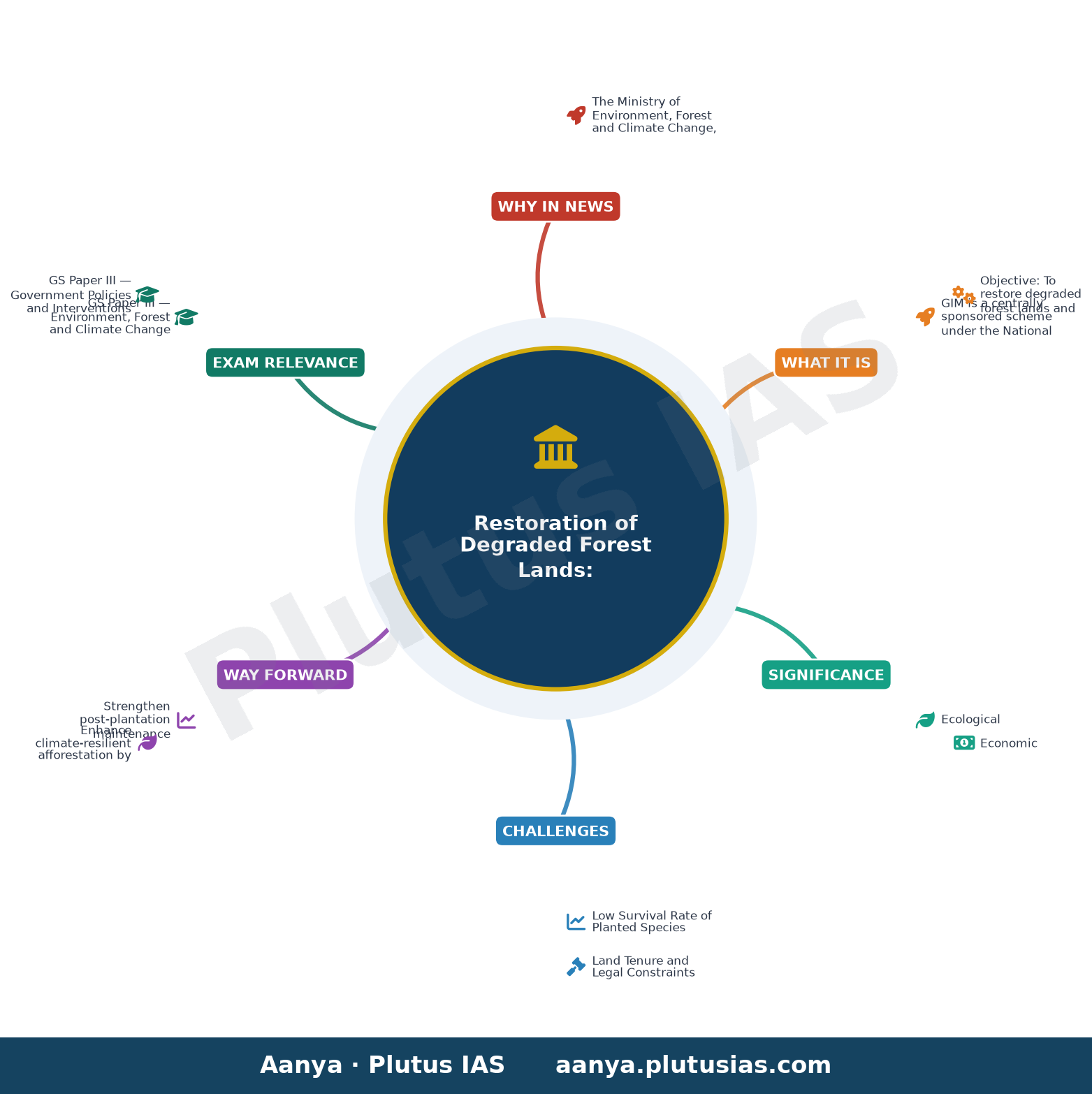
- GS Paper III — Environment, Forest and Climate Change | GS Paper III — Government Policies and Interventions
- Prelims: Green India Mission (GIM), National Action Plan on Climate Change (NAPCC), Forest Survey of India (FSI), India State of Forest Report (ISFR), Joint Forest Management Committees (JFMCs), Geo-tagging of plantations, Geo-spatial monitoring
- Essay: Sustainable forest management as a tool for climate change mitigation and adaptation, Balancing developmental imperatives with ecological restoration: Lessons from India’s afforestation programmes
Quick Revision: The Green India Mission (GIM) restores degraded forest lands through an integrated landscape approach, using community participation and geospatial monitoring to enhance carbon sinks and ecosystem services, in line with India’s NDCs under the UNFCCC.
Why is this in the news?
The Ministry of Environment, Forest and Climate Change, in a written reply to a Lok Sabha question on 10 August 2026, provided an update on the implementation status of the Green India Mission (GIM), including the extent of degraded forest land restored, state-wise distribution of funds, and the monitoring mechanisms employed to ensure ecological restoration and survival of plantations. The response highlighted the integrated landscape approach, community participation, and the use of geospatial technologies in tracking progress under the mission.
Background
- GIM was operationalised from 2015-16 with the objective of restoring degraded forests and non-forest landscapes through an integrated land-scape approach, aiming to enhance ecosystem services and carbon sinks.
- Degraded forest lands are areas where forest cover has been significantly reduced due to anthropogenic pressures, natural calamities, or poor management, leading to loss of biodiversity and ecosystem services.
- The mission aligns with India’s international commitments under the United Nations Framework Convention on Climate Change (UNFCCC), including the Nationally Determined Contributions (NDCs) to create an additional carbon sink of 2.5 to 3 billion tonnes of CO2 equivalent by 2030.
- The mission complements other afforestation initiatives such as the Compensatory Afforestation Fund Management and Planning Authority (CAMPA) and the Nagar Van Yojana (NVY) for urban greening.
- Forest degradation is a critical concern in India, with approximately 23.4% of the country’s forest cover classified as ‘degraded’ as per the India State of Forest Report (ISFR) 2021.
What is the Green India Mission (GIM)?
- GIM is a centrally sponsored scheme under the National Mission for a Green India, launched as part of the National Action Plan on Climate Change (NAPCC) to address climate change through forestry interventions.
- Objective: To restore degraded forest lands and non-forest landscapes using an integrated landscape approach, enhancing biodiversity, ecosystem services, and carbon sequestration.
- Scope: The mission covers 17 states and one Union Territory, with a total of 1,84,467 hectares of degraded land restored from 2015-16 to the present.
- Implementation Framework: Activities are implemented through local institutions such as Joint Forest Management Committees (JFMCs), Village Forest Committees (VFCs), and community-based organisations, ensuring participatory governance.
- Monitoring Mechanisms: A multi-tiered monitoring system is employed, including geo-tagging of plantations, GIS-based mapping, drone surveys, third-party evaluations, and periodic assessments by the Forest Survey of India (FSI).
- Technology Integration: The mission leverages geospatial tools such as Remote Sensing, GIS, and geo-tagged photographs to track progress, ensure transparency, and facilitate data-driven decision-making.
- Outcome Indicators: Key performance metrics include survival rate of plantations, increase in forest cover, enhancement of ecosystem services, and improvement in local micro-climate and air quality.
Key Features
| Feature | Significance |
|---|---|
| Integrated Landscape Approach (ILA) | Adopts a holistic, multi-sectoral framework to restore degraded forests and non-forest lands, integrating ecological, social, and economic dimensions for sustainable land-use planning. |
| Eco-Restoration Targets (2015-16 to 2025-26) | Achieved restoration of 1,84,467 hectares across 17 states and 1 UTs through targeted afforestation and ecological interventions, demonstrating measurable progress under NAPCC. |
| Urban Forest Scheme (NVY) (2020-21 to 2026-27) | Aims to develop 600 urban forests and 400 urban gardens to enhance urban greenery, improve micro-climate, and mitigate air pollution in densely populated areas. |
| Multi-Level Monitoring Framework | Utilizes geospatial tools (GIS, geo-tagging, drone surveillance) and third-party audits to ensure transparency, accountability, and survival rate assessment of planted species. |
| Community-Based Implementation | Engages Joint Forest Management Committees (JFMCs), Village Forest Committees (VFCs), and self-help groups for post-plantation care, nursery establishment, and livelihood linkages, fostering local ownership. |
Why it Matters
Ecological
- Restores biodiversity by regenerating degraded ecosystems, thereby supporting endangered flora and fauna and enhancing carbon sequestration.
- Improves soil health and water retention, reducing desertification and land degradation in vulnerable regions such as arid and semi-arid zones.
- Contributes to climate change mitigation by increasing forest cover, which acts as a carbon sink under India’s Nationally Determined Contributions (NDCs).
Economic
- Generates rural employment through afforestation, nursery development, and maintenance activities, particularly in tribal and forest-dependent communities.
- Supports agroforestry and non-timber forest produce (NTFP) based livelihoods, diversifying income sources for local populations.
- Reduces expenditure on disaster management by mitigating risks of landslides, floods, and soil erosion in restored landscapes.
Social
- Enhances food security and nutrition by promoting fruit-bearing and medicinal plants in restored areas, benefiting local diets and traditional knowledge systems.
- Strengthens community resilience by integrating indigenous knowledge with modern restoration techniques, ensuring cultural continuity.
- Improves public health outcomes by reducing air pollution in urban areas through the Urban Forest Scheme (NVY).
Governance & Institutional
- Demonstrates Centre-State coordination under the National Action Plan on Climate Change (NAPCC), with states implementing plans through decentralized institutions like JFMCs and VFCs.
- Leverages geospatial technologies for real-time monitoring, ensuring evidence-based policy interventions and reducing leakages in fund utilization.
- Promotes convergence with other schemes such as the Compensatory Afforestation Fund Management and Planning Authority (CAMPA) for integrated funding and execution.
Challenges
1. Low Survival Rate of Planted Species
- Survival rates of planted saplings often fall below 50% due to inadequate post-plantation care, water scarcity, and pest attacks, particularly in arid and semi-arid regions.
- Lack of standardized protocols for nursery management and species selection leads to poor adaptability of species to local ecological conditions.
UPSC Link: Environmental degradation and desertification
2. Land Tenure and Legal Constraints
- Ambiguities in land ownership, particularly in forest fringe areas, hinder long-term restoration commitments and community participation.
- Delays in land-use change approvals and encroachment issues in degraded forest lands impede restoration efforts.
UPSC Link: Forest rights and conservation policies
3. Climate Variability and Extreme Events
- Increasing frequency of droughts, heatwaves, and erratic rainfall patterns due to climate change threatens the success of restoration projects.
- Frequent forest fires in dry seasons, exacerbated by anthropogenic pressures, can reverse restoration gains in a short span.
UPSC Link: Climate change impacts
4. Funding Gaps and Resource Allocation
- Insufficient and inconsistent budgetary allocations for maintenance and monitoring activities post-plantation, leading to premature project closures.
- Delays in release of CAMPA funds to states due to procedural bottlenecks affect the timely execution of restoration activities.
UPSC Link: Resource mobilization and fiscal federalism
5. Institutional Capacity and Stakeholder Engagement
- Limited technical expertise in local institutions for designing and implementing integrated landscape restoration plans.
- Low participation of women and marginalized communities in decision-making processes, despite their significant role in forest management.
UPSC Link: Decentralization and local governance
Challenges — UPSC Perspective
| Issue | Concern |
|---|---|
| Survival Rate of Saplings | Post-plantation care and water management issues reduce ecological benefits of restoration. |
| Land Tenure Insecurity | Legal ambiguities and encroachments delay and complicate restoration efforts. |
| Climate Extremes | Droughts, fires, and erratic rainfall undermine long-term sustainability of restored ecosystems. |
| Funding Delays | Inconsistent budgetary flows and procedural hurdles hinder project continuity and impact assessment. |
| Community Participation Gaps | Inadequate inclusion of local stakeholders, especially women, limits ownership and effectiveness. |
| Monitoring and Evaluation Deficits | Over-reliance on manual inspections and lack of standardized metrics for success assessment. |
Government Initiatives — Must-Memorise for Prelims
- Green India Mission (GIM) under NAPCC
- Compensatory Afforestation Fund Management and Planning Authority (CAMPA) for funding convergence
Way Forward
- Strengthen post-plantation maintenance protocols with standardized survival rate benchmarks (e.g., minimum 70% survival for 3 years) and penalties for non-compliance.
- Enhance climate-resilient afforestation by prioritizing native, drought-tolerant species and integrating agroforestry models in restoration plans.
- Streamline land tenure reforms to secure community rights and facilitate long-term restoration commitments in degraded forest lands.
- Leverage drone-based monitoring and remote sensing for real-time assessment of restoration progress and early detection of degradation.
- Promote convergence with MGNREGA for afforestation and soil conservation activities, ensuring sustainable livelihood linkages.
- Establish a dedicated fund for urban forestry under NVY with performance-linked disbursements to cities based on greenery outcomes.
- Develop gender-inclusive restoration frameworks by mandating 30% representation of women in JFMCs and VFCs and training programs for their capacity building.
- Integrate restoration projects with India’s NDC targets and SDG 15 (Life on Land) for global accountability and funding opportunities.
UPSC Value Addition
Keywords for Mains Answer-Writing
Green India Mission (GIM) · National Action Plan on Climate Change (NAPCC) · Compensatory Afforestation Fund Management and Planning Authority (CAMPA) · Joint Forest Management Committees (JFMC) · Village Forest Committees (VFC) · Integrated Landscape Approach · Degraded forest land restoration · Urban Forest Scheme (NVY) · Geo-tagging of afforestation sites · India State of Forest Report (ISFR) · Forest Survey of India (FSI) · Third-party monitoring of afforestation · Climate change mitigation through afforestation · Community-based forest management
Constitutional & Policy Linkages
- Article 48A: Directive Principles of State Policy on protection and improvement of environment and safeguarding forests and wildlife
- Seventh Schedule: Concurrent List (Entry 17A: Forests; Entry 17B: Protection of wild animals and birds) for Centre-State coordination in forest governance
Concept Flow
Degraded land and deforestation → Loss of biodiversity and carbon sinks → Implementation of Green India Mission (GIM) under NAPCC → Integrated Landscape Approach (ILA) for restoration → Afforestation and eco-restoration activities → Multi-level monitoring (GIS, drones, third-party audits) → Improved ecosystem services (soil, water, air quality) → Enhanced climate resilience and livelihoods → Contribution to NDCs and SDGs
Prelims Practice Questions
Q1. Consider the following statements regarding the Green India Mission (GIM):
1. GIM is one of the nine missions under the National Action Plan on Climate Change (NAPCC).
2. GIM focuses exclusively on afforestation in urban areas.
3. GIM employs geo-tagging and GIS-based mapping for monitoring afforestation activities.
4. GIM is implemented through Joint Forest Management Committees (JFMC) and Village Forest Committees (VFC).
How many of the above statements are correct?
- Only one
- Only two
- Only three
- All
Answer: All — Statements 1, 3, and 4 are correct. Statement 2 is incorrect as GIM targets both degraded forest lands and non-forest areas, including urban afforestation under the Urban Forest Scheme (NVY).
Q2. Assertion (A): The Compensatory Afforestation Fund Management and Planning Authority (CAMPA) is the nodal agency for fund disbursement under the Urban Forest Scheme (NVY).
Reason (R): CAMPA administers funds for afforestation activities under the Green India Mission (GIM) and related schemes.
- Both A and R are true, and R is the correct explanation of A
- Both A and R are true, but R is not the correct explanation of A
- A is true, but R is false
- A is false, but R is true
Answer: ? — Assertion (A) is false because CAMPA is not the nodal agency for the Urban Forest Scheme (NVY); it primarily administers funds for compensatory afforestation under the Compensatory Afforestation Fund Act, 2016. Reason (R) is true as CAMPA does administer funds for GIM and related afforestation activities.
Q3. Match the following initiatives with their respective objectives:
Column I (Initiative) | Column II (Objective)
1. Green India Mission (GIM) | A. Development of urban forests and urban orchards
2. Urban Forest Scheme (NVY) | B. Restoration of degraded forest lands using an integrated landscape approach
3. India State of Forest Report (ISFR) | C. Assessment of forest cover using remote sensing and ground verification
4. Joint Forest Management Committees (JFMC) | D. Community-based forest management involving local stakeholders
- 1-B, 2-A, 3-C, 4-D
- 1-A, 2-B, 3-C, 4-D
- 1-B, 2-C, 3-A, 4-D
- 1-D, 2-A, 3-B, 4-C
Answer: 1-B, 2-A, 3-C, 4-D — The correct matching is: 1-B (GIM aims at restoring degraded forest lands), 2-A (NVY focuses on urban forests and orchards), 3-C (ISFR assesses forest cover), and 4-D (JFMC involves community-based forest management).
Mains Practice Question
✍ The Green India Mission (GIM) exemplifies India’s commitment to climate change mitigation through afforestation and ecological restoration. Critically examine the institutional mechanisms, technological interventions, and community participation under GIM. Also, analyse the challenges in ensuring the long-term sustainability of restored forest lands. (15 Marks)
Approach: MODEL-ANSWER SKELETON:
1. **Introduction (2 Marks)**:
– Brief background of GIM as part of NAPCC and its objectives (restoration of degraded forest lands and non-forest areas using an integrated landscape approach).
– Mention the scale of implementation (1,84,467 hectares across 17 states and 1 U.T. from 2015-16 to 2026-27).
2. **Institutional Mechanisms (4 Marks)**:
– Role of CAMPA in fund disbursement and monitoring.
– Involvement of Joint Forest Management Committees (JFMC) and Village Forest Committees (VFC) for community-based management.
– Collaboration between central and state agencies (e.g., Forest Survey of India for remote sensing and ground verification).
– Third-party monitoring and periodic assessments.
3. **Technological Interventions (4 Marks)**:
– Use of geo-tagging, GIS-based mapping, and drone-based monitoring for real-time tracking of afforestation sites.
– Remote sensing by FSI for forest cover assessment (ISFR reports every two years).
– Data-driven decision-making and transparency in fund utilization.
4. **Community Participation (3 Marks)**:
– Empowerment of local communities through JFMC and VFC.
– Livelihood linkages (e.g., nurseries, maintenance activities) to ensure stakeholder buy-in.
– Challenges: Limited capacity of local institutions, uneven participation, and conflicts over land use.
5. **Challenges to Long-term Sustainability (2 Marks)**:
– Ensuring survival rates of planted saplings (post-plantation care and maintenance).
– Balancing ecological restoration with competing land uses (agriculture, urbanization).
– Climate change impacts (droughts, pests) and adaptive management.
6. **Conclusion (2 Marks)**:
– GIM as a model for climate-resilient afforestation with multi-stakeholder governance.
– Need for stronger institutional capacity, adaptive management, and policy integration for long-term success.
Source: PIB (Press Information Bureau)
Generated by AanyaAi for educational purpose.

- एआई से वैश्विक खतरा: मानवता के लिए गंभीर चुनौती और समाधान - October 2, 2026
- Maharashtra’s ₹10,520 Cr BharatNet Revamp: Key for UPSC & State PCS - October 2, 2026
- गुजरात सरकार द्वारा मालधारियों के स्थानांतरण की घोषणा, जानिए पूरा विवरण - October 2, 2026

No Comments