


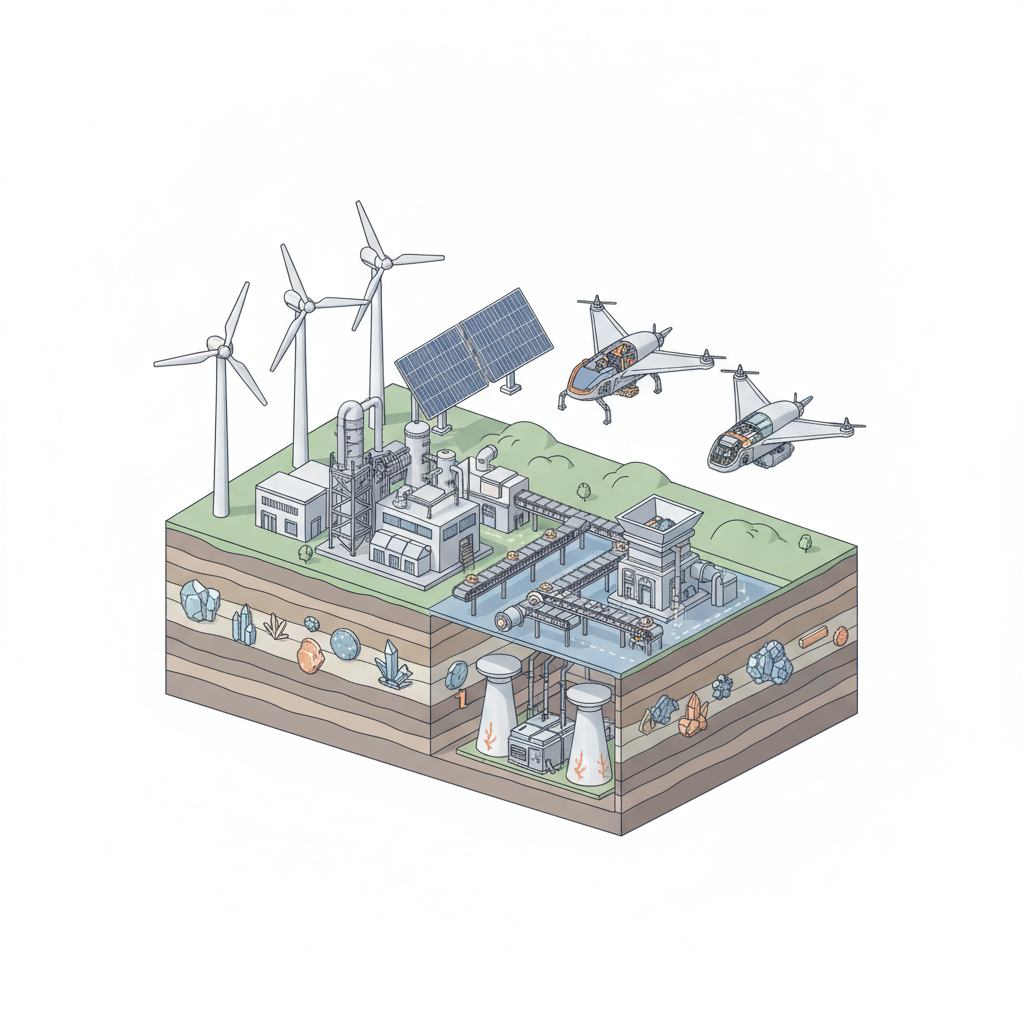
01 Sep छत्तीसगढ़’s Critical Mineral Auction: 5 Blocks to Boost India’s Mining Sector
✎ Critical minerals are vital for India’s industrial growth, energy transition, and strategic autonomy; Chhattisgarh’s inclusion in the eighth phase of mineral block auctions underscores its role in strengthening the country’s…
Subject Relevance — Where This Topic Fits
- GS Paper III — Science & Technology (Mineral Resources, Critical Minerals) | GS Paper III — Economy (Resource Mobilisation, Industrial Policy) | GS Paper III — Environment & Ecology (Sustainable Mining, Environmental Governance)
- Prelims: Critical Minerals, Mineral Policy 2023, Auction of Mineral Blocks, National Mineral Exploration Policy (NMEP), Atmanirbhar Bharat in Mineral Sector, Rare Earth Elements, Graphite, Vanadium, Tin, Columbite, Molybdenum, Tungsten, Glauconite
- Essay: Resource Security and National Development: The Imperative of Critical Minerals, Balancing Economic Growth and Environmental Sustainability in Resource Extraction
Quick Revision: Critical minerals are vital for India’s industrial growth, energy transition, and strategic autonomy; Chhattisgarh’s inclusion in the eighth phase of mineral block auctions underscores its role in strengthening the country’s mineral ecosystem through transparent auctions and sustainable development.
Why is this in the news?
The Ministry of Mines organised a roadshow in Raipur, Chhattisgarh, to promote the eighth phase of auctions for Critical and Strategic Mineral Blocks, during which the state’s Chief Minister highlighted Chhattisgarh’s mineral potential and commitment to sustainable mineral development. Five mineral blocks from Chhattisgarh were included in this phase, underscoring the state’s role in India’s critical mineral ecosystem and the Union Government’s push for accelerated exploration and mining of critical minerals essential for industrial growth, energy transition, and strategic autonomy.
Background
- Critical minerals are essential inputs for modern industries, clean energy technologies, and defence applications, including electric vehicles, solar panels, wind turbines, and advanced electronics.
- India’s mineral security is increasingly dependent on the exploration and development of critical minerals, as highlighted in the National Mineral Exploration Policy (NMEP).
- The Union Government has been promoting transparent auction mechanisms for mineral blocks to attract private investment and enhance domestic production of critical minerals.
- Chhattisgarh is a mineral-rich state with significant reserves of graphite, rare earth elements, rare metals, vanadium, molybdenum, tungsten, and glauconite, among others.
- The eighth phase of auctions includes 20 mineral blocks across nine states, with 17 composite licences and 3 mining leases, covering minerals critical for India’s industrial and energy security.
What are Critical and Strategic Minerals?
- Critical minerals are those whose supply chain is vulnerable to disruption and whose absence could significantly impact economic growth, energy security, or national defence.
- Strategic minerals are those that are essential for national security and industrial sovereignty, including rare earth elements, graphite, cobalt, and lithium.
- Critical minerals are used in high-tech industries such as electronics, renewable energy, aerospace, and defence manufacturing.
- India’s critical mineral requirements are projected to grow significantly due to the transition to clean energy, electric mobility, and digital technologies.
- The Government of India has identified 30 minerals as critical, including graphite, rare earth elements, vanadium, molybdenum, tungsten, and glauconite.
- The National Mineral Exploration Policy (NMEP) aims to accelerate exploration of critical minerals through public-private partnerships and advanced technologies.
- Transparent auction mechanisms for mineral blocks are designed to ensure fair competition, attract investment, and maximise resource utilisation while adhering to environmental and social safeguards.
- Sustainable mineral development requires balancing economic extraction with environmental conservation, community welfare, and technological innovation in mining processes.
Key Features
| Feature | Significance |
|---|---|
| Critical & Strategic Mineral Blocks | These blocks are essential for India’s energy transition, defence manufacturing, and high-tech industries, including renewable energy technologies, electric vehicles, and semiconductor supply chains. |
| Auction Mechanism (Composites Licence & Mining Lease) | The dual licensing model (exploration + mining) accelerates resource development while ensuring transparency and investor confidence through competitive bidding. |
| State-Level Commitment (Chhattisgarh) | Demonstrates proactive governance in leveraging mineral endowments to boost local economies, infrastructure, and industrial corridors aligned with national priorities. |
| Mineral Value Chain Integration | Focus on processing, refining, and value addition beyond extraction ensures higher economic returns and reduces import dependency for critical minerals. |
| Technology-Driven Mining Oversight | Use of digital platforms (e.g., mineral monitoring systems) and transparent portals enhances accountability, reduces leakages, and supports sustainable mining practices. |
Why it Matters
Economic Growth & Industrialisation
- Critical minerals underpin India’s transition to a green economy, supporting sectors like solar panels (silicon, gallium), wind turbines (rare earths), and batteries (lithium, cobalt).
- Strengthening domestic supply chains reduces import bills and enhances trade balance, particularly for minerals with high import dependence.
- Chhattisgarh’s participation in the auction aligns with the state’s existing industrial base (e.g., steel, power) and creates new industrial hubs through mineral-based industries.
Strategic Autonomy & Security
- Critical minerals are vital for defence production (e.g., titanium for aerospace, tungsten for munitions) and strategic technologies, reducing vulnerability to global supply disruptions.
- A robust domestic mineral ecosystem supports India’s ‘Atmanirbhar Bharat’ vision by minimising reliance on mineral-rich nations with geopolitical risks.
- Exploration and development of these minerals enhance India’s negotiating power in international mineral markets and supply agreements.
Sustainable Development & Employment
- Mineral-led industrialisation in Chhattisgarh can generate employment in mining, processing, and ancillary industries, particularly in tribal and rural areas.
- Sustainable mining practices and value addition reduce environmental degradation and ensure long-term ecological balance.
- Localised mineral processing units can spur ancillary industries, fostering inclusive growth and reducing migration pressures.
Policy & Governance Reforms
- Transparent auction mechanisms and digital monitoring systems improve governance, reduce corruption, and attract responsible private investment.
- State-centre coordination ensures alignment of mineral policies with national priorities, such as the National Mineral Policy 2019 and Mineral Security Strategy.
- Incentivising exploration and value addition through fiscal measures (e.g., tax breaks, subsidies) accelerates sectoral growth.
Challenges
1. Geological Exploration Risks
- High upfront costs and geological uncertainties in exploration deter private players, necessitating government-led geophysical surveys and risk-sharing mechanisms.
- Limited high-resolution geological data in many regions (including Chhattisgarh) hampers accurate resource estimation and investor confidence.
UPSC Link: Geological Survey of India (GSI) and National Mineral Exploration Policy (NMEP)
2. Environmental & Social Concerns
- Mining activities can lead to land degradation, water pollution, and displacement of local communities, requiring strict adherence to environmental safeguards and rehabilitation plans.
- Balancing mineral extraction with tribal rights (e.g., Forest Rights Act, 2006) and ensuring Free, Prior, and Informed Consent (FPIC) are critical for sustainable development.
UPSC Link: Environmental Impact Assessment (EIA) Notification 2006, Forest Rights Act 2006
3. Infrastructure & Logistics Bottlenecks
- Inadequate transport (rail, road) and power infrastructure in mineral-rich states like Chhattisgarh increases operational costs and delays project timelines.
- Port infrastructure for mineral exports/imports is underdeveloped, limiting India’s ability to integrate into global mineral supply chains.
UPSC Link: Bharatmala Pariyojana, Dedicated Freight Corridors
4. Regulatory & Bureaucratic Hurdles
- Delays in obtaining clearances (e.g., forest, environment, mining leases) due to multi-layered approvals and inter-departmental coordination issues slow down project execution.
- Inconsistent implementation of mineral policies across states creates regulatory arbitrage, discouraging long-term investments.
UPSC Link: Mines and Minerals (Development and Regulation) Act, 1957
5. Technological & Skill Gaps
- India lacks advanced mineral processing and refining technologies, leading to heavy reliance on imports for high-value mineral products.
- Shortage of skilled manpower in mining, geology, and metallurgy necessitates targeted skilling programs and industry-academia collaborations.
UPSC Link: National Mineral Policy 2019, Skill India Mission
Challenges — UPSC Perspective
| Issue | Concern |
|---|---|
| High Exploration Costs | Deters private investment due to geological uncertainties and long payback periods. |
| Environmental Degradation | Risk of land degradation, water pollution, and biodiversity loss without strict enforcement of safeguards. |
| Land Acquisition Delays | Protracted processes under the Right to Fair Compensation and Transparency in Land Acquisition Act, 2013, hinder project timelines. |
| Skill Shortages | Lack of trained professionals in mineral exploration, mining engineering, and metallurgy limits sectoral growth. |
| Policy Fragmentation | Inconsistent state-level mineral policies create regulatory uncertainty for investors. |
| Logistics Constraints | Poor transport and port infrastructure increase operational costs and delay mineral supply chains. |
Government Initiatives — Must-Memorise for Prelims
- National Mineral Exploration Policy (NMEP) 2016
- Mineral Security Strategy (proposed under Ministry of Mines)
- Pradhan Mantri Khanij Kshetra Kalyan Yojana (PMKKKY) for tribal welfare
- National Mineral Policy 2019
Way Forward
- Accelerate geological surveys and data generation through GSI and state agencies to reduce exploration risks.
- Streamline regulatory approvals via single-window clearance systems and digital platforms for faster project execution.
- Invest in critical mineral processing and refining infrastructure to reduce import dependency and add value domestically.
- Enhance skill development through collaborations with IITs, NITs, and industry for mining, geology, and metallurgy.
- Strengthen state-centre coordination via inter-ministerial task forces to align mineral policies with national priorities.
- Develop dedicated freight corridors and port infrastructure to improve mineral logistics and supply chain efficiency.
- Promote sustainable mining practices through strict enforcement of EIA norms, rehabilitation plans, and community engagement.
- Encourage public-private partnerships (PPPs) for mineral exploration and development to share risks and rewards.
UPSC Value Addition
Keywords for Mains Answer-Writing
Critical Minerals Mission · Mineral Security Partnership · National Mineral Exploration Policy (NMEP) · Critical and Strategic Mineral Blocks · Atmanirbhar Bharat in minerals · Mineral Value Chain · Graphite, Rare Earth Elements, Vanadium · Sustainable Mining · Mineral Auction Regime · State-Centre coordination in mineral governance
Constitutional & Policy Linkages
- Article 246 (Seventh Schedule) – Distribution of legislative powers between Union and States (Entry 54: Mines and minerals).
- Article 297 – Declaration of land, minerals, etc., as property of the Union.
- Article 300A – Right to property (protection against arbitrary acquisition for mining projects).
Concept Flow
Critical Mineral Demand → Industrialisation & Energy Transition → National Mineral Policy 2019 → Auction of Mineral Blocks → State Participation (Chhattisgarh) → Investment & Technology Inflow → Mineral Value Chain Development → Economic Growth & Strategic Autonomy. → Auction Mechanism → Transparent Bidding → Composites Licence & Mining Lease → Exploration & Mining → Processing & Refining → Domestic Supply Chain → Reduced Import Dependency. → State Commitment → Infrastructure Development → Skilled Workforce → Industrial Corridors → Employment Generation → Inclusive Growth. → Environmental Safeguards → EIA Compliance → Rehabilitation Plans → Sustainable Mining → Community Consent → Long-term Viability. → Geological Surveys → Resource Estimation → Investor Confidence → Private Participation → Sectoral Growth. → Regulatory Reforms → Single-Window Clearance → Faster Approvals → Project Execution → Economic Returns. → Public-Private Partnerships → Risk Sharing → Technology Transfer → Skill Development → Global Competitiveness.
Prelims Practice Questions
Q1. Consider the following statements regarding Critical and Strategic Minerals in India:
1. Graphite, Rare Earth Elements, and Vanadium are classified as Critical Minerals.
2. The National Mineral Exploration Policy (NMEP) 2016 aims to enhance exploration of mineral resources.
3. The Mineral Auction Regime was introduced under the Mines and Minerals (Development and Regulation) Act, 1957.
4. The Ministry of Coal is the nodal authority for the auction of Critical Mineral Blocks.
How many of the above statements are correct?
- Only one
- Only two
- Only three
- All four
Answer: Only three — Statements 1, 2, and 3 are correct. Statement 4 is incorrect as the Ministry of Mines is the nodal authority for the auction of Critical Mineral Blocks, not the Ministry of Coal.
Q2. Assertion (A): The eighth phase of auction for Critical and Strategic Mineral Blocks includes five mineral blocks located in Chhattisgarh.
Reason (R): Chhattisgarh is one of the leading states in India for mineral exploration and mining, particularly for graphite and rare earth elements.
Options:
A. Both A and R are true, and R is the correct explanation of A.
B. Both A and R are true, but R is not the correct explanation of A.
C. A is true, but R is false.
D. A is false, but R is true.
Answer: ? — Both the assertion and reason are true. Chhattisgarh is indeed a leading state in mineral exploration, and the eighth phase of auction includes five mineral blocks from the state, making R the correct explanation of A.
Q3. Match the following Critical Minerals with their primary industrial applications:
Column I (Critical Mineral) Column II (Primary Application)
A. Graphite 1. Battery manufacturing
B. Rare Earth Elements 2. Steel alloying
C. Vanadium 3. Permanent magnets
D. Titanium 4. Aerospace and medical implants
Options:
A. A-1, B-3, C-2, D-4
B. A-2, B-1, C-3, D-4
C. A-1, B-2, C-3, D-4
D. A-3, B-1, C-2, D-4
- A
- B
- C
- D
Answer: A — Graphite is primarily used in battery manufacturing (A-1). Rare Earth Elements are used in permanent magnets (B-3). Vanadium is used in steel alloying (C-2). Titanium is used in aerospace and medical implants (D-4).
Mains Practice Question
✍ The Government of India has recently expanded the auction of Critical and Strategic Mineral Blocks to include five blocks in Chhattisgarh. In this context, critically examine the significance of Critical Minerals for India’s economic growth and strategic autonomy. (15 Marks)
Approach: MODEL-ANSWER SKELETON:
1. **Introduction (2 Marks)**
– Define Critical Minerals: Minerals essential for economic development and national security, with supply chain risks.
– Reference India’s reliance on imports for key minerals like lithium, cobalt, and rare earths.
2. **Strategic Significance of Critical Minerals (5 Marks)**
– **Economic Growth**: Link to sectors like renewable energy (solar panels, wind turbines), electric vehicles (batteries), and electronics (semiconductors).
– **Energy Transition**: Role in India’s shift to clean energy (e.g., graphite for batteries, vanadium for energy storage).
– **Defence and Aerospace**: Use in manufacturing advanced materials (e.g., titanium for aircraft, rare earths for missiles).
– **Self-Reliance**: Reduce import dependence and enhance supply chain resilience (e.g., Atmanirbhar Bharat initiative).
3. **Policy and Institutional Framework (4 Marks)**
– **National Mineral Exploration Policy (NMEP) 2016**: Aimed at systematic exploration and resource augmentation.
– **Mineral Auction Regime**: Under MMDR Act, 1957, to attract private investment and promote transparency.
– **Critical Mineral Mission**: Launched to identify and develop domestic mineral resources.
– **State-Centre Coordination**: Role of state governments (e.g., Chhattisgarh) in facilitating exploration and mining.
4. **Challenges and Way Forward (4 Marks)**
– **Exploration Gaps**: Limited high-quality geological data and technological constraints.
– **Environmental Concerns**: Balancing mining with sustainability (e.g., tribal rights, forest clearances).
– **Value Addition**: Need to move beyond raw mineral exports to processing and manufacturing (e.g., mineral value chain development).
– **International Partnerships**: Engagement with Mineral Security Partnership (MSP) and other global initiatives.
5. **Conclusion (1 Mark)**
– Summarise the critical role of minerals in India’s future and the need for a balanced, sustainable, and strategic approach.
Source: PIB (Press Information Bureau)
Chhattisgarh PCS (CGPSC) — State PCS Practice
Prelims: Which of the following initiatives was recently launched by the Chhattisgarh government to strengthen its role in India’s Critical Mineral Ecosystem under the leadership of Chief Minister Vishnu Deo Sai?
- A. Establishment of a dedicated Critical Mineral Mission in Chhattisgarh
- B. Signing of MoUs with national agencies for mineral exploration and development
- C. Launch of a state-wide awareness campaign on sustainable mining practices
- D. Introduction of a new mineral policy exclusively for tribal-dominated districts
Answer: B. Signing of MoUs with national agencies for mineral exploration and development — The Chhattisgarh government, led by Chief Minister Vishnu Deo Sai, recently signed MoUs with national agencies to bolster mineral exploration and development, aligning with the state’s commitment to the Critical Mineral Ecosystem.
Mains: Discuss the significance of Chhattisgarh’s role in India’s Critical Mineral Ecosystem. How can the state leverage its mineral resources for sustainable economic growth while ensuring environmental conservation and tribal welfare? (Answer in 250-300 words)
Generated by AanyaAi for educational purpose.
Related guides on our sites
- How to prepare for GS paper 1 for UPSC CSE mains exam
- Best UPSC coaching for IFOS exam
- Best mentorship programme for upsc
- UPSC+BA degree

- Shivraj Singh Chouhan launches ‘Khet Bachao Abhiyan’ to save farmland - October 23, 2026
- उत्तराखंड राज्यपाल की पीएम मोदी से महत्वपूर्ण बैठक: जानिए मुख्य बिंदु - October 23, 2026
- How India’s Rs 20,000 Cr CCUS Budget Can Drive Net-Zero Goals - October 23, 2026

No Comments