


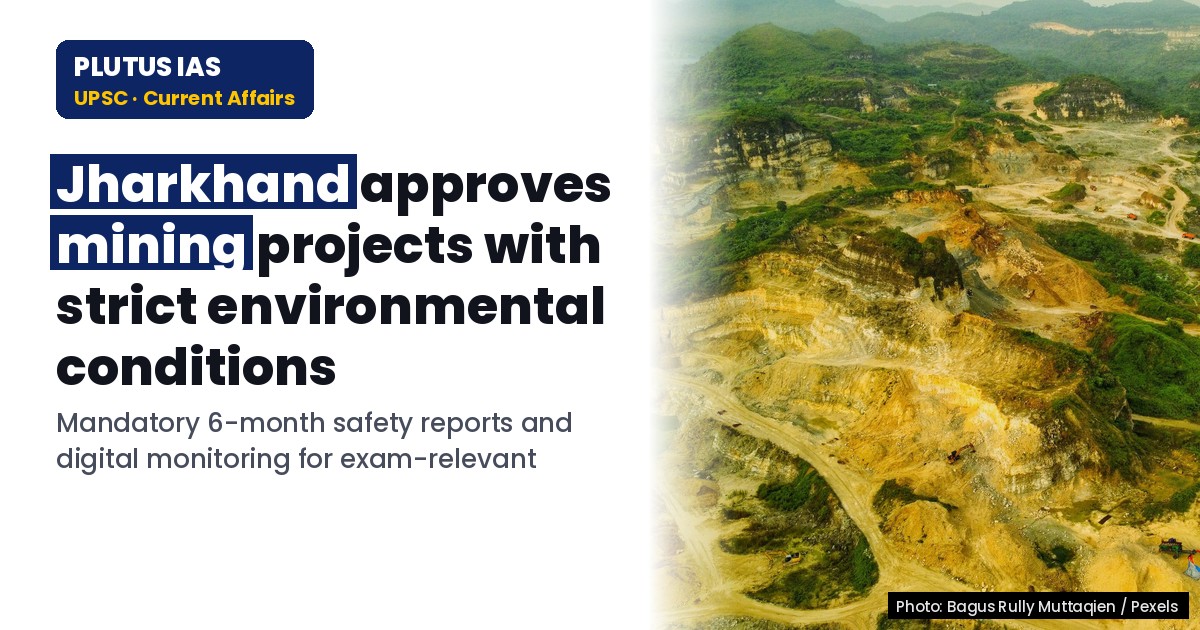
28 Oct झारखंड में खनन परियोजनाओं को मिलीं कड़ी पर्यावरणीय शर्तें
✎ The State Level Environment Impact Assessment Authority (SEIAA) in Jharkhand has mandated bi-annual reporting of environmental and safety compliance for mining projects, geo-tagged photographic evidence, and mandatory…
Subject Relevance — Where This Topic Fits
- GS Paper II — Governance, Transparency and Accountability | GS Paper III — Environment, Conservation, Environmental Pollution and Degradation, Environmental Impact Assessment
- Prelims: Environmental Impact Assessment (EIA) 2006, State Level Environment Impact Assessment Authority (SEIAA), Mining Lease Rules, Forest (Conservation) Act, 1980, National Green Tribunal (NGT), Geo-tagging of projects, Environmental Management Plan (EMP), Terms of Reference (ToR)
- Essay: Environmental governance and sustainable development: Balancing economic growth with ecological preservation, Role of regulatory institutions in enforcing environmental laws: A case study of Jharkhand’s mining sector
Quick Revision: The State Level Environment Impact Assessment Authority (SEIAA) in Jharkhand has mandated bi-annual reporting of environmental and safety compliance for mining projects, geo-tagged photographic evidence, and mandatory afforestation, with non-compliance leading to revocation of approvals.
Why is this in the news?
The State Level Environment Impact Assessment Authority (SEIAA) of Jharkhand has granted environmental approvals to multiple small-scale mining projects in the state under stringent environmental conditions. The approvals mandate bi-annual reporting of safety and environmental compliance standards, geo-tagged photographic evidence, and mandatory afforestation, reflecting a tightening of regulatory oversight in response to judicial directives and ecological imperatives.
Background
- The State Level Environment Impact Assessment Authority (SEIAA) is a statutory body constituted under the Environmental Impact Assessment (EIA) Notification, 2006, to appraise projects at the state level for environmental clearance.
- Jharkhand, a mineral-rich state, faces significant environmental challenges due to unregulated mining activities, including deforestation, soil erosion, air and water pollution, and displacement of local communities.
- The Supreme Court and the National Green Tribunal (NGT) have repeatedly emphasised the need for strict adherence to environmental safeguards, particularly in mining and forest-adjacent areas, to prevent ecological degradation and ensure sustainable resource extraction.
- The Forest (Conservation) Act, 1980, imposes stringent conditions on mining activities within or near forest areas, including the requirement of prior approval from the central government for diversion of forest land.
- The EIA Notification, 2006, mandates the preparation of an Environment Management Plan (EMP) and Terms of Reference (ToR) for mining projects, outlining mitigation measures for environmental impacts.
- Recent judicial interventions, including orders from the Jharkhand High Court, have directed state authorities to enforce environmental norms rigorously and ensure compliance with statutory safeguards.
What is the Environmental Impact Assessment (EIA) Notification, 2006, and its role in mining regulation?
- The EIA Notification, 2006, is a legal instrument issued under the Environment (Protection) Act, 1986, to regulate projects that may have significant environmental impacts, including mining activities.
- It classifies projects into categories (A and B) based on their potential environmental impact and assigns appraisal responsibilities to either the Ministry of Environment, Forest and Climate Change (MoEFCC) or the State Level Environment Impact Assessment Authority (SEIAA).
- For mining projects, the EIA Notification mandates the preparation of an Environment Impact Assessment (EIA) Report and an Environment Management Plan (EMP), which must address impacts on air, water, soil, biodiversity, and socio-economic conditions.
- The notification requires public consultation for Category A and some Category B projects to ensure transparency and stakeholder participation in the decision-making process.
- The SEIAA, as the state-level authority, is responsible for appraising Category B projects and ensuring compliance with environmental norms, including afforestation, pollution control, and worker safety measures.
- The Terms of Reference (ToR) issued by the SEIAA outline the specific environmental studies and mitigation measures required for a project, forming the basis for the EIA Report.
- Non-compliance with the conditions stipulated in the ToR or EIA Report can lead to the revocation of environmental clearance and legal action under the Environment (Protection) Act, 1986.
Key Features
| Feature | Significance |
|---|---|
| Mandatory six-monthly safety compliance reports with geo-tagged photographs | Ensures real-time monitoring and accountability of mining projects, reducing environmental and safety lapses through periodic verification. |
| 10% of proposed green area reserved for ‘Ped Maa Ke Naam Abhiyan’ | Promotes afforestation and ecological balance, aligning with national climate commitments and local biodiversity goals. |
| Digital surveillance and geo-tagging of mining sites | Facilitates transparent oversight by regulatory authorities, enabling data-driven enforcement of environmental norms. |
| Mandatory environmental management plan for populated areas within 500m of mining sites | Protects human settlements from dust, noise, and structural hazards, integrating public health safeguards into project design. |
| Cancellation of approvals for non-compliance with conditions | Enforces strict regulatory discipline, deterring violations and ensuring adherence to environmental safeguards. |
Why it Matters
Environmental Governance
- Demonstrates proactive enforcement of environmental norms in mining, balancing economic activities with ecological sustainability.
- Sets a precedent for other states to adopt stringent monitoring mechanisms in resource extraction sectors.
- Aligns with India’s commitments under international agreements such as the Paris Agreement and the Convention on Biological Diversity.
Regulatory Framework
- Highlights the role of State-Level Environmental Impact Assessment Authorities (SEIAAs) in decentralised environmental governance.
- Showcases the integration of judicial directives (e.g., Jharkhand High Court orders) into executive decision-making processes.
- Emphasises the importance of ‘Terms of Reference’ (ToR) in project approvals, ensuring standardised compliance checks.
Public Health and Safety
- Prioritises worker safety and community health through structured environmental management plans.
- Addresses occupational hazards in mining, such as respiratory diseases and accidents, via mandatory safety protocols.
- Ensures mitigation of dust and noise pollution, critical for reducing respiratory ailments in nearby populations.
Economic Implications
- Balances resource exploitation with sustainability, preventing long-term ecological degradation that could harm local economies.
- Encourages responsible mining practices, potentially enhancing investor confidence in environmentally compliant projects.
- Supports the ‘Green India Mission’ by mandating afforestation, contributing to carbon sequestration and ecosystem restoration.
Challenges
1. Enforcement and Compliance Gaps
- Risk of superficial compliance by project proponents, given the lack of on-ground monitoring infrastructure in remote mining areas.
- Potential delays in approvals due to stringent conditions, impacting economic activities and employment generation.
- Challenges in ensuring geo-tagged data authenticity, which could undermine the transparency of compliance reports.
UPSC Link: GS-III: Environmental Governance
2. Ecological and Social Trade-offs
- Conflict between mining expansion and forest conservation, particularly in ecologically sensitive zones of Jharkhand.
- Displacement and livelihood concerns for local communities dependent on forest resources, necessitating robust rehabilitation plans.
- Balancing rapid economic development with environmental protection, a recurring challenge in resource-rich states.
UPSC Link: GS-III: Forest Conservation
3. Technological and Institutional Constraints
- Limited capacity of state agencies to process and analyse geo-tagged data for real-time monitoring.
- Inadequate digital infrastructure in rural mining regions, hindering seamless data submission and verification.
- Coordination gaps between SEIAA, forest departments, and local authorities, leading to fragmented enforcement.
UPSC Link: GS-II: Governance
4. Legal and Jurisdictional Issues
- Overlapping mandates of central and state authorities in environmental regulation, creating ambiguity in enforcement.
- Delays in judicial proceedings for violations, which may dilute the deterrent effect of cancellation clauses.
- Need for harmonised guidelines across states to prevent regulatory arbitrage in mining approvals.
UPSC Link: GS-II: Constitutional Framework
Challenges — UPSC Perspective
| Issue | Concern |
|---|---|
| Superficial compliance by project proponents | Risk of regulatory bypass through manipulated or incomplete reports. |
| Limited state capacity for real-time monitoring | Inability to verify geo-tagged data promptly, reducing oversight effectiveness. |
| Ecological degradation in mining zones | Long-term soil erosion, water contamination, and biodiversity loss. |
| Community displacement and livelihood loss | Inadequate rehabilitation measures exacerbating socio-economic inequalities. |
| Coordination failures among regulatory bodies | Fragmented enforcement leading to gaps in environmental safeguards. |
Way Forward
- Strengthen state-level monitoring agencies with advanced digital tools for real-time data analysis and verification.
- Conduct periodic third-party audits of mining projects to ensure compliance with environmental and safety norms.
- Develop community-based grievance redressal mechanisms to empower local populations in oversight processes.
- Integrate mining projects into state-level climate action plans, aligning with India’s Nationally Determined Contributions (NDCs).
- Enhance inter-departmental coordination between SEIAA, forest departments, and district administrations for unified enforcement.
- Promote research on sustainable mining technologies to reduce ecological footprints while maintaining economic viability.
- Establish a dedicated fund for afforestation and ecological restoration in mining-affected regions.
- Mandate mandatory training for project proponents on environmental management and safety protocols.
UPSC Value Addition
Keywords for Mains Answer-Writing
Environmental Impact Assessment (EIA) 2006 · State Expert Appraisal Committee (SEAC) · Mining and Environment · Environmental Management Plan (EMP) · Green cover expansion · Geo-tagging of mining sites · Environmental Compliance · Forest Conservation Act 1980 · Sustainable Mining · Environmental Monitoring · Jharkhand State Level Environment Impact Assessment Authority (SEIAA) · Environmental Clearance (EC) · Environmental Management Plan (EMP) · Forest (Conservation) Act, 1980 · Geo-tagging and digital surveillance · Environmental degradation mitigation · Mining sector regulation · Environmental governance in India · Environmental safeguards in mining projects
Constitutional & Policy Linkages
- {‘Article 48A’: ‘Directive Principle: Protection and improvement of environment.’, ‘Article 51A(g)’: ‘Fundamental Duty: Duty to protect and improve natural environment.’}
Concept Flow
Mining projects require environmental clearance → State-Level Environmental Impact Assessment Authority (SEIAA) imposes strict conditions → Projects approved with mandatory six-monthly compliance reports → Digital surveillance and geo-tagging ensure transparency → Non-compliance leads to cancellation of approvals → Enforcement gaps necessitate stronger institutional capacity → Balancing economic development with ecological sustainability remains a challenge.
Prelims Practice Questions
Q1. Consider the following statements regarding the Environmental Impact Assessment (EIA) Notification, 2006 in India:
1. The EIA Notification 2006 mandates the submission of a compliance report every six months for mining projects.
2. The State Expert Appraisal Committee (SEAC) is responsible for the appraisal of projects under Category B of the EIA Notification.
3. The Forest (Conservation) Act, 1980 is not applicable to mining projects located outside notified forest areas.
4. The EIA Notification 2006 requires mandatory geo-tagging of mining sites for environmental monitoring.
How many of the above statements are correct?
- Only one
- Only two
- Only three
- All four
Answer: All four — Statements 1, 2, and 4 are correct. Statement 3 is incorrect as the Forest (Conservation) Act, 1980 applies to all activities, including mining, that may affect forest land, regardless of whether the area is notified as a forest.
Q2. Assertion (A): The State Level Environment Impact Assessment Authority (SEIAA) in Jharkhand has recently mandated the submission of environmental compliance reports every six months for mining projects.
Reason (R): This is to ensure real-time monitoring and compliance with environmental safeguards in mining activities.
Options:
A. Both A and R are true, and R is the correct explanation of A.
B. Both A and R are true, but R is NOT the correct explanation of A.
C. A is true, but R is false.
D. A is false, but R is true.
Answer: ? — Both Assertion (A) and Reason (R) are true, and Reason (R) correctly explains Assertion (A). The SEIAA’s directive for bi-annual compliance reporting is a mechanism for real-time environmental monitoring and enforcement of safeguards.
Q3. Match the following environmental safeguards mandated by the State Level Environment Impact Assessment Authority (SEIAA) in Jharkhand with their respective objectives:
Column I (Safeguard) | Column II (Objective)
1. Geo-tagging of mining sites | A. To ensure transparency in environmental compliance reporting
2. Mandatory afforestation | B. To mitigate environmental degradation and restore green cover
3. Environmental Management Plan (EMP) | C. To establish a digital surveillance mechanism for environmental monitoring
4. Bi-annual compliance reporting | D. To outline mitigation measures and monitoring protocols for environmental impacts
Options:
A. 1-A, 2-B, 3-D, 4-C
B. 1-C, 2-B, 3-D, 4-A
C. 1-B, 2-A, 3-C, 4-D
D. 1-D, 2-C, 3-A, 4-B
Answer: ? — The correct match is: 1-C (Geo-tagging of mining sites for digital surveillance), 2-B (Mandatory afforestation to restore green cover), 3-D (Environmental Management Plan to outline mitigation measures), and 4-A (Bi-annual compliance reporting for transparency).
Mains Practice Question
✍ The State Level Environment Impact Assessment Authority (SEIAA) in Jharkhand has recently imposed stringent environmental safeguards on mining projects, including mandatory geo-tagging, bi-annual compliance reporting, and green cover expansion. Critically examine the effectiveness of these safeguards in ensuring sustainable mining practices in India. Also, discuss the constitutional and statutory framework governing environmental governance in the mining sector. (15 Marks)
Approach: MODEL-ANSWER SKELETON:
1. **Introduction (2 Marks)**
– Briefly define the SEIAA and its role under the Environmental Impact Assessment (EIA) Notification, 2006.
– Mention the recent Jharkhand SEIAA directives: geo-tagging, bi-annual compliance reporting, green cover expansion (10% of proposed area under ‘Ped Ma’ campaign), and mandatory Environmental Management Plans (EMPs).
2. **Effectiveness of Safeguards (6 Marks)**
– **Geo-tagging and Digital Surveillance**: Discuss how real-time monitoring can deter illegal mining and ensure compliance with environmental norms. Cite examples of successful digital surveillance in other states (e.g., Odisha’s satellite-based monitoring).
– **Bi-annual Compliance Reporting**: Highlight its role in ensuring continuous oversight and accountability. Compare with the earlier annual reporting system.
– **Green Cover Expansion**: Analyze the 10% reservation for afforestation under the ‘Ped Ma’ campaign. Discuss challenges like land availability, species selection, and long-term survival rates.
– **Environmental Management Plans (EMPs)**: Explain how EMPs outline mitigation measures for dust control, water pollution, and worker safety. Reference the Forest (Conservation) Act, 1980, and the need for EMPs to align with forest conservation norms.
3. **Constitutional and Statutory Framework (4 Marks)**
– **Constitutional Provisions**: Article 48A (Directive Principle of State Policy) and Article 51A(g) (Fundamental Duty) mandate environmental protection. Article 21 (Right to Life) has been interpreted to include the right to a healthy environment (Subhash Kumar v. State of Bihar, 1991).
– **Statutory Framework**:
– Environmental Impact Assessment (EIA) Notification, 2006: Categorizes projects (A and B) and mandates EIA studies for Category A projects.
– Forest (Conservation) Act, 1980: Regulates activities in forest areas, including mining.
– National Green Tribunal (NGT) Act, 2010: Provides a specialized forum for environmental disputes.
– Mines and Minerals (Development and Regulation) Act, 1957: Regulates mineral concessions and environmental compliance.
4. **Challenges and Way Forward (3 Marks)**
– **Challenges**: Limited manpower for enforcement, corruption, lack of awareness among stakeholders, and delays in compliance reporting.
– **Way Forward**: Strengthen SEIAA’s capacity, integrate AI and remote sensing for monitoring, incentivize compliance through tax rebates, and promote community participation in environmental governance.
5. **Conclusion (2 Marks)**
– Summarize the role of SEIAA’s directives in promoting sustainable mining.
– Emphasize the need for a balanced approach that aligns economic development with environmental conservation, citing global best practices (e.g., Norway’s mineral governance model).
Source: amarujala.com
Jharkhand PCS (JPSC) — State PCS Practice
Prelims: As per recent Jharkhand government directives, mining projects in the state must submit safety compliance reports to regulatory authorities at what maximum interval?
- Annually
- Every six months
- Quarterly
- Biennially
Answer: Every six months — The Jharkhand government has mandated mining projects to submit safety compliance reports every six months to ensure strict adherence to environmental and safety standards.
Mains: Discuss the significance of the recent Jharkhand government’s decision to impose stringent conditions on mining projects, including mandatory six-monthly safety compliance reports. Analyze its impact on tribal communities, environmental sustainability, and the state’s governance framework.
Generated by AanyaAi for educational purpose.
Related guides on our sites
- Anthropology VS PSIR
- Best PSIR optional coaching
- Best PSIR optional coaching online
- Best PSIR optional teacher

- NAMASTE Scheme: Enhancing Sanitation Workers’ Livelihoods & Safety - November 14, 2026
- एमएसएमई का विशेष अभियान 6.0: स्वच्छता और लंबित मामलों का निपटारा - November 14, 2026
- Sea Vigil-26: Coastal Defence Drills Off Visakhapatnam - November 14, 2026

No Comments