


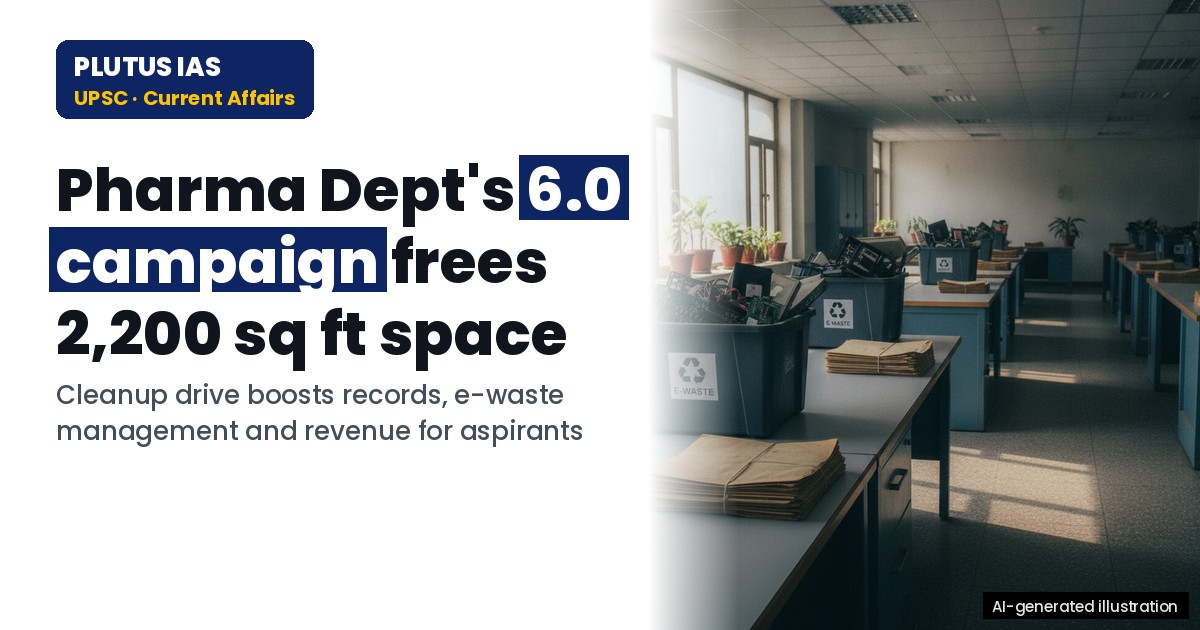
29 Oct विशेष अभियान 6.0: औषध विभाग ने ई-कचरा, स्वच्छता एवं कार्यस्थल कुशलता बढ़ाई
✎ Special Campaign 6.0 (SCDPC 6.0) by the Department of Pharmaceuticals (DoP) is a governance reform initiative focusing on e-waste management, space optimisation, and administrative efficiency, with measurable outcomes in…
Subject Relevance — Where This Topic Fits
- GS Paper II — Governance, Transparency and Accountability | GS Paper III — Environment and Pollution Control | GS Paper III — Disaster and Waste Management | GS Paper IV — Ethics in Governance
- Prelims: Special Campaign for Disposal of Pending Cases (SCDPC), E-Waste (Management) Rules, 2022, Centralised Public Grievance Redressal and Monitoring System (CPGRAMS), National Pharmaceutical Pricing Authority (NPPA), Pharmaceuticals and Medical Devices Bureau of India (PMBI), Public Sector Undertakings (PSUs) in pharmaceutical sector
- Essay: Administrative Reforms and Governance Efficiency in India, Sustainable Waste Management: A Path to Environmental Stewardship
Quick Revision: Special Campaign 6.0 (SCDPC 6.0) by the Department of Pharmaceuticals (DoP) is a governance reform initiative focusing on e-waste management, space optimisation, and administrative efficiency, with measurable outcomes in sanitation, record management, and grievance redressal.
Why is this in the news?
The Department of Pharmaceuticals (DoP), under the Ministry of Chemicals and Fertilizers, has concluded Special Campaign 6.0 (SCDPC 6.0) with measurable outcomes in e-waste management, space optimisation, and administrative efficiency. The campaign, conducted from 02 to 31 October 2026, achieved significant milestones including the disposal of 14,700 sanitation drives, clearance of 2,200 sq ft of office space, and revenue generation of ₹2.30 lakh from scrap disposal, underscoring the government’s commitment to sustainable governance and circular economy principles.
Background
- The Department of Pharmaceuticals (DoP) is a nodal agency under the Ministry of Chemicals and Fertilizers, responsible for policy formulation, pricing regulation, and promotion of the pharmaceutical industry in India.
- The Special Campaign for Disposal of Pending Cases (SCDPC) is a government-wide initiative launched in 2021 to expedite the disposal of pending matters, enhance administrative efficiency, and promote cleanliness and space optimisation in government offices.
- E-Waste (Management) Rules, 2022, mandate the scientific disposal of electronic waste through authorised recyclers, ensuring compliance with environmental safeguards and circular economy principles.
- The campaign is part of the broader ‘Swachhata Hi Seva’ (Cleanliness is Service) movement, aligning with the government’s vision of ‘Minimum Government, Maximum Governance’ and the Sustainable Development Goals (SDGs), particularly SDG 12 (Responsible Consumption and Production).
- The DoP oversees several subordinate organisations, including the National Pharmaceutical Pricing Authority (NPPA), Pharmaceuticals and Medical Devices Bureau of India (PMBI), and three PSUs: Bengal Chemicals and Pharmaceuticals Limited (BCPL), Hindustan Antibiotics Limited (HAL), and Karnataka Antibiotics and Pharmaceuticals Limited (KAPL).
What is Special Campaign 6.0 (SCDPC 6.0)?
- Special Campaign 6.0 is a time-bound, government-wide initiative launched by the Department of Pharmaceuticals (DoP) from 02 to 31 October 2026, aimed at expediting the disposal of pending cases, enhancing administrative efficiency, and promoting cleanliness, e-waste management, and optimal utilisation of office space.
- The campaign is part of the broader ‘Special Campaign for Disposal of Pending Cases’ (SCDPC) series, which has been institutionalised to foster a culture of accountability, transparency, and responsiveness in public administration.
- Key focus areas include scientific e-waste management under the E-Waste (Management) Rules, 2022; systematic record management; effective grievance redressal; and space optimisation to create clutter-free, productive work environments.
- The campaign leverages digital tools such as the Centralised Public Grievance Redressal and Monitoring System (CPGRAMS) to track and resolve public grievances, ensuring timely and accountable service delivery.
- Administrative reforms under the campaign include the simplification of rules and procedures, with 17 out of 20 identified bottlenecks addressed to streamline processes and improve governance efficiency.
- The campaign also emphasises environmental sustainability by promoting scientific disposal of e-waste, reducing the carbon footprint of government offices, and fostering a culture of environmental stewardship among employees.
- Measurable outcomes include the conduct of 14,700 sanitation drives, clearance of 2,200 sq ft of office space, disposal of 1,011 electronic items as e-waste, and revenue generation of ₹2.30 lakh from scrap disposal, demonstrating tangible progress in governance and sustainability.
- The campaign is monitored through the National Special Campaign Portal, where departments document their achievements, ensuring transparency and accountability in the implementation of governance reforms.
Key Features
| Feature | Significance |
|---|---|
| Swachhta Abhiyan (14,700 campaigns) | Institutionalises cleanliness drives to enhance workplace hygiene and environmental awareness across subordinate offices, including NIPERs, PMBI, and PSUs. |
| E-waste Management (1,011 items) | Ensures compliance with E-waste (Management) Rules, 2022 by safely disposing of IT, consumer electronics, and laboratory equipment through authorised recyclers. |
| Office Space Optimisation (2,200 sq ft) | Facilitates systematic record management and disposal of redundant files, freeing up physical space for productive use. |
| Revenue Generation (₹2.30 lakh) | Monetises office scrap through authorised disposal channels, contributing to departmental resource efficiency. |
| Pending Case Disposal (e.g., 57/58 state references) | Accelerates administrative efficiency by resolving long-pending matters through structured monitoring and grievance redressal mechanisms. |
Why it Matters
Administrative Efficiency
- Demonstrates the implementation of Special Campaign for Disposal of Pending Matters (SCDPM) 6.0, aligning with the Union Government’s emphasis on reducing pendency in governance.
- Enhances public service delivery by expediting grievance redressal (e.g., 132 public complaints resolved against a target of 72) and parliamentary references.
- Promotes systematic record management, reducing clutter and improving accessibility of official documents.
Environmental Governance
- Advances compliance with the E-waste (Management) Rules, 2022, ensuring environmentally responsible disposal of electronic waste.
- Encourages sustainable workplace practices through cleanliness drives and waste segregation, fostering a culture of environmental stewardship.
Fiscal Discipline
- Generates revenue from scrap disposal (₹2.30 lakh), demonstrating cost-effective resource utilisation within government departments.
- Optimises office space utilisation, reducing unnecessary expenditure on storage and maintenance of redundant records.
Institutional Capacity Building
- Strengthens operational frameworks in subordinate offices (e.g., NIPERs, PMBI, PSUs) by embedding best practices in cleanliness, record-keeping, and waste management.
- Serves as a model for other ministries and departments to replicate similar initiatives under SCDPM.
Challenges
1. Institutional Resistance to Change
- Long-standing bureaucratic inertia may impede adoption of digital record-keeping and systematic waste management practices.
- Resistance from staff accustomed to traditional filing systems and ad-hoc disposal methods.
UPSC Link: GS-II: Governance
2. Resource Constraints in Subordinate Offices
- Limited manpower and infrastructure in PSUs (e.g., BCPL, HAL) may hinder effective implementation of e-waste management protocols.
- Inadequate training on scientific disposal methods for electronic waste.
UPSC Link: GS-III: Environment
3. Monitoring and Accountability Gaps
- Ensuring real-time tracking of grievances and pending cases across decentralised offices remains a persistent challenge.
- Risk of relapse into pre-campaign practices without sustained oversight.
UPSC Link: GS-II: Governance
4. Public Awareness and Participation
- Limited citizen engagement in e-waste segregation and disposal may dilute the impact of departmental initiatives.
- Need for broader awareness campaigns to align public behaviour with sustainable practices.
UPSC Link: GS-III: Environment
Challenges — UPSC Perspective
| Issue | Concern |
|---|---|
| Legacy Record Systems | Over-reliance on physical files complicates digitisation and space optimisation efforts. |
| E-waste Segregation | Lack of standardised protocols for identifying and segregating hazardous electronic waste. |
| Grievance Redressal Delays | Systemic bottlenecks in tracking and resolving public complaints despite structured mechanisms. |
| Staff Training Gaps | Insufficient capacity-building initiatives to equip employees with modern record-keeping and waste management tools. |
| Infrastructure Deficits | Inadequate storage and disposal facilities in PSUs for large-scale e-waste management. |
Way Forward
- Institutionalise digital record-keeping systems (e.g., e-files) across all subordinate offices to reduce physical clutter.
- Expand training programmes for staff on E-waste (Management) Rules, 2022 and sustainable workplace practices.
- Establish dedicated e-waste collection centres in PSUs and affiliated institutions for streamlined disposal.
- Enhance public-private partnerships with authorised recyclers to improve e-waste processing efficiency.
- Implement a real-time dashboard for monitoring pending cases, grievances, and resource optimisation metrics.
- Conduct quarterly audits to assess compliance with cleanliness and waste management protocols.
- Launch awareness campaigns in regional languages to educate employees and the public on e-waste segregation.
- Integrate SCDPM outcomes into annual performance appraisals to incentivise adherence to best practices.
UPSC Value Addition
Keywords for Mains Answer-Writing
Special Campaign 6.0 · Department of Pharmaceuticals · e-waste management · E-Waste (Management) Rules 2022 · scientific disposal of e-waste · office space optimization · Swachhata Abhiyan · record management · grievance redressal · CPGRAMS · administrative efficiency · sustainable workplace practices · Ministry of Chemicals and Fertilizers · National Pharmaceutical Pricing Authority (NPPA) · Public Sector Undertakings (PSUs) · Bengal Chemicals and Pharmaceuticals Limited (BCPL) · Hindustan Antibiotics Limited (HAL) · Karnataka Antibiotics and Pharmaceuticals Limited (KAPL) · sustainable development goals (SDGs) · digital governance · public administration reform
Concept Flow
Initiation of SCDPM 6.0 → Focus on cleanliness, e-waste management, and record optimisation → Implementation across subordinate offices (NIPERs, PMBI, PSUs) → Monitoring via National Special Campaign Portal → Generation of revenue and space optimisation → Enhanced administrative efficiency and environmental governance.
Prelims Practice Questions
Q1. Consider the following statements regarding the Special Campaign 6.0 (SCDPA) launched by the Department of Pharmaceuticals:
1. It focuses solely on the disposal of e-waste generated by public sector undertakings.
2. The campaign aims to optimize office space by reviewing and disposing of physical and electronic records.
3. The campaign includes the scientific disposal of e-waste under the E-Waste (Management) Rules, 2022.
4. The campaign mandates the use of centralized public grievance redressal mechanisms only for parliamentary references.
How many of the above statements are correct?
- Only one
- Only two
- Only three
- All four
Answer: Only three — Statements 2 and 3 are correct. Statement 1 is incorrect as the campaign covers e-waste management, cleanliness, and office space optimization across all affiliated offices, not just PSUs. Statement 4 is incorrect as the campaign includes grievance redressal for all types of public complaints via CPGRAMS, not limited to parliamentary references.
Q2. Assertion (A): The Special Campaign 6.0 (SCDPA) of the Department of Pharmaceuticals emphasizes the scientific disposal of e-waste in compliance with the E-Waste (Management) Rules, 2022.
Reason (R): The campaign includes the disposal of 1,011 old electronic and electrical equipment items through authorized recyclers.
Code:
(A) Both A and R are true, and R is the correct explanation of A.
(B) Both A and R are true, but R is NOT the correct explanation of A.
(C) A is true but R is false.
(D) A is false but R is true.
- A
- B
- C
- D
Answer: A — Both Assertion (A) and Reason (R) are true, and R correctly explains A. The campaign’s focus on scientific e-waste disposal under the E-Waste (Management) Rules, 2022 is evidenced by the disposal of 1,011 items through authorized recyclers.
Q3. Match the following initiatives under Special Campaign 6.0 (SCDPA) with their respective objectives:
Column I (Initiative) Column II (Objective)
A. Swachhata Abhiyan 1. Optimizing office space by reviewing records
B. E-waste disposal 2. Promoting cleanliness and environmental awareness
C. Record management 3. Scientific disposal of electronic waste
D. Grievance redressal 4. Resolving public complaints via CPGRAMS
Select the correct match:
(A) A-2, B-3, C-1, D-4
(B) A-1, B-2, C-3, D-4
(C) A-4, B-3, C-2, D-1
(D) A-2, B-1, C-3, D-4
- A
- B
- C
- D
Answer: A — The correct matches are: A-2 (Swachhata Abhiyan promotes cleanliness), B-3 (E-waste disposal involves scientific management), C-1 (Record management optimizes office space), and D-4 (Grievance redressal resolves complaints via CPGRAMS).
Mains Practice Question
✍ The Department of Pharmaceuticals, under the Ministry of Chemicals and Fertilizers, has undertaken Special Campaign 6.0 (SCDPA) to enhance administrative efficiency and promote sustainable workplace practices. Critically examine the campaign’s objectives, mechanisms, and outcomes in the context of e-waste management, office space optimization, and grievance redressal. Also, analyse the significance of such initiatives for achieving Sustainable Development Goals (SDGs) in public administration. (15 Marks)
Approach: MODEL-ANSWER SKELETON:
1. **Introduction (2 marks)**
– Define Special Campaign 6.0 (SCDPA) and its launch context by the Department of Pharmaceuticals.
– State its overarching goal: enhancing administrative efficiency, promoting cleanliness, and ensuring sustainable workplace practices.
– Mention the timeline (02 October to 31 October 2026) and affiliated organizations (NIPER, PMBI, PSUs like BCPL, HAL, KAPL).
2. **Objectives and Mechanisms (4 marks)**
– **E-waste management**: Explain the campaign’s focus on scientific disposal of e-waste under the *E-Waste (Management) Rules, 2022*. Highlight the disposal of 1,011 electronic items and revenue generation (₹2.30 lakh) from scrap disposal.
– **Office space optimization**: Describe the review of 4,283 physical files and 20 e-files, closure of 489 redundant files, and freeing up 2,200 sq. ft. of office space.
– **Grievance redressal**: Discuss the disposal of public complaints (132) and appeals (39) via CPGRAMS, and simplification of 17 out of 20 identified procedural bottlenecks.
– **Swachhata Abhiyan**: Note the conduct of 14,700 cleanliness drives across regional offices.
3. **Outcomes and Data (3 marks)**
– Quantify achievements: 14,700 cleanliness drives (target: 12,208), 4,283 files reviewed, 2,200 sq. ft. space freed, ₹2.30 lakh revenue, and disposal of 1,011 e-waste items.
– Highlight the campaign’s role in improving administrative efficiency, reducing pendency, and promoting environmental sustainability.
4. **Linkage to SDGs (3 marks)**
– **SDG 12 (Responsible Consumption and Production)**: Discuss how e-waste management aligns with reducing waste and promoting recycling.
– **SDG 11 (Sustainable Cities and Communities)**: Explain the importance of clean and organized workplaces for employee well-being and productivity.
– **SDG 16 (Peace, Justice, and Strong Institutions)**: Emphasize the role of grievance redressal and procedural simplification in enhancing public trust and institutional accountability.
5. **Critical Analysis (3 marks)**
– **Strengths**: Highlight the campaign’s comprehensive approach, data-driven outcomes, and alignment with national priorities (e.g., Swachh Bharat Mission, Digital India).
– **Limitations**: Discuss potential challenges such as scalability, long-term sustainability of cleanliness drives, and ensuring compliance across diverse regional offices.
– **Suggestions**: Propose measures like regular audits, capacity-building for staff, and integration with digital governance initiatives (e.g., e-office systems).
6. **Conclusion (2 marks)**
– Summarize the campaign’s role in transforming public administration through efficiency, sustainability, and citizen-centric governance.
– Emphasize the need for such initiatives to be institutionalized and scaled across other ministries/departments.
Source: PIB (Press Information Bureau)
Generated by AanyaAi for educational purpose.
Related guides on our sites
- Anthropology VS PSIR
- Best PSIR optional coaching
- Best PSIR optional coaching online
- Best PSIR optional teacher

- IDBI Bank Strategic Disinvestment: Process & Flexibility Explained for UPSC - October 30, 2026
- भारत की UNSC चुनाव रणनीति: AI और समुद्री सुरक्षा को प्राथमिकता - October 30, 2026
- Indian Navy’s First Training Squadron Departs Colombo After Joint Exercises - October 30, 2026

No Comments