


31 Oct ‘विकसित भारत युवा संवाद’: 11,000 युवाओं ने सीखे मतदान के अधिकार
✎ The ‘Viksit Bharat Yuva Samvaad: Apne Vote Ko Jaane’ campaign is a youth-centric electoral literacy initiative under the ‘My India’ programme, designed to foster informed democratic participation among first-time voters through…
Subject Relevance — Where This Topic Fits
- GS Paper II — Constitutional Framework, Electoral Reforms, and Democratic Participation | GS Paper II — Role of Civil Society and Youth in Governance
- Prelims: Electoral Literacy Clubs (ELCs), First-time Voters, Systematic Voters’ Education and Electoral Participation (SVEEP), National Voters’ Day, My India (Mera Yuva Bharat – MY Bharat), Viksit Bharat 2047
- Essay: The Role of Youth in Democratic Governance: Challenges and Opportunities, Electoral Literacy as a Pillar of Informed Citizenship
Quick Revision: The ‘Viksit Bharat Yuva Samvaad: Apne Vote Ko Jaane’ campaign is a youth-centric electoral literacy initiative under the ‘My India’ programme, designed to foster informed democratic participation among first-time voters through interactive sessions, voter awareness drives, and civic education.
Why is this in the news?
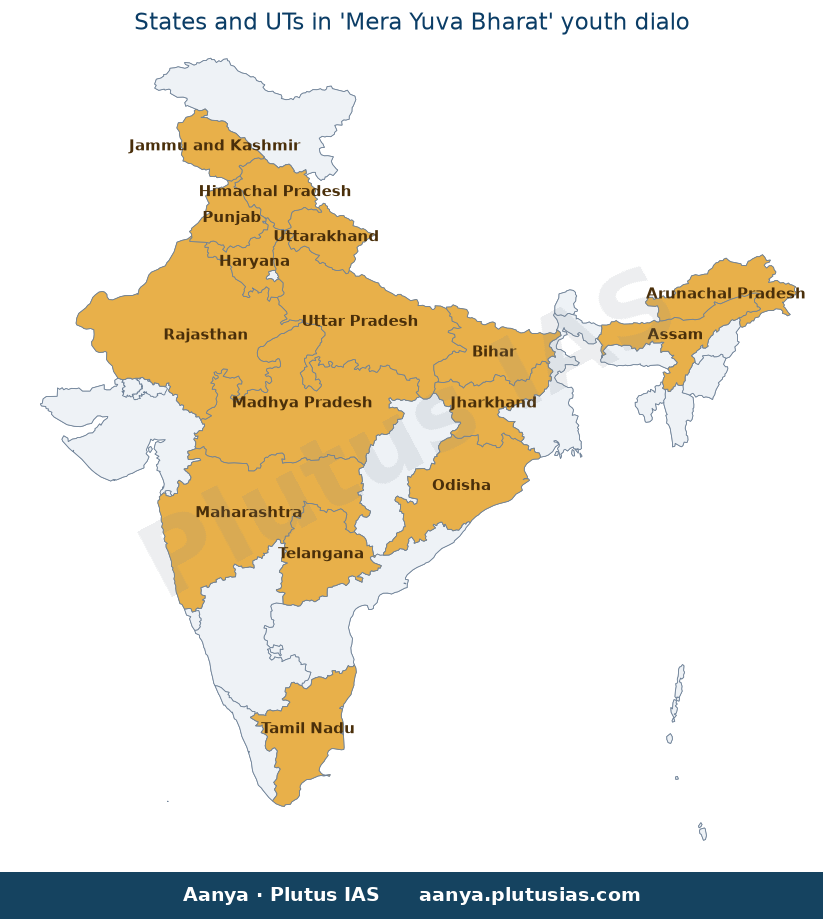
The Ministry of Youth Affairs and Sports, under the Department of Youth Affairs, launched the ‘Viksit Bharat Yuva Samvaad: Apne Vote Ko Jaane’ campaign as part of the ‘My India’ (Mera Yuva Bharat – MY Bharat) initiative. Between 26 October 2026 and 5 November 2026, 62 programmes were conducted across 16 states and Union Territories, engaging over 11,000 youth in electoral awareness and democratic participation activities. This campaign is part of a broader effort to reach 500 universities, colleges, and institutions nationwide, with a focus on first-time voters and fostering informed electoral choices.
Background
- The Constitution of India, under Article 324, vests the Election Commission of India (ECI) with the superintendence, direction, and control of elections, including voter education and awareness.
- The Systematic Voters’ Education and Electoral Participation (SVEEP) programme, launched by the ECI in 2009, aims to enhance electoral participation through targeted awareness campaigns, particularly among marginalised and youth demographics.
- The ‘My India’ (Mera Yuva Bharat – MY Bharat) initiative, launched in 2023, is a youth-centric programme designed to foster leadership, civic engagement, and national integration among India’s youth population.
- India’s youth demographic, comprising over 65% of the population below 35 years, represents a critical constituency for electoral engagement and democratic sustainability.
- The ‘Viksit Bharat 2047’ vision underscores the need for inclusive growth and participatory governance, with youth playing a pivotal role in nation-building.
- Electoral literacy is a key component of civic education, ensuring that citizens, especially first-time voters, understand their rights, duties, and the electoral process.
What is the ‘Viksit Bharat Yuva Samvaad: Apne Vote Ko Jaane’ Campaign?
- The campaign is a youth-focused initiative under the ‘My India’ (Mera Yuva Bharat – MY Bharat) programme, aimed at enhancing electoral awareness and fostering informed democratic participation among India’s youth.
- It seeks to engage first-time voters and students in discussions on electoral rights, processes, and civic responsibilities, thereby strengthening the democratic fabric of the nation.
- The campaign includes interactive sessions with elected representatives, youth icons, and domain experts, providing a platform for dialogue on governance, leadership, and nation-building.
- Programmes are conducted in collaboration with educational institutions, including colleges and universities, to ensure wide reach and accessibility among the youth demographic.
- Key activities include voter awareness drives, ‘Democratic Pledges’ (Loktantrik Shapath), and discussions on responsible social media use in the context of electoral literacy.
- The campaign leverages ‘Yuva Adarsh’ (Youth Icons) as facilitators to engage with participants, share experiences, and address queries related to electoral processes and civic duties.
- The initiative aligns with the broader ‘Viksit Bharat 2047’ vision, emphasising youth participation as a cornerstone of India’s developmental trajectory.
- The campaign employs a multi-state approach, covering diverse geographies to ensure inclusivity and representation across India’s linguistic, cultural, and socio-economic spectrums.
Key Features
| Feature | Significance |
|---|---|
| Nationwide outreach to 500 universities/colleges | Ensures equitable access to electoral awareness across diverse geographies and socio-economic groups |
| Focus on first-time voters | Targets demographic segment with highest potential for long-term democratic engagement |
| Interactive dialogue with elected representatives and role models | Bridges information asymmetry by providing direct access to democratic processes |
| ‘अपना वोट जानें’ (Know Your Vote) theme | Demystifies electoral mechanics, including registration, polling procedures, and candidate evaluation |
| ‘लोकतांत्रिक शपथ’ (Democratic Pledge) | Reinforces civic duty and ethical voting behaviour through structured commitment |
Why it Matters
Democratic Participation
- Enhances voter literacy, reducing abstention among youth through structured awareness campaigns
- Fosters inter-generational dialogue by involving elected representatives and youth icons
- Promotes informed decision-making by clarifying electoral rights and responsibilities
Institutional Synergy
- Leverages ‘मेरा युवा भारत’ (MY Bharat) platform to institutionalise youth engagement in governance
- Integrates elected representatives, academia, and youth icons for multi-stakeholder collaboration
- Demonstrates Centre-State coordination in implementing national-level initiatives
Behavioural Change
- Encourages critical evaluation of electoral information, countering misinformation and disinformation
- Instils civic responsibility through structured pledges and oaths
- Normalises participatory democracy as a lifelong commitment rather than episodic activity
Geographical Inclusivity
- Covers 28 states/UTs, addressing regional disparities in electoral awareness
- Engages diverse linguistic and cultural contexts through localised programmes
- Reaches remote and border areas (e.g., Jammu & Kashmir, Arunachal Pradesh)
Challenges
1. Information Asymmetry in Electoral Processes
- First-time voters often lack clarity on registration, polling booths, and EVM procedures
- Misinformation on voting rights and candidate profiles persists despite awareness campaigns
UPSC Link: Polity: Electoral Reforms
2. Sustaining Long-Term Engagement
- Short-term campaigns risk fading into obscurity without follow-up mechanisms
- Youth participation may decline post-election if institutional linkages are weak
UPSC Link: Polity: Youth Participation
3. Regional Disparities in Implementation
- Variations in programme execution across states due to administrative capacity differences
- Language barriers and local sensitivities may hinder effective outreach
UPSC Link: Polity: Centre-State Relations
4. Digital Divide and Misinformation
- Urban-rural divide in access to digital literacy programmes
- Social media platforms as vectors for electoral misinformation require targeted countermeasures
UPSC Link: Polity: Role of Social Media
Challenges — UPSC Perspective
| Issue | Concern |
|---|---|
| Low voter turnout among youth | Structural barriers such as lack of awareness and procedural complexity |
| Language and cultural barriers | Limits reach in multilingual and diverse socio-cultural contexts |
| Sustainability of engagement | Risk of campaign fatigue and loss of momentum post-event |
| Misinformation in electoral processes | Undermines informed decision-making and trust in democratic institutions |
| Administrative capacity gaps | Uneven implementation across states due to resource constraints |
Government Initiatives — Must-Memorise for Prelims
- मेरा युवा भारत (MY Bharat)
- युवा आदर्श कार्यक्रम (Yuva Adarsh Programme)
- निर्वाचन आयोग द्वारा मतदाता शिक्षा और मतदान जागरूकता अभियान (Election Commission’s Systematic Voters’ Education and Electoral Participation Programme – SVEEP)
Way Forward
- Institutionalise follow-up mechanisms to sustain engagement beyond campaign duration
- Expand digital literacy modules to counter misinformation on social media platforms
- Strengthen collaboration with state governments for uniform implementation standards
- Integrate electoral awareness into school/college curricula as part of civic education
- Develop regional language content to address linguistic diversity
- Establish a feedback loop with participants to assess programme effectiveness
- Leverage MY Bharat volunteers for grassroots-level outreach in underserved areas
- Partner with civil society organisations to amplify reach in marginalised communities
UPSC Value Addition
Keywords for Mains Answer-Writing
Electoral Literacy Clubs · My India (Mera Yuva Bharat) · Yuva Dialogue Series · Viksit Bharat Yuva Samvad · First-time Voters · Electoral Awareness · Democratic Participation · Voter Education · Citizenship Education · National Service Scheme (NSS) · Yuva Adarsh (Youth Icons) · Voter’s Pledge (Loktantrik Shapa) · Election Commission of India · Constitutional Literacy · Civic Responsibility · Youth Engagement in Democracy
Constitutional & Policy Linkages
- Article 326: Adult Suffrage (Right to Vote)
- Article 325: No person to be ineligible for inclusion in electoral rolls on grounds of religion, race, caste, or sex
- Article 84: Qualification for membership of Parliament
Concept Flow
Youth awareness deficit → Structured electoral literacy campaigns → Direct interaction with representatives → Civic duty reinforcement through pledges → Sustained democratic participation → Informed voting behaviour → Strengthened democratic institutions
Prelims Practice Questions
Q1. Consider the following statements regarding the ‘Viksit Bharat Yuva Samvad: Apna Vote Jaane’ campaign:
1. The campaign is being conducted under the aegis of the Ministry of Youth Affairs and Sports.
2. It aims to reach 500 universities, colleges, and institutions across India.
3. The campaign includes ‘Yuva Adarsh’ (youth icons) as key facilitators.
4. The campaign is scheduled to run from 26 October 2026 to 05 November 2026.
How many of the above statements are correct?
- Only one
- Only two
- Only three
- All four
Answer: All four — Statements 1, 2, and 3 are correct. Statement 4 is incorrect as the campaign is scheduled from 26 October 2026 to 05 November 2026, which is a 11-day period, not the duration stated.
Q2. Assertion (A): The ‘Viksit Bharat Yuva Samvad’ campaign includes a component called ‘Loktantrik Shapa’ (Voter’s Pledge).
Reason (R): The campaign aims to instill a sense of civic responsibility and democratic participation among first-time voters.
Options:
A. Both A and R are true, and R is the correct explanation of A.
B. Both A and R are true, but R is not the correct explanation of A.
C. A is true, but R is false.
D. A is false, but R is true.
Answer: ? — Both Assertion (A) and Reason (R) are true. The ‘Loktantrik Shapa’ is indeed a component of the campaign, and its purpose is to instill civic responsibility and democratic participation among youth, making R the correct explanation of A.
Q3. Match the following states/UTs with the regions they belong to as per the ‘Viksit Bharat Yuva Samvad’ campaign:
Column I (State/UT) | Column II (Region)
——————-|——————-
1. Arunachal Pradesh | A. Northern Region
2. Rajasthan | B. Eastern Region
3. Uttarakhand | C. North-Eastern Region
4. Jharkhand | D. Western Region
Options:
A. 1-C, 2-D, 3-A, 4-B
B. 1-A, 2-B, 3-C, 4-D
C. 1-D, 2-C, 3-A, 4-B
D. 1-B, 2-A, 3-D, 4-C
Answer: ? — Correct matches are: Arunachal Pradesh (C. North-Eastern Region), Rajasthan (D. Western Region), Uttarakhand (A. Northern Region), and Jharkhand (B. Eastern Region).
Mains Practice Question
✍ Examine the significance of youth engagement in democratic processes through initiatives like the ‘Viksit Bharat Yuva Samvad: Apna Vote Jaane’ campaign. How does such an initiative contribute to strengthening electoral literacy and civic responsibility among first-time voters? (15 Marks)
Approach: MODEL-ANSWER SKELETON:
1. **Introduction**: Define electoral literacy and civic responsibility in the context of democratic participation. Highlight the role of youth as first-time voters in shaping India’s democratic future.
2. **Electoral Literacy as a Pillar of Democracy**:
– Explain the concept of electoral literacy and its importance in ensuring informed voting.
– Reference the role of the Election Commission of India (ECI) in promoting voter education (e.g., Systematic Voters’ Education and Electoral Participation (SVEEP) programme).
– Discuss how initiatives like ‘Electoral Literacy Clubs’ (ELCs) function under the ECI to educate youth.
3. **Civic Responsibility and Democratic Participation**:
– Define civic responsibility and its link to democratic governance.
– Discuss the role of youth in nation-building, referencing constitutional provisions such as Fundamental Duties (Article 51A) and the Directive Principles of State Policy (Article 39A, 46).
– Highlight the importance of ‘Voter’s Pledge’ (Loktantrik Shapa) as a symbolic commitment to democratic values.
4. **Role of ‘Yuva Adarsh’ and Dialogue Series**:
– Explain how ‘Yuva Adarsh’ (youth icons) serve as role models and facilitators in bridging the gap between institutions and youth.
– Discuss the significance of ‘Yuva Dialogue Series’ in creating a platform for interaction between elected representatives, youth icons, and young citizens.
5. **Challenges and Way Forward**:
– Identify challenges in youth engagement, such as misinformation, low voter turnout, and apathy.
– Suggest measures to enhance electoral literacy, such as leveraging social media, integrating civic education in school curricula, and strengthening partnerships between educational institutions and electoral bodies.
6. **Conclusion**: Summarize the transformative potential of such initiatives in fostering a culture of informed and responsible citizenship among India’s youth.
Source: PIB (Press Information Bureau)
Generated by AanyaAi for educational purpose.
Related guides on our sites
- Anthropology VS PSIR
- Best PSIR optional coaching
- Best PSIR optional coaching online
- Best PSIR optional teacher

- ‘विकसित भारत युवा संवाद’: 11,000 युवाओं ने सीखे मतदान के अधिकार - October 31, 2026
- मुख्यमंत्री 2 नवंबर को महिला नीति शिखर सम्मेलन का करेंगे उद्घाटन - October 31, 2026
- Centre releases Rs 1.09 lakh crore tax devolution to states - October 31, 2026

No Comments