


15 Jul केंद्रीय मंत्रिमंडल ने मोबाइल फोन विनिर्माण योजना (एमपीएमएस) को दी मंजूरी
Subject Relevance — Where This Topic Fits
- GS Paper III — Indian Economy and issues relating to Planning, Mobilization of Resources, Growth, Development and Employment | GS Paper III — Science and Technology- Developments and their applications and effects in everyday life | GS Paper III — Industrial Policy and its effects on industrial growth
- Prelims: MPMS Scheme, Production Linked Incentive (PLI), Electronics Manufacturing, Make in India, Value Addition, Technological Sovereignty, Export Promotion, Global Value Chains, R&D Incentives, Employment Generation
- Essay: India’s Journey Towards Self-Reliance: From Imports to Global Manufacturing Hub, The Digital Economy and its Role in India’s Economic Transformation
Quick Revision: The Mobile Phone Manufacturing Scheme (MPMS) is a ₹62,500 crore, five-year initiative to boost domestic mobile phone production, value addition, and global competitiveness through production-linked incentives, with a strong focus on technological sovereignty and indigenous R&D.
Why is this in the news?
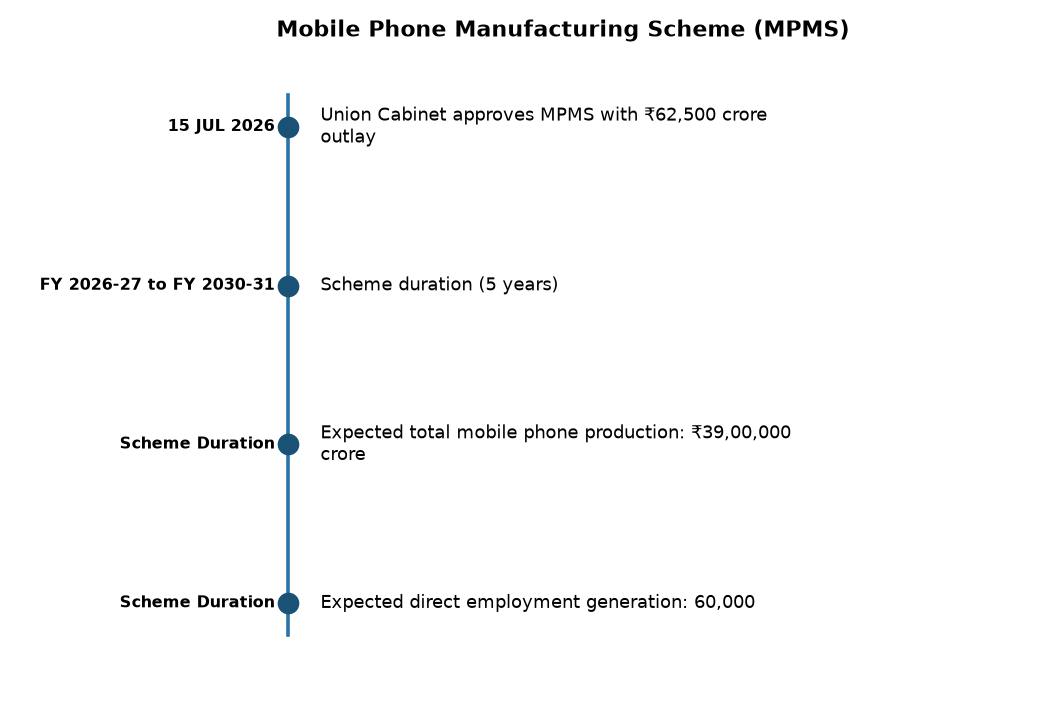
The Union Cabinet, chaired by Prime Minister Shri Narendra Modi, has recently approved the Mobile Phone Manufacturing Scheme (MPMS) with a substantial budgetary outlay of ₹62,500 crore. This strategic approval, effective for a five-year period from FY 2026-27 to FY 2030-31, underscores the government’s unwavering commitment to bolster domestic manufacturing, enhance value addition, and solidify India’s position as a global electronics manufacturing powerhouse, building upon the successes of previous initiatives like the Production Linked Incentive (PLI) scheme for Large Scale Electronics Manufacturing (LSEM).
Background
- India has emerged as the world’s second-largest mobile phone manufacturer, with 99.2% of domestically used mobile phones now manufactured within the country.
- The ‘Make in India’ vision has been instrumental in a seven-fold increase in electronics manufacturing and an eleven-fold rise in exports since FY 2014-15.
- Mobile phone manufacturing has become a cornerstone of India’s electronics manufacturing ecosystem, significantly driving growth and exports.
- Smartphones were the largest product category exported from India in 2025, surpassing traditional exports like diesel fuel and cut diamonds.
- The Production Linked Incentive (PLI) scheme for Large Scale Electronics Manufacturing (PLI-LSEM), which concluded on March 31, 2026, played a pivotal role in establishing India as a global hub for mobile manufacturing and exports.
- The electronics manufacturing sector is a major employment generator, particularly for youth in remote areas, with some plants employing over 5,000 individuals.
What is the Mobile Phone Manufacturing Scheme (MPMS)?
- The Mobile Phone Manufacturing Scheme (MPMS) is a new government initiative approved by the Union Cabinet with a budgetary outlay of ₹62,500 crore.
- Its primary objective is to promote production, enhance domestic value addition, build resilient supply chains, and boost global competitiveness in mobile phone manufacturing.
- The scheme aims to achieve technological sovereignty, generate significant economic value, and foster the creation of indigenous brands through design and R&D in India.
- MPMS has a duration of five years, commencing from Financial Year 2026-27 and concluding in Financial Year 2030-31.
- It offers varying incentive rates, ranging from 2.25% to 5% on eligible sales of mobile phones manufactured in India.
- An additional incentive of up to 1.5% is provided for domestic sourcing of key components and sub-assemblies, encouraging backward integration.
- To promote indigenous brand development, a further incentive of 3% on eligible sales is offered for product design and research & development activities.
- The scheme is projected to lead to a total mobile phone production of approximately ₹39,00,000 crore and create around 60,000 direct jobs over its duration.
Key Features
| Feature | Significance |
|---|---|
| Budgetary Outlay of ₹62,500 Crore | Demonstrates significant government commitment and provides substantial financial backing for the scheme’s objectives. |
| 5-Year Duration (FY 2026-27 to FY 2030-31) | Offers a stable policy environment for long-term investment and strategic planning by manufacturers. |
| Production-Linked Incentives (2.25% to 5% on Sales) | Directly encourages increased production volumes and rewards manufacturing growth, aligning incentives with output. |
| Additional 1.5% Incentive for Domestic Sourcing | Promotes backward integration, strengthens the domestic supply chain, and reduces reliance on imports for components. |
| Additional 3% Incentive for Design & R&D | Fosters innovation, encourages the development of indigenous intellectual property, and supports the creation of Indian brands. |
| Focus on Technological Sovereignty | Aims to reduce dependence on foreign technology and build India’s capabilities in advanced electronics manufacturing. |
Why it Matters
Economic Growth and Employment Generation
- Expected to boost total mobile phone production to ₹39,00,000 crore, significantly contributing to the national GDP.
- Projected to create approximately 60,000 direct jobs, particularly benefiting youth in rural and semi-urban areas, addressing unemployment.
- Stimulates ancillary industries and services, leading to indirect job creation and broader economic multiplier effects.
Enhancing Global Competitiveness and Exports
- Aims to make India a global electronics manufacturing hub, attracting foreign investment and technology.
- Significant increase in mobile phone exports is anticipated, strengthening India’s position in global value chains.
- By fostering indigenous design and R&D, the scheme seeks to elevate India from an assembly hub to a center for innovation and product development.
Technological Sovereignty and Value Addition
- Focus on domestic sourcing of components and R&D will reduce reliance on imports and enhance indigenous capabilities.
- Promotes the creation of ‘Indian patents’ and ‘swadeshi brands’, fostering technological self-reliance.
- Drives domestic value addition, moving beyond basic assembly to more complex manufacturing processes and component production.
Strengthening Supply Chain Resilience
- By encouraging domestic sourcing and manufacturing, the scheme aims to build more robust and less vulnerable supply chains.
- Reduces exposure to global supply chain disruptions, enhancing national economic security.
- Diversifies global manufacturing bases, making India a reliable alternative for electronics production.
Challenges
1. Global Competition and Scale
- India faces intense competition from established manufacturing hubs like China and Vietnam, which possess larger scale and mature ecosystems.
- Achieving cost competitiveness while maintaining quality standards globally remains a significant hurdle.
UPSC Link: GS Paper III — Industrial Policy
2. Infrastructure Deficiencies
- Despite improvements, gaps persist in logistics, power supply, and connectivity, which can increase operational costs for manufacturers.
- Development of world-class industrial parks and testing facilities is crucial for advanced electronics manufacturing.
UPSC Link: GS Paper III — Infrastructure
3. Skill Gap and R&D Ecosystem
- A shortage of highly skilled labour in advanced electronics manufacturing, design, and R&D poses a challenge.
- Building a robust R&D ecosystem that can consistently innovate and produce cutting-edge technology requires sustained investment and collaboration.
UPSC Link: GS Paper III — Skill Development, Science & Technology
4. Component Ecosystem Development
- While mobile phone assembly has grown, a strong domestic ecosystem for high-value components (e.g., semiconductors, displays) is still nascent.
- Incentivizing the manufacturing of these critical components requires significant capital investment and technological expertise.
UPSC Link: GS Paper III — Industrial Growth, Self-Reliance
5. Policy Consistency and Implementation
- Ensuring long-term policy stability and efficient implementation of incentive schemes is vital to build investor confidence.
- Streamlining regulatory processes and reducing bureaucratic hurdles are essential for ease of doing business.
UPSC Link: GS Paper II — Governance, GS Paper III — Industrial Policy
Challenges — UPSC Perspective
| Issue | Concern |
|---|---|
| Dependency on Imports for High-Value Components | Limits domestic value addition and exposes the supply chain to external shocks. |
| Limited Indigenous R&D and Design Capabilities | Hinders the creation of unique Indian brands and technological sovereignty. |
| Skilled Workforce Shortage | Constrains growth in advanced manufacturing and R&D sectors. |
| Infrastructure Gaps (Logistics, Power) | Increases operational costs and reduces global competitiveness. |
| Intense Global Competition | Requires continuous innovation and cost-effectiveness to maintain market share. |
| Capital Intensive Nature of Electronics Manufacturing | Demands significant investment and long gestation periods for returns. |
Government Initiatives — Must-Memorise for Prelims
- Production Linked Incentive (PLI) Scheme for Large Scale Electronics Manufacturing (LSEM)
- Scheme for Promotion of Manufacturing of Electronic Components and Semiconductors (SPECS)
- Modified Special Incentive Package Scheme (MSIPS)
- National Policy on Electronics (NPE) 2019
- Phased Manufacturing Programme (PMP)
- Digital India Programme
- Make in India Initiative
- Startup India Initiative
- Skill India Mission
- National Semiconductor Mission
Way Forward
- Prioritize the development of a robust domestic component ecosystem, especially for high-value items like semiconductors and displays, through targeted incentives and R&D support.
- Invest significantly in skill development programs tailored for advanced electronics manufacturing, design, and R&D, collaborating with industry and academia.
- Strengthen the R&D infrastructure and foster a culture of innovation by increasing public and private investment, facilitating industry-academia partnerships, and streamlining patenting processes.
- Continuously improve logistics, power infrastructure, and connectivity to reduce operational costs and enhance the ease of doing business for manufacturers.
- Ensure policy stability, transparency, and efficient implementation of incentive schemes to build long-term investor confidence and attract global players.
- Promote sustainable and green manufacturing practices within the electronics sector to align with global environmental standards and enhance brand image.
- Explore strategic international collaborations for technology transfer, joint ventures, and market access to accelerate growth and integration into global value chains.
- Focus on developing indigenous brands with unique selling propositions, leveraging India’s vast domestic market and design talent.
UPSC Value Addition
Keywords for Mains Answer-Writing
Technological Sovereignty · Global Value Chains · Production Linked Incentive · Domestic Value Addition · Electronics Manufacturing Ecosystem · Export Diversification · Skill Development · Supply Chain Resilience · Indigenous R&D · Make in India · Economic Multiplier · Industrial Policy
Constitutional & Policy Linkages
- Article 38: State to secure a social order for the promotion of welfare of the people (DPSP – employment generation)
- Article 39: Certain principles of policy to be followed by the State (DPSP – securing adequate means of livelihood)
- Article 246: Distribution of legislative powers (Union List – Industries, Trade and Commerce)
- National Policy on Electronics (NPE) 2019: Policy framework for electronics manufacturing
- Foreign Trade Policy: Governs export-import regulations and incentives.
Concept Flow
Government Policy (MPMS) → Incentives for Manufacturing & R&D → Increased Domestic Production & Value Addition → Enhanced Global Competitiveness & Exports → Economic Growth & Job Creation → Technological Sovereignty & Self-Reliance
Prelims Practice Questions
Q1. Consider the following statements regarding the Mobile Phone Manufacturing Scheme (MPMS):
1. The scheme has a budgetary outlay of ₹62,500 crore for a period of five years.
2. It provides an additional incentive for domestic sourcing of key components and sub-assemblies.
3. The scheme aims to achieve technological sovereignty and promote indigenous brands through R&D.
Which of the statements given above are correct?
- A. 1 and 2 only
- B. 2 and 3 only
- C. 1 and 3 only
- D. 1, 2 and 3
Answer: D. 1, 2 and 3 — Statement 1 is correct: The MPMS has a budgetary outlay of ₹62,500 crore for FY 2026-27 to FY 2030-31. Statement 2 is correct: The scheme includes an additional 1.5% incentive for domestic sourcing. Statement 3 is correct: A core objective is technological sovereignty and promoting Indian brands through design and R&D with a 3% incentive.
Q2. Which of the following statements best describes the primary objective of the Mobile Phone Manufacturing Scheme (MPMS)?
- A. To provide free mobile phones to economically weaker sections of society.
- B. To solely focus on increasing the import of advanced mobile phone components.
- C. To boost domestic production, value addition, and global competitiveness in mobile phone manufacturing.
- D. To establish India as a major consumer market for imported electronics.
Answer: C. To boost domestic production, value addition, and global competitiveness in mobile phone manufacturing. — The primary objective of MPMS is clearly stated as promoting production, domestic value addition, building resilient supply chains, and enhancing global competitiveness in mobile phone manufacturing. Options A, B, and D contradict the scheme’s stated goals.
Mains Practice Question
✍ The newly approved Mobile Phone Manufacturing Scheme (MPMS) represents a significant stride towards India’s ambition of becoming a global electronics manufacturing hub. Critically analyse the potential of MPMS to foster technological sovereignty and enhance India’s position in global value chains, while also discussing the key challenges that need to be addressed for its successful implementation. (250 words)
Approach: Begin by introducing MPMS and its context within India’s ‘Make in India’ vision and the success of previous PLI schemes. In the first part, discuss how MPMS fosters technological sovereignty through incentives for R&D, indigenous design, and domestic sourcing, and how it enhances India’s position in global value chains by boosting exports and attracting investment. In the second part, critically analyse challenges such as global competition, infrastructure deficits, skill gaps, and the need for a robust component ecosystem. Conclude by suggesting a way forward focusing on policy consistency, targeted skill development, and strategic R&D investments to ensure the scheme’s long-term success.
Source: PIB (Press Information Bureau)

- सिम्बेक्स-2026: भारत-सिंगापुर नौसैनिक अभ्यास विशाखापत्तनम में शुरू, जानिए महत्वपूर्ण बिंदु - October 22, 2026
- PM-DAKSH Scheme: Key Features for UPSC & State PCS Aspirants - October 22, 2026
- जयशंकर और टस्क की बैठक: मोदी-टस्क वार्ता से पहले भारत-पोलैंड संबंधों की दिशा तय - October 22, 2026

No Comments