


27 Jul कोसी-मेची अंतरराज्यीय लिंक परियोजना: UPSC के लिए महत्वपूर्ण जानकारी
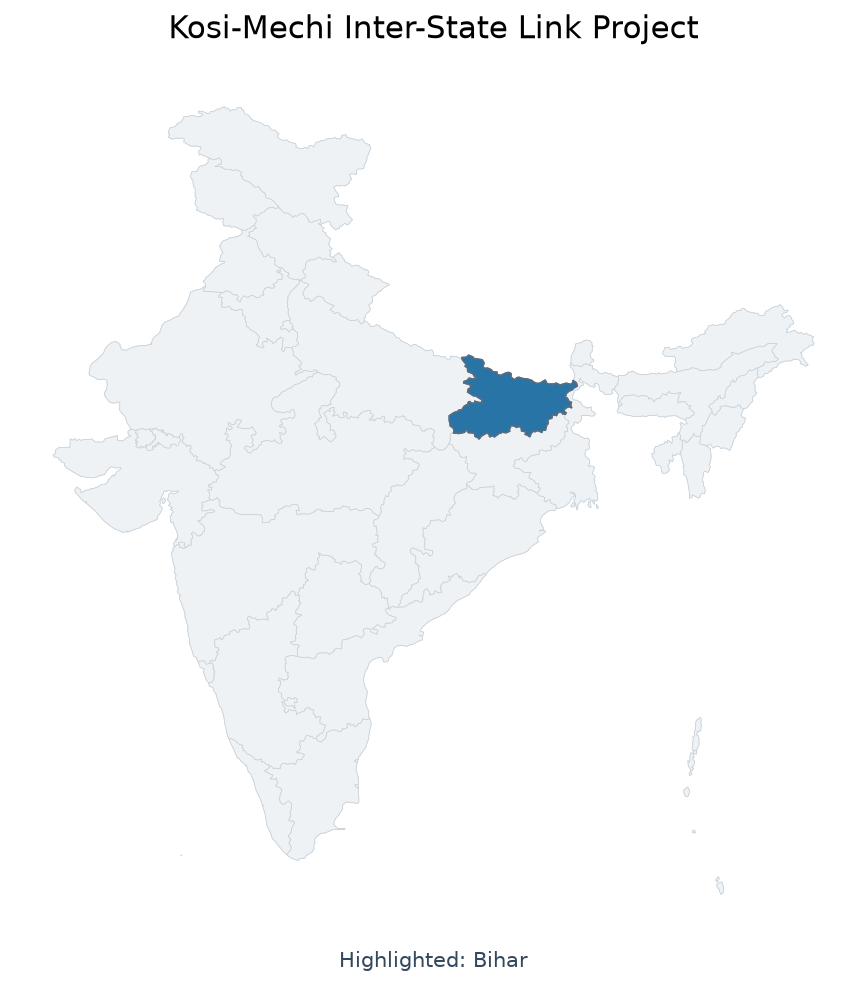
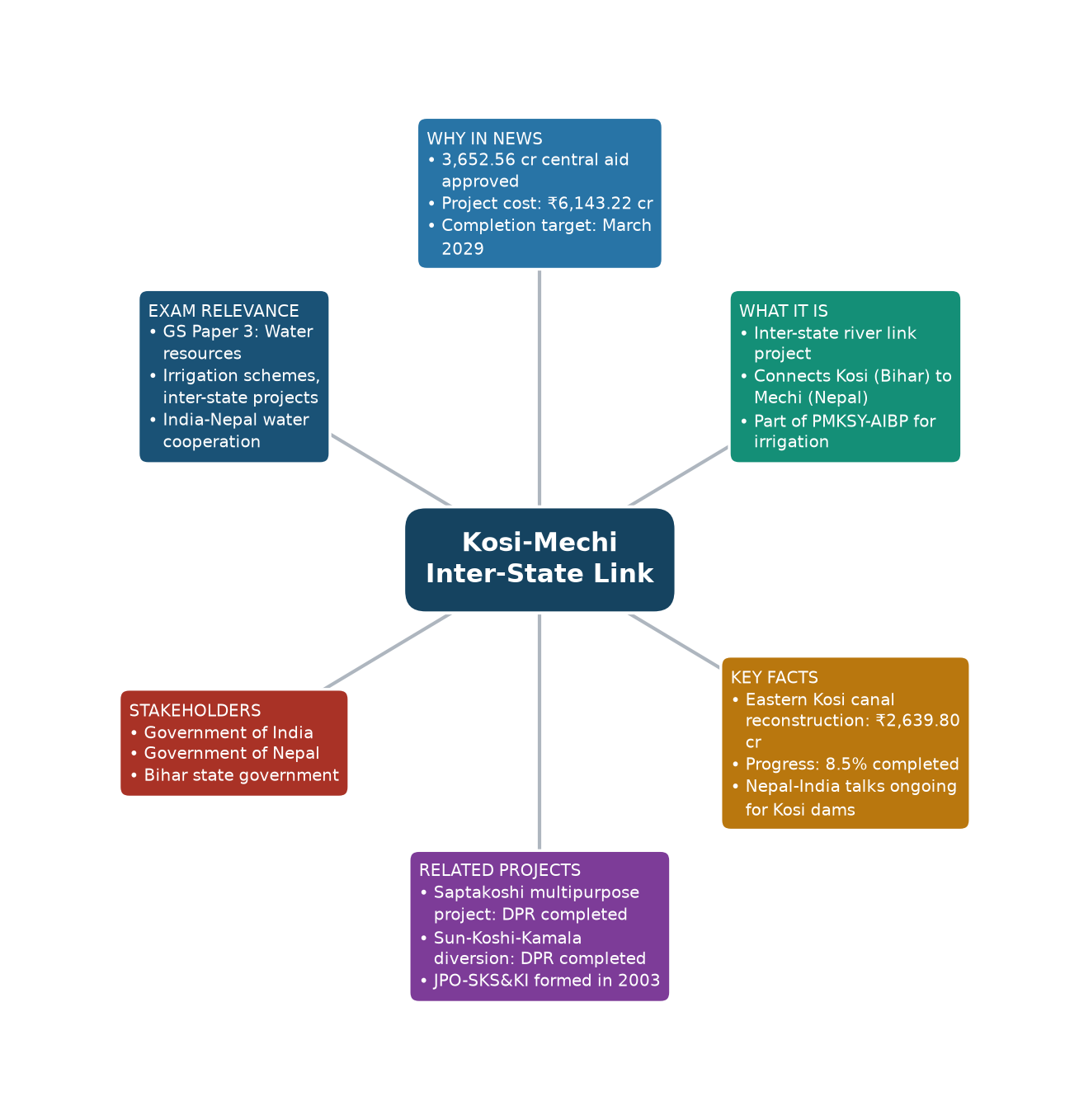
Map & concept mind-map: Kosi-Mechi Inter-State Link Project
Subject Relevance — Where This Topic Fits
- GS Paper II — International Relations (India-Nepal bilateral cooperation) | GS Paper III — Economy (Infrastructure development, irrigation, flood management)
- Prelims: Inter-State Water Disputes Act, 1956, Pradhan Mantri Krishi Sinchayee Yojana (PMKSY), Accelerated Irrigation Benefit Programme (AIBP), Kosi River Basin, Bihar-Nepal border management, Flood Management Programme (FMP), Joint Project Office (JPO-SKSKI), GLOF (Glacial Lake Outburst Flood) studies
- Essay: Water security and sustainable development in South Asia, India’s infrastructure diplomacy and regional cooperation
Quick Revision: The Kosi-Mechi Inter-State Link Project is a ₹6,143.22 crore initiative under PMKSY-AIBP to enhance irrigation, flood control, and water security in Bihar, with ₹3,652.56 crore central assistance and a March 2029 completion deadline.
Why is this in the news?
The Kosi-Mechi Inter-State Link Project has been included under the Pradhan Mantri Krishi Sinchayee Yojana-Accelerated Irrigation Benefit Programme (PMKSY-AIBP) with a central assistance of ₹3,652.56 crore for a total estimated cost of ₹6,143.22 crore. Scheduled for completion by March 2029, the project aims to enhance irrigation, mitigate floods, and ensure water security in Bihar and eastern India, while also fostering bilateral cooperation with Nepal through joint water resource management initiatives.
Background
- The Kosi River, originating in Nepal, is a transboundary river with significant flood-prone areas in Bihar, necessitating integrated water resource management.
- The 2003 India-Nepal Joint Project Office (JPO-SKSKI) was established to develop Detailed Project Reports (DPRs) for multipurpose projects like the Sapta-Kosi and Sun-Kosi-Kamala Diversion schemes.
- Bihar has historically faced severe flooding due to the Kosi River’s unstable course, leading to recurrent socio-economic losses.
- The PMKSY-AIBP, launched in 2015, aims to enhance irrigation coverage and mitigate droughts by providing financial assistance for major and medium irrigation projects.
- India-Nepal bilateral engagements on water resources have focused on flood control, irrigation, and hydropower development, with regular high-level discussions.
- The Eastern Kosi Main Canal’s reconstruction, contracted at ₹2,639.80 crore, is a critical component of the broader Kosi-Mechi Link Project.
What is the Kosi-Mechi Inter-State Link Project?
- A multipurpose inter-state water project aimed at linking the Kosi and Mechi rivers to improve irrigation, flood control, and water security in Bihar and adjoining regions.
- The project is part of the broader Kosi-Mechi Link Canal system, designed to transfer surplus waters from the Kosi River to the Mechi River basin, thereby addressing water scarcity in eastern Bihar.
- The total estimated cost of the project is ₹6,143.22 crore, with ₹3,652.56 crore provided as central assistance under PMKSY-AIBP, ensuring financial viability and timely execution.
- The project includes the reconstruction of the Eastern Kosi Main Canal over a 41.30 km stretch, contracted at ₹2,639.80 crore, with 8.5% physical progress achieved as of July 2026.
- The project aligns with the National Perspective Plan (NPP) for inter-linking of rivers (ILR), which aims to address regional imbalances in water availability through large-scale infrastructure development.
- The project’s implementation involves close coordination between the governments of India and Nepal, particularly for managing transboundary water resources and addressing flood risks in the shared river basins.
Key Features
| Feature | Significance |
|---|---|
| Total Project Cost | ₹6,143.22 crore, with ₹3,652.56 crore central assistance under PMKSY-AIBP, ensuring financial viability and accelerated implementation. |
| Completion Timeline | March 2029, with 8.5% physical progress achieved as of July 2026, indicating phased execution. |
| Inter-State Linkage | Connects Kosi and Mechi rivers across Bihar and West Bengal, addressing irrigation deficits in eastern India. |
| Nepal-India Cooperation | Ongoing bilateral negotiations for Kosi dam construction to enhance flood control and mutual benefits. |
| Integrated Basin Management | Part of broader efforts under the Kosi-Gandak Basin Authority framework, though no formal proposal exists yet. |
Why it Matters
Economic Development
- Augments irrigation potential by 3.69 lakh hectares, enhancing agricultural productivity in drought-prone eastern India.
- Reduces dependency on monsoon rainfall, stabilising farm incomes and food security.
- Supports PMKSY’s objective of ‘Har Khet Ko Pani’ by ensuring equitable water distribution across states.
Strategic Infrastructure
- Strengthens water security in the eastern Himalayan foothills, a region vulnerable to climate-induced water stress.
- Mitigates flood risks in Bihar and West Bengal through integrated river basin management.
- Enhances inland navigation potential, reducing logistics costs for agricultural produce.
Diplomatic Cooperation
- Demonstrates India’s commitment to transboundary water resource management with Nepal, fostering regional stability.
- Aligns with the 2019 India-Nepal Joint Vision Statement on shared rivers and hydropower cooperation.
- Facilitates joint flood forecasting and disaster management mechanisms.
Environmental Sustainability
- Promotes efficient water use through modern irrigation techniques under PMKSY-AIBP.
- Supports ecosystem restoration in the Kosi-Gandak basin, a Ramsar-listed wetland of international importance.
- Incorporates climate-resilient design to address glacial lake outburst flood (GLOF) risks.
Challenges
1. Transboundary Water Governance
- Requires sustained diplomatic engagement with Nepal to finalise the Kosi dam agreement, given historical sensitivities.
- Balancing flood control with hydropower generation and ecological concerns demands multi-stakeholder consensus.
- Delays in Nepal-India Joint Committee meetings (e.g., none in 2025-26) hinder progress on DPRs.
UPSC Link: GS-II: India-Nepal Relations
2. Technical and Geological Risks
- Complex terrain and seismic activity in the Himalayan foothills necessitate rigorous geological surveys (e.g., 1,258m drilling for Sapta Kosi).
- GLOF risks from Himalayan glaciers require adaptive engineering solutions to prevent downstream damage.
- Siltation and river morphology changes may reduce long-term efficacy of the inter-linking project.
UPSC Link: GS-III: Disaster Management
3. Financial and Implementation Hurdles
- Achieving 8.5% progress in 1.5 years for a ₹6,143 crore project indicates potential delays in execution.
- Land acquisition and rehabilitation challenges in densely populated eastern India may escalate costs.
- Dependence on central assistance under PMKSY-AIBP necessitates strict compliance with monitoring frameworks.
UPSC Link: GS-III: Infrastructure Financing
4. Environmental and Social Concerns
- Large-scale river interlinking may disrupt local ecosystems and livelihoods dependent on natural river flows.
- Potential displacement of communities and loss of biodiversity in the Kosi-Gandak basin require robust EIA and R&R policies.
- Climate change-induced water scarcity may alter project assumptions, necessitating adaptive management.
UPSC Link: GS-III: Environmental Impact Assessment
5. Institutional and Policy Gaps
- Absence of a permanent Kosi-Gandak Basin Authority limits coordinated water resource management.
- Fragmented governance across states (Bihar, West Bengal) and central agencies may lead to implementation bottlenecks.
- Need for stronger inter-state coordination mechanisms to align project objectives with state-specific priorities.
UPSC Link: GS-II: Federalism
Challenges — UPSC Perspective
| Issue | Concern |
|---|---|
| Diplomatic Delays | Lack of regular Nepal-India Joint Committee meetings hampers progress on transboundary projects. |
| Geological Instability | Himalayan seismic activity and GLOF risks pose engineering challenges for dam construction. |
| Financial Constraints | Project cost overruns and land acquisition delays may strain central and state exchequers. |
| Ecosystem Disruption | River interlinking could alter sediment flow, affecting wetlands and biodiversity in the basin. |
| Policy Fragmentation | Absence of a dedicated basin authority undermines integrated water resource management. |
| Climate Vulnerability | Changing precipitation patterns may reduce the project’s long-term benefits and increase maintenance costs. |
Government Initiatives — Must-Memorise for Prelims
- Pradhan Mantri Krishi Sinchayee Yojana – Accelerated Irrigation Benefit Programme (PMKSY-AIBP)
Way Forward
- Accelerate diplomatic negotiations with Nepal to finalise the Kosi dam agreement, including flood control and hydropower sharing terms.
- Conduct comprehensive Environmental Impact Assessments (EIA) and Resettlement & Rehabilitation (R&R) plans for affected communities.
- Strengthen inter-state coordination mechanisms to align project objectives with state-specific irrigation and flood management priorities.
- Implement climate-resilient engineering designs to mitigate GLOF and seismic risks in the Himalayan foothills.
- Enhance monitoring and evaluation frameworks under PMKSY-AIBP to ensure timely completion and cost control.
- Integrate the project with the proposed Kosi-Gandak Basin Authority to ensure holistic water resource management.
- Leverage technological advancements in remote sensing and GIS for real-time flood forecasting and water distribution.
- Promote community participation in project planning to address social and ecological concerns.
UPSC Value Addition
Keywords for Mains Answer-Writing
Inter-State River Linking Project (ILR) · Kosi-Mechi Link Project · Pradhan Mantri Krishi Sinchayee Yojana-Accelerated Irrigation Benefit Programme (PMKSY-AIBP) · Flood management and irrigation infrastructure · India-Nepal transboundary water cooperation · Kosi-Gandak Basin Authority · Saptakosi Multipurpose Project · Sun-Kosi-Kamala Diversion Multipurpose Project · Glacial Lake Outburst Flood (GLOF) studies · Hydrological and seismic surveys in river basins · Bihar flood management initiatives · Central assistance for inter-state water projects
Concept Flow
Kosi-Mechhi Interlinking Project → Transboundary Water Governance (India-Nepal) → PMKSY-AIBP Funding → Irrigation Augmentation → Agricultural Productivity → Food Security → Climate Resilience → Kosi River Basin → Himalayan Glacial Lake Outburst Floods (GLOFs) → Seismic Vulnerability → Engineering Challenges → Adaptive Infrastructure Design → Inter-State River Water Disputes → Federalism → State-Centre Coordination → Policy Fragmentation → Institutional Reforms → River Interlinking → Ecosystem Disruption → Environmental Impact Assessment → Biodiversity Loss → Sustainable Development Goals → Flood-Prone Eastern India → Climate Change → Water Scarcity → Agricultural Stress → Economic Instability → Policy Intervention
Prelims Practice Questions
Q1. Consider the following statements regarding the Kosi-Mechi Inter-State Link Project: 1) It is being implemented under the PMKSY-AIBP with a total outlay of ₹6,143.22 crore. 2) The project aims to provide irrigation to drought-prone areas in Bihar. 3) The project is expected to be completed by March 2029. Which of the statements given above is/are correct?
- 1 and 2 only
- 2 and 3 only
- 1 and 3 only
- 1, 2 and 3
Answer: 1, 2 and 3 — All three statements are correct. The Kosi-Mechi Link Project is funded under PMKSY-AIBP with a total cost of ₹6,143.22 crore, aims to enhance irrigation in drought-prone Bihar, and is scheduled for completion by March 2029.
Q2. Which of the following projects is NOT associated with the India-Nepal transboundary water cooperation in the Kosi basin?
- Saptakosi Multipurpose Project
- Sun-Kosi-Kamala Diversion Multipurpose Project
- Kosi-Mechi Inter-State Link Project
- National River Linking Project (NRLP)
Answer: National River Linking Project (NRLP) — The Kosi-Mechi Inter-State Link Project is an intra-state (within India) project, whereas the other three are transboundary initiatives involving India and Nepal.
Q3. The term ‘GLOF’ in the context of the Kosi basin refers to:
- Groundwater Level Observation Framework
- Glacial Lake Outburst Flood
- Geological Landform Observation Facility
- General Land Ownership Framework
Answer: Glacial Lake Outburst Flood — GLOF stands for Glacial Lake Outburst Flood, a critical hydrological risk studied in the Kosi basin due to its glacial origins and potential for catastrophic flooding.
Mains Practice Question
✍ Critically examine the significance of the Kosi-Mechi Inter-State Link Project for Bihar’s agricultural productivity and flood resilience. How does this project align with India’s broader Inter-State River Linking Programme (ILR)? Substantiate your answer with relevant hydrological and institutional frameworks.
Approach: The answer should begin by outlining the objectives of the Kosi-Mechi Link Project, including its role in augmenting irrigation in drought-prone districts of Bihar and mitigating flood risks. Discuss the project’s alignment with the PMKSY-AIBP and its integration into the broader ILR Programme, which aims to transfer surplus water from flood-prone to water-scarce regions. Highlight the institutional mechanisms, such as the Joint Project Office (JPO-SKSKI) for India-Nepal cooperation, and the technical studies (e.g., GLOF, hydrological surveys) that underpin its feasibility. Conclude by addressing challenges, such as transboundary negotiations with Nepal and environmental concerns, while emphasizing the project’s potential to enhance agricultural output and flood resilience.
Source: PIB (Press Information Bureau)
Generated by AanyaAi for educational purpose.


No Comments