


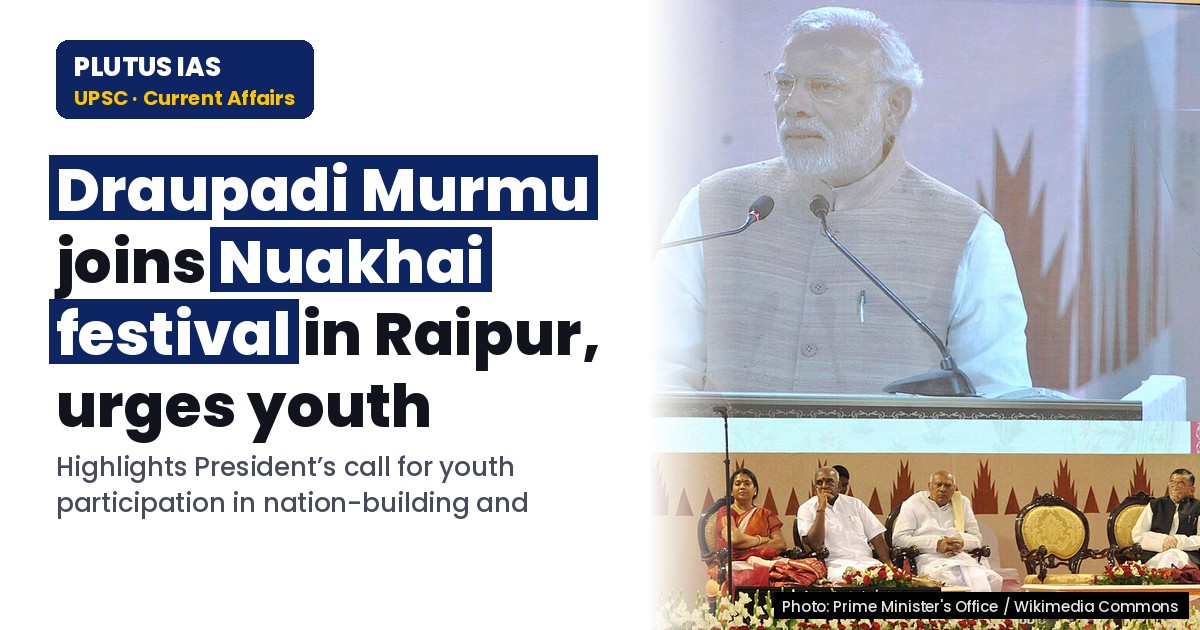
23 Oct द्रौपदी मुर्मु ने रायपुर में नुआखाई महोत्सव में लिया भाग, युवाओं को दिया संदेश
✎ Nuakhai is a harvest festival that integrates cultural heritage, agricultural sustainability, and community participation, serving as a reminder of India’s agrarian roots and the collective responsibility towards farmers and…
Subject Relevance — Where This Topic Fits
- GS Paper II — Governance, Constitution and Social Justice | GS Paper III — Agriculture, Environment and Rural Development | GS Paper IV — Ethics and Human Interface
- Prelims: Nuakhai festival, Agricultural traditions of India, Women’s participation in rural economy, Naxalism and Left-Wing Extremism, National Development Agenda 2047
- Essay: The Role of Cultural Heritage in National Integration, Youth as Catalysts for Societal Transformation
Quick Revision: Nuakhai is a harvest festival that integrates cultural heritage, agricultural sustainability, and community participation, serving as a reminder of India’s agrarian roots and the collective responsibility towards farmers and natural resources.
Why is this in the news?
The President of India, Smt. Droupadi Murmu, participated in the ‘Seva Samman Parv’ and ‘Yuva Prabodhan’ programmes organised on the occasion of the Nuakhai festival in Raipur, Chhattisgarh, on 22 October 2026. The address highlighted the cultural, agricultural, and ethical dimensions of Nuakhai, while emphasizing the collective responsibility towards farmers, natural resources, and youth empowerment in India’s developmental trajectory.
Background
- Nuakhai is an annual harvest festival celebrated predominantly in the Western Odisha and adjoining regions of Chhattisgarh, Jharkhand, and Andhra Pradesh, marking the beginning of the new rice harvest season.
- The festival is rooted in agricultural traditions and is observed with community feasts, rituals, and cultural programmes, symbolising gratitude to nature, farmers, and the earth.
- Chhattisgarh, a state with significant tribal and agricultural communities, has been a focal point for addressing issues such as Left-Wing Extremism (LWE) and promoting inclusive development.
- The Government of India’s ‘Viksit Bharat @2047’ vision aims for a developed India by 2047, integrating cultural heritage, sustainable agriculture, and youth participation as key pillars.
- The address aligns with constitutional provisions promoting social justice, gender equality (Article 15), and the directive principles of state policy (Article 39, 48, 48A) regarding agriculture and environmental conservation.
What is the Nuakhai Festival?
- Nuakhai is a socio-religious festival celebrated by the farming communities of Western Odisha and parts of Chhattisgarh, marking the first harvest of the new rice crop.
- The word ‘Nuakhai’ is derived from two Odia words: ‘nua’ (new) and ‘khai’ (food), signifying the consumption of the newly harvested rice as a sacred offering to deities and ancestors.
- The festival is observed on the fifth day of the lunar fortnight of Bhadraba (August–September), following a series of rituals including ‘Nuakhai Juhar’ (exchange of greetings) and ‘Bhoga’ (offering of rice to deities).
- Nuakhai embodies the principles of gratitude, community bonding, and sustainable agricultural practices, reflecting India’s rich cultural and agricultural heritage.
- The festival promotes social cohesion by bringing together farmers, artisans, and local communities in a shared celebration of abundance and mutual respect.
- Nuakhai is not merely a cultural event but a testament to India’s agrarian economy, where over 50% of the rural population is directly or indirectly dependent on agriculture.
- The festival also highlights the role of women in agricultural activities, food preparation, and community rituals, underscoring gender-inclusive participation in rural development.
Key Features
| Feature | Significance |
|---|---|
| Nuakhai Festival | A traditional agrarian festival of Odisha and adjoining regions, symbolising gratitude to nature, agricultural heritage, and community bonding. |
| Seva Samman Parv | A cultural-cum-social event celebrating farmers’ contributions, food security, and collective responsibility towards natural resources. |
| Yuva Prabodhan Programme | An initiative to engage youth in nation-building, emphasising ethical conduct, ambition, and service-oriented action. |
| Women’s Participation | Highlighting the critical role of women in achieving the 2047 ‘Viksit Bharat’ goal through equitable participation in social and economic spheres. |
| Naxalism Rehabilitation | Acknowledging the successful mainstreaming of erstwhile Naxal-affected youth through developmental initiatives and youth empowerment. |
Why it Matters
Cultural and Social
- Reinforces the preservation of indigenous agricultural traditions and communal harmony through participatory festivals like Nuakhai.
- Promotes intergenerational transmission of cultural values, ensuring continuity of India’s pluralistic ethos.
- Demonstrates the integration of marginalised communities (e.g., former Naxal-affected youth) into the national mainstream via developmental pathways.
Economic
- Underscores the foundational role of agriculture in India’s economy, with direct implications for food security and rural livelihoods.
- Emphasises the need for sustainable resource management to ensure long-term agricultural productivity and climate resilience.
Political and Governance
- Illustrates the use of cultural diplomacy and grassroots engagement by constitutional authorities to foster national unity and social cohesion.
- Highlights the intersection of cultural festivals with governance priorities, such as rehabilitation and youth empowerment.
Youth and Human Resource Development
- Stresses the importance of ethical leadership, ambition, and service in youth development for national progress.
- Advocates for a holistic approach to youth empowerment, combining skill development with moral and civic responsibility.
Gender and Inclusion
- Reinforces the constitutional principle of gender equality (Article 15) by advocating for women’s active participation in nation-building.
- Calls for systemic changes in societal attitudes to enable women’s socio-economic empowerment.
Challenges
1. Agrarian Distress and Farmer Suicides
- Persistent challenges in ensuring remunerative prices, access to credit, and climate-resilient agriculture for small and marginal farmers.
- Need for integrated policies addressing input costs, market access, and post-harvest losses to sustain agricultural livelihoods.
UPSC Link: GS3: Agriculture
2. Climate Change and Resource Depletion
- Increasing frequency of extreme weather events impacting crop yields and water availability, necessitating adaptive agricultural practices.
- Urgent requirement for sustainable natural resource management to balance developmental needs with ecological conservation.
UPSC Link: GS3: Environment
3. Naxalism and Left-Wing Extremism
- Residual pockets of Naxalism require continued focus on socio-economic development, education, and livelihood opportunities to prevent relapse.
- Importance of integrating former extremists into mainstream society through skill development and employment.
UPSC Link: GS3: Security
4. Youth Unemployment and Skill Gaps
- Bridging the divide between formal education and industry requirements to enhance employability and economic mobility.
- Need for vocational training and entrepreneurship support to channel youth energy into productive avenues.
UPSC Link: GS3: Employment
5. Gender Inequality and Societal Norms
- Deep-rooted patriarchal attitudes continue to restrict women’s participation in decision-making and economic activities.
- Policy gaps in enforcing gender-sensitive frameworks at grassroots levels hinder inclusive growth.
UPSC Link: GS1: Social Issues
Challenges — UPSC Perspective
| Issue | Concern |
|---|---|
| Farmer Distress | Low income, debt cycles, and vulnerability to market fluctuations threaten agricultural sustainability. |
| Climate Vulnerability | Erratic monsoons and soil degradation reduce agricultural productivity and food security. |
| Extremism Resurgence | Residual ideological influences and economic disparities may reignite Naxal-affected regions. |
| Youth Aspirations vs. Reality | Mismatch between educational outcomes and job market demands fuels frustration and migration. |
| Women’s Participation Gaps | Cultural barriers and lack of access to resources limit women’s contribution to economic growth. |
Government Initiatives — Must-Memorise for Prelims
- PM-KISAN (Pradhan Mantri Kisan Samman Nidhi)
- PM-FME (PM Formalisation of Micro Food Processing Enterprises Scheme)
- Deendayal Antyodaya Yojana – National Rural Livelihoods Mission (DAY-NRLM)
- Skill India Mission
Way Forward
- Strengthen agricultural extension services to disseminate climate-resilient farming techniques and market linkages.
- Expand vocational training programmes under Skill India Mission to align youth skills with industry needs.
- Enhance women’s SHGs (Self-Help Groups) under DAY-NRLM to improve economic participation and decision-making.
- Implement targeted rehabilitation programmes for former extremists, focusing on education, employment, and social reintegration.
- Promote participatory governance models at the grassroots to ensure inclusive development and reduce socio-economic disparities.
- Integrate cultural festivals like Nuakhai into local governance calendars to reinforce community identity and social cohesion.
- Develop agri-climate advisory systems to mitigate risks from climate change and improve farm productivity.
UPSC Value Addition
Keywords for Mains Answer-Writing
Nuakhai festival · President of India · agricultural traditions · community participation · youth empowerment · women’s empowerment · Naxal-affected regions · collective responsibility · cultural heritage · sustainable agriculture
Constitutional & Policy Linkages
- Article 15 (Prohibition of discrimination on grounds of religion, race, caste, sex or place of birth)
- Article 21 (Right to Life and Personal Liberty, including right to livelihood)
- Article 48 (Duty of the State to organise agriculture and animal husbandry on modern and scientific lines)
- Article 51A (Fundamental Duties – to value and preserve the rich heritage of our composite culture)
Concept Flow
Agricultural festivals (e.g., Nuakhai) → Cultural preservation and community bonding → Reinforcement of social fabric. → Farmers’ contributions to food security → Recognition of agrarian economy’s role in national development → Policy prioritisation for rural uplift. → Youth engagement through programmes like Yuva Prabodhan → Ethical leadership and service orientation → Nation-building and progress. → Women’s participation in cultural and economic spheres → Gender equality (Article 15) → Inclusive growth and sustainable development. → Rehabilitation of former extremists → Social integration and mainstreaming → Reduction in Left-Wing Extremism (GS3: Security). → Collective responsibility towards natural resources → Sustainable development goals → Climate resilience and food security.
Prelims Practice Questions
Q1. Consider the following statements regarding the Nuakhai festival:
1. Nuakhai is a harvest festival celebrated primarily in the state of Odisha.
2. The festival symbolizes the community’s gratitude to the farmers and the land for the harvest.
3. Nuakhai is celebrated on the day after the full moon in the month of Bhadra.
4. The festival is exclusively celebrated by tribal communities in India.
How many of the above statements are correct?
- Only one
- Only two
- Only three
- All four
Answer: Only three — Statements 1 and 2 are correct. Nuakhai is indeed a harvest festival celebrated in Odisha and symbolizes gratitude to farmers and the land. Statement 3 is incorrect as Nuakhai is celebrated on the day after the full moon in the month of Bhadrapada (August–September). Statement 4 is incorrect as the festival is not exclusive to tribal communities and is widely celebrated across Odisha.
Q2. Assertion (A): The President of India is the constitutional head of the state and exercises executive powers directly.
Reason (R): The President of India is bound by the advice of the Council of Ministers as per Article 74(1) of the Constitution.
Options:
A. Both A and R are true, and R is the correct explanation of A.
B. Both A and R are true, but R is not the correct explanation of A.
C. A is true, but R is false.
D. A is false, but R is true.
- A
- B
- C
- D
Answer: ? — Assertion (A) is false because the President of India is the constitutional head but does not exercise executive powers directly; these are exercised by the Council of Ministers. Reason (R) is true as Article 74(1) states that the President shall act in accordance with the advice of the Council of Ministers.
Q3. Match the following pairs related to agricultural festivals in India:
Column I (Festival) | Column II (State)
1. Nuakhai | A. Punjab
2. Pongal | B. Odisha
3. Baisakhi | C. Tamil Nadu
4. Onam | D. Kerala
Options:
A. 1-B, 2-C, 3-A, 4-D
B. 1-A, 2-C, 3-B, 4-D
C. 1-B, 2-D, 3-A, 4-C
D. 1-C, 2-B, 3-A, 4-D
- A
- B
- C
- D
Answer: A — 1. Nuakhai is a harvest festival celebrated in Odisha. 2. Pongal is celebrated in Tamil Nadu. 3. Baisakhi is celebrated in Punjab. 4. Onam is celebrated in Kerala. The correct match is 1-B, 2-C, 3-A, 4-D.
Mains Practice Question
✍ The Nuakhai festival, celebrated in Odisha and parts of Chhattisgarh, embodies the principles of agricultural tradition, community participation, and sustainable resource management. Critically examine the role of such cultural festivals in promoting social cohesion, economic resilience, and environmental stewardship in contemporary India. (15 Marks)
Approach: MODEL-ANSWER SKELETON:
1. **Introduction (2 Marks)**: Define Nuakhai and its cultural significance as a harvest festival. Briefly outline its connection to agricultural traditions, community participation, and environmental stewardship.
2. **Social Cohesion (4 Marks)**:
– Discuss how festivals like Nuakhai foster social cohesion by bringing communities together, strengthening cultural identity, and promoting inter-community harmony.
– Cite examples of similar festivals (e.g., Pongal, Bihu, Baisakhi) and their role in social integration.
– Reference Durkheim’s theory of collective effervescence to explain the unifying power of such festivals.
3. **Economic Resilience (4 Marks)**:
– Explain how festivals like Nuakhai contribute to economic resilience by supporting local agriculture, rural livelihoods, and small-scale industries (e.g., handicrafts, food processing).
– Discuss government schemes like PM-KISAN, PM-FME, and the National Mission for Sustainable Agriculture (NMSA) that align with such traditions.
– Highlight the role of cooperative farming and community-based agricultural practices in enhancing economic stability.
4. **Environmental Stewardship (3 Marks)**:
– Examine how festivals like Nuakhai promote environmental stewardship by encouraging sustainable agricultural practices, conservation of natural resources, and gratitude toward nature.
– Discuss the concept of ‘Vasudhaiva Kutumbakam’ (the world is one family) and its relevance to environmental ethics in Indian traditions.
– Reference the National Mission for Clean Ganga (NMCG) and the National Afforestation Programme (NAP) as contemporary initiatives that align with these values.
5. **Challenges and Critique (2 Marks)**:
– Acknowledge challenges such as commercialization of festivals, loss of traditional knowledge, and environmental degradation due to modern agricultural practices.
– Discuss the need for balancing tradition with modernity to ensure sustainable outcomes.
6. **Conclusion (2 Marks)**: Summarize the role of cultural festivals in promoting social cohesion, economic resilience, and environmental stewardship. Emphasize the need for policy interventions to preserve and promote such traditions in contemporary India.
Source: PIB (Press Information Bureau)
Chhattisgarh PCS (CGPSC) — State PCS Practice
Prelims: Chhattisgarh’s ‘Nuakhai’ festival is primarily associated with which of the following communities?
- A) Tribal communities of Chhattisgarh
- B) Urban Hindu communities of Raipur
- C) Agricultural communities of Madhya Pradesh
- D) Coastal fishing communities of Odisha
Answer: A) Tribal communities of Chhattisgarh — Nuakhai is a traditional harvest festival celebrated by the tribal communities of Chhattisgarh, particularly in the western and southern regions.
Mains: Discuss the significance of the ‘Seva Samman Parv’ and ‘Yuva Prabodhan’ programs organized by the Chhattisgarh government during the Nuakhai festival in Raipur. How do these initiatives contribute to the socio-economic development of the state?
Generated by AanyaAi for educational purpose.

- मद्रास उच्च न्यायालय ने तमिलनाडु धर्मार्थ विभाग की लापरवाही पर कड़ी टिप्पणी की - October 23, 2026
- PM Modi’s Vision: Capacity Building Commission & Mission Karmayogi for Civil Services - October 23, 2026
- रक्षा मंत्री का सेना प्रमुखों को महत्वपूर्ण निर्देश: सुरक्षा चुनौतियों का सामना करने की तैयारी - October 23, 2026

No Comments