


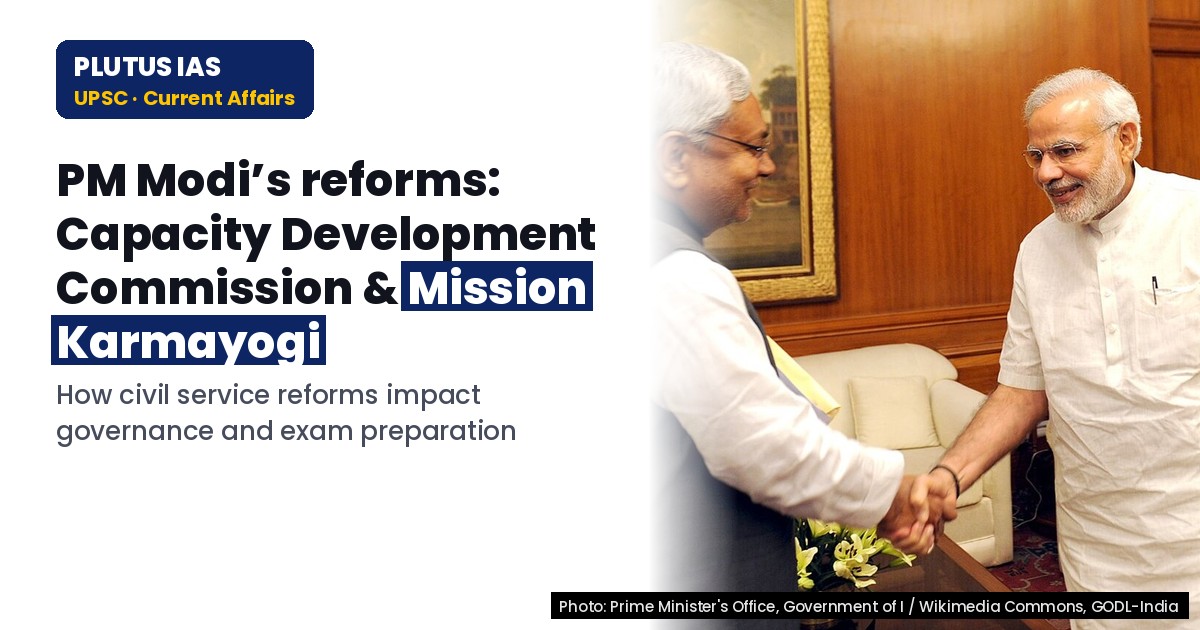
23 Oct PM Modi’s Vision: Capacity Building Commission & Mission Karmayogi for Civil Services
✎ Mission Karmayogi and the Capacity Building Commission aim to institutionalise competency-driven civil service reforms by transitioning from rule-based to role-based governance, leveraging digital platforms like iGOT Karmayogi…
Subject Relevance — Where This Topic Fits
- GS Paper II — Governance, Constitution, Polity, Social Justice and International Relations (Governance Section) | GS Paper IV — Ethics, Integrity and Aptitude (Civil Service Values and Ethics)
- Prelims: Mission Karmayogi, Capacity Building Commission, iGOT Karmayogi, Civil Service Capacity Building, Role-based governance, Rule-based governance, CPGRAMS, Digital Life Certificate, Lok Shikayat Nivaran, Civil Service Training Institutions
- Essay: The Role of Institutional Reforms in Enhancing Governance in India, Technology and Governance: Bridging the Trust Divide
Quick Revision: Mission Karmayogi and the Capacity Building Commission aim to institutionalise competency-driven civil service reforms by transitioning from rule-based to role-based governance, leveraging digital platforms like iGOT Karmayogi, and transforming training institutions into centres of excellence to enhance public service delivery.
Why is this in the news?
The statement by Union Minister Dr. Jitendra Singh on 23 October 2026 highlights the foundational role of the Capacity Building Commission (CBC) in India’s civil service reforms under Mission Karmayogi. It underscores the transition from rule-based to role-based governance, the centrality of training institutions in capacity development, and the broader administrative reforms initiated by the Government of India since 2014 to enhance citizen-centric governance. The context is set within a regional workshop in Uttar Pradesh, attended by state and union territory representatives, to deliberate on transforming government training institutions into modern competency-driven centres.
Background
- The Government of India, under Prime Minister Narendra Modi, initiated a series of governance reforms in 2014 aimed at enhancing efficiency, transparency, and citizen-centric service delivery.
- Mission Karmayogi, launched in 2020, represents a paradigm shift in civil service capacity building by moving from a rule-based to a role-based governance framework, focusing on competency development for civil servants.
- The Capacity Building Commission (CBC) was established as a statutory body under the National Programme for Civil Services Capacity Building (NPCSCB) to oversee and coordinate capacity-building efforts across government training institutions.
- The iGOT Karmayogi platform serves as the digital backbone for Mission Karmayogi, offering online training modules to over 19 lakh registered civil servants.
- Administrative reforms since 2014 have included simplifying processes, reducing bureaucratic hurdles, and leveraging technology to improve public service delivery and grievance redressal mechanisms.
- The CPGRAMS (Centralised Public Grievance Redress and Monitoring System) has seen a significant rise in complaints from around 2 lakh in 2014 to approximately 25 lakh annually, reflecting increased public trust in the grievance redressal system.
What is Mission Karmayogi and the Capacity Building Commission?
- Mission Karmayogi is a national programme for civil services capacity building, launched in 2020, aimed at transforming civil servants into effective, role-based, and citizen-centric public servants through competency development.
- The programme is implemented under the National Programme for Civil Services Capacity Building (NPCSCB), a government initiative to enhance the skills and capabilities of civil servants across all levels of government.
- The Capacity Building Commission (CBC) is a statutory body established under NPCSCB to oversee the implementation of Mission Karmayogi, coordinate capacity-building efforts, and ensure the transformation of government training institutions into modern, competency-driven centres.
- The CBC is mandated to develop a competency framework for civil servants, assess training needs, and promote excellence in civil service training through collaboration with premier institutions like the Lal Bahadur Shastri National Academy of Administration (LBSNAA) and state-level training academies.
- The iGOT Karmayogi platform is a digital learning ecosystem that provides online training modules, resources, and assessments to civil servants, enabling continuous learning and professional development.
- The transition from rule-based to role-based governance under Mission Karmayogi emphasises outcome-based performance, accountability, and alignment of civil servant competencies with their assigned roles and responsibilities.
- The CBC’s vision includes transforming government training institutions into ‘Centres of Excellence’ that foster innovation, research, and best practices in civil service training and capacity building.
- The reforms aim to enhance the efficiency, responsiveness, and integrity of the civil service, thereby improving public service delivery and citizen satisfaction.
Key Features
| Feature | Significance |
|---|---|
| Mission Karmayogi | Represents a paradigm shift from rule-based to role-based governance, aligning civil service competencies with functional responsibilities for improved public service delivery. |
| Capacity Building Commission (CBC) | Proposed by the Prime Minister in 2014, it aims to institutionalise capacity-building reforms in the civil services through structured training and competency frameworks. |
| iGOT Karmayogi Platform | A digital learning ecosystem for 19+ lakh registered officers, enabling continuous skill enhancement and standardised training across government departments. |
| Digitisation of Pension Processes | Introduction of biometric and facial-recognition technologies in life certificates has reduced compliance burdens for pensioners while ensuring transparency. |
| Simplification of Recruitment Procedures | Removal of gazetted officer attestation requirements and restrictions on interviews in select recruitments to enhance efficiency and reduce corruption risks. |
Why it Matters
Governance and Public Administration
- Institutionalises a competency-driven civil service through structured capacity-building mechanisms, ensuring alignment with evolving governance needs.
- Promotes role-based governance, reducing bureaucratic rigidity and enhancing responsiveness to citizen-centric policies.
- Strengthens the institutional framework for continuous learning and performance evaluation in the civil services.
Economic Efficiency and Transparency
- Reduces transaction costs in public service delivery through digital reforms (e.g., life certificates, grievance redressal systems).
- Enhances trust in public institutions by streamlining processes and ensuring timely resolution of citizen grievances.
- Lowers corruption risks by minimising discretionary elements in recruitment and attestation procedures.
Human Resource Development in Civil Services
- Shifts focus from tenure-based promotions to competency-based career progression, fostering meritocracy.
- Leverages technology (e.g., iGOT platform) to democratise access to training and skill development across all ranks.
- Encourages collaboration between central and state governments to standardise training content and methodologies.
Challenges
1. Implementation Gaps in State-Level Capacity Building
- Variations in administrative capacity across states may hinder uniform adoption of CBC-driven reforms.
- Need for sustained funding and resource allocation to modernise training institutions and digital infrastructure.
- Resistance to cultural change within bureaucratic hierarchies accustomed to traditional rule-based systems.
UPSC Link: GS-II: Federalism and Centre-State Relations
2. Digital Divide and Technological Adoption
- Uneven access to digital tools among civil servants, particularly in remote or resource-constrained regions.
- Cybersecurity risks associated with centralised digital platforms like iGOT Karmayogi.
- Training requirements for officers to effectively utilise digital governance tools.
UPSC Link: GS-III: Science & Technology
3. Monitoring and Evaluation Mechanisms
- Lack of robust metrics to assess the impact of capacity-building initiatives on service delivery outcomes.
- Need for periodic audits to ensure alignment between training content and ground-level governance challenges.
- Data privacy concerns in collecting and analysing officer performance data.
UPSC Link: GS-II: Governance and Accountability
4. Inter-Ministerial Coordination
- Fragmented ownership of training programmes across ministries may dilute the effectiveness of CBC-led reforms.
- Bureaucratic silos could impede the integration of role-based competencies into existing HR policies.
- Requirement for a unified governance framework to oversee implementation across departments.
UPSC Link: GS-II: Government Policies and Interventions
Challenges — UPSC Perspective
| Issue | Concern |
|---|---|
| State-Level Implementation | Variations in administrative capacity may lead to uneven adoption of reforms. |
| Digital Literacy | Officers in remote areas may face challenges in utilising digital training platforms effectively. |
| Resource Allocation | Sustained funding for modernising training institutions remains a critical bottleneck. |
| Cultural Resistance | Bureaucratic inertia may hinder the transition from rule-based to role-based governance. |
| Monitoring Framework | Absence of standardised metrics to evaluate the impact of capacity-building initiatives. |
Government Initiatives — Must-Memorise for Prelims
- Mission Karmayogi
- Capacity Building Commission (CBC)
- iGOT Karmayogi Platform
Way Forward
- Establish a multi-tiered monitoring framework to track the progress of CBC-led reforms across states and ministries.
- Develop standardised competency frameworks tailored to sector-specific governance challenges.
- Expand digital infrastructure in under-resourced regions to ensure equitable access to training platforms.
- Institutionalise periodic reviews of training content to align it with emerging governance priorities.
- Strengthen inter-ministerial coordination through a unified governance structure for capacity-building initiatives.
- Launch targeted capacity-building programmes for officers in leadership roles to drive cultural change.
- Enhance cybersecurity protocols for digital governance platforms to safeguard officer data.
- Promote public-private partnerships to leverage expertise in modernising training methodologies.
UPSC Value Addition
Keywords for Mains Answer-Writing
Capacity Building Commission · Mission Karmayogi · Civil Service Reforms · Role-based governance · Rule-based governance · iGOT Karmayogi · Governance transformation · Administrative reforms · Public service delivery · Civil Service Capacity Building · Government Training Institutes · Digital governance · CPGRAMS · Digital Life Certificate · Biometric authentication · Facial recognition technology · Governance excellence centers · Competency-driven administration · Government accountability · Citizen-centric governance
Concept Flow
2014: Prime Minister initiates governance reforms focusing on efficiency and citizen-centricity. → 2014–2023: Digital reforms (e.g., life certificates, grievance redressal) reduce transaction costs and enhance transparency. → 2023: Capacity Building Commission (CBC) conceptualised to institutionalise civil service reforms. → 2023–Present: Mission Karmayogi and iGOT platform launched to shift governance from rules to roles. → 2026: Regional workshops (e.g., Sadhana Series) facilitate state-level adoption of CBC-driven reforms. → Future: Sustained implementation of competency frameworks to achieve measurable improvements in public service delivery.
Prelims Practice Questions
Q1. Consider the following statements regarding Mission Karmayogi:
1. It aims to transition governance from a rule-based to a role-based system.
2. The iGOT Karmayogi platform is an integral component of this mission.
3. The mission focuses exclusively on training of Group A officers.
4. The Capacity Building Commission was established under this mission.
How many of the above statements are correct?
- Only one
- Only two
- Only three
- All
Answer: All — Statements 1, 2, and 4 are correct. Mission Karmayogi seeks to transform governance from a rule-based to a role-based approach, leverages the iGOT Karmayogi platform for capacity building, and established the Capacity Building Commission. Statement 3 is incorrect as the mission encompasses all levels of civil servants, not just Group A officers.
Q2. Assertion (A): The Capacity Building Commission was conceptualized by the Prime Minister in 2014.
Reason (R): The commission was established to oversee the implementation of Mission Karmayogi, which aims to enhance the competencies of civil servants.
Options:
A. Both A and R are true, and R is the correct explanation of A.
B. Both A and R are true, but R is not the correct explanation of A.
C. A is true, but R is false.
D. A is false, but R is true.
Answer: ? — Assertion (A) is false because the Capacity Building Commission was conceptualized after 2014, not in 2014. Reason (R) is true as the commission was established to implement Mission Karmayogi, which focuses on civil servant competency enhancement. Thus, R does not explain A.
Q3. Match the following initiatives with their respective objectives:
Initiatives:
1. CPGRAMS
2. Digital Life Certificate
3. iGOT Karmayogi
4. Mission Karmayogi
Objectives:
A. Streamlining grievance redressal for citizens
B. Enhancing digital governance and reducing bureaucratic burden
C. Providing a centralized platform for civil service capacity building
D. Transitioning governance from rule-based to role-based systems
Choose the correct match:
- 1-A, 2-B, 3-C, 4-D
- 1-B, 2-A, 3-D, 4-C
- 1-C, 2-D, 3-A, 4-B
- 1-D, 2-C, 3-B, 4-A
Answer: 1-A, 2-B, 3-C, 4-D — 1-A: CPGRAMS (Centralized Public Grievance Redress and Monitoring System) is designed for grievance redressal. 2-B: Digital Life Certificate uses biometric and facial recognition to simplify pensioner compliance. 3-C: iGOT Karmayogi is a digital platform for civil service training. 4-D: Mission Karmayogi aims to reform governance from rule-based to role-based systems.
Mains Practice Question
✍ The Capacity Building Commission, conceptualized under Mission Karmayogi, represents a paradigm shift in civil service reforms in India. Critically examine the significance of this shift from rule-based to role-based governance in enhancing administrative efficiency and citizen-centric service delivery. (15 Marks)
Approach: MODEL-ANSWER SKELETON:
1. **Introduction**: Define rule-based vs. role-based governance; contextualize Mission Karmayogi and the Capacity Building Commission within India’s administrative reforms post-2014.
2. **Significance of the Shift**:
– **Administrative Efficiency**: Role-based governance aligns responsibilities with competencies, reducing procedural bottlenecks (cite examples like CPGRAMS, Digital Life Certificate).
– **Citizen-Centric Delivery**: Focus on outcomes over processes enhances service quality (reference iGOT Karmayogi’s competency-driven training modules).
– **Accountability**: Clear role definitions improve performance measurement and redressal mechanisms.
3. **Challenges and Criticisms**:
– **Implementation Gaps**: Resistance to cultural change in bureaucracy; need for sustained institutional support.
– **Capacity Constraints**: Training institutes must evolve into excellence centers (reference the Capacity Building Commission’s role in accreditation and resource allocation).
– **Digital Divide**: Ensuring equitable access to digital platforms across regions.
4. **Comparative Perspective**: Contrast with traditional rule-based systems (e.g., UPSC’s role in recruitment vs. competency-based postings under Mission Karmayogi).
5. **Conclusion**: Evaluate the overall impact—whether the shift addresses systemic inefficiencies while maintaining constitutional safeguards. Highlight the need for continuous monitoring and adaptive governance frameworks.
Source: PIB (Press Information Bureau)
Generated by AanyaAi for educational purpose.
Related guides on our sites
- Current affairs for upsc 2026
- Best PSIR optional coaching for upsc
- Best PSIR optional teacher for upsc
- Best teacher of PSIR optional for upsc

- UPSC Alert: India Launches National Action Plan for Inland Small Fisheries - October 24, 2026
- विशेष अभियान 6: कपड़ा आयुक्त कार्यालय ने सफाई और दक्षता में बढ़ाया योगदान - October 24, 2026
- Inter-Caste Marriage Scheme: UPSC Exam Polity & Governance Insight - October 24, 2026

No Comments