


28 Jul पंचायती राज संस्थाओं के सशक्तिकरण पर नवीनतम रिपोर्ट: UPSC के लिए महत्वपूर्ण विश्लेषण
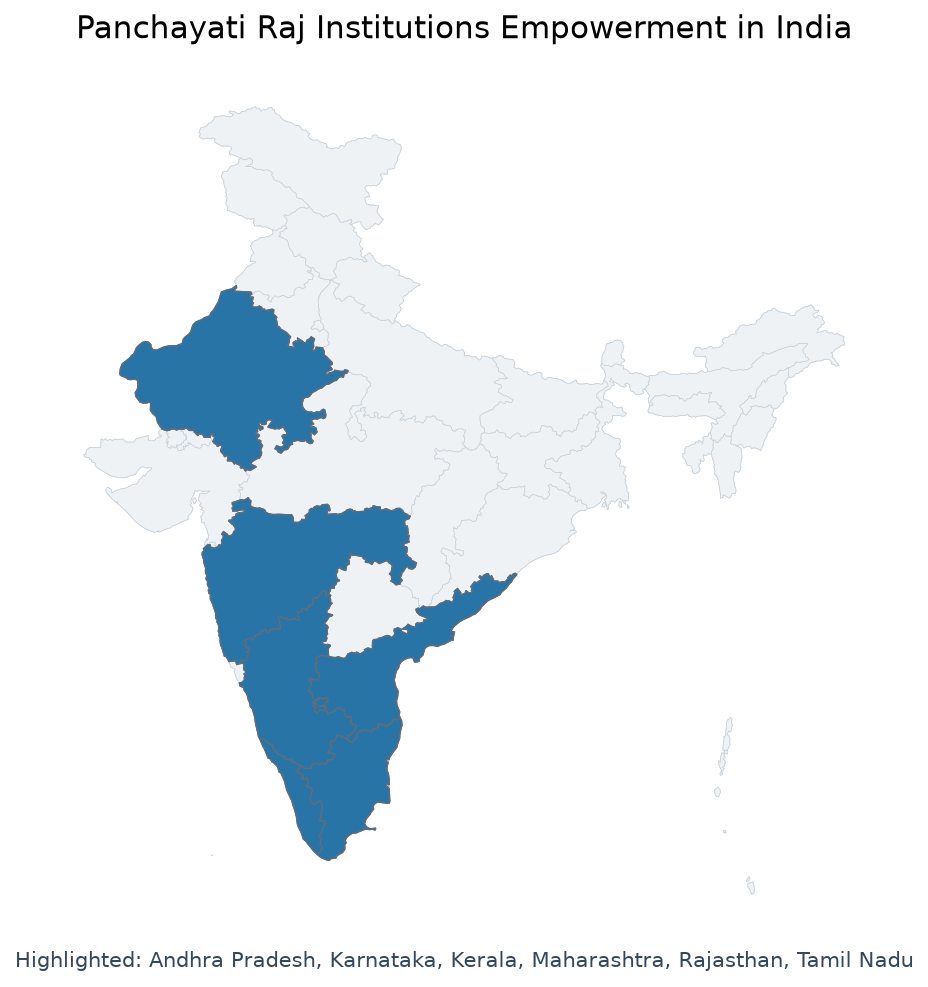
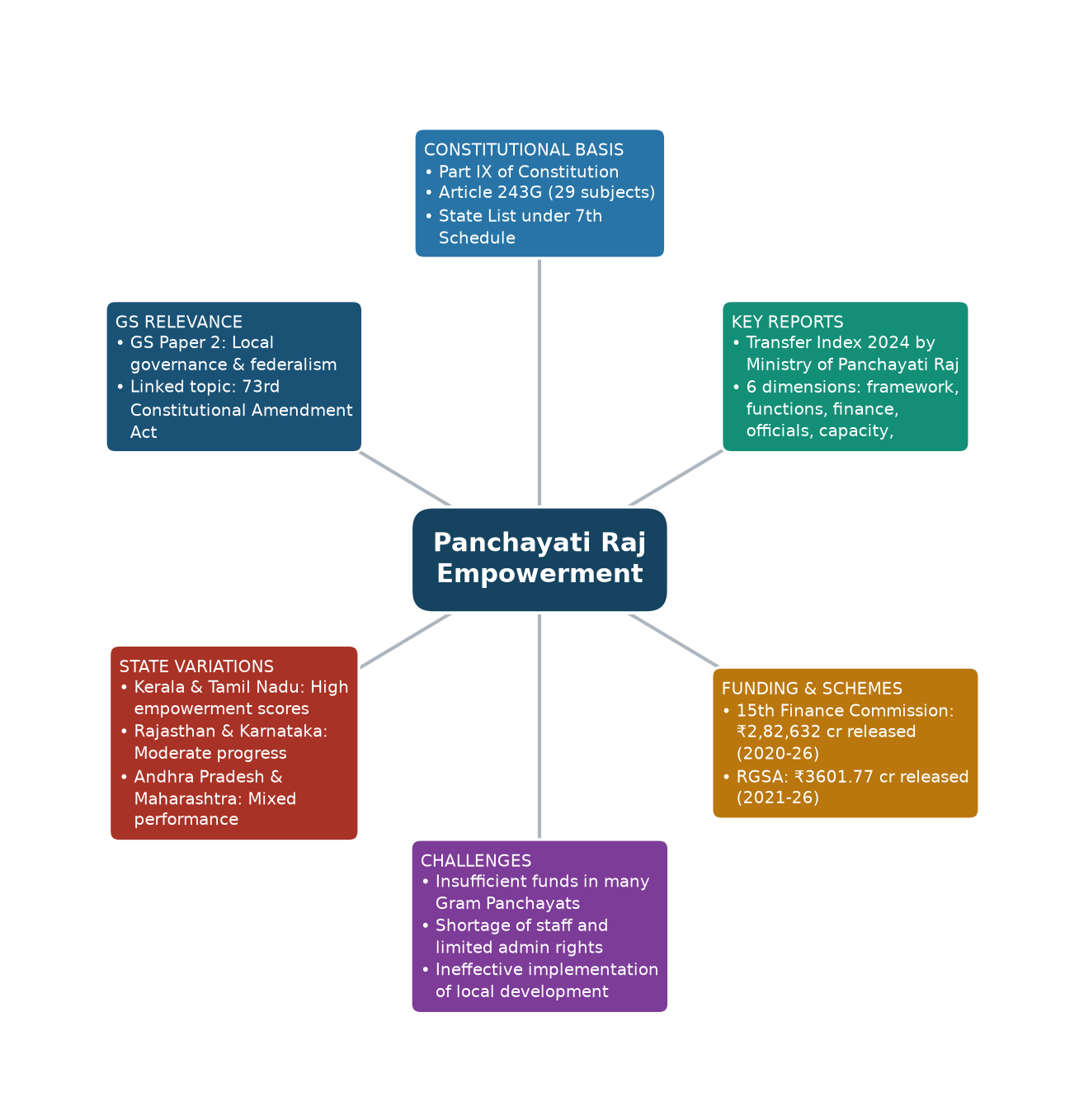
Map & concept mind-map: Panchayati Raj Institutions Empowerment in India
Subject Relevance — Where This Topic Fits
- GS Paper II — Constitutional, Administrative and Local Governance | GS Paper III — Public Finance and Governance
- Prelims: Panchayati Raj, 73rd Amendment Act, 15th Finance Commission, eGramSwaraj, RGSA, PFMS, GEM, State List (7th Schedule), Eleventh Schedule, Article 243(G), Part IX of Constitution
- Essay: Role of decentralised governance in achieving inclusive development and social justice, Challenges in fiscal federalism and local self-governance in India
Quick Revision: PRIs derive their constitutional mandate from Part IX of the Constitution (73rd Amendment Act, 1992), with Article 243(G) empowering them for economic development and social justice under the Eleventh Schedule, but their effectiveness depends on state-specific legislation, fiscal devolution, and digital governance.
Why is this in the news?
The Ministry of Panchayati Raj released the report titled ‘Status of Transfer to Panchayats: A Compendium of Evidence-Based Ranking, 2024’ in February 2025, assessing the financial and administrative empowerment of Panchayati Raj Institutions (PRIs) across states. This report highlights systemic gaps in fund utilisation, capacity building, and administrative autonomy at the grassroots level, underscoring the need for structural reforms to strengthen local democracy as envisaged under Part IX of the Constitution.
Background
- The 73rd Constitutional Amendment Act, 1992, inserted Part IX into the Constitution, establishing a three-tier Panchayati Raj system (Gram Panchayat, Panchayat Samiti, Zila Parishad) to ensure decentralised governance.
- Article 243(G) empowers state legislatures to devolve powers and responsibilities to PRIs for planning and implementing economic development and social justice schemes, including the 29 subjects listed in the Eleventh Schedule.
- PRIs operate under state-specific Panchayati Raj Acts, leading to variations in structure, functions, and fiscal autonomy across states.
- The 15th Finance Commission (2020–26) allocated ₹2,97,555 crore to PRIs, with ₹2,82,632 crore released, reflecting challenges in fund disbursement and utilisation.
- The Revised National Gram Swaraj Abhiyan (RGSA) scheme, operational since FY 2021-22, aims to strengthen PRIs through capacity building, training, and institutional support, with ₹3,601.77 crore released over five years.
- Digital governance initiatives like eGramSwaraj, integrated with PFMS and GEM, have enhanced transparency and seamless fund flow.
What are Panchayati Raj Institutions (PRIs) and their Constitutional Framework?
- PRIs are statutory local self-government bodies established under Part IX of the Constitution to ensure participatory democracy at the grassroots level.
- The 73rd Amendment Act mandates regular elections, reservation for women (33%) and marginalised groups, and a State Finance Commission to recommend fiscal devolution to PRIs.
- Article 243(G) empowers PRIs to prepare plans for economic development and social justice, with powers devolved for 29 subjects in the Eleventh Schedule, including agriculture, minor irrigation, and rural housing.
- State legislatures frame Panchayati Raj Acts, leading to heterogeneity in institutional structures, administrative autonomy, and fiscal transfers across states.
- PRIs face challenges such as inadequate financial resources, staff shortages, limited administrative authority, and weak institutional capacity, hindering effective implementation of local development schemes.
- The 15th Finance Commission’s recommendations for PRI devolution are based on criteria like population, area, and fiscal performance, aiming to bridge fiscal gaps at the local level.
- Digital platforms like eGramSwaraj integrate planning, budgeting, accounting, and audit, ensuring transparency, accountability, and real-time monitoring of PRI finances.
Key Features
| Feature | Significance |
|---|---|
| Constitutional Framework (Part IX) | Establishes Panchayati Raj Institutions (PRIs) as a three-tier system for local self-government, ensuring democratic decentralisation under Article 243 to 243O. |
| Devolution Index (2024 Report) | Quantifies the extent of devolution of funds, functions, and functionaries to PRIs across six dimensions: framework, functions, finance, personnel, capacity building, and accountability. |
| e-GramSwaraj Platform | Integrated digital governance tool for end-to-end planning, budgeting, accounting, monitoring, and online payments, enhancing transparency and financial management in PRIs. |
| 15th Finance Commission Grants (2020-26) | Provides untied funds to PRIs (₹2,82,632 crore released) to strengthen local development, with state-wise allocations detailed in Annexure I. |
| National Gram Swaraj Abhiyan (RGSA) | Centrally Sponsored Scheme (₹3,601.77 crore released over 5 years) aimed at capacity building, training, and institutional strengthening of PRIs. |
Why it Matters
Democratic Decentralisation
- Enhances grassroots democracy by devolving powers to PRIs, ensuring participatory governance and localised decision-making as envisaged in the 73rd Constitutional Amendment.
- Strengthens accountability of local representatives to constituents, fostering trust in public institutions at the micro-level.
Fiscal Federalism
- Augments fiscal autonomy of PRIs through devolved funds (e.g., 15th FC grants), enabling targeted local development without excessive state control.
- Promotes equitable resource distribution by linking allocations to performance metrics (e.g., Devolution Index).
Administrative Efficiency
- Digital platforms like e-GramSwaraj streamline financial processes, reducing leakages and improving audit compliance (90.73% audits completed in 2024-25).
- Integration with PFMS and GEM ensures transparent procurement, real-time fund tracking, and efficient expenditure monitoring.
Social Justice & Inclusion
- PRIs facilitate implementation of welfare schemes (e.g., MGNREGA, PM-KISAN) at the village level, ensuring last-mile delivery of benefits to marginalised sections.
- Reserved seats for women (33%) and SCs/STs (proportionate) in PRIs promote inclusive governance and representation.
Challenges
1. Inadequate Financial Devolution
- Disparities in devolution across states lead to uneven resource availability, hindering uniform local development.
- Shortfalls in 15th FC fund releases (₹2,97,555 crore allocated vs. ₹2,82,632 crore released) exacerbate fiscal constraints for PRIs.
UPSC Link: 73rd Amendment Act (Part IX)
2. Human Resource Deficits
- Chronic shortages of trained personnel (e.g., accountants, engineers) at the PRI level impede project execution and service delivery.
- Lack of career progression pathways discourages skilled professionals from joining local governance.
UPSC Link: Article 243G (Functions of PRIs)
3. Weak Administrative Autonomy
- State-level dominance in transfers of funds and functionaries often dilutes PRI autonomy, reducing their decision-making authority.
- Bureaucratic interference in local planning processes undermines the spirit of decentralisation.
UPSC Link: State List (7th Schedule)
4. Digital Divide & Capacity Gaps
- Limited digital literacy among PRI members restricts effective use of e-GramSwaraj and other governance tools.
- Inadequate training under RGSA hampers institutional capacity to utilise devolved funds efficiently.
UPSC Link: Article 243ZD (District Planning)
5. Audit & Accountability Lacunae
- Despite high audit compliance (90.73%), delayed or incomplete audits persist in some PRIs, risking financial mismanagement.
- Lack of independent audit mechanisms at the local level reduces transparency in fund utilisation.
UPSC Link: Article 243Z (Audit of Accounts)
Challenges — UPSC Perspective
| Issue | Concern |
|---|---|
| State Dominance in Devolution | PRIs lack functional autonomy due to excessive state control over funds and personnel transfers. |
| Low Audit Compliance | Delayed or incomplete audits undermine financial accountability in PRIs. |
| Digital Illiteracy | Limited technical skills among PRI members restrict utilisation of e-governance tools. |
| Unequal Resource Distribution | Disparities in 15th FC grants allocation create uneven development across regions. |
| Human Resource Shortages | Shortage of skilled staff (e.g., accountants, engineers) hampers local project implementation. |
Government Initiatives — Must-Memorise for Prelims
- 15th Finance Commission Grants (2020-26)
- e-GramSwaraj Platform
Way Forward
- Strengthen devolution of 3Fs (Funds, Functions, Functionaries) to PRIs by amending state Panchayati Raj Acts to align with constitutional mandates (Article 243G).
- Expand RGSA to cover digital literacy training and capacity-building programmes for PRI members, with mandatory certification.
- Enhance audit mechanisms by integrating AI-driven tools in e-GramSwaraj to detect anomalies and reduce manual errors.
- Establish a dedicated PRI Cadre under state civil services to address human resource shortages and ensure career progression.
- Mandate quarterly public disclosures of PRI finances and projects via e-GramSwaraj to enhance transparency and citizen oversight.
- Conduct state-wise benchmarking exercises using the Devolution Index to identify lagging regions and target interventions.
- Promote inter-state knowledge exchange programmes to replicate best practices in devolution and governance.
UPSC Value Addition
Keywords for Mains Answer-Writing
Panchayati Raj Institutions · 73rd Constitutional Amendment Act · 11th Schedule · State List · Article 243(G) · Devolution Index · Fifteenth Finance Commission · e-GramSwaraj · Public Financial Management System · National Gram Swaraj Abhiyan · Local Governance · Administrative Autonomy · Financial Devolution · Audit Transparency · Capacity Building
Constitutional & Policy Linkages
- Article 243 (Definitions)
- Article 243A (Gram Sabha)
- Article 243G (Powers, Authority, and Responsibilities of PRIs)
- Article 243Z (Audit of Accounts of PRIs)
- Article 243ZD (District Planning Committee)
- 73rd Constitutional Amendment Act (Part IX)
Concept Flow
Constitutional mandate (73rd Amendment) → Establishment of PRIs (three-tier system) → Devolution of 3Fs (funds, functions, functionaries) → State-level Panchayati Raj Acts → Implementation gaps (financial, administrative, human resource deficits) → Digital governance tools (e-GramSwaraj) → Performance assessment (Devolution Index 2024) → Challenges (audit delays, digital divide) → Way forward (capacity building, autonomy reforms)
Prelims Practice Questions
Q1. Which of the following is NOT a dimension used in the Devolution Index to assess the empowerment of Panchayati Raj Institutions (PRIs) as per the report released by the Ministry of Panchayati Raj in 2024?
- A. Framework
- B. Functions
- C. Foreign Policy
- D. Accountability
Answer: C. Foreign Policy — The Devolution Index evaluates PRIs on six dimensions: Framework, Functions, Finance, Personnel, Capacity Building, and Accountability. Foreign Policy is not a relevant dimension for PRIs as they operate at the local governance level.
Q2. The 73rd Constitutional Amendment Act, 1992, mandates the establishment of Panchayati Raj Institutions in India. Under which part of the Constitution does this amendment fall?
- A. Part IX
- B. Part X
- C. Part XI
- D. Part XII
Answer: A. Part IX — The 73rd Constitutional Amendment Act, 1992, which introduced Part IX to the Constitution, pertains to the Panchayati Raj system. This part outlines the structure, composition, and powers of PRIs.
Q3. Which of the following schemes is aimed at strengthening the capacity of Panchayati Raj Institutions through training and skill development?
- A. MGNREGA
- B. National Gram Swaraj Abhiyan (NGSA)
- C. Pradhan Mantri Awas Yojana
- D. Swachh Bharat Mission
Answer: B. National Gram Swaraj Abhiyan (NGSA) — The National Gram Swaraj Abhiyan (NGSA), launched in 2022-23, is a centrally sponsored scheme designed to enhance the capabilities of PRIs through training, skill development, and institutional strengthening.
Mains Practice Question
✍ Critically examine the role of the 73rd Constitutional Amendment Act in empowering Panchayati Raj Institutions (PRIs) in India. Assess the effectiveness of the Devolution Index in measuring the financial and administrative empowerment of PRIs, and suggest measures to further strengthen local governance.
Approach: Begin by outlining the constitutional provisions of the 73rd Amendment Act, including the establishment of PRIs, their composition, and the devolution of powers under the 11th Schedule. Discuss the Devolution Index as a tool for assessing PRI empowerment across six dimensions: framework, functions, finance, personnel, capacity building, and accountability. Highlight the challenges faced by PRIs, such as inadequate financial resources, staff shortages, and limited administrative autonomy. Evaluate the effectiveness of schemes like the National Gram Swaraj Abhiyan (NGSA) and digital platforms like e-GramSwaraj in enhancing transparency and efficiency. Conclude by proposing measures such as increased financial devolution, capacity-building programs, and stronger audit mechanisms to further empower PRIs and strengthen local governance.
Source: PIB (Press Information Bureau)
Generated by AanyaAi for educational purpose.

- झारखंड का 1.36 लाख करोड़ का बकाया खत्म! केंद्र बनाम राज्य अब सुप्रीम कोर्ट में - September 14, 2026
- Jharkhand’s ₹1.36 Lakh Crore Dues: Supreme Court Battle Over MMDRA Amendment - September 14, 2026
- गुजरात में स्थापित होंगे भारत के 12 सेमीकंडक्टर संयंत्रों में से 6, जानिए कैसे? - September 14, 2026

No Comments