


28 Jul पंचायती राज संस्थाओं के सशक्तिकरण पर नवीनतम रिपोर्ट: UPSC के लिए महत्वपूर्ण जानकारी
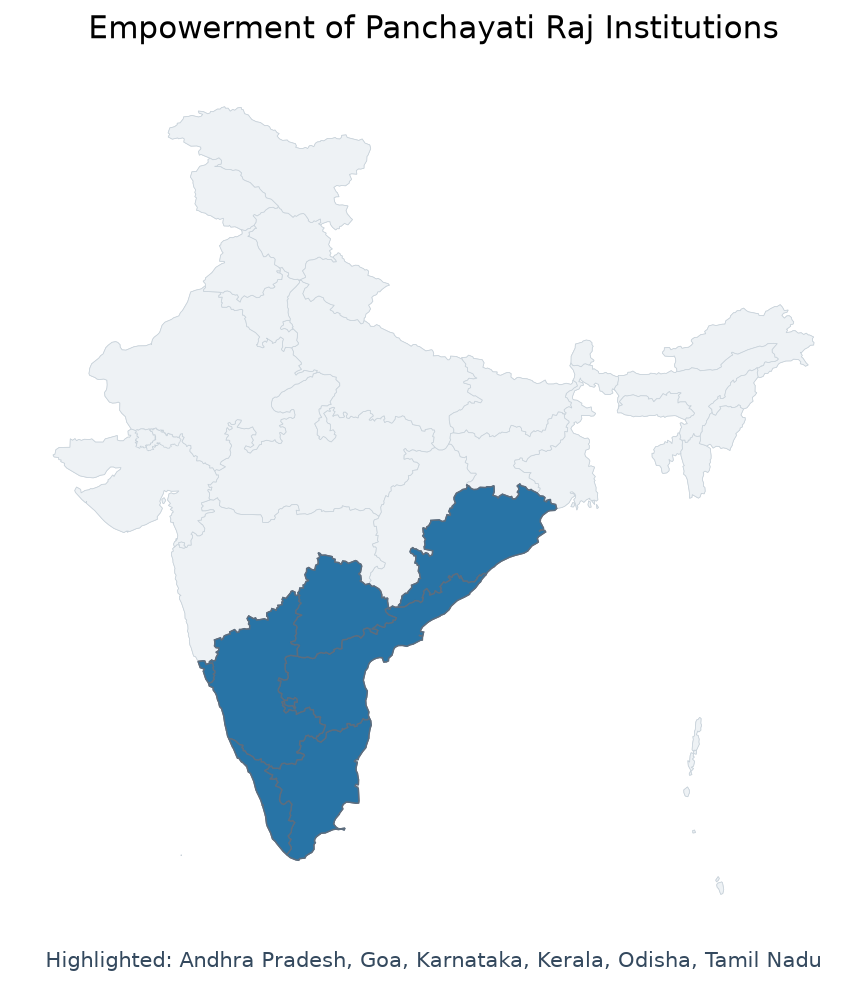
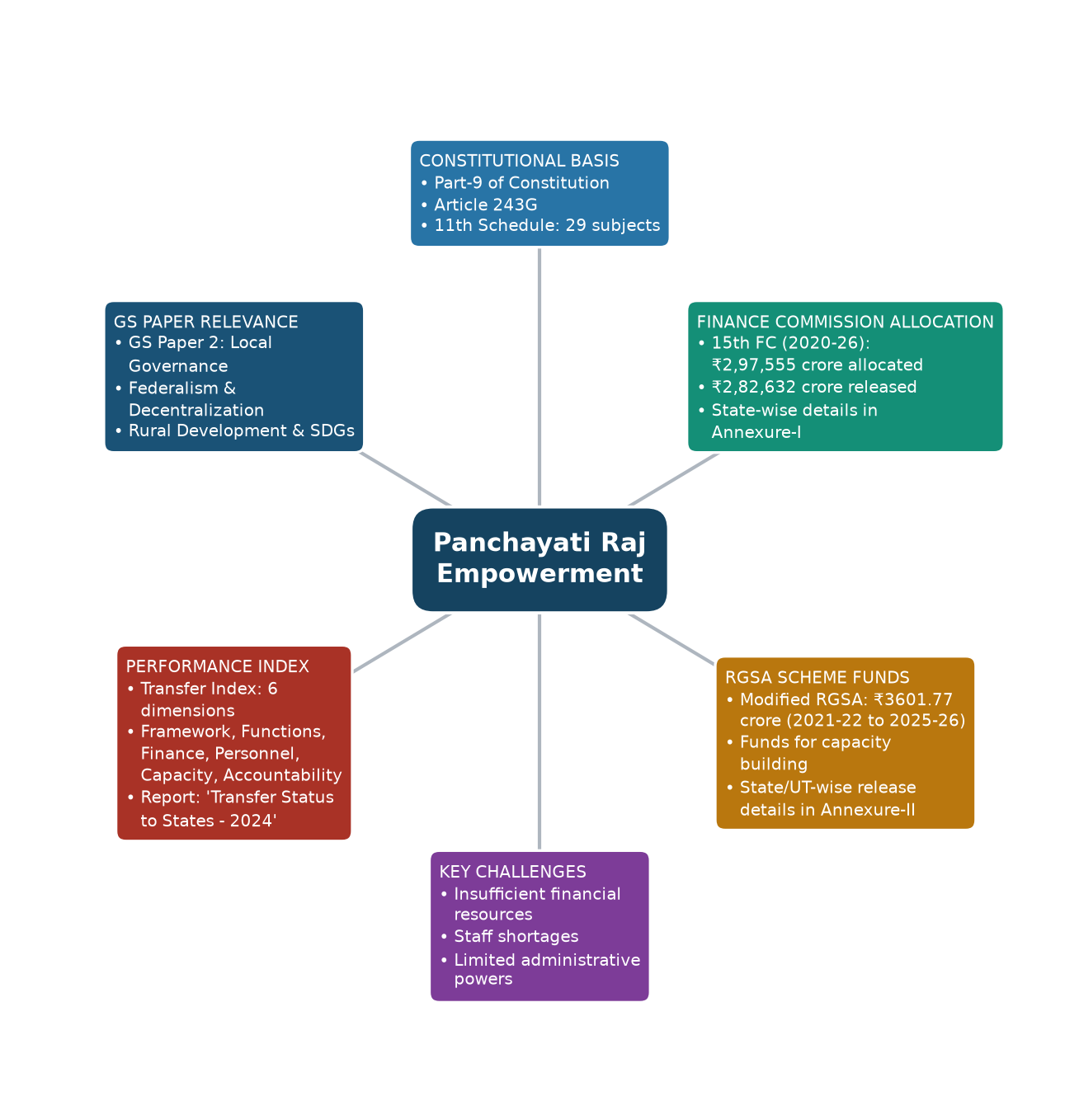
Map & concept mind-map: Empowerment of Panchayati Raj Institutions
Subject Relevance — Where This Topic Fits
- GS Paper II — Constitutional, Statutory, Regulatory and various Quasi-judicial Bodies | GS Paper III — Development, Inclusion and associated Programmes
- Prelims: 73rd Constitutional Amendment Act, 15th Finance Commission, e-Gram Swaraj, National Gram Swaraj Abhiyan, Panchayati Raj Acts, 11th Schedule, Article 243(G), Public Finance Management System (PFMS), Government e-Marketplace (GeM), AuditOnline
- Essay: Decentralisation and grassroots democracy: The bedrock of participatory governance, Technology as an enabler for inclusive development and transparency
Quick Revision: PRIs derive their empowerment from constitutional provisions (Part IX, Article 243(G), 11th Schedule) and state-specific Panchayati Raj Acts, with financial and administrative autonomy strengthened through Finance Commission transfers, RGSA, and digital governance platforms like e-Gram Swaraj.
Why is this in the news?
The Ministry of Panchayati Raj released a report titled ‘Status of Transfer to Panchayats: A Criterion-Based Ranking, 2024’ in February 2025, assessing the financial and administrative empowerment of Panchayati Raj Institutions (PRIs) across states and Union Territories. The report introduces a transfer index based on six dimensions—framework, function, finance, personnel, capacity building, and accountability—highlighting systemic challenges such as inadequate financial resources, staff shortages, and limited administrative authority that impede effective local governance and service delivery.
Background
- PRIs derive their legal and functional framework from state-specific Panchayati Raj Acts, which operationalise constitutional provisions under Article 243(G) and the Eleventh Schedule, assigning 29 subjects to local governments.
- Digital governance initiatives, including the e-Gram Swaraj platform, integrate planning, budgeting, accounting, monitoring, and audit functions, enhancing transparency and accountability in PRI operations.
What are Panchayati Raj Institutions (PRIs) and their empowerment framework?
- PRIs are constitutional bodies established under Part IX of the Constitution, functioning as institutions of local self-government in rural areas.
- Their empowerment is governed by state-specific Panchayati Raj Acts, which implement the constitutional mandate of Article 243(G) and the Eleventh Schedule, assigning 29 subjects for local governance.
- Empowerment encompasses six critical dimensions: (1) Framework (legal and institutional structure), (2) Function (assigned roles and responsibilities), (3) Finance (fiscal devolution and resource allocation), (4) Personnel (staffing and administrative capacity), (5) Capacity Building (training and skill development), and (6) Accountability (audit, transparency, and grievance redressal).
- Financial empowerment includes devolution of funds from the Finance Commission, state budgets, and centrally sponsored schemes like RGSA, aimed at reducing fiscal deficits at the local level.
- Administrative empowerment involves delegation of functions, staffing norms, and decision-making authority to PRIs, enabling them to plan and execute local development schemes independently.
- Capacity building programmes under RGSA focus on training elected representatives and officials in governance, financial management, and project implementation to enhance service delivery.
- Digital governance tools like e-Gram Swaraj integrate end-to-end planning, budgeting, accounting, and audit processes, ensuring real-time monitoring and reducing leakages.
- Accountability mechanisms include mandatory audits, social audits, and integration with platforms like PFMS, GeM, and AuditOnline to ensure transparency in fund utilisation and procurement.
Key Features
| Feature | Significance |
|---|---|
| Integrated Digital Platform (eGramSwaraj) | Enables end-to-end planning, budgeting, accounting, monitoring, and online payments for Panchayati Raj Institutions (PRIs), enhancing transparency and efficiency in local governance. |
| Constitutional Devolution Index (2024) | Ranks states/UTs across six dimensions—framework, function, finance, personnel, capacity building, and accountability—providing a data-driven assessment of PRI empowerment. |
| 15th Finance Commission Grants (2020-21 to 2025-26) | Provides Rs. 2,82,632 crore to PRIs for local development, with state-wise allocations enhancing financial autonomy of local bodies. |
| Revised Rashtriya Gram Swaraj Abhiyan (RGSA) | Allocated Rs. 3,601.77 crore over five years (2021-22 to 2025-26) to strengthen PRI capacity through training, resource mobilization, and institutional reforms. |
| Audit Compliance (2024-25) | 90.73% of PRIs (2,40,435 out of 2,64,998) submitted audit reports, demonstrating improved financial accountability and governance at the grassroots level. |
Why it Matters
Constitutional and Democratic
- PRIs are constitutional entities under Part IX of the Constitution, ensuring democratic decentralization and local self-governance as a fundamental feature of India’s federal structure.
- Empowerment of PRIs strengthens the third tier of governance, aligning with the Directive Principles of State Policy (Article 40) to promote local development and social justice.
- Enhanced financial and administrative autonomy of PRIs ensures equitable resource distribution and inclusive growth, reducing disparities between rural and urban areas.
Fiscal Federalism
- Devolution of funds (Rs. 2,82,632 crore under 15th FC) to PRIs enhances fiscal federalism by enabling local bodies to plan and execute development schemes tailored to grassroots needs.
- Integration with PFMS and GEM ensures transparent fund flow, reducing leakages and improving accountability in public expenditure at the local level.
- Audit compliance (90.73%) reflects improved financial discipline, aligning with the principles of cooperative federalism enshrined in the Constitution.
Administrative Efficiency
- Digital governance platforms like eGramSwaraj streamline administrative processes, reducing bureaucratic delays and improving service delivery in rural areas.
- Capacity-building initiatives under RGSA (Rs. 3,601.77 crore) enhance the skills of PRI functionaries, enabling them to manage local resources and implement development projects effectively.
- Standardized frameworks for devolution (Constitutional Devolution Index) provide a benchmark for states to assess and improve their PRI empowerment strategies.
Challenges
1. Inadequate Financial Resources
- Many PRIs face shortages in funds due to delays in devolution or underutilization of allocated resources, limiting their ability to execute development projects.
- Disparities in fund allocation among states (as per 15th FC data) create uneven development outcomes, exacerbating regional inequalities.
- Limited revenue-generation mechanisms at the local level constrain financial sustainability of PRIs.
UPSC Link: GS-II: Fiscal Federalism
2. Human Resource Deficits
- Shortages of trained personnel in PRIs hinder effective planning, implementation, and monitoring of local development schemes.
- High turnover of PRI functionaries, especially in remote areas, disrupts continuity in governance and capacity-building efforts.
- Lack of specialized skills in financial management, audit, and digital governance limits the efficiency of PRIs.
UPSC Link: GS-II: Governance
3. Administrative and Legal Constraints
- Variations in state-specific Panchayati Raj Acts lead to inconsistencies in devolution of powers, creating confusion and inefficiencies in governance.
- Delays in the transfer of subjects under the Eleventh Schedule (e.g., agriculture, rural development) to PRIs restrict their operational autonomy.
- Weak enforcement of audit and accountability mechanisms undermines the credibility of PRI governance.
UPSC Link: GS-II: Constitutional Framework
4. Digital Divide and Infrastructure Gaps
- Limited internet connectivity and digital literacy in rural areas hinder the adoption of eGramSwaraj and other digital governance tools.
- Inadequate training for PRI members on digital platforms reduces their ability to leverage technology for efficient governance.
- Cybersecurity risks and data privacy concerns pose challenges to the integration of PRIs with national digital ecosystems.
UPSC Link: GS-III: Science & Technology
5. Political and Bureaucratic Interference
- Interference from state governments or local political leaders in the functioning of PRIs can undermine their autonomy and effectiveness.
- Lack of political will to devolve powers and resources to PRIs perpetuates a top-down approach to governance, reducing local participation.
- Bureaucratic red tape in fund disbursement and project approvals delays critical development initiatives.
UPSC Link: GS-II: Governance
Challenges — UPSC Perspective
| Issue | Concern |
|---|---|
| Fund Shortages | Insufficient devolved funds limit PRI capacity to execute local development projects. |
| Personnel Gaps | Lack of trained staff in PRIs hampers planning, implementation, and monitoring of schemes. |
| Legal Inconsistencies | Variations in state Panchayati Raj Acts create operational ambiguities and inefficiencies. |
| Digital Exclusion | Poor internet connectivity and low digital literacy hinder adoption of e-governance tools. |
| Political Interference | External interference from state governments or local leaders undermines PRI autonomy. |
| Audit Non-Compliance | Non-submission or delayed audit reports reflect weak financial accountability in PRIs. |
Government Initiatives — Must-Memorise for Prelims
- Rashtriya Gram Swaraj Abhiyan (RGSA)
- 15th Finance Commission Grants for Panchayats
- eGramSwaraj (Digital Governance Platform)
Way Forward
- Strengthen fiscal devolution by ensuring timely and equitable distribution of funds to PRIs under the 15th and subsequent Finance Commissions.
- Expand capacity-building programs under RGSA to train PRI functionaries in financial management, digital governance, and project implementation.
- Harmonize state-specific Panchayati Raj Acts with constitutional provisions to ensure consistent devolution of powers and resources.
- Enhance digital infrastructure in rural areas through targeted investments in internet connectivity, training, and cybersecurity for PRIs.
- Establish a robust grievance redressal mechanism to address delays in fund disbursement, audit compliance, and administrative bottlenecks.
- Promote participatory governance by involving local communities in planning, monitoring, and evaluating PRI-led development projects.
- Encourage states to adopt best practices from the Constitutional Devolution Index to benchmark and improve their PRI empowerment strategies.
- Leverage public-private partnerships (PPPs) to supplement PRI resources for critical infrastructure and service delivery in rural areas.
UPSC Value Addition
Keywords for Mains Answer-Writing
Panchayati Raj Institutions (PRIs) · Constitutional Provisions (Part IX) · 15th Finance Commission · Devolution Index · National Gram Swaraj Abhiyan (NGSA) · e-GramSwaraj · Public Financial Management System (PFMS) · Local Governance · Fiscal Decentralisation · Administrative Autonomy of PRIs · Article 243G · Eleventh Schedule · State List (7th Schedule) · Audit Transparency in PRIs
Constitutional & Policy Linkages
- Article 243 (Part IX) – Constitutional provisions for Panchayats.
- Article 243(छ) – Empowerment of Panchayats for economic development and social justice.
- Eleventh Schedule – 29 subjects for devolution to Panchayats.
Concept Flow
Constitutional mandate (Part IX) → Establishment of PRIs as local self-governing bodies. → Devolution of powers and funds (15th FC, RGSA) → Financial and administrative empowerment of PRIs. → Digital governance (eGramSwaraj) → Transparency, accountability, and efficiency in PRI operations. → Audit compliance and capacity-building → Strengthened governance and service delivery at grassroots level. → Regional disparities and resource gaps → Need for equitable devolution and targeted interventions. → Political and bureaucratic challenges → Requirement for institutional reforms and autonomy for PRIs. → Outcome: Inclusive, participatory, and sustainable rural development through empowered PRIs.
Prelims Practice Questions
Q1. Which of the following is NOT a dimension assessed in the ‘Devolution Index’ for Panchayati Raj Institutions (PRIs) as per the 2024 report?
- A. Framework
- B. Functions
- C. Financial Inclusion
- D. Capacity Building
Answer: C. Financial Inclusion — The Devolution Index assesses PRIs across six dimensions: Framework, Functions, Finance, Personnel, Capacity Building, and Accountability. Financial Inclusion is not one of them.
Q2. Under which constitutional provision are Panchayati Raj Institutions (PRIs) empowered to prepare plans for economic development and social justice?
- A. Article 243D
- B. Article 243G
- C. Article 243I
- D. Article 243W
Answer: B. Article 243G — Article 243G empowers PRIs to prepare plans for economic development and social justice, including subjects listed in the Eleventh Schedule.
Q3. The ‘e-GramSwaraj’ platform is primarily designed to enhance which of the following aspects of Panchayati Raj Institutions?
- A. Electoral processes
- B. Financial transparency and audit
- C. Land record management
- D. Urban local governance
Answer: B. Financial transparency and audit — e-GramSwaraj is an integrated digital platform for planning, budgeting, accounting, monitoring, and online payments to improve financial transparency and audit in PRIs.
Mains Practice Question
✍ Critically examine the role of the 15th Finance Commission in strengthening the fiscal decentralisation of Panchayati Raj Institutions (PRIs). How has the ‘Devolution Index’ contributed to this process? Suggest measures to further enhance the financial and administrative autonomy of PRIs.
Approach: Begin by outlining the constitutional and statutory framework governing fiscal decentralisation to PRIs, including the role of the 15th Finance Commission. Analyse the quantum and utilisation of funds allocated under the 15th FC, highlighting gaps if any. Discuss the significance of the Devolution Index in assessing the effectiveness of fund transfers and its impact on local governance. Conclude with actionable recommendations such as strengthening audit mechanisms, capacity building, and leveraging digital governance tools like e-GramSwaraj to ensure transparent and efficient fund utilisation.
Source: PIB (Press Information Bureau)
Generated by AanyaAi for educational purpose.

- झारखंड का 1.36 लाख करोड़ का बकाया खत्म! केंद्र बनाम राज्य अब सुप्रीम कोर्ट में - September 14, 2026
- Jharkhand’s ₹1.36 Lakh Crore Dues: Supreme Court Battle Over MMDRA Amendment - September 14, 2026
- गुजरात में स्थापित होंगे भारत के 12 सेमीकंडक्टर संयंत्रों में से 6, जानिए कैसे? - September 14, 2026

No Comments