


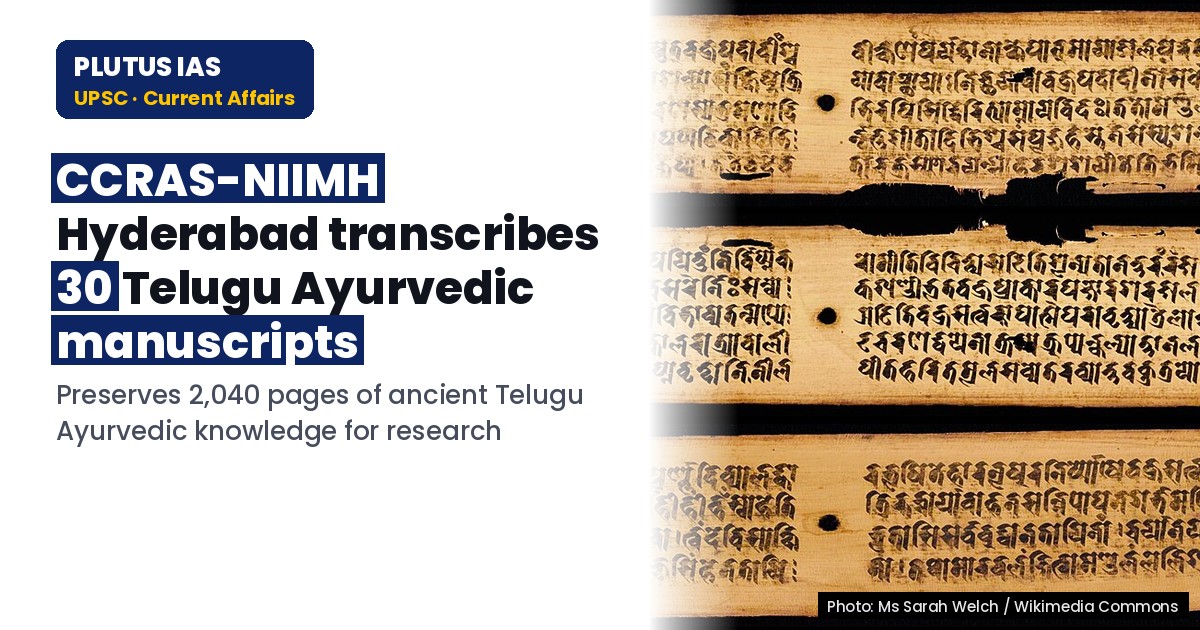
30 Oct 3-Day Workshop on Telugu Ayurvedic Manuscript Transcription in Hyderabad
✎ The CCRAS-NIIMH workshop exemplifies India’s institutional efforts to preserve Ayurvedic heritage through paleographic transcription, critical editing, and capacity-building in manuscript science.
Subject Relevance — Where This Topic Fits
- GS Paper II — Governance, Constitution, Polity, Social Justice and International Relations (Cultural Heritage and Preservation) | GS Paper III — Environment, Biodiversity, and Conservation (Traditional Knowledge Systems)
- Prelims: Ayurveda, CCRAS, NIIMH, Manuscript Conservation, Paleography, Telugu Script, Traditional Knowledge Digital Library (TKDL), Ministry of AYUSH
- Essay: The Imperative of Preserving India’s Intangible Cultural Heritage, Traditional Knowledge Systems and Modern Scientific Validation
Quick Revision: The CCRAS-NIIMH workshop exemplifies India’s institutional efforts to preserve Ayurvedic heritage through paleographic transcription, critical editing, and capacity-building in manuscript science.
Why is this in the news?
A three-day workshop on the transcription and editing of Telugu Ayurvedic manuscripts was organised by the Central Council for Research in Ayurvedic Sciences (CCRAS) in collaboration with the National Institute of Indian Medical Heritage (NIIMH), Hyderabad. The event, held from 26 to 28 October 2026, highlighted the systematic documentation and preservation of India’s medical heritage through advanced paleographic techniques and scholarly collaboration, underscoring the government’s commitment to safeguarding traditional knowledge systems under the Ministry of AYUSH.
Background
- Ayurveda, as a codified system of medicine, relies heavily on ancient manuscripts preserved in languages such as Sanskrit, Tamil, Telugu, and others, which contain critical therapeutic knowledge.
- The Government of India, through the Ministry of AYUSH, has prioritised the preservation and digitisation of traditional medical knowledge to prevent loss due to decay, neglect, or lack of standardised transcription methods.
- The National Institute of Indian Medical Heritage (NIIMH), Hyderabad, functions as a nodal agency for the conservation and study of India’s medical heritage, including Ayurvedic, Siddha, Unani, and other traditional systems.
- The Central Council for Research in Ayurvedic Sciences (CCRAS) has been instrumental in conducting research, documentation, and capacity-building initiatives to promote Ayurveda’s scientific validation and global outreach.
- Paleography, the study of ancient writing systems, is essential for accurately transcribing and interpreting manuscripts written on materials such as palm leaves and handmade paper.
- The Traditional Knowledge Digital Library (TKDL) project, initiated by the Council of Scientific and Industrial Research (CSIR), serves as a model for digitising traditional knowledge to prevent misappropriation and facilitate research.
What is the CCRAS-NIIMH Workshop on Telugu Ayurvedic Manuscript Transcription?
- The workshop was a capacity-building initiative organised by CCRAS in partnership with NIIMH, Hyderabad, aimed at training researchers, scholars, and practitioners in the transcription, editing, and critical analysis of Telugu Ayurvedic manuscripts.
- It focused on restoring and transcribing 30 Telugu Ayurvedic manuscripts comprising 2,040 pages, which are preserved in historical formats such as palm-leaf manuscripts and handmade paper.
- The primary objective was to develop specialised skills in paleography, manuscript conservation, and critical editing to ensure accurate documentation of India’s medical heritage.
- The workshop included hands-on training sessions led by experts in paleography, manuscript science, and Ayurvedic studies, such as Sri Narasimha (Tirumala Tirupati Devasthanam Library), Sri P.V.S. Kumar (Manuscript Science Expert), and Uttam Vaidya Pammi Satyanarayana Shastri.
- Participants included faculty members, postgraduate scholars, and researchers from premier Ayurvedic institutions, including SV Ayurvedic College (Tirupati), Rajarajeshwari Ayurvedic Medical College (Bidar, Karnataka), and Basavaraj Patil Ayurvedic College (Bidar).
- The event underscored the importance of systematic documentation to prevent the erosion of traditional medical knowledge and to facilitate its integration with modern scientific research.
- The workshop also highlighted the role of institutions like CCRAS and NIIMH in promoting interdisciplinary research at the intersection of Ayurveda, history, and digital humanities.
- Such initiatives are aligned with national policies promoting the preservation of intangible cultural heritage and the global recognition of India’s traditional knowledge systems.
Key Features
| Feature | Significance |
|---|---|
| Three-day transcription and editing workshop | A focused capacity-building initiative for the systematic restoration and documentation of Telugu Ayurvedic manuscripts, integrating palaeography, philology, and critical editing techniques. |
| Transcription of 2,040 pages from 30 manuscripts | A concrete output demonstrating the application of standardized transcription protocols to convert fragile palm-leaf and paper manuscripts into searchable, machine-readable text. |
| Expert-led technical sessions | Leverages domain specialists in manuscriptology, Ayurvedic textual criticism, and Telugu palaeography to ensure methodological rigour in heritage conservation. |
| Multi-institutional participation | Engages scholars, faculty, and postgraduate students from Ayurvedic colleges and research institutions, fostering collaborative networks for heritage studies. |
| Integration with CCRAS-NIIMH initiatives | Aligns with the Central Council for Research in Ayurvedic Sciences’ ongoing research projects on medical heritage documentation and preservation. |
Why it Matters
Cultural Heritage Preservation
- Facilitates the recovery of India’s Ayurvedic textual heritage preserved in Telugu script, a critical linguistic and regional tradition within classical Indian medicine.
- Ensures the long-term accessibility of priceless medical knowledge encoded in fragile palm-leaf manuscripts, which are vulnerable to decay and loss due to environmental and anthropogenic factors.
- Contributes to the global visibility of Telugu Ayurvedic literature, historically underrepresented in comparative studies of South Asian medical traditions.
Scientific Documentation
- Establishes a replicable model for the transcription and critical editing of Ayurvedic manuscripts, integrating philological rigour with Ayurvedic exegesis.
- Produces standardized, searchable texts that enable computational analysis of Ayurvedic terminology, dosage formulations, and therapeutic protocols across historical periods.
- Supports evidence-based research in Ayurveda by providing reliable primary texts for pharmacological, clinical, and historical studies.
Institutional Capacity Building
- Enhances the technical competencies of Ayurvedic scholars and researchers in manuscriptology, palaeography, and editorial practices, addressing a critical skill gap in heritage conservation.
- Strengthens institutional linkages between CCRAS, NIIMH, and Ayurvedic colleges, creating a sustainable ecosystem for heritage documentation.
- Promotes interdisciplinary collaboration between Ayurveda, linguistics, and conservation science, fostering innovation in heritage studies.
Policy and Governance
- Demonstrates the operationalisation of the Ayush Ministry’s mandate under the National Medical Heritage Mission to document and preserve India’s medical heritage.
- Provides empirical data and methodological frameworks that can inform future policy directives for the conservation of Ayurvedic manuscripts across regional languages.
- Highlights the role of government-led initiatives in safeguarding intangible cultural heritage, aligning with India’s commitments under UNESCO conventions.
Challenges
1. Fragility and Degradation of Manuscripts
- High susceptibility of palm-leaf manuscripts to insect damage, fungal decay, and physical fragmentation due to environmental exposure.
- Lack of standardized conservation protocols for Telugu Ayurvedic manuscripts, leading to inconsistent preservation practices across institutions.
- Limited availability of non-invasive imaging technologies for fragile manuscripts, complicating digitisation efforts.
UPSC Link: GS Paper 1: Indian Heritage and Culture
2. Linguistic and Scriptual Complexity
- Telugu Ayurvedic manuscripts employ archaic linguistic forms, regional dialects, and specialized medical terminology, posing challenges for accurate transcription.
- Divergence between modern Telugu orthography and historical script forms, requiring palaeographic expertise for precise interpretation.
- Absence of comprehensive dictionaries or glossaries for historical Ayurvedic Telugu, increasing the risk of misinterpretation during transcription.
UPSC Link: GS Paper 1: Indian Languages and Scripts
3. Skill Deficit in Manuscriptology
- Paucity of trained manuscriptologists and palaeographers specialising in Ayurvedic texts, particularly in regional languages like Telugu.
- Limited integration of manuscriptology into Ayurvedic education curricula, resulting in a shortage of qualified professionals for heritage conservation.
- Need for continuous professional development programmes to update scholars on evolving conservation technologies and methodologies.
UPSC Link: GS Paper 1: Indian Culture
4. Standardisation and Quality Control
- Lack of universally accepted transcription guidelines for Ayurvedic manuscripts, leading to inconsistencies in output quality across projects.
- Absence of peer-review mechanisms for transcribed texts, increasing the risk of errors propagating in published editions.
- Need for cross-institutional collaboration to develop and enforce quality benchmarks for manuscript transcription and editing.
UPSC Link: GS Paper 2: Governance and Institutions
Challenges — UPSC Perspective
| Issue | Concern |
|---|---|
| Physical degradation of manuscripts | Risk of irreversible loss of textual knowledge due to environmental and biological factors. |
| Linguistic ambiguity in historical texts | Difficulty in accurately interpreting archaic terminology and script forms. |
| Limited institutional expertise | Shortage of trained professionals in manuscriptology and Ayurvedic textual criticism. |
| Absence of standardised transcription protocols | Inconsistencies in transcription quality and output across projects. |
| Inadequate digitisation infrastructure | Constraints in applying non-invasive imaging and digital preservation techniques. |
| Interdisciplinary knowledge gaps | Lack of integration between Ayurveda, linguistics, and conservation science in training programmes. |
Way Forward
- Establish a National Ayurvedic Manuscript Transcription Task Force under CCRAS to standardise transcription protocols and quality benchmarks across regional languages.
- Develop a digital repository of transcribed Ayurvedic manuscripts with open-access licensing to facilitate research and global collaboration.
- Integrate manuscriptology and palaeography modules into Ayurvedic college curricula to address the skill deficit in heritage conservation.
- Collaborate with the Archaeological Survey of India (ASI) and state archaeology departments to assess and conserve fragile Telugu Ayurvedic manuscripts in situ.
- Launch a fellowship programme for early-career researchers to specialise in Telugu Ayurvedic manuscriptology and critical editing.
- Invest in portable non-invasive imaging technologies (e.g., multispectral imaging) for digitisation of fragile manuscripts in regional repositories.
- Promote interdisciplinary research through joint workshops with linguists, historians, and conservation scientists to refine transcription methodologies.
- Document case studies of successful manuscript transcription projects to serve as templates for replication in other regional languages.
UPSC Value Addition
Keywords for Mains Answer-Writing
CCRAS · NIIMH Hyderabad · Telugu Ayurvedic manuscripts · Manuscript transcription · Manuscript editing · Palaeography · Ayurvedic heritage · Traditional knowledge preservation · Central Council for Research in Ayurvedic Sciences · National Institute of Indian Medical Heritage · Ayush Ministry · Manuscript conservation · Textual criticism · Ancient medical knowledge · Ayurvedic research · Manuscriptology · Cultural heritage · Indigenous medical systems · Manuscript restoration
Concept Flow
Historical preservation of Ayurvedic knowledge in Telugu script → Fragility of palm-leaf manuscripts → Need for systematic transcription and editing → Capacity-building workshop under CCRAS-NIIMH → Transcription of 30 manuscripts (2,040 pages) → Standardised digital texts → Enhanced accessibility for research and education → Contribution to India’s intangible cultural heritage preservation.
Prelims Practice Questions
Q1. Consider the following statements regarding the Central Council for Research in Ayurvedic Sciences (CCRAS):
1. CCRAS is an autonomous body under the Ministry of Ayush, Government of India.
2. It is mandated to conduct research in Ayurveda, Siddha, and Unani systems of medicine.
3. The National Institute of Indian Medical Heritage (NIIMH) is a constituent unit of CCRAS.
4. CCRAS exclusively focuses on modern pharmaceutical research and does not engage with traditional knowledge systems.
How many of the above statements are correct?
- Only one
- Only two
- Only three
- All
Answer: Only three — Statements 1, 2, and 3 are correct. CCRAS operates under the Ministry of Ayush and conducts research across Ayurveda, Siddha, and Unani systems. NIIMH, Hyderabad, is a constituent unit of CCRAS. Statement 4 is incorrect as CCRAS actively engages in the preservation and study of traditional knowledge systems, including Ayurvedic manuscripts.
Q2. Assertion (A): The transcription and editing of ancient Ayurvedic manuscripts require specialised palaeographic skills.
Reason (R): Ancient manuscripts are often written in scripts that are no longer in contemporary use and may contain archaic terminology.
Code:
(A) Both A and R are true and R is the correct explanation of A.
(B) Both A and R are true but R is not the correct explanation of A.
(C) A is true but R is false.
(D) A is false but R is true.
- A
- B
- C
- D
Answer: A — Both A and R are true, and R correctly explains A. Palaeographic skills are essential for accurately transcribing manuscripts written in ancient scripts and deciphering archaic terminology, ensuring the preservation of authentic knowledge.
Q3. Match the following pairs related to Ayurvedic heritage preservation:
Column I (Institution) Column II (Location)
1. Central Council for Research in Ayurvedic Sciences (CCRAS) A. New Delhi
2. National Institute of Indian Medical Heritage (NIIMH) B. Hyderabad
3. All India Institute of Ayurveda (AIIA) C. Bengaluru
4. Morarji Desai National Institute of Yoga (MDNIY) D. New Delhi
Select the correct match:
- 1-A, 2-B, 3-D, 4-C
- 1-B, 2-A, 3-D, 4-C
- 1-A, 2-B, 3-C, 4-D
- 1-D, 2-B, 3-A, 4-C
Answer: 1-A, 2-B, 3-D, 4-C — 1-A (CCRAS is headquartered in New Delhi), 2-B (NIIMH is located in Hyderabad), 3-D (AIIA is in New Delhi), 4-C (MDNIY is in Bengaluru).
Mains Practice Question
✍ The transcription and critical editing of ancient Ayurvedic manuscripts represent a critical intervention in the preservation of India’s intangible cultural heritage. Critically analyse the significance of such initiatives, with particular reference to the recent three-day workshop on Telugu Ayurvedic manuscripts organised by CCRAS-NIIMH, Hyderabad. Also, elucidate the challenges involved in the preservation and dissemination of traditional medical knowledge in the digital age. (15 Marks)
Approach: MODEL-ANSWER SKELETON:
1. **Introduction (2 Marks)**
– Define intangible cultural heritage with reference to UNESCO 2003 Convention.
– Contextualise Ayurveda as a living tradition and its global relevance.
– Mention the CCRAS-NIIMH workshop as a contemporary initiative.
2. **Significance of Manuscript Transcription and Editing (5 Marks)**
– **Preservation of Authentic Knowledge**: Explain how transcription prevents loss of knowledge due to decay, linguistic drift, and script obsolescence.
– **Research and Validation**: Highlight how edited texts enable systematic study, comparative analysis, and validation of Ayurvedic principles (e.g., Charaka Samhita, Sushruta Samhita).
– **Policy and Legal Framework**: Reference the National Mission on Manuscripts (2003) and the Ayush Ministry’s role in heritage conservation.
– **Cultural Continuity**: Emphasise the transmission of traditional knowledge to future generations and its role in identity formation.
– **Global Relevance**: Note how digitised manuscripts facilitate international collaboration and research in traditional medicine.
3. **Challenges in the Digital Age (5 Marks)**
– **Technological Barriers**: Discuss issues in digitisation (e.g., script recognition for ancient scripts like Telugu Grantha, preservation of palm-leaf manuscripts).
– **Standardisation and Quality Control**: Challenges in ensuring accuracy in transcription and editing, including the need for peer review and cross-verification.
– **Access and Dissemination**: Address the digital divide, language barriers, and the need for open-access repositories.
– **Ethical and Legal Issues**: Concerns over intellectual property rights, commercial exploitation, and the ethical use of traditional knowledge.
– **Institutional Capacity**: Highlight the need for trained palaeographers, linguists, and interdisciplinary collaboration.
4. **Conclusion (3 Marks)**
– Summarise the dual imperative: preserving authenticity while adapting to modern tools.
– Recommend a multi-stakeholder approach involving government, academia, and civil society.
– Stress the role of policy frameworks like the National Digital Library of India (NDLI) and the Ayush Grid in scaling such initiatives.
**Key Terms to Use**: Palaeography, textual criticism, UNESCO 2003 Convention, National Mission on Manuscripts, Ayush Grid, intangible cultural heritage, digital humanities.
Source: PIB (Press Information Bureau)
Telangana PCS (TGPSC (TSPSC)) — State PCS Practice
Prelims: Which of the following organizations collaborated with the Central Council for Research in Ayurvedic Sciences (CCRAS) to organize a three-day workshop on transcription and editing of Telugu Ayurvedic manuscripts at NIIMH, Hyderabad?
- A. National Institute of Indian Medical Heritage (NIIMH), Hyderabad
- B. Telangana State Archaeology Department
- C. Osmania University, Hyderabad
- D. Indian Council of Historical Research (ICHR)
Answer: A. National Institute of Indian Medical Heritage (NIIMH), Hyderabad — The workshop was organized by CCRAS in collaboration with the National Institute of Indian Medical Heritage (NIIMH), Hyderabad, as part of efforts to preserve and document Telugu Ayurvedic manuscripts.
Mains: Discuss the significance of the three-day workshop on transcription and editing of Telugu Ayurvedic manuscripts organized by CCRAS-NIIMH, Hyderabad, in the context of preserving India’s traditional medical knowledge and its relevance to Telangana’s cultural heritage.
Generated by AanyaAi for educational purpose.
Related guides on our sites
- Sociology vs History
- Best ias coaching in Hyderabad
- Best history optional coaching in delhi
- UPSC History optional

- ISRO launches NVS-03 satellite to strengthen India’s NavIC GPS system - October 31, 2026
- हिमाचल की मुख्यमंत्री सहारा योजना: 10 हजार लाभार्थियों को मिलेगी आर्थिक मदद, डीसी करेंगे सत्यापन - October 31, 2026
- Kerala CM Urges Protection of Vembanad Lake’s Ecology for UPSC - October 31, 2026

No Comments