


06 Sep 342 Officers Commissioned at OTA: UPSC Security Analysis & Trends
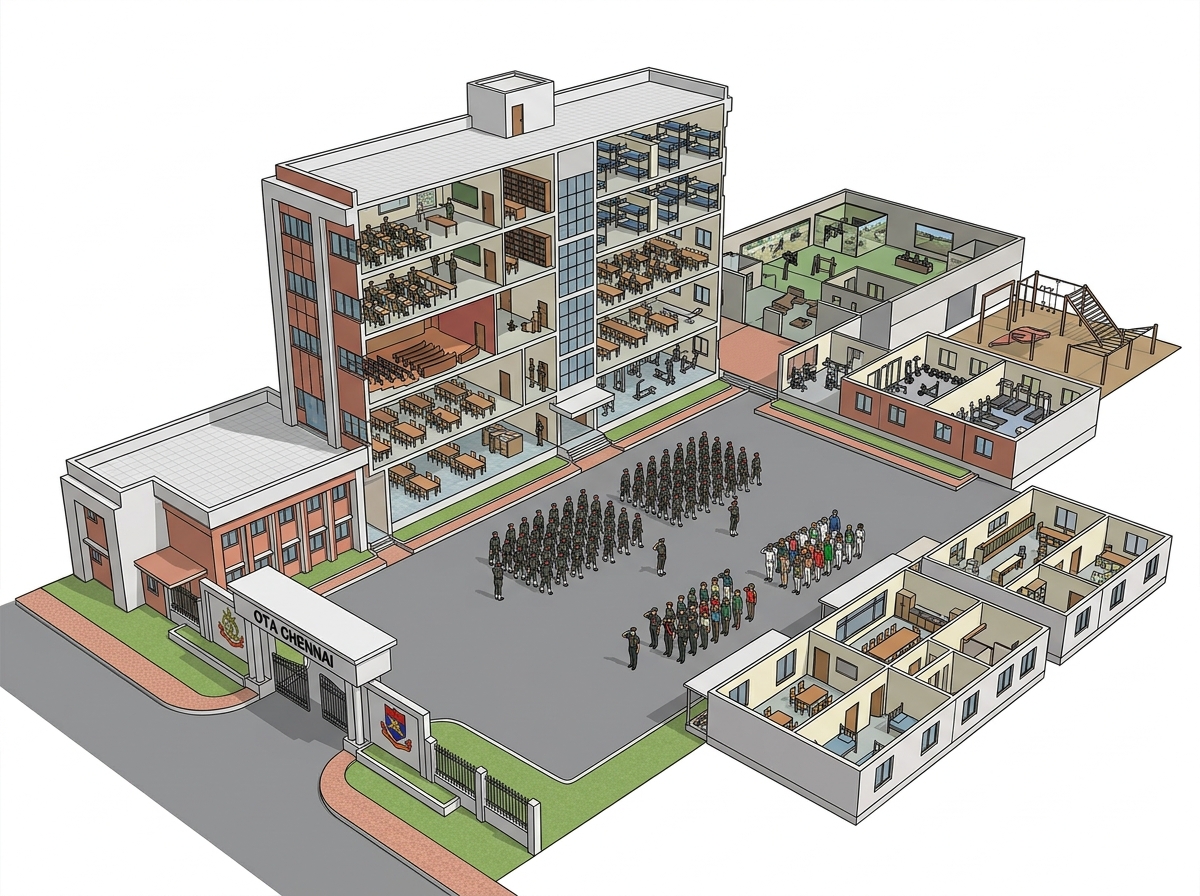
✎ The Officers Training Academy (OTA), Chennai, is a premier institution for training Short Service Commissioned Officers (SSCOs) of the Indian Army, with a 49-week programme culminating in the Passing Out Parade (POP) and…
Subject Relevance — Where This Topic Fits
- GS Paper III — Security
- Prelims: Officers Training Academy (OTA), Passing Out Parade (POP), Sword of Honour, Battalion Under Officer, Cadet Adjutant, NCC, Armed Forces
- Essay: The ethos of service and sacrifice: A study of institutional values in the Indian Armed Forces
Quick Revision: The Officers Training Academy (OTA), Chennai, is a premier institution for training Short Service Commissioned Officers (SSCOs) of the Indian Army, with a 49-week programme culminating in the Passing Out Parade (POP) and commissioning of officers.
Why is this in the news?
The commissioning of 342 officers, including 17 cadets from seven friendly foreign countries, at the Officers Training Academy (OTA), Chennai, on 6 September 2026, underscores the institution’s role in nurturing leadership, discipline, and operational readiness within the Indian Army. The Passing Out Parade (POP) serves as a formal validation of the training regimen that prepares cadets for multifaceted roles in national security and international cooperation.
Background
- The Officers Training Academy (OTA), Chennai, was established in 1963 as a premier institution for training short-service commissioned officers for the Indian Army, complementing the Indian Military Academy (IMA), Dehradun.
- The OTA conducts a 49-week training programme for cadets, including physical conditioning, tactical training, leadership development, and academic modules aligned with contemporary military requirements.
- The Passing Out Parade (POP) is a ceremonial culmination of training, where cadets are commissioned as officers and awarded medals for excellence in academics, leadership, and physical performance.
- The inclusion of foreign cadets reflects India’s commitment to defence diplomacy and capacity-building initiatives under the ‘Neighbourhood First’ and ‘Act East’ policies.
- The Indian Armed Forces have historically relied on short-service commissions to induct officers for specific durations, providing flexibility in manpower planning and operational deployment.
What is the Officers Training Academy (OTA)?
- The OTA is a training establishment of the Indian Army located in Chennai, Tamil Nadu, dedicated to the training of Short Service Commissioned Officers (SSCOs).
- It was established in 1963 and has since expanded to include women officers and foreign cadets.
- The academy conducts a rigorous 49-week training programme that integrates physical training, weapons handling, tactical drills, leadership development, and academic instruction in military subjects.
- Cadets at the OTA undergo training in disciplines such as infantry tactics, field engineering, communications, and military law, with a focus on operational readiness.
- The Passing Out Parade (POP) is a ceremonial event where cadets are commissioned as officers in the Indian Army, marked by the award of medals, trophies, and the presentation of the ‘Sword of Honour’ for the top performer.
- The OTA also trains officers for the Territorial Army and provides specialised courses for foreign military personnel under India’s defence cooperation programmes.
- The academy’s alumni include officers who have served in diverse roles, including peacekeeping missions under the United Nations, counter-insurgency operations, and disaster relief operations.
Key Features
| Feature | Significance |
|---|---|
| Passing Out Parade (POP) at Officers Training Academy (OTA) | Formal induction of trained cadets into the Indian Army, marking the culmination of rigorous military training and academic evaluation. |
| Sword of Honour and Medals | Highest honours awarded to top-performing cadets, symbolising excellence in leadership, discipline, and military aptitude. |
| Foreign Cadets from Friendly Nations | Demonstrates India’s commitment to defence diplomacy and capacity-building through joint training initiatives. |
| Family Tradition of Military Service | Reflects the enduring societal respect for the Armed Forces and intergenerational motivation for national service. |
| Chief of the Naval Staff’s Address | Emphasises the timeless values of courage, leadership, and human endeavour in warfare, irrespective of technological advancements. |
Why it Matters
Institutional Significance
- OTA, Chennai, serves as a premier training institution for Short Service Commission (SSC) officers in the Indian Army, ensuring a steady pipeline of competent leaders.
- The induction of 342 officers, including 17 from friendly foreign countries, reinforces India’s role as a regional security provider and a hub for defence training.
- The ceremony underscores the professionalisation of the Indian Armed Forces, where meritocracy and institutional values supersede other considerations.
Strategic Significance
- The inclusion of foreign cadets from Bhutan, Eswatini, Lesotho, Seychelles, Tanzania, Uganda, and Zimbabwe highlights India’s defence diplomacy and capacity-building initiatives in the Global South.
- The training of officers at OTA aligns with India’s broader strategic objectives of fostering regional stability and enhancing interoperability with partner nations.
- The event reflects India’s commitment to the United Nations’ peacekeeping operations, where trained officers often serve in leadership roles.
Societal Significance
- The participation of cadets from diverse backgrounds, including first-generation military families, exemplifies the inclusive nature of India’s defence services.
- The event serves as a source of inspiration for youth across the country, particularly in remote regions like Ladakh, where Lt. Stanzin Tsangyang’s achievement is a notable milestone.
- It reinforces the Armed Forces’ image as a symbol of national pride and a viable career path for young Indians.
Challenges
1. Ensuring Gender Parity in Military Leadership
- While the Indian Army has made progress in inducting women officers, challenges persist in achieving parity in senior leadership and combat roles.
- The Armed Forces must address systemic biases and structural barriers to ensure equitable opportunities for women in all spheres of military service.
UPSC Link: GS Paper 1: Role of Women in Armed Forces
2. Balancing Short Service Commission (SSC) and Permanent Commission (PC)
- The Indian Army relies heavily on SSC officers for operational roles, but the transition to PC remains a critical challenge for career progression and retention.
- Policy reforms are needed to incentivise SSC officers to opt for PC, ensuring a stable and motivated officer cadre.
UPSC Link: GS Paper 3: Defence Reforms and Officer Induction
3. Maintaining Training Standards Amidst Technological Advancements
- The rapid evolution of warfare, including cyber and space domains, necessitates continuous updates to training curricula at institutions like OTA.
- Ensuring that training remains relevant to modern combat scenarios without compromising core military values is a persistent challenge.
UPSC Link: GS Paper 3: Military Modernisation and Training
Challenges — UPSC Perspective
| Issue | Concern |
|---|---|
| Recruitment from Remote Regions | Ensuring equitable representation from geographically isolated areas like Ladakh and the Northeast. |
| Retention of Trained Officers | Addressing attrition rates due to better civilian career opportunities or dissatisfaction with service conditions. |
| Integration of Foreign Cadets | Overcoming language barriers, cultural differences, and ensuring seamless adaptation to Indian military ethos. |
| Gender Representation in Combat Roles | Expanding opportunities for women in traditionally male-dominated domains such as infantry and armoured corps. |
| Balancing Tradition and Modernity | Preserving core military values while adapting to technological advancements in warfare. |
Way Forward
- Enhance outreach programmes in remote and underrepresented regions to attract diverse talent into the Armed Forces.
- Review and reform the Short Service Commission (SSC) to Permanent Commission (PC) transition policies to improve retention and career progression.
- Integrate gender-neutral policies in recruitment, training, and deployment to accelerate gender parity in military leadership.
- Modernise training curricula at OTA to include cyber warfare, space operations, and hybrid warfare scenarios.
- Strengthen defence diplomacy through expanded training programmes for officers from friendly foreign nations, aligning with India’s strategic objectives.
- Promote research and development in military training methodologies to ensure adaptability to evolving global security challenges.
- Foster public-private partnerships to provide career counselling and mentorship for aspiring officers, particularly in rural and semi-urban areas.
UPSC Value Addition
Keywords for Mains Answer-Writing
Officers Training Academy (OTA) Chennai · Indian Army officer commissioning · Passing Out Parade (POP) · defence training institutions · women in armed forces · foreign cadets in Indian military training · leadership development in armed forces · military ethics and courage · defence diplomacy · Army recruitment and training · NCC and military service · family tradition in military service · defence governance and institutions
Concept Flow
Recruitment of cadets through rigorous selection processes at OTA Chennai. → Undergoing 49-week training programme encompassing physical, academic, and leadership development. → Evaluation through Passing Out Parade (POP) to assess readiness for commissioning as officers. → Awarding honours (Sword of Honour, Medals) to top performers, symbolising excellence. → Commissioning as officers into the Indian Army, marking the transition from cadets to military leaders. → Integration into operational units, where commissioned officers apply their training in real-world scenarios. → Continuous professional development through advanced courses and postings, ensuring sustained leadership in the Armed Forces.
Prelims Practice Questions
Q1. Consider the following statements regarding the Officers Training Academy (OTA) in Chennai:
1. The OTA is responsible for training officers for the Indian Army.
2. The OTA conducts the Passing Out Parade (POP) to commission officers.
3. The OTA exclusively trains Indian cadets and does not admit foreign nationals.
4. The OTA awards medals such as the ‘Sword of Honour’ to outstanding cadets.
How many of the above statements are correct?
- Only one
- Only two
- Only three
- All
Answer: All — Statements 1, 2, and 4 are correct. The OTA trains officers for the Indian Army, conducts the POP for commissioning, and awards medals like the ‘Sword of Honour’. Statement 3 is incorrect as the OTA also trains cadets from friendly foreign countries.
Q2. Assertion (A): The Indian Army commissions officers through the Passing Out Parade (POP) at the Officers Training Academy (OTA).
Reason (R): The OTA is the sole institution responsible for training all officers of the Indian Army.
- Both A and R are true, and R is the correct explanation of A
- Both A and R are true, but R is not the correct explanation of A
- A is true but R is false
- A is false but R is true
Answer: A is true but R is false — Assertion (A) is true as the POP at OTA is a formal event for commissioning officers. However, Reason (R) is false because the OTA does not train all officers of the Indian Army; other training institutions like the Indian Military Academy (IMA) also commission officers.
Q3. Match the following terms related to defence training in India with their correct descriptions:
Column I
A. Officers Training Academy (OTA)
B. Passing Out Parade (POP)
C. NCC
D. Defence diplomacy
Column II
1. A formal event where cadets are commissioned as officers
2. A voluntary youth organisation promoting national integration and discipline
3. A training institution for Short Service Commission officers of the Indian Army
4. Cooperation between countries in defence training and capacity-building
- A-3, B-1, C-2, D-4; A-2, B-1, C-3, D-4; A-1, B-2, C-3, D-4; A-4, B-3, C-2, D-1
- answer_string_array_indexed_answer_key_indexed_answer_key_indexed_answer_key_indexed_answer_key_0
- explain_match_with_full_pairs_in_explain
- format_match
Answer: A-3, B-1, C-2, D-4; A-2, B-1, C-3, D-4; A-1, B-2, C-3, D-4; A-4, B-3, C-2, D-1 — A-3: OTA is a training institution for Short Service Commission officers of the Indian Army. B-1: POP is a formal event where cadets are commissioned as officers. C-2: NCC is a voluntary youth organisation promoting national integration and discipline. D-4: Defence diplomacy involves cooperation between countries in defence training and capacity-building.
Mains Practice Question
✍ The Officers Training Academy (OTA) in Chennai serves as a critical institution for the Indian Army’s officer cadre through its Short Service Commission (SSC) training programme. In this context, critically examine the role of OTA in enhancing the operational readiness and leadership development of the Indian Army. Also, assess the significance of foreign cadets’ participation in OTA’s training programmes for India’s defence diplomacy. (15 Marks)
Approach: MODEL-ANSWER SKELETON:
1. **Introduction (2 marks)**: Define OTA, its establishment, and its role in training SSC officers for the Indian Army. Mention the Passing Out Parade (POP) as the formal commissioning event.
2. **Role of OTA in operational readiness (5 marks)**:
– Training curriculum: Emphasis on physical fitness, tactical training, leadership, and ethical values.
– Short Service Commission (SSC): Duration, eligibility, and its role in meeting short-term manpower requirements while providing a pipeline for Permanent Commission (PC).
– Integration with regular Army units: Cadets undergo unit training post-commissioning, bridging the gap between training and operational deployment.
– Women in OTA: Highlight the inclusion of women officers and its impact on gender diversity in the Army.
– Family tradition and motivation: Cite examples like Lt. Stanzin Tsangyang and Lt. Ritika Dubey to illustrate how family backgrounds influence recruitment and retention.
3. **Leadership development (4 marks)**:
– Focus on character-building: Reference Admiral Swaminathan’s speech on courage as a muscle and the human dimension of warfare.
– Awards and recognitions: ‘Sword of Honour’, OTA Gold Medal, and Silver Medal as incentives for excellence.
– NCC background: Role of NCC in fostering interest in military service among cadets.
4. **Defence diplomacy through foreign cadets (4 marks)**:
– Significance of foreign participation: Strengthening bilateral relations with friendly nations (e.g., Bhutan, Eswatini, Seychelles).
– Capacity-building: OTA’s role in training officers from allied countries, enhancing interoperability in joint exercises.
– Soft power projection: India’s image as a responsible regional power through military training collaborations.
– Challenges: Language barriers, cultural adaptation, and ensuring equitable training standards.
5. **Conclusion (2 marks)**: Summarise OTA’s dual role in bolstering the Indian Army’s operational capabilities and its contribution to India’s defence diplomacy. Highlight the need for continued investment in training infrastructure and curriculum to meet evolving security challenges.
Source: The Hindu
Generated by AanyaAi for educational purpose.
Related guides on our sites
- Current affairs for upsc 2026
- UPSC EPFO syllabus
- Gs Paper 1 Syllabus
- How to prepare for GS paper 1 for UPSC CSE mains exam

- Shivraj Singh Chouhan launches ‘Khet Bachao Abhiyan’ to save farmland - October 23, 2026
- उत्तराखंड राज्यपाल की पीएम मोदी से महत्वपूर्ण बैठक: जानिए मुख्य बिंदु - October 23, 2026
- How India’s Rs 20,000 Cr CCUS Budget Can Drive Net-Zero Goals - October 23, 2026

No Comments