


24 Jan India–EU Partnership: India’s Growing Engagement with European Union
This article covers “Daily Current Affairs” and From India–EU Partnership: India’s Growing Engagement with European Union
SYLLABUS MAPPING
GS – 2 – international relation – India–EU Partnership: India’s Growing Engagement with European Union.
FOR PRELIMS
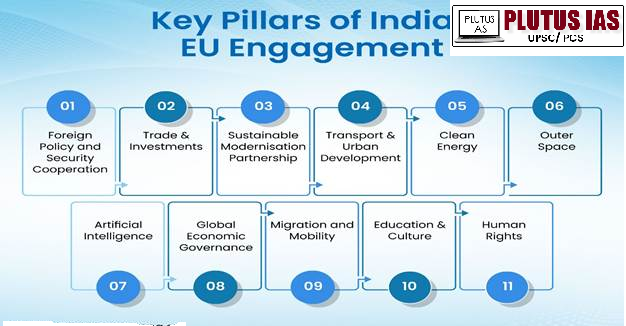
What are the main pillars of India–EU relations?
FOR MAINS
Why is the European Union important for India’s foreign policy?
Why in the News?
India–EU relations have gained renewed strategic momentum as both sides step up engagement ahead of the forthcoming India–EU Summit in New Delhi. The partnership aims to revive long-pending FTA negotiations and adopt a new Joint Strategic Agenda to shape cooperation beyond the current roadmap. Collaboration spans key areas such as trade and investment, clean energy, science and technology, security and defence, digital initiatives, connectivity, space, and agriculture.
This momentum is reinforced by sustained high-level political engagement. Notably, in February 2025, the EU College of Commissioners led by President Ursula von der Leyen visited New Delhi—the first full Commission visit to a non-European partner. Leaders have also met regularly at multilateral forums, including the G7 and G20, most recently in Canada in June 2025, and remained in close contact through high-level calls in September 2025.
Overview of India–EU Relations
India–EU relations are anchored in shared values and principles, including democracy, the rule of law, a rules-based international order, and effective multilateralism. The partnership spans a broad spectrum encompassing trade and investment, security and defence, climate action and clean energy, digital transition, connectivity, science and technology, and people-to-people exchanges. The European Union remains India’s largest trading partner in goods, with bilateral trade reaching approximately USD 136 billion in 2024–25. The EU is also among India’s top overall trading partners when goods and services are taken together. Guided by the ‘India–EU Strategic Partnership: A Roadmap to 2025’, adopted in 2020, the relationship continues to evolve towards greater mutual prosperity and global stability.
Evolution of India–EU Engagement
Early Foundations
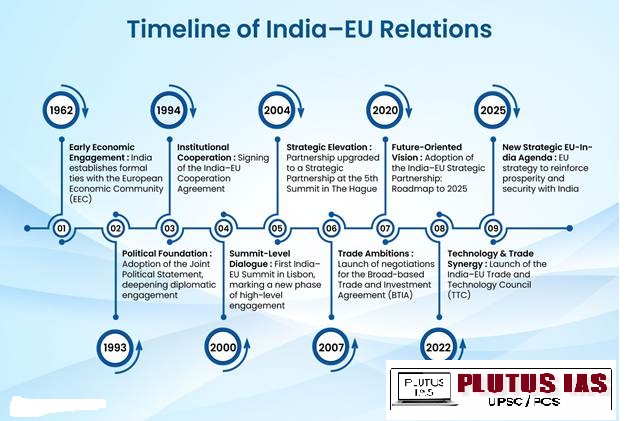
Diplomatic relations between India and the European Economic Community (EEC) date back to the early 1960s, with India among the first countries to establish formal ties in 1962. This early engagement laid the foundation for structured cooperation, culminating in the Joint Political Statement (1993) and the Cooperation Agreement (1994), which strengthened political dialogue and economic linkages.
Key Milestones in the Early 2000s
The partnership gained momentum in the early 2000s. The first India–EU Summit, held in Lisbon in June 2000, institutionalised annual high-level political dialogue. In 2004, at the fifth summit in The Hague, relations were upgraded to a Strategic Partnership, expanding cooperation beyond trade to include security, culture, and global issues.
Recent Breakthroughs
Building on this foundation, engagement has accelerated in recent years. The adoption of the India–EU Strategic Partnership Roadmap to 2025 in July 2020, the resumption of FTA and investment negotiations in May 2021, and the launch of the India–EU Trade and Technology Council (TTC) in April 2022 marked a shift towards action-oriented cooperation. The second TTC Ministerial Meeting, held in New Delhi in February 2025, further advanced collaboration in digital and green technologies, reflecting a move from dialogue to implementation.
Strategic Partnership Architecture
Over the past decade, India–EU relations have transitioned from primarily dialogue-based engagement to strategic and operational cooperation across defence, infrastructure, investment, labour mobility, and emerging global challenges. The Roadmap to 2025 has been instrumental in guiding this evolution, leading to initiatives such as the Trade and Technology Council and the proposed Security and Defence Partnership, positioning India as a key partner for the EU in addressing climate change, supply chain resilience, and regional stability.
Trade and Economic Cooperation
Trade remains a cornerstone of the partnership. Bilateral merchandise trade reached USD 136 billion in 2024–25, with EU exports to India dominated by machinery, transport equipment, and chemicals, while Indian exports to the EU include machinery, chemicals, base metals, mineral products, and textiles. Services trade has also expanded steadily. Between 2019 and 2024, Indian services exports to the EU increased from EUR 19 billion to EUR 37 billion, while EU services exports to India rose to EUR 29 billion, underscoring growing economic interdependence.
Defence and Security Cooperation
India–EU security and defence cooperation deepened significantly in 2025. The Leaders’ Statement issued during the February 2025 visit of the EU College of Commissioners agreed to explore a Security and Defence Partnership, accompanied by discussions between the EU Commissioner for Defence and Space and India’s Minister of State for Defence.
This momentum continued with a December 2025 visit by a delegation from the Society of Indian Defence Manufacturers to Brussels, aimed at fostering defence-industrial cooperation. In September 2025, the EU Political and Security Committee, representing all 27 EU member states, undertook its first-ever visit to Asia, holding high-level meetings in India to advance strategic dialogue.
Operational cooperation has been reinforced through joint naval exercises, including in the Indian Ocean (June 2025), Gulf of Guinea (October 2023), and Gulf of Aden (June 2021), as well as coordinated humanitarian escort operations near Somalia. In an address to the European Parliament on 21 January 2026, the EU High Representative for Foreign Affairs and Security Policy described the upcoming 16th India- EU Summit as a pivotal opportunity to deepen security cooperation, including in maritime security, cybersecurity, cyber defence, and counterterrorism.
Clean Energy and Climate Cooperation
Energy and climate action form a central pillar of the India–EU partnership. The Clean Energy and Climate Partnership (CECP), established in 2016, entered Phase III in November 2024, reflecting expanded cooperation. The EU has been a partner in the International Solar Alliance since 2018 and supports sustainable transport and urban mobility projects in India through the European Investment Bank.
Cooperation also extends to offshore wind energy, gas infrastructure, methane emissions reduction, investments, and technology transfer. The EU’s accession to the Coalition for Disaster Resilient Infrastructure (CDRI) in March 2021 further underscores shared climate priorities. In advanced scientific domains, India and the EU signed an R&D agreement on peaceful uses of nuclear energy with EURATOM in July 2020, and India has been an associate member of CERN since 2017.
Connectivity Initiatives
Connectivity has emerged as a strategic pillar of India–EU cooperation, aimed at promoting sustainable, inclusive, and resilient linkages.
India–EU Connectivity Partnership (2021): Focuses on transport, digital, and energy infrastructure, facilitating the movement of goods, services, data, capital, and people.
Trilateral Development Cooperation (June 2025): Enables joint development projects in third countries.
India–Middle East–Europe Economic Corridor (IMEC): Announced in September 2023 on the margins of the G20 Summit in New Delhi, involving India, the EU, key European states, the Middle East, and he United States.
Science, Technology, and Space Cooperation
Science and technology cooperation is anchored in the 2007 Science and Technology Cooperation Agreement, guided by a Joint Steering Committee. Collaboration spans smart grids, water, vaccines, ICT, polar science, and researcher mobility, including engagement with the European Research Council. India also participates in selected projects under the EU’s Horizon 2020 programme through co-funding arrangements.
Space cooperation has expanded significantly. Building on early collaboration through Ariane launches in the 1980s, India and the EU now cooperate closely through ISRO–ESA agreements covering Earth observation, navigation, and mission support. The successful launch of ESA’s Proba-3 mission by ISRO’s PSLV-XL in December 2024 and the signing of a Joint Statement of Intent on human space exploration in May 2025 highlight the growing depth of engagement.
Migration and Mobility
Migration cooperation has evolved from dialogue to structured frameworks, notably the Common Agenda on Migration and Mobility (2016). The 9th High-Level Dialogue on Migration and Mobility in November 2025 advanced proposals for legal migration pathways, including a pilot European Legal Gateway Office in India.
As of end-2024, over 931,600 Indian nationals resided in the EU, forming the largest group of EU Blue Card holders. Educational ties are equally strong, with more than 6,000 Indian students receiving Erasmus Mundus scholarships over the past two decades.
Best ias coaching in delhi Best ias coaching in chandigarh
Prelims question:
Q. With reference to India–European Union (EU) relations, consider the following statements:
1.The India–EU Trade and Technology Council (TTC) was launched in 2022 to promote cooperation in digital and green technologies.
2.The European Union is India’s largest trading partner in goods.
3.The India–EU Connectivity Partnership was launched during the G20 Summit held in New Delhi in 2023.
Which of the statements given above is/are correct?
(a) 1 and 2 only
(b) 2 and 3 only
(c) 1 and 3 only
(d) 1, 2 and 3
Answer: A
Q. “India–European Union relations have gained renewed strategic momentum in recent years.”
Discuss the key areas of cooperation between India and the EU and examine their significance for India’s foreign policy. (250 words)

- Artemis II: Humanity’s Return to Lunar Space and India’s Place in the New Moon Race - April 2, 2026
- A Missed Opportunity to Guarantee Minimum Wages - March 31, 2026
- ‘India’s Growth Claims, A Clash with Data Reality’. - March 30, 2026

No Comments