


30 Mar ‘India’s Growth Claims, A Clash with Data Reality’.
This article covers “Daily Current Affairs” and From ‘India’s Growth Claims, A Clash with Data Reality’.
SYLLABUS MAPPING
GS -3 – Inclusive growth and issues arising from it – ‘India’s Growth Claims, A Clash with Data Reality’.
FOR PRELIMS
What is the main concern about India’s GDP data?
FOR MAINS
Why is the informal sector important.
Why in the News?
India’s official GDP figures have long projected an image of rapid economic progress, but this often contrasts with the lived realities of many citizens facing unemployment, stagnant incomes, inflation, and economic insecurity. This gap has sparked debate over whether headline growth truly reflects broad-based development.
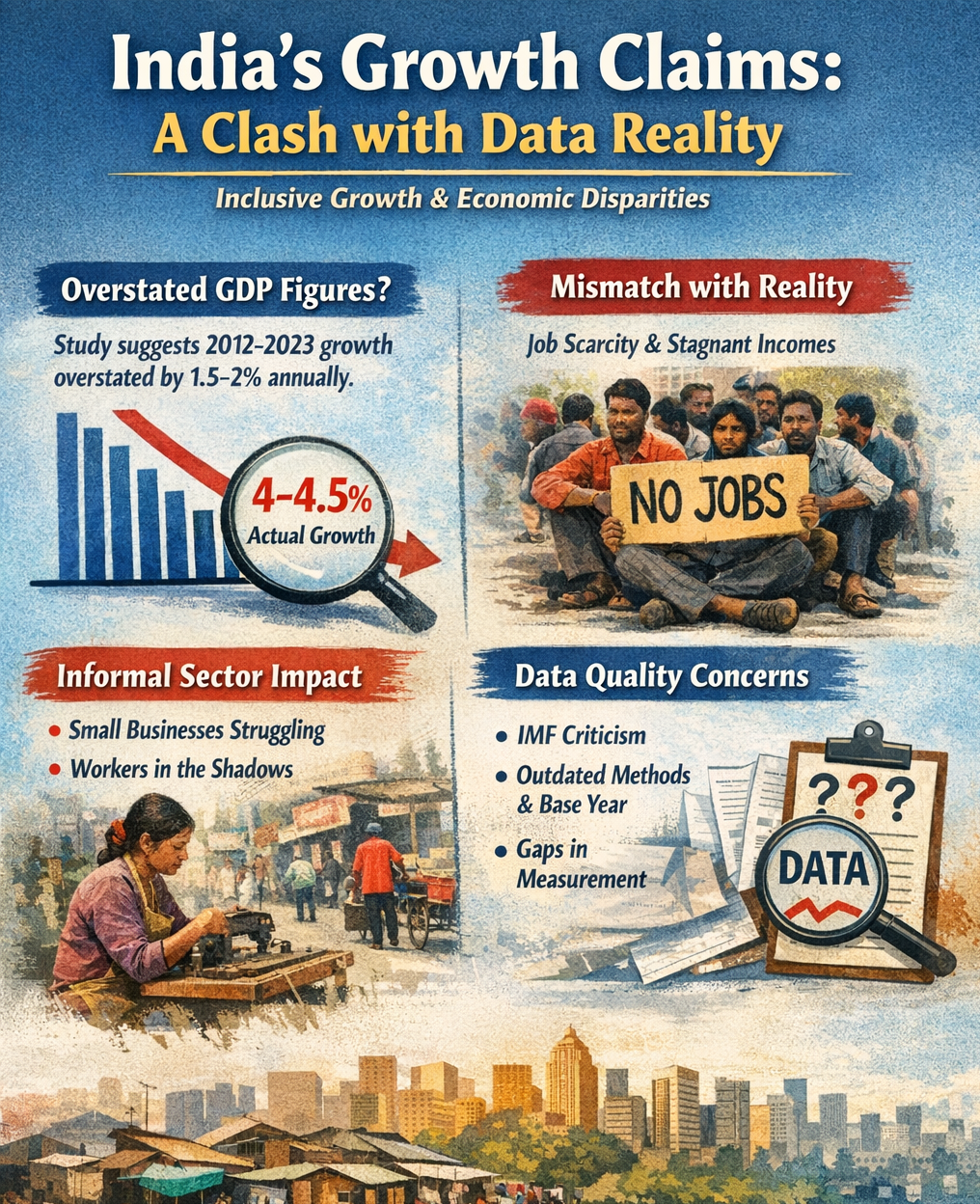
The debate intensified after a March 2026 Peterson Institute paper argued that India’s GDP growth from 2012–23 may have been overstated by 1.5–2 percentage points annually, suggesting actual growth was closer to 4–4.5% and the economy smaller than official estimates. Alongside concerns raised by the IMF, delays in base-year revision, and weak measurement of the informal sector, the issue has drawn attention to possible flaws in India’s economic data especially as strong official growth figures coexist with weak jobs, investment, and demand on the ground.
Core Issue
At its heart, the debate is whether India’s official GDP estimates provide an accurate picture of economic activity or suffer from methodological biases that overstate growth, particularly post-2011. Critics argue that reliance on formal sector proxies, outdated deflators (often based on Wholesale Price Index rather than producer or consumer prices), and an outdated base year (2011-12) have created distortions. The recent study traces misestimation to two key problems: using formal corporate data as a proxy for the informal sector (which was hit harder by shocks) and inappropriate price deflators that failed to capture relative price shifts.
While government responses emphasize ongoing revisions and high growth prints, independent analyses highlight a growing gap between headline numbers and ground-level indicators like private investment, real wages, manufacturing job creation, and consumption patterns.
Why India’s GDP Data is Being Questioned
The questioning stems from persistent discrepancies between official growth claims and other economic signals. The 2026 paper suggests post-2011 overestimation of 1.5–2 percentage points annually, leading to a potential 22% overstatement of economy size. Earlier work by Arvind Subramanian and others had flagged similar issues. Additional red flags include the IMF’s data quality concerns, sizeable gaps between production/income-side and expenditure-side GDP estimates, and reliance on single deflation methods. High reported growth coexists with sluggish credit off-take in some segments, concerns over corporate sales data, and youth unemployment, making the narrative harder to reconcile with everyday experiences.
Even small annual errors compound over time, distorting long-term comparisons, investment decisions, and perceptions of policy success.
Structural Weaknesses in Economic Measurement
India’s national accounts have long faced challenges due to the economy’s dual structure. Estimation increasingly leans on formal sector data—corporate filings, organised industry reports, and administrative sources—which are easier to collect but do not fully represent the broader economy. The base year (still anchored to 2011-12 in recent periods) has become outdated, and deflators based on commodity prices (WPI) may not accurately reflect production costs or value addition across sectors. Recent government efforts aim to address this through methodological overhauls, including better incorporation of surveys like ASUSE and PLFS for unincorporated enterprises.
However, structural issues persist: limited direct measurement of small-scale and household enterprises, infrequent comprehensive surveys, and challenges in capturing dynamic shifts in a rapidly evolving economy.
Formal vs Informal Economy: The Measurement Gap
India’s informal (unorganised) sector accounts for a significant share of Gross Value Added (historically over 50% in many estimates, though varying by sector and definition) and employs the vast majority of the workforce, especially in agriculture, trade, construction, and services. Formal sector data is used as a proxy for informal activity in many calculations, assuming similar trends. Yet, the two sectors often diverge sharply—particularly after policy shocks that disproportionately affected cash-dependent, small-scale operations. This “visibility problem” means the formal sector is overrepresented in statistics, while the larger informal segment remains underrepresented or mis measured.
The informal economy’s porous boundaries with formal systems add complexity, but the gap in direct data collection creates blind spots.
Disconnect Between GDP Growth and Lived Economic Reality
Despite reported high growth, several indicators paint a more subdued picture: sluggish private investment in recent years, stagnant or slow real wage growth in many segments, limited job creation in labour-intensive manufacturing, and persistent concerns over youth unemployment and underemployment. Consumption patterns, especially in rural areas, have shown weakness at times, and the benefits of growth appear concentrated. Citizens often experience the economy through the lens of job quality, income security, and price stability rather than aggregate GDP, leading to a credibility gap in the official narrative.
Impact of Demonetisation, GST, and COVID-19
A series of major shocks severely disrupted the informal economy:
Demonetisation (2016): Hit cash-reliant sectors hard, causing short-term contractions in trade, manufacturing, and services.
GST rollout (2017): Increased compliance burdens on small firms, leading to some closures and formalisation pressures, though it also improved tax collections long-term.
COVID-19 pandemic: Disproportionately affected informal workers through lockdowns, reverse migration, and loss of livelihoods, with estimates suggesting massive job and output losses in unorganised segments.
Analyses indicate cumulative economic losses to the informal sector in the range of ₹11.3–11.5 lakh crore (around 4.3% of FY23 GDP), with millions of jobs affected and many small enterprises shutting down. Because GDP methods relied heavily on formal indicators, the full extent of distress in informal areas may not have been fully captured in real-time statistics, creating statistical blind spots.
Rising Inequality and the Illusion of Formalisation
Economic growth has increasingly concentrated benefits among large corporations and higher-income groups, while public welfare delivery faces challenges in effectiveness and reach. Formalisation is often touted as progress—reflected in higher tax collections and organised sector data—but it can mask the displacement of small businesses, rising market concentration, and reduced livelihood diversity. What appears as efficiency gains in national accounts may represent economic displacement for millions in the informal workforce, exacerbating inequality and contributing to the perception that growth is not sufficiently inclusive.
Concerns About Data Transparency and Statistical Credibility
Recent years have seen delays in key data exercises, including the 2021 Census (further postponed due to various reasons), non-release or delays in certain consumption surveys, and controversies surrounding unemployment and other sensitive datasets. These patterns have fueled perceptions of discomfort with unfavourable data. The IMF’s grading and calls for updated base years, better price indices, and improved informal sector coverage have added to the scrutiny. While the government has initiated revisions (e.g., new GDP series efforts in 2026), critics argue for greater independence and timeliness in statistical releases to restore credibility.
Why Reliable Statistics Matter in a Democracy
Statistics are essential public infrastructure, not merely tools for showcasing achievements. Credible, transparent data allows citizens to hold governments accountable, enables evidence-based policy design, and helps identify emerging crises before they escalate. In a democracy as large and diverse as India’s, unreliable numbers risk turning economic management into guesswork. They undermine informed public discourse and weaken the social contract between the state and its people. When data aligns with reality, it builds trust; when it diverges, it erodes it.
Implications for Governance, Policy-Making, and Public Trust
Inaccurate statistics can lead to misguided policies—over-optimistic fiscal planning, misallocated resources, or delayed interventions in distressed sectors. They affect investment decisions by domestic and foreign players and shape public perception of government performance. Persistent doubts risk damaging institutional credibility, reducing policy effectiveness, and fostering cynicism. For governance, the stakes are high: better data is crucial for targeted welfare, employment generation, and sustainable development strategies in an economy aspiring for inclusive growth.
Way Forward
To address these challenges, India should:
Strengthen the independence and capacity of statistical institutions (e.g., Ministry of Statistics and Programme Implementation).
Accelerate the adoption of improved methodologies, including regular, robust surveys for the informal and household sectors, updated base years, and more appropriate deflators (moving beyond heavy WPI reliance).
Ensure timely conduct and release of key exercises like the Census and consumption surveys.
Promote greater transparency by mini – mising selective data handling and encouraging peer review or independent validation where appropriate.
Invest in digital tools and administrative data integration while safeguarding privacy and quality.
Foster a culture that values data as a neutral public good rather than a political instrument.
Recent steps toward methodological revisions are positive; sustaining and deepening them will be key.
Conclusion
Q. Consider the following statements regarding recent concerns over India’s GDP estimation:
1. A 2026 working paper by economists Abhishek Anand, Josh Felman, and Arvind Subramanian suggested that India’s GDP growth between 2012 and 2023 may have been overestimated by approximately 1.5 to 2 percentage points annually.
2. One major methodological issue highlighted is the use of formal sector data as a proxy for the vast informal sector, which was disproportionately affected by shocks like demonetisation, GST, and COVID-19.
3. The International Monetary Fund (IMF) has consistently given India an ‘A’ grade for the quality of its national accounts data in recent Article IV reports.
Which of the statements given above is/are correct?
(a) 1 and 2 only
(b) 2 and 3 only
(c) 1 and 3 only
(d) 1, 2 and 3
Answer: (a) 1 and 2 only
“Despite impressive headline GDP growth figures, there exists a growing disconnect between official economic statistics and the lived economic realities of ordinary citizens in India.” In the light of recent studies highlighting GDP misestimation, examine the structural weaknesses in India’s economic measurement system and suggest measures to bridge the gap between data and ground reality. (15 Marks)

- Artemis II: Humanity’s Return to Lunar Space and India’s Place in the New Moon Race - April 2, 2026
- A Missed Opportunity to Guarantee Minimum Wages - March 31, 2026
- ‘India’s Growth Claims, A Clash with Data Reality’. - March 30, 2026

No Comments