


31 Mar A Missed Opportunity to Guarantee Minimum Wages
This article covers “Daily Current Affairs” and From A Missed Opportunity to Guarantee Minimum Wages
SYLLABUS MAPPING
GS -3 – Rural Economy, Employment, Wage Policy – A Missed Opportunity to Guarantee Minimum Wages.
FOR PRELIMS
What is the key factor influencing the success of employment guarantee schemes ?
FOR MAINS
What major issue persists in the VB-G RAM G Act ?
Why in the news
Public employment programmes are vital to India’s rural welfare framework, protecting people from unemployment, poverty, and distress migration. MGNREGA (2005) has been a major initiative, guaranteeing 100 days of wage employment to rural households and supporting livelihood security, asset creation, women’s empowerment, and rural infrastructure.
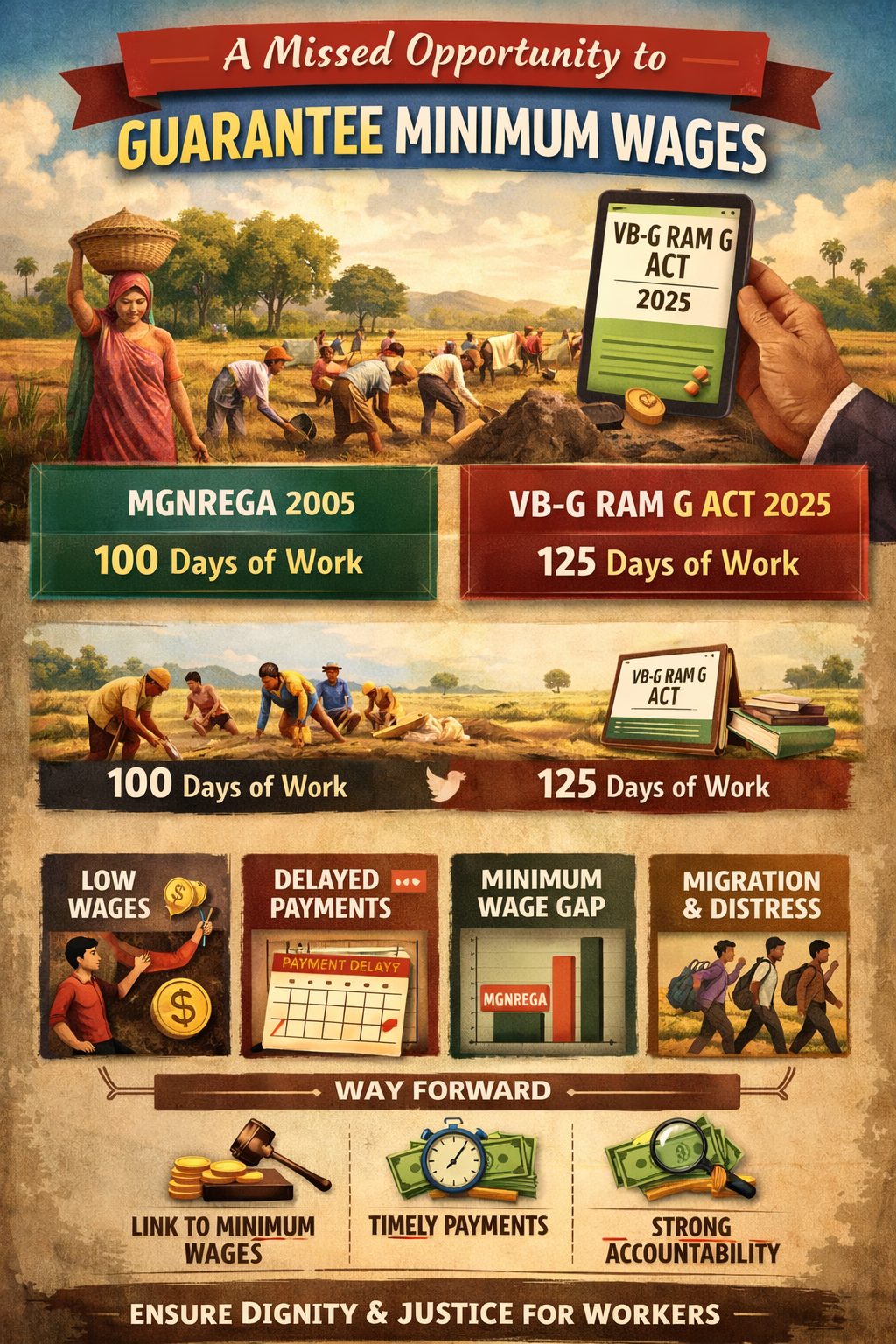
The proposed VB-G RAM G Act, 2025 seeks to replace and expand MGNREGA by increasing the guarantee to 125 days, introducing a 60:40 Centre–State funding model (90:10 for North-Eastern and Himalayan states), and adding digital governance reforms.
Yet, the real success of both schemes depends on fair wage determination, which is crucial for worker participation, programme credibility, rural demand, and overall sustainability. Without wage justice, these programmes risk becoming symbolic rather than transformative.
Why Wage Rates Are Central
Wage rates are the lifeblood of any employment guarantee programme. In the early years of MGNREGA, when wages were competitive or aligned with prevailing rates, the scheme witnessed strong enthusiasm and high participation, particularly among women and marginalised groups. Higher wages incentivised mobilisation, reduced distress migration, and injected purchasing power into rural economies, boosting local demand for goods and services.
Conversely, suppressed wages dampen incentives, leading to lower turnout and weakened programme impact. Governments often face fiscal pressures to restrain wages to control costs, but this short-term approach undermines long-term goals. Wages influence not just individual livelihoods but also the scheme’s role as a wage floor in rural labour markets. When MGNREGA wages set a decent benchmark, they exert upward pressure on private market rates, enhancing bargaining power for all rural workers. Low or stagnant wages erode this multiplier effect, diminishing the programme’s contribution to social justice and economic resilience.
Evolution of Wage Determination under MGNREGA
Originally, Section 6(2) of the MGNREGA linked wages to state-specific minimum wages notified under the Minimum Wages Act, 1948. This decentralised approach ensured relevance to local labour markets, cost of living, and agricultural cycles, while reinforcing statutory labour protections.
In 2009, the Central government invoked Section 6(1) to assume direct control over wage fixation, initially setting a uniform base of ₹100 per day. This shift promised uniformity and faster adjustments but gradually led to centralisation. Wages were thereafter indexed primarily to the Consumer Price Index for Agricultural Labourers (CPI-AL), resulting in nominal increases that failed to keep pace with rising living costs or minimum wage revisions in many states. What began as a move for policy coherence evolved into a mechanism for wage control, distancing the programme from dynamic local realities.
Problems Caused by Wage Stagnation
The real-wage freeze has become a defining flaw. Although nominal MGNREGA wages have risen modestly—reaching, for instance, ₹370 per day in Karnataka from April 2025 and up to ₹400 in Haryana in some revisions—real wages (adjusted for inflation) have stagnated or declined in many regions since the centralisation. By 2025-26, in a majority of states, MGNREGA wages lagged behind statutory minimum wages for agricultural labour, often by ₹50–150 per day. This gap violates the spirit of labour protections and creates legal inconsistencies, as the state cannot legitimately pay below minimum rates for similar work.
Moreover, MGNREGA wages have fallen behind market rates in several areas, where timely private employment offers better immediate returns. Compounding this are persistent issues of delayed payments, payment uncertainty, and administrative inefficiencies. Market wages are usually disbursed promptly, while MGNREGA payments, despite electronic fund transfers, frequently suffer glitches in Aadhaar-based systems, NMMS attendance apps, and fund flow delays. Technological failures exacerbate uncertainty, discouraging workers who cannot afford to wait weeks for earnings.
Impact on Workers and Rural Economy
Declining participation is the most visible outcome. Workers, facing low real wages and unreliable payments, increasingly opt for migration or informal work, weakening the scheme’s reach. This reduces its role as a reliable safety net during lean agricultural seasons or economic shocks.
The erosion of MGNREGA as a wage floor has diminished rural workers’ bargaining power. Private employers face less competitive pressure, potentially suppressing overall wages. Reduced participation also undermines the programme’s multiplier effects on rural demand and consumption. Distress migration rises, straining urban resources and fragmenting families. Women, who constituted a significant share of MGNREGA beneficiaries, are particularly affected, as lower incentives limit their economic agency.
A vicious cycle emerges: lower participation weakens on-ground vigilance and social accountability, creating space for corruption, leakages, and ghost works. This further erodes trust, widening the gap between official data and ground realities.
Governance and Implementation Concerns
Beyond wages, governance challenges plague the programme. Delayed payments—sometimes stretching beyond the mandated 15 days—trigger compensation provisions that are poorly enforced. Administrative inefficiencies, inadequate staffing at block and gram panchayat levels, and technological glitches in measurement, muster rolls, and FTO generation contribute to non-payments or underpayments. Corruption manifests in various forms, from inflated records to diversion of funds, despite digitisation efforts.
These issues not only deter genuine workers but also inflate reported expenditure while under-delivering actual employment and assets.
Critical Assessment of VB-G RAM G Act
The VB-G RAM G Act, 2025, enhances the guarantee to 125 days and introduces provisions for weekly or fortnightly wage payments, unemployment allowance, digital attendance, geotagging, and real-time MIS monitoring. It adopts a cost-sharing model that shifts greater responsibility to states. However, it represents continuity rather than bold reform in critical areas.
Centralised wage determination persists, with the Central government notifying rates that “shall not be less than” previous MGNREGA rates but without a mandatory link to state minimum wages. This removes earlier explicit alignment provisions, raising legal ambiguity regarding compliance with the Minimum Wages Act and constitutional labour standards. While the Act promises prompt payments and accountability mechanisms, it lacks robust, enforceable reforms for grievance redressal, independent social audits, or penalties that effectively deter corruption. Without addressing the wage justice deficit, the new framework risks perpetuating stagnation and inefficiencies under a new name.
Constitutional, Legal, and Policy Angle
India’s Constitution envisions social justice and dignity of labour through the Directive Principles of State Policy (DPSP). Article 39 directs the state to ensure adequate means of livelihood, while Article 43 specifically calls for a living wage, decent working conditions, and economic democracy. Article 21, interpreted expansively by the Supreme Court, includes the right to livelihood as part of the right to life with dignity.
Paying wages below minimum rates under a state-sponsored programme undermines these commitments. Judicial precedents have upheld minimum wages as essential to prevent exploitation and uphold human dignity. MGNREGA’s wage policy must align with these principles to avoid creating an unconstitutional sub-minimum floor for rural workers. From a policy perspective, employment guarantees succeed when they reinforce, rather than undercut, broader labour protections and rural development goals.
Way Forward
Meaningful reform requires delinking wages from mere inflation indexation and linking them explicitly to or above state-specific minimum wages, with periodic revisions based on local cost-of-living indices and labour market surveys. This would restore legal compliance, boost participation, and strengthen the wage floor.
Equally critical are measures for timely payments: strict enforcement of weekly/fortnightly disbursals, automatic compensation for delays, and accountability at every stage—from measurement to FTO generation. Strengthening transparency through mandatory, independent social audits, real-time public dashboards, and robust grievance redressal mechanisms (with time-bound resolution) can rebuild trust.
Decentralisation should be revisited, allowing greater state flexibility in wage setting and programme design within a national framework. Enhanced funding, capacity building at grassroots levels, convergence with other schemes for skill development, and protection against technological exclusion (e.g., for workers without reliable digital access) are essential. Finally, political will to treat these programmes as investments in human capital rather than mere fiscal liabilities will determine their success.
Conclusion
Q. Consider the following statements regarding wage determination under MGNREGA:
1.Initially, wages under MGNREGA were linked to the state-specific minimum wages as per Section 6(2) of the Act.
2.In 2009, the Central Government invoked Section 6(1) to assume direct control over wage fixation.
3.Currently, MGNREGA wages are mandatorily required to be at least equal to the statutory minimum wages notified by the respective states.
Which of the statements given above is/are correct?
(a) 1 and 2 only
(b) 2 and 3 only
(c) 1 and 3 only
(d) 1, 2 and 3
Answer: (a) 1 and 2 only
Q. “The effectiveness of rural employment guarantee programmes in India critically depends on fair and timely wage payment rather than mere expansion of guaranteed days of work.” In the light of the evolution of wage policy under MGNREGA and the provisions of the proposed Viksit Bharat Guarantee for Rozgar and Ajeevika Mission (Gramin) Act, critically examine this statement. Suggest measures to strengthen wage justice in such programmes. ( 15 Marks , 250 words )

- Artemis II: Humanity’s Return to Lunar Space and India’s Place in the New Moon Race - April 2, 2026
- A Missed Opportunity to Guarantee Minimum Wages - March 31, 2026
- ‘India’s Growth Claims, A Clash with Data Reality’. - March 30, 2026

No Comments