


02 Apr Artemis II: Humanity’s Return to Lunar Space and India’s Place in the New Moon Race
This article covers “Daily Current Affairs” and From Artemis II: Humanity’s Return to Lunar Space and India’s Place in the New Moon Race.
SYLLABUS MAPPING
GS -3 – Science and technology – Artemis II: Humanity’s Return to Lunar Space and India’s Place in the New Moon Race
FOR PRELIMS
What is the Artemis II Mission?
FOR MAINS
What makes Artemis II Mission significant?
Why in the news
The Artemis II mission, launched successfully on April 1, 2026, from Kennedy Space Center, marks a historic milestone as NASA’s first crewed mission to the Moon’s vicinity since Apollo 17 in 1972—ending a gap of over five decades in human lunar exploration. This 10-day flight sends four astronauts—NASA’s Reid Wiseman (commander), Victor Glover (pilot), Christina Koch, and CSA’s Jeremy Hansen—on a lunar flyby aboard the Orion spacecraft atop the Space Launch System (SLS) rocket.
After more than 50 years, the Moon has regained centrality in science, strategy, and global power politics. It offers opportunities for scientific discovery, resource utilization (including water ice), and a testing ground for deep-space technologies essential for Mars missions. In an era of multipolar competition, lunar leadership symbolizes technological prowess, strategic influence, and national prestige, while raising questions of sustainable governance and equitable access.
What is Artemis II Mission?
Artemis II is NASA’s first crewed Artemis mission. It will send four astronauts on a approximately 10-day journey in a lunar flyby trajectory, without landing on the Moon. This marks the first time humans have ventured into lunar space since the Apollo era.
The mission uses NASA’s powerful Space Launch System (SLS) rocket and the Orion spacecraft. Its primary purpose is to test and validate critical systems—life support, navigation, communication, and crew safety—in deep space ahead of future crewed lunar landings, currently targeted around 2028. The crew will perform proximity operations, orbit-raising burns, and other checks while the spacecraft orbits Earth initially before heading translunar.
Artemis Programme and NASA’s Long-Term Lunar Vision
The Artemis programme builds methodically on previous steps. Artemis I (2022) was an uncrewed test flight of the SLS and Orion that successfully orbited the Moon for about 25 days.
Artemis II provides the first crewed validation. Subsequent missions aim to progress toward sustained presence. NASA envisions shifting from Apollo-style short visits to long-term human habitation on the Moon. The roadmap includes frequent missions (roughly every six months in the future), extended astronaut stays, and eventual construction of a permanent or semi-permanent Moon base through phased infrastructure development involving international partners and private companies.
This differs markedly from the Apollo era (1969–1972), which focused on symbolic “flags and footprints” landings with brief surface stays. Artemis emphasizes sustainability, resource utilization, and preparation for Mars, integrating commercial landers and broader collaboration.
Why the Moon Matters Again
The renewed focus on the Moon stems from multiple converging factors:
Scientific research opportunities: The lunar surface and south pole offer pristine records of solar system history, potential for astronomy from the far side (free from Earth interference), and studies of regolith and volatiles.
Resources: Water ice in permanently shadowed craters could provide drinking water, oxygen, and rocket fuel (via electrolysis), reducing dependency on Earth resupply.
Deep-space platform: The Moon serves as a proving ground for technologies, habitats, and operations needed for Mars missions, with lower gravity aiding launches.
Strategic and geopolitical importance: Control over lunar orbits, landing sites, and resources translates into technological leadership and influence in the emerging space economy.
Prestige and commercial potential: Success enhances national stature while opening avenues for private enterprise in a future lunar economy.
In essence, the Moon is no longer just a destination but a stepping stone for humanity’s multi-planetary future and a arena for peaceful yet competitive exploration.
Travel Time: Artemis vs Other Lunar Missions
Artemis II will reach the Moon’s vicinity in about 3–4 days (with lunar approach around day 6 of the mission), following a fast, high-energy trajectory similar to Apollo missions.
In contrast, recent missions like India’s Chandrayaan-3 (2023) took over 40 days. It employed a series of gradual Earth-bound orbits to raise apogee before translunar injection—a fuel-efficient but time-intensive path suited to lower-thrust rockets.
The difference reflects technological and objective choices:
Fast route (Artemis/Apollo) requires more powerful rockets (Saturn V then; SLS now) and higher energy for direct or near-direct paths.
Slow route conserves fuel, allowing smaller launch vehicles and cost-effective missions.
Both approaches highlight evolving priorities: Apollo and Artemis prioritize speed and crew safety in powerful systems; many modern un crewed missions emphasize efficiency and affordability.
Artemis II Flight Path and Why It Is Significant
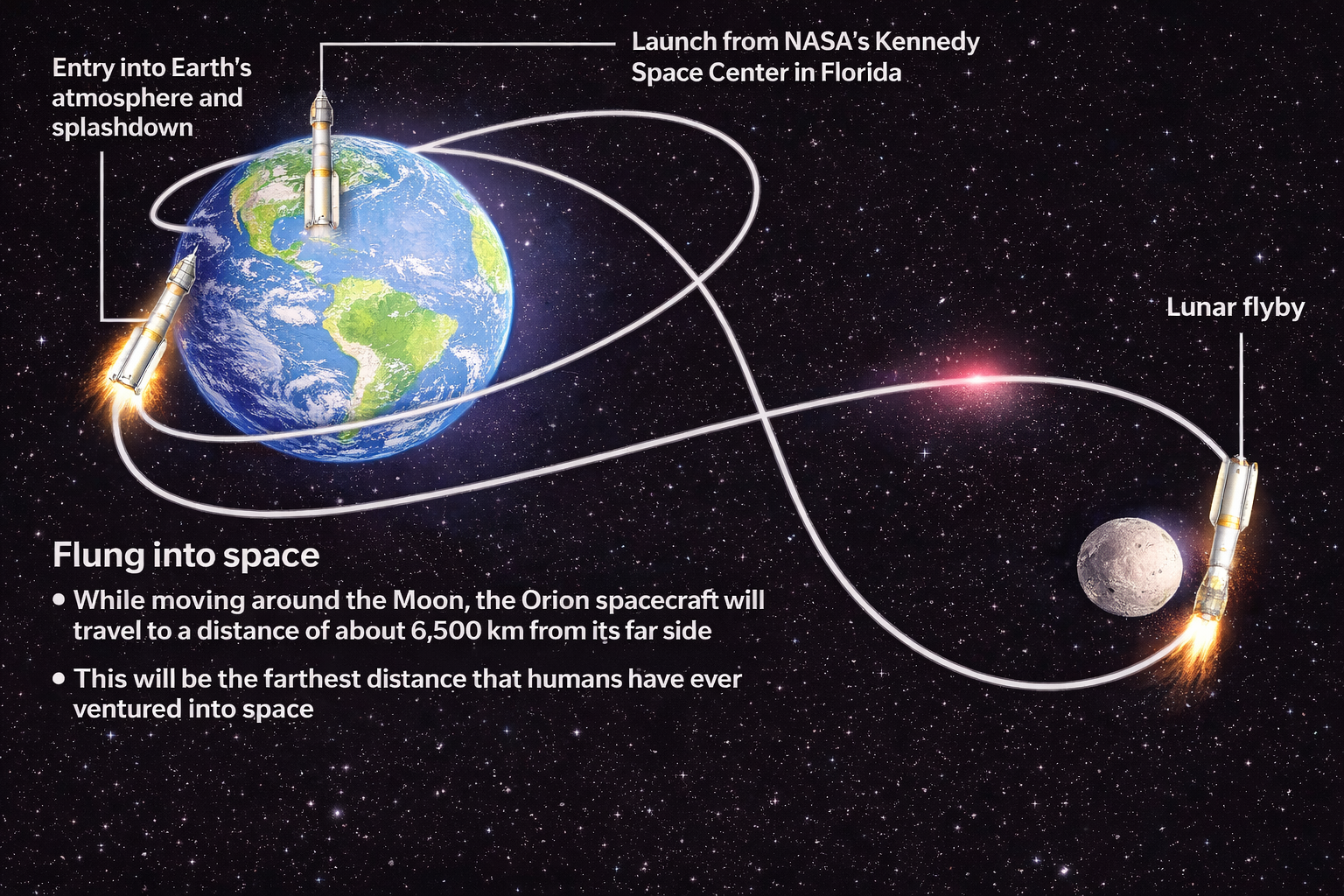
The mission profile begins with the SLS launching Orion into Earth orbit. The crew will orbit Earth twice (including apogee and perigee raise burns) while conducting system checks and proximity operations demonstrations. They will then perform translunar injection to head toward the Moon.
Orion will fly around the Moon on a free-return trajectory and travel up to 6,500 km beyond the far side—the farthest humans have ever been from Earth, surpassing Apollo records. The spacecraft will then return for Pacific splashdown after about 10 days.
This path is significant because it rigorously tests deep-space capabilities: radiation shielding, life support for extended durations beyond low-Earth orbit, communication delays, navigation accuracy, and crew performance in a high-stakes environment. Success builds confidence for crewed landings and long-duration missions.
Global Lunar Race: From US–USSR Rivalry to Multipolar Competition
The original space race was bipolar—US vs USSR—with Apollo driven by Cold War prestige. Today’s lunar competition is multipolar, involving the United States (leading Artemis with international partners), China (with its own crewed lunar ambitions), India, Japan, European agencies, and private companies like SpaceX and Blue Origin.
Modern dynamics blend national prestige, strategic influence, technology leadership, and commercial opportunity. Partnerships coexist with competition, as seen in Artemis Accords versus alternative frameworks. This era emphasizes sustainable exploration alongside power projection in cislunar space.
India’s Position in the New Lunar Era
When Apollo 11 landed in 1969, ISRO was not yet formally established (it was created shortly after). Today, India stands as a major space power with proven low-cost, reliable capabilities.
Key achievements include the Chandrayaan series, particularly Chandrayaan-3’s successful soft landing near the lunar south pole in 2023, which demonstrated India’s growing expertise in lunar missions.
India’s long-term ambition is a human Moon landing by 2040, while China targets 2030. India has transitioned from a developing participant to a serious stakeholder, contributing scientific payloads and gaining credibility through cost-effective innovation.
By pursuing pragmatic, capability-driven ambitions, India can emerge as a pivotal player in humanity’s return to the Moon and beyond, contributing to a shared, sustainable space future.
This comprehensive analysis underscores that Artemis II is not merely a mission but a gateway to a new chapter in exploration—one where science, strategy, and geopolitics intersect, offering India both challenges and transformative opportunities. By pursuing pragmatic, capability-driven ambitions, India can emerge as a pivotal player in humanity’s return to the Moon and beyond, contributing to a shared, sustainable space future.
This comprehensive analysis underscores that Artemis II is not merely a mission but a gateway to a new chapter in exploration—one where science, strategy, and geopolitics intersect, offering India both challenges and transformative opportunities.
Opportunities for India
NASA’s lunar push creates multifaceted opportunities for India:
Launch services and cost-effective mission support.
Robotics, navigation, and communication systems.
Scientific payloads and instruments.
Growth for private space startups in manufacturing and supply chains.
Collaboration in academia and research for lunar science.
Participation in the emerging lunar economy through infrastructure, habitats, and resource technologies.
By leveraging its strengths in affordability and reliability, India can position itself as a key partner and competitor in this expanding domain.
Challenges and Concerns
Despite optimism, challenges persist:
High costs of human-rated systems and sustained operations.
Technological risks, including reliability of new vehicles like SLS/Orion and life support in deep space.
Sustainability of long-term presence, including waste management and environmental impact on the Moon.
Space governance issues, such as legal frameworks for resource extraction and preventing militarization.
Resource competition and ensuring equitable access for developing nations.
A balanced approach requires international norms that prevent a “tragedy of the commons” while fostering inclusive participation.
Way Forward
To capitalize on the new lunar era, India should:
Strengthen ISRO–private sector collaboration (e.g., via IN-SPACe) for innovation and scale.
Invest robustly in human spaceflight (Gaganyaan), deep-space propulsion, and landing technologies.
Build a vibrant space manufacturing ecosystem and supply chain resilience.
Deepen international partnerships, including under Artemis Accords and bilateral ties with NASA and others.
Develop expertise in space law, diplomacy, and sustainable governance.
Align lunar goals with scientific advancement, strategic autonomy, and socio-economic development—such as technology spin-offs for Earth applications.
Conclusion

- Artemis II: Humanity’s Return to Lunar Space and India’s Place in the New Moon Race - April 2, 2026
- A Missed Opportunity to Guarantee Minimum Wages - March 31, 2026
- ‘India’s Growth Claims, A Clash with Data Reality’. - March 30, 2026

No Comments