


31 Jan Glacial Lake Outburst Floods in the Himalaya Karakoram: A Growing Climate Risk
This article covers “Daily Current Affairs” and From Glacial Lake Outburst Floods in the Himalaya Karakoram: A Growing Climate Risk
SYLLABUS MAPPING
GS-3- Environment – Glacial Lake Outburst Floods in the Himalaya Karakoram: A Growing Climate Risk
FOR PRELIMS
What is a Glacial Lake Outburst Flood ?
FOR MAINS
Why is the Himalaya–Karakoram region referred to as the “Third Pole” ?
WHY IN THE NEWS
The Himalaya Karakoram region often described as the “Third Pole” due to its vast reserves of ice and snow is undergoing rapid and profound transformation under the influence of climate change. Among the most alarming consequences of this transformation is the escalating risk of Glacial Lake Outburst Floods (GLOFs). A recent scientific study published in NPJ Natural Hazards (22 January 2026) warns that while the number, size, and volume of glacial lakes have expanded sharply since 1990, the systems designed to assess, monitor, and manage associated flood risks have failed to keep pace. As a result, nearly one million people living downstream of glacial lakes across South Asia are exposed to sudden and potentially catastrophic flooding.
The study highlights a widening gap between advances in climate science and the realities of disaster governance in high mountain regions one with serious implications for ecosystem stability, infrastructure development, and human security.
Understanding GLOFs and Their Rising Frequency
A Glacial Lake Outburst Flood (GLOF) occurs when a glacial lake—held back by a fragile natural dam of ice or unconsolidated moraine debris—suddenly breaches. Such failures can release millions of cubic metres of water within hours, often entraining rocks, sediment, and vegetation. This debris-laden flow dramatically amplifies the destructive potential of GLOFs, transforming them into high-energy flood waves capable of devastating downstream valleys.
The study documents 388 GLOF events across the Himalaya–Karakoram region to date. Moraine-dammed lakes account for the largest proportion of recorded incidents, followed closely by ice-dammed lakes. Of particular concern is the growing emergence of supraglacial lakes, which form on the surface of glaciers and are inherently unstable due to rapid ice melt and internal drainage processes.
Strikingly, the Karakoram region alone accounts for more than half of all recorded GLOFs (196 events), despite hosting fewer glacial lakes than several Himalayan sub-regions. This paradox points to complex interactions between glacier dynamics, steep topography, tectonic activity, and climatic variability, underscoring the limitations of simple lake-count-based risk assessments.
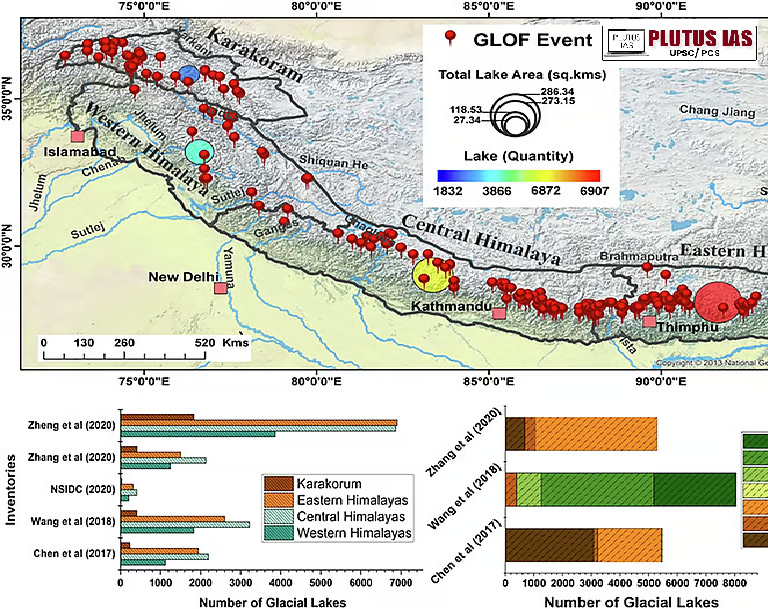
Figure – 1; Glacial Lakes in the Himalaya Karakoram
Climate Change as a Risk Multiplier
Climate change acts as a decisive risk multiplier in high mountain environments. The Himalaya–Karakoram region is experiencing elevation-dependent warming, a phenomenon in which temperatures rise faster at higher altitudes than the global average. This accelerates glacier thinning and retreat, fundamentally altering the cryosphere.
Since 1990.
key Findings of the Study
The number of glacial lakes has increased by 53 per cent
Surface area has expanded by 51 per cent
Water volume has grown by 48 per cent
Crucially, lake-terminating glaciers are retreating significantly faster than land-terminating glaciers, reinforcing a dangerous feedback loop: glacier retreat enlarges lakes, larger lakes increase hydrostatic pressure on natural dams, and weakened dams become increasingly susceptible to sudden failure.
These fragile systems are often triggered by external shocks such as extreme rainfall events, ice or rock avalanches, earthquakes, and rapid surface melting, all of which are becoming more frequent or intense under a warming climate.
Scale of the Threat
388 GLOF events recorded across the Himalaya–Karakoram
Karakoram: 196
Central Himalayas: 99
Eastern Himalayas: 72
Western Himalayas: 21
Nearly 1 million people live within 10 km downstream of glacial lakes.
India and the Wider Regional Context
South Asia has already witnessed the devastating consequences of GLOFs. In 2013, the Uttarakhand disaster, triggered by extreme rainfall and the failure of the Chorabari glacial lake system, resulted in thousands of deaths and widespread destruction of settlements, roads, and religious infrastructure. More recently, the 2023 Sikkim GLOF, caused by the breach of South Lhonak Lake, exposed the acute vulnerability of hydropower projects, mountain towns, and transport corridors in the eastern Himalayas.
Beyond India, Pakistan, Nepal, Bhutan, and China have all recorded significant GLOF events. River systems originating in the Himalaya–Karakoram—such as the Indus, Ganga, and Brahmaputra—cross national boundaries, making GLOFs a transboundary climate risk. Yet, current responses remain largely national, fragmented, and reactive, rather than regionally coordinated and preventive.
Persistent Gaps in Research, Monitoring, and Preparedness
Despite growing scientific attention, the study identifies several critical shortcomings in how GLOF risks are currently understood and managed.
Inadequate Risk Assessment
Most existing glacial lake inventories are static snapshots, failing to capture seasonal fluctuations, rapid lake expansion, or short-lived but highly dangerous lakes that can form and drain within months.
Data Inconsistencies
There is no uniform standard for defining glacial lakes. Variations in size thresholds, classification criteria, and mapping techniques across datasets make regional comparisons unreliable and undermine evidence-based policymaking.
Overreliance on Remote Sensing
Harsh terrain and climatic conditions limit field-based observations, leading to heavy dependence on satellite imagery. While invaluable, remote sensing often suffers from coarse resolution, cloud cover, and limited ground validation, especially for small or debris-covered lakes.
Neglect of Social Vulnerability
Risk assessments tend to focus on physical hazards while paying insufficient attention to downstream social vulnerability. Many exposed communities are remote, economically fragile, and poorly connected to emergency services, severely limiting their capacity to respond to sudden disasters.
Limited Early Warning Systems
Although early warning systems (EWS) have proven effective in some pilot areas, their coverage across the Himalaya remains patchy, uneven, and poorly integrated with local governance structures.
From Hazard Mapping to Risk Governance: The Way Forward
The study argues for a fundamental shift from reactive disaster response to anticipatory and integrated risk governance.
Key priorities include:
Standardised and dynamic glacial lake inventories with harmonised definitions and regular updates
Expansion of ground-based monitoring, including automatic weather stations, lake-level sensors, and community observations
Robust early warning systems, linked to local administrations and supported by community preparedness and evacuation planning
Mainstreaming climate risk assessments into hydropower, road construction, urban expansion, and tourism development in mountain regions
Strengthened regional cooperation for data sharing, joint research, and transboundary disaster response
Alignment with global frameworks such as the Sendai Framework for Disaster Risk Reduction, which emphasises prevention, preparedness, and resilience
CONCLUSION
The Himalaya Karakoram region stands at the frontline of climate-induced disasters. The rapid expansion of glacial lakes, combined with weak risk assessment and inadequate adaptation mechanisms, poses a growing threat to lives, livelihoods, and hard-won development gains across South Asia. As climate change accelerates cryospheric transformations, GLOFs must be recognised not as rare natural calamities, but as predictable and manageable risks.
Bridging the gap between science, policy, and local action is no longer optional. It is essential if the region is to move from vulnerability to resilience in an era of warming mountains.
Best ias coaching in delhi Best ias coaching in chandigarh
PRELIMS QUESTION
Q. With reference to Glacial Lake Outburst Floods (GLOFs) in the Himalaya–Karakoram region, consider the following statements:
1.Moraine-dammed lakes account for the largest share of recorded GLOF events in the region.
2.Lake-terminating glaciers retreat faster than land-terminating glaciers, increasing GLOF risk.
3.The Karakoram region has the highest number of glacial lakes in the Himalaya–Karakoram region.
4.Elevation-dependent warming refers to faster temperature rise at higher altitudes.
Which of the statements given above are correct ?
(a) 1, 2 and 4 only
(b) 1, 3 and 4 only
(c) 2 and 3 only
(d) 1, 2, 3 and 4
Answer: (a)
Q. Glacial Lake Outburst Floods in the Himalaya–Karakoram region pose a transboundary climate risk. Discuss the need for regional cooperation and institutional mechanisms to address this emerging threat. (250 words)

- Artemis II: Humanity’s Return to Lunar Space and India’s Place in the New Moon Race - April 2, 2026
- A Missed Opportunity to Guarantee Minimum Wages - March 31, 2026
- ‘India’s Growth Claims, A Clash with Data Reality’. - March 30, 2026

No Comments