


17 Feb Circular Economy in Indian Agriculture: Transforming Waste to Wealth for Sustainable Prosperity
This article covers “Daily Current Affairs” and From Circular Economy in Indian Agriculture: Transforming Waste to Wealth for Sustainable Prosperity
SYLLABUS MAPPING
GS- 3- Agriculture – Circular Economy in Indian Agriculture: Transforming Waste to Wealth for Sustainable Prosperity
FOR PRELIMS
What is meant by circular economy in agriculture ?
FOR MAINS
What are the major challenges in managing agricultural waste in India?
Why in the News?
In February 2026, the Government of India underscored the “Waste to Wealth” initiative as a critical pillar for environmental sustainability and economic growth. With India generating an estimated 350 million tonnes of agricultural waste annually, the transition toward a circular economy has become an ecological and economic imperative to ensure long-term food security and climate resilience.
Defining the Concept
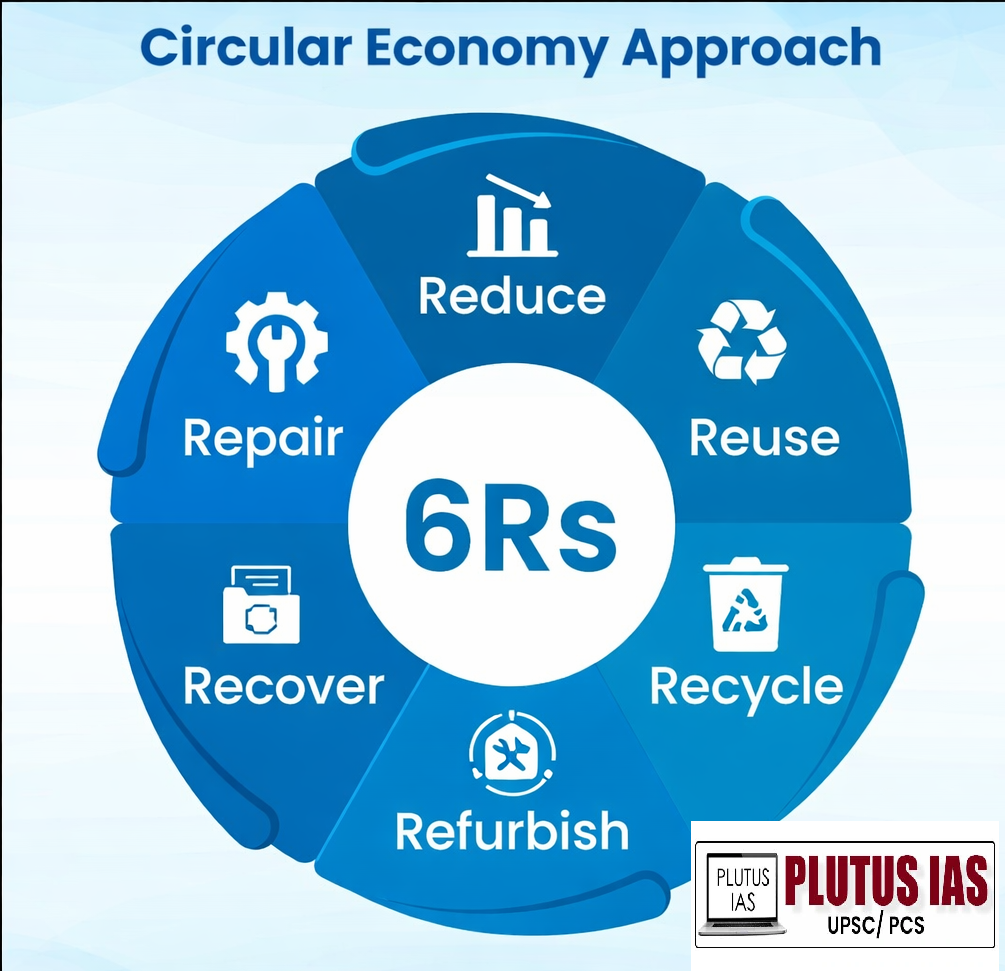
Circularity in agriculture represents a systemic transformation of production and consumption patterns. It aims to minimize the extraction of raw materials, water, and energy while eliminating waste at every stage of the value chain. This approach is guided by the six R,s: Reduce, Reuse, Recycle, Refurbish, Recover, and Repair. Unlike the linear “take-make-dispose” model, a circular economy ensures that materials remain in productive use for extended periods through “true recycling,” where waste is converted back to its original form or higher-value recovery without quality loss.
Background and Context
India’s agricultural sector, while pivotal for food and nutritional security, is a major source of waste during cultivation, harvesting, and processing. Globally, 1.3 billion tonnes of food produced for human consumption are wasted annually. In India, the mismanagement of organic waste in landfills releases methane and other greenhouse gases, accelerating climate change and contaminating air, soil, and water. However, this waste holds immense potential: the Ministry of New and Renewable Energy estimates that agricultural residues can generate over 18,000 MW of power annually and produce nutrient-rich organic fertilizers.
Significance and Importance
Economic Growth and Employment: By 2050, India’s circular economy is expected to reach a market value of $2 trillion and create 10 million jobs.
Energy and Soil Security: Converting residues into Compressed Biogas (CBG) and organic manure reduces dependence on chemical inputs and enhances soil health.
Climate Mitigation: Technologies like engineered biochar sequester carbon and remove environmental contaminants, evolving food waste management into a crucial pillar of circularity.
Resource Efficiency: Drawing inspiration from nature’s regenerative systems, circularity ensures optimal resource use with minimal waste.
Key Issues and Challenges
In-situ Burning: To quickly prepare land for the next cycle, farmers often burn crop residues (stubble), leading to the depletion of soil nutrients and severe air pollution.
Post-Harvest Losses: Significant quantitative (weight/volume) and qualitative (nutrients/taste) reductions occur throughout the post-harvest system.
Livestock Waste Management: Managing enormous quantities of dung and the safe disposal of animal carcasses during disease outbreaks remains a technical and financial challenge.
Food Waste at the Retail Level: Approximately 60% of global food waste is generated at the household level, contributing heavily to greenhouse gas emissions.
Economic, Social, and Environmental Impact
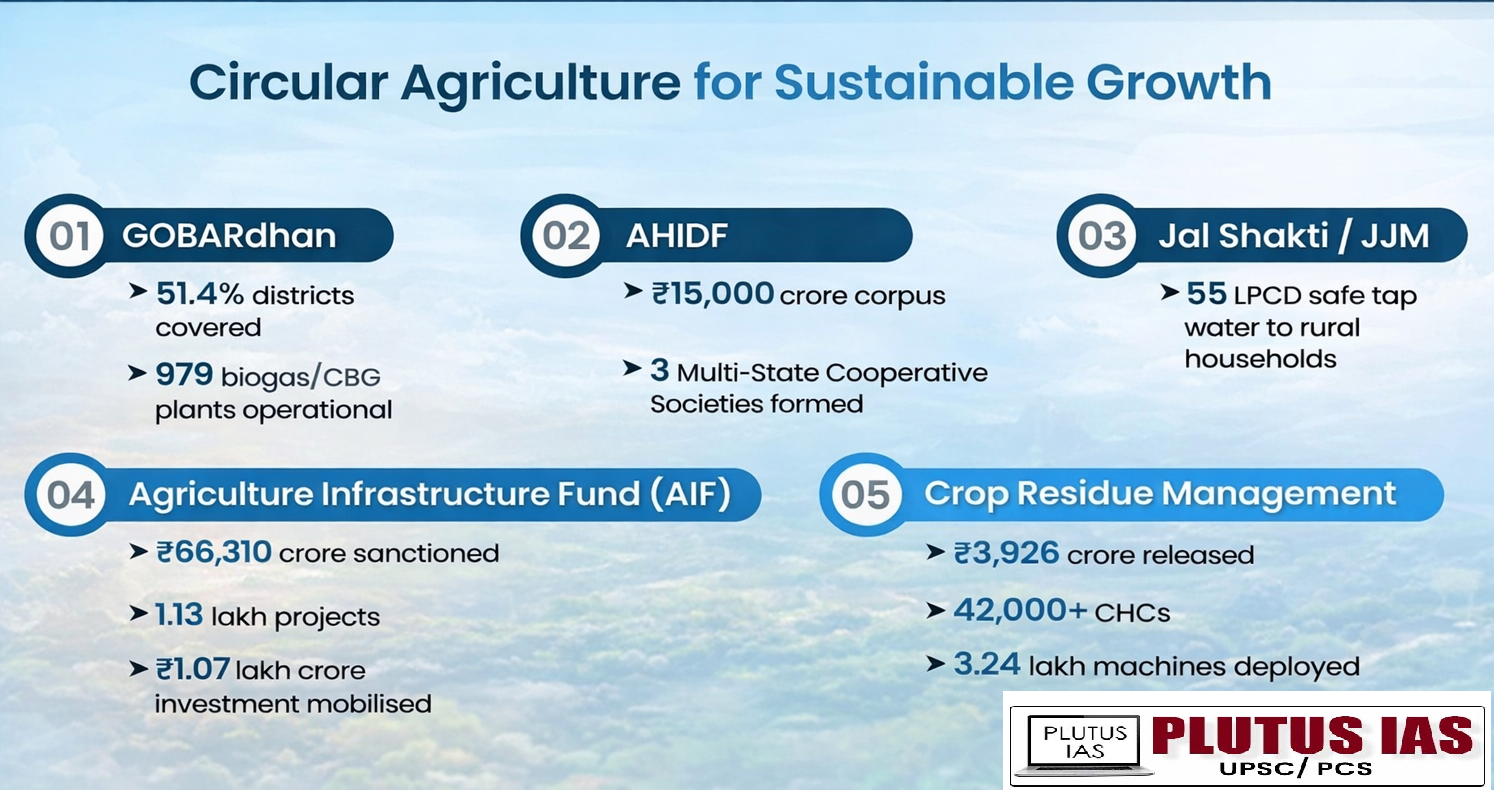
Economic: Infrastructure funds like the Agriculture Infrastructure Fund (AIF) have sanctioned ₹66,310 crore for over 1.13 lakh projects, including cold storage and processing units, enhancing farmer income.
Social: The Jal Jeevan Mission and Jal Shakti Mission promote water security and the reuse of treated wastewater for agriculture, ensuring sustainable water governance in rural areas.
Environmental: Circular practices directly support SDG 12 (Responsible Consumption and Production) and SDG 2 (Zero Hunger) by improving soil health and reducing chemical dependence.
Governance and Institutional Aspects
The government has launched several multi-sectoral initiatives to drive circularity:
GOBARdhan Scheme: A multi-ministerial effort to convert cattle dung and food waste into CBG and organic manure. As of January 2026, it covers 51.4% of India’s districts with 979 operational plants.
Crop Residue Management (CRM): Since 2018-19, ₹3,926.16 crore has been released to states like Punjab and Haryana to promote in-situ and ex-situ residue management through over 42,000 Custom Hiring Centres (CHCs).
AHIDF and AIF: The Animal Husbandry Infrastructure Development Fund (₹15,000 crore corpus) and AIF provide institutional credit for waste-to-wealth infrastructure and organic input production.
Multi-State Cooperative Societies (MSCS): Three new societies have been formed to promote organic manure and scientific management of animal by-products like hides and bones.
Way Forward
1. Scaling Infrastructure: Accelerate the establishment of CHCs and biogas plants in the remaining 48.6% of districts not yet covered by GOBARdhan.
2. Technological Integration: Promote the use of engineered biochar and biomass recycling through targeted incentives to enhance nutrient use efficiency.
3. Regulatory Harmonization: Further simplify norms for organic manure under the Fertiliser Control Order to attract private investment and strengthen the waste-to-wealth ecosystem.
4. Integrated Water Management: Expand the reuse of domestic and industrial wastewater for non-potable agricultural purposes to reduce the pressure on groundwater.
5. Behavioral Change: Incentivize farmers for ex-situ management of stubble, where residues are collected for bioenergy rather than burned.
Conclusion
The transition to a circular economy in agriculture demonstrates that economic expansion and environmental stewardship are not mutually exclusive. By aligning economic incentives with ecological outcomes—through flagship schemes like GOBARdhan and AIF—India is effectively turning agricultural waste into a cornerstone of sustainable prosperity. This shift is vital for achieving the vision of an Atmanirbhar Bharat and Viksit Bharat 2047, ensuring that the nation’s growth remains inclusive, climate-resilient, and firmly rooted in Sustainable Development Goals (SDGs)
Best ias coaching in delhi Best ias coaching in chandigar
Prelims question:
Q. With reference to the Circular Economy in Agriculture and Waste-to-Wealth initiatives in India, consider the following statements:
1.Circular economy promotes the “take-make-dispose” model to increase productivity.
2.The GOBARdhan Scheme focuses on converting cattle dung and organic waste into compressed biogas and organic manure.
3.Agricultural residues in India have the potential to generate significant renewable energy.
4.Crop residue burning improves soil fertility by enhancing nutrient recycling.
Which of the statements given above are correct ?
(a) 1 and 2 only
(b) 2 and 3 only
(c) 1, 3 and 4 only
(d) 2, 3 and 4 only
Answer: (b) 2 and 3 only
Mains Question:
Q. Explain the concept of circular economy in agriculture. How can it contribute to climate resilience, farmer income, and sustainable development in India? (250 words)

- Artemis II: Humanity’s Return to Lunar Space and India’s Place in the New Moon Race - April 2, 2026
- A Missed Opportunity to Guarantee Minimum Wages - March 31, 2026
- ‘India’s Growth Claims, A Clash with Data Reality’. - March 30, 2026

No Comments