


18 Feb The Dawn of a Creative Superpower: WAVES 2025 and India’s Strategic Shift in the Media & Entertainment Landscape
This article covers “Daily Current Affairs” and From The Dawn of a Creative Superpower: WAVES 2025 and India’s Strategic Shift in the Media & Entertainment Landscape
SYLLABUS MAPPING
GS- 2- International Relation – The Dawn of a Creative Superpower: WAVES 2025 and India’s Strategic Shift in the Media & Entertainment Landscape
FOR PRELIMS
What was the main aim of WAVES 2025?
FOR MAINS
How does WAVES 2025 support India’s creative economy ?
Why in the News?
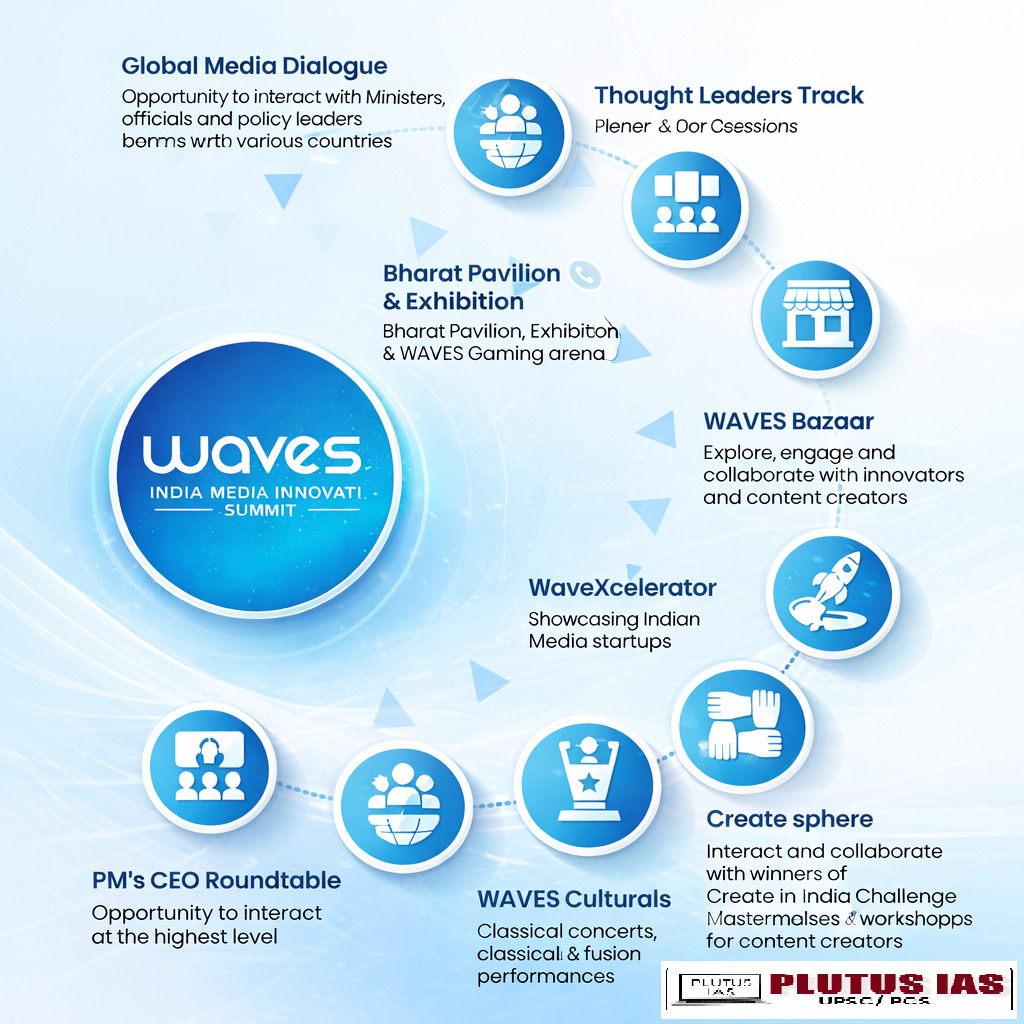
In May 2025, Mumbai hosted the inaugural World Audio Visual and Entertainment Summit (WAVES 2025), a landmark event that signals India’s transition from being a consumer of global content to a central architect of the global creative economy. With the adoption of the WAVES Declaration by 77 nations, the summit has established a multilateral framework for ethical media, digital inclusion, and cross-border co-productions, positioning the creative sector as a primary engine for Viksit Bharat 2047.
Defining the Concept: The Creative Economy
The Creative Economy encompasses sectors that bridge culture, technology, and commerce, specifically focusing on the Media and Entertainment (M&E) ecosystem. It includes film, broadcasting, digital media, music, and the rapidly expanding AVGC-XR (Animation, Visual Effects, Gaming, Comics, and Extended Reality) segment. Within the UPSC framework, this sector is viewed not merely as “entertainment” but as a critical component of soft power, employment generation, and technological innovation.
Background and Context
Historically, India’s engagement with the global creative market was fragmented across regional and sectoral lines. WAVES 2025 marks a paradigm shift by creating a single, integrated framework that connects policy, commerce, and talent. The summit was designed as a living interface to link Indian creators with global markets, ensuring that “Create in India” becomes as significant as “Make in India”.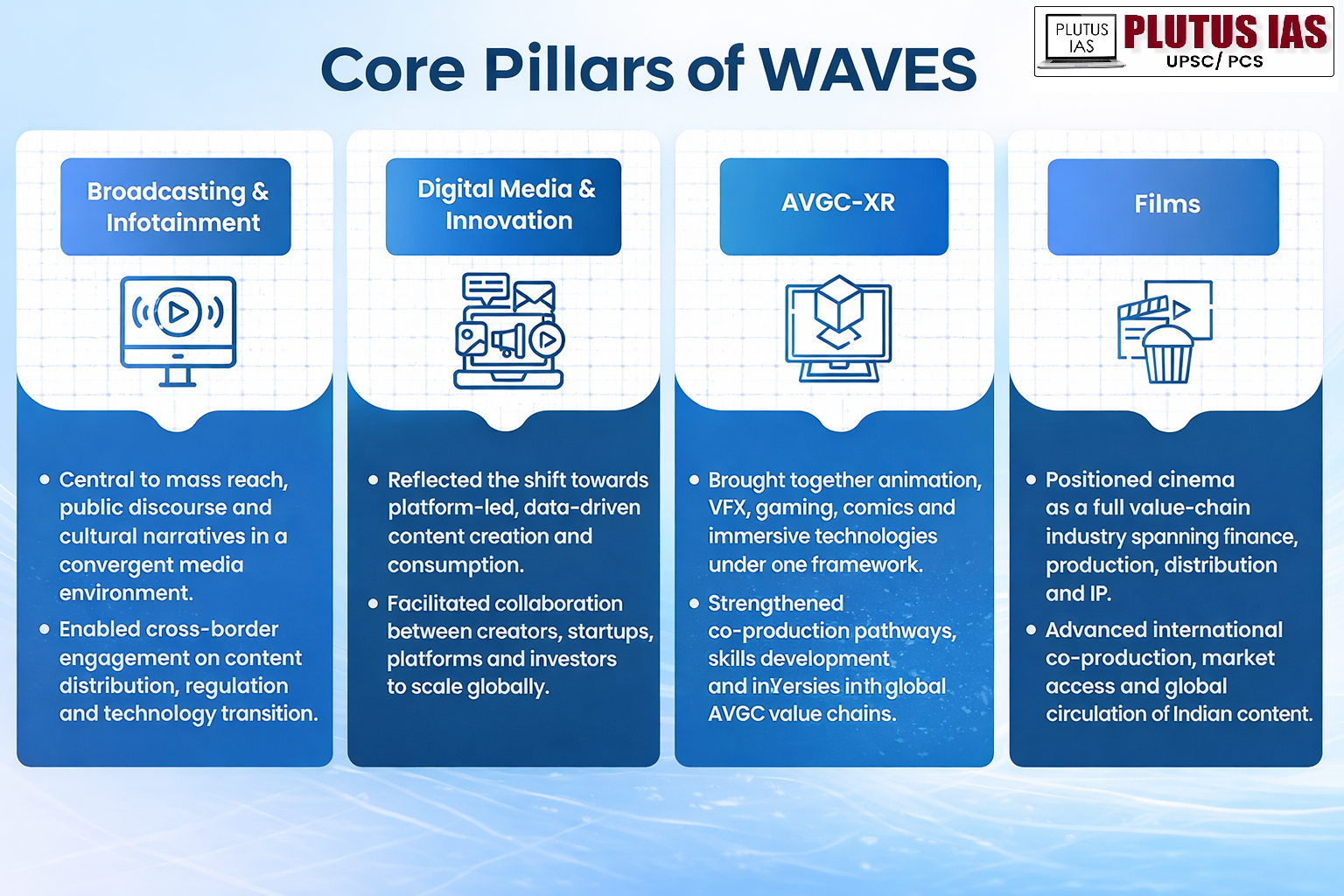
Significance and Importance
Economic Growth Engine: The creative industries are no longer niche; they are export-ready sectors capable of significant revenue generation. For instance, the WAVES Bazaar alone facilitated business transactions exceeding ₹800 crore, with projections crossing ₹1,000 crore.
Global Soft Power: By “Connecting Creators and Connecting Countries,” India leverages its cultural diversity—from classical traditions to contemporary digital media—to foster global harmony and resilience.
Start up Incubation: Through platforms like Wave X, the summit bridges the gap between early-stage ventures in language technologies and global investors like Google and Microsoft, accelerating the “Lab to Market” transition.
Employment and Inclusivity: The sector is a major provider of opportunities for youth, women, and underrepresented groups, aligning with the goals of inclusive growth.
Constitutional and Legal Dimensions
Freedom of Expression (Article 19(1)(a)): The summit’s focus on diverse voices and fact-based journalism reinforces the constitutional right to free speech while emphasizing the duty to counter misinformation and disinformation.
Intellectual Property Rights (IPR): A core pillar of the WAVES Declaration is the protection of intellectual property, which is essential for fair and open markets and the sustainability of creative professions.
WAVES Declaration: This multilateral commitment functions as a “Soft Law” framework, where 77 nations agreed on principles of transparency, accountability, and inclusivity in media governance.
Governance and Institutional Aspects
India is building a robust institutional architecture to support this vision:
National Centre of Excellence: The designation of IICT as the National Centre of Excellence for AVGC-XR signals a commitment to advanced skills and production capabilities.
Educational Integration: The government has announced AVGC Content Creator Labs across 15,000 secondary schools and 500 colleges, aiming to train two million professionals by 2030. This represents a forward-looking strategy to embed creative technology into the education system.
Key Issues and Challenges
The Digital Divide: Despite growth, the WAVES Declaration acknowledges that bridging the digital divide remains a priority to ensure equitable participation across all communities.
Ethical Use of AI: The rise of Artificial Intelligence in content creation poses risks regarding transparency and accountability.
Market Friction: Moving from a “pitch” to a “partnership” often faces bureaucratic and commercial friction, which platforms like WAVES Bazaar seek to mitigate through structured B2B meetings.
Misinformation: In an era of digital media, upholding fact-based journalism and cultural sensitivities while countering disinformation is a constant struggle for regulators.
Ethical and Democratic Concerns
The summit highlighted that creativity must be guided by public interest content. The WAVES Declaration explicitly calls for the responsible use of emerging technologies, ensuring that AI and digital platforms do not undermine human rights or cultural diversity. This aligns with democratic values of fostering an informed citizenry through ethical media practices.
Way Forward: A Policy Roadmap
Sustained Infrastructure: WAVES must transition from a biennial event into a permanent digital infrastructure (like the year-round WAVES Bazaar) to provide continuous market access.
Global Co-production Treaties: India should leverage the WAVES Declaration to sign more bilateral co-production treaties, facilitating joint funding and trade in creative services.
Skilling at Scale: The target of 2 million professionals by 2030 requires urgent implementation of school-level labs to ensure a “talent pipeline” that is globally competitive.
Regulatory Clarity on AI: Developing a clear legal framework for the use of AI in M&E, focusing on transparency and IPR protection, is essential to attract global studios.
Conclusion
WAVES 2025 has demonstrated that India’s creative economy is no longer on the sidelines but is a central driver of diplomacy and growth. By combining imagination with organisation, India is positioning itself as a global convener in cultural governance. Ultimately, this initiative serves the vision of Viksit Bharat 2047, linking creative ambition to Sustainable Development Goals (SDGs), long-term peace, and inclusive prosperity.
Prelims question:
Q. With reference to the WAVES Declaration 2025, consider the following statements:
1. It was endorsed by 77 participating nations in Mumbai.
2. It explicitly focuses on bridging the digital divide and the ethical use of Artificial Intelligence.
3. It calls for the total deregulation of media markets to encourage international co-productions.
Which of the statements given above is/are correct?
A) 1 and 2 only
B) 2 and 3 only
C) 1 and 3 only
D) 1, 2, and 3
Answer: A) 1 and 2 only.
Mains Question:
Q. “The creative economy is evolving from a cultural expression into a strategic engine of economic growth and soft power.” In the light of WAVES 2025 and the WAVES Declaration, evaluate India’s potential to become a global hub for the AVGC-XR sector by 2047. (250 Words)

- Artemis II: Humanity’s Return to Lunar Space and India’s Place in the New Moon Race - April 2, 2026
- A Missed Opportunity to Guarantee Minimum Wages - March 31, 2026
- ‘India’s Growth Claims, A Clash with Data Reality’. - March 30, 2026

No Comments