


19 Feb Harnessing India’s Demographic Dividend in the Age of Artificial Intelligence: A Strategic Roadmap for 2026
This article covers “Daily Current Affairs” and From Harnessing India’s Demographic Dividend in the Age of Artificial Intelligence: A Strategic Roadmap for 2026.
SYLLABUS MAPPING
GS- 3- Science and technology – Harnessing India’s Demographic Dividend in the Age of Artificial Intelligence: A Strategic Roadmap for 2026.
FOR PRELIMS
What is meant by AI–Demographic Synergy?
FOR MAINS
Why is Sovereign AI important for India?
Why in the News?
The India-AI Impact Summit 2026, which commenced on 16th February 2026, has brought to the forefront India’s strategic vision of placing its youth at the centre of the global Artificial Intelligence (AI) revolution. Coupled with the Union Budget 2026–27, which prioritises AI skilling and the “Orange Economy,” India is signalling a shift from being a mere consumer of technology to a global hub for AI-driven innovation and talent.
Defining the Concept: The AI-Demographic Synergy
In simple terms, India’s Youth Dividend refers to the economic growth potential resulting from the country’s large working-age population. Currently, over 65% of India’s population is under the age of 35.
Artificial Intelligence (AI), in this context, is viewed not just as a disruptive technology, but as a transformative force and a “key lever” to enhance the productivity of this demographic powerhouse. The synergy between the two involves transition from “passive learning to active participation,” where youth are equipped with digital fluency and interdisciplinary expertise to drive a future-ready economy.
Background and Context
Historically, India’s demographic dividend was leveraged through the IT services boom. However, the current era demands a structural transformation.
Economic Context: AI-related job postings in South Asia rose from 2.9% to 6.5% between 2023 and 2025, with AI skill demand growing 75% faster than non-AI roles.
Policy Evolution: The IndiaAI Mission, backed by an allocation of over ₹10,300 crore, marks a transition toward building Sovereign AI—indigenous models tailored to India’s linguistic and developmental needs.
Significance and Importance
Economic Momentum: India’s youth are the “engine of economic momentum,” with AI projected to reshape livelihoods and enhance national productivity.
Job Creation in Emerging Sectors: The focus on the Orange Economy (Animation, Visual Effects, Gaming, and Comics – AVGC) is expected to generate nearly 20 lakh (2 million) jobs by 2030.
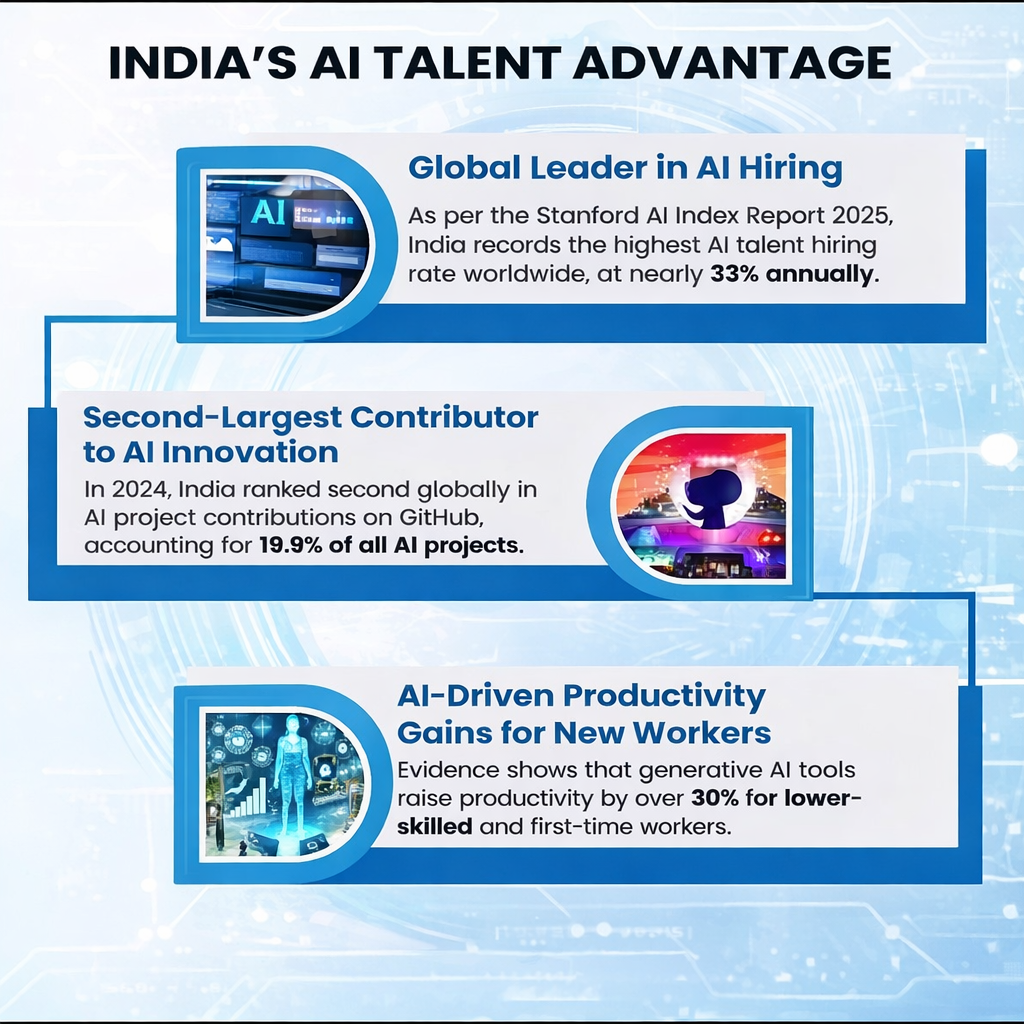
Global Leadership: According to the Stanford Global AI Index Report 2025, India’s AI skill penetration is 2.5 times higher than the global average, positioning the country as a leader in “responsible, inclusive, and use-case driven AI”.
Inclusivity: By democratising access to digital infrastructure, India is ensuring innovation emerges from beyond metropolitan hubs, with over 50% of start ups now originating in Tier-2 and Tier-3 cities.
Key Issues and Challenges
Labour Market Resilience: Accelerated AI adoption creates “employment pressures” for younger workers in roles with high AI exposure, necessitating urgent policy interventions to manage this transition.
Infrastructure Gaps: High-end compute power remains expensive. While the government provides subsidised access (₹65/hour for GPUs), scaling this to meet the needs of millions remains a challenge.
Skill Mismatch: There is an urgent need to sync classroom education with rapidly evolving industry needs to prevent the demographic dividend from becoming a “demographic burden”.
Ethical Risks: The rise of AI brings challenges related to data privacy, misinformation, and accountability, as highlighted by the national push for “AI Responsibility Pledges”.
Constitutional and Legal Dimensions
While India does not yet have a standalone AI Act, the framework is guided by:
Article 21A (Right to Education): The National Education Policy (NEP) 2020 integrates AI literacy as an essential competency, fulfilling the spirit of providing quality, future-ready education.
Directive Principles (Article 38 & 39): The state’s duty to promote a social order that minimises inequalities is reflected in the India AI Mission’s efforts to provide equitable access to compute and data for all citizens.
Sovereign AI: The focus on building “indigenous AI models” aligns with the constitutional goal of maintaining national sovereignty in the digital age.
Economic and Social Impact
The “AI by HER” Movement: Dedicated programmes for women-led AI startups (targeting 150 founders) aim to translate empathy-driven innovation into scalable solutions for healthcare and education, fostering gender-inclusive growth.
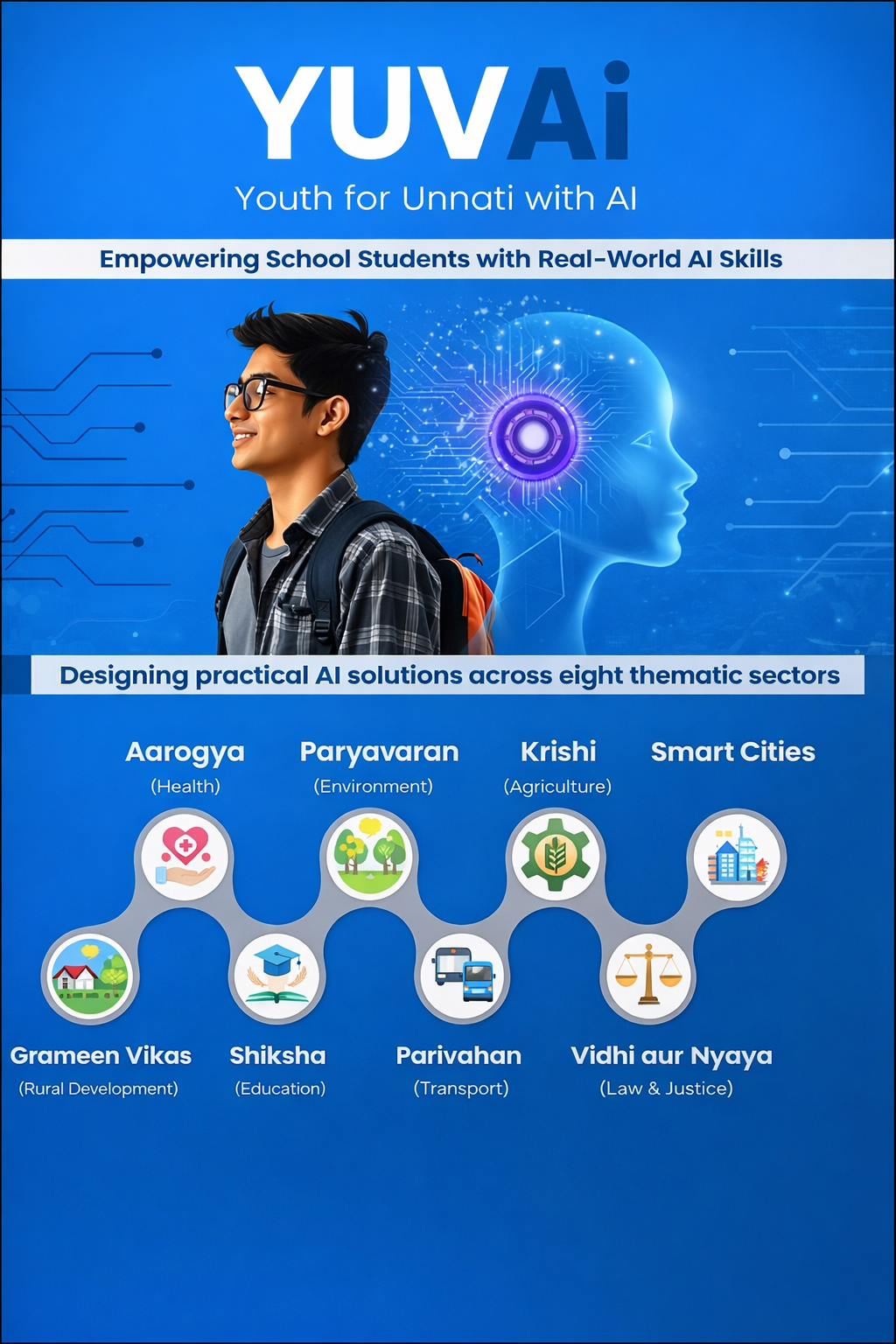
Vocational Transformation: Through the Skill India Mission (SOAR), over 1.34 lakh students and teachers are being upskilled, ensuring that the benefits of AI reach the grassroots level.
Grassroots Innovation: The establishment of AI Data and AI Labs in ITIs and Polytechnics across 27 States/UTs ensures that high-end resources are not confined to elite institutions.
Governance and Institutional Aspects
Education to Employment and Enterprise Standing Committee: Proposed in the 2026-27 Budget to assess how AI affects job requirements and to bridge the gap between academia and enterprise demand.
Multi-tiered Infrastructure: The government is expanding compute capacity from 38,000 GPUs to 58,000 high-end GPUs to support the startup ecosystem.
Institutional Framework: Collaboration between MeitY, MSDE (Ministry of Skill Development and Entrepreneurship), and industry bodies like NASSCOM via platforms like FutureSkills Prime.
Global Comparison
India stands out globally for its “scale of skilling.” While many developed nations focus on high-end research, India is focusing on “AI for All”.
Skill Penetration: India’s relative penetration (2.5x global average) outperforms many peers in the Stanford Global AI Index.
Enterprise Adoption: 87% of Indian enterprises actively use AI, compared to lower adoption rates in several other developing economies.
Ethical and Democratic Concerns
The Guinness World Record of 2.5 lakh AI Responsibility Pledges in 24 hours underscores India’s commitment to “human-centric” and “ethically grounded” AI. The focus is on:
Transparency and Explainability: Building AI systems that address real-world challenges while being accountable to the citizens.
Digital Trust: Combatting misinformation and ensuring data privacy as core components of digital citizenship.
Way Forward
Scaling Sovereign AI: Development of indigenous models that understand India’s linguistic diversity is crucial for “outcome-driven” AI.
Strengthening the “Orange Economy”: Operationalising the Indian Institute of Creative Technologies (IICT) and content creator labs in 15,000 schools will be vital for job creation.
Equitable Compute Access: Expanding the GPU infrastructure to 58,000 units must be accompanied by further subsidies for rural entrepreneurs.
Lifelong Learning: Enhancing the Skill India Digital Hub (SIDH) to provide continuous upskilling as AI models evolve.
Evidence-Based Implementation: Using the AI Impact Startup Book as a repository to scale successful “pilot projects” into “population-scale deployment” across ministries.
Conclusion
India’s journey toward a Viksit Bharat by 2047 is inextricably linked to how it manages its youth dividend in the AI era. By prioritising inclusive growth, democratic governance, and responsible innovation, India is not just adopting AI—it is defining its ethical and social contours for the world. As the nation advances, empowering the young population with AI capabilities will remain the cornerstone of long-term productivity and Atmanirbhar Bharat (Self-reliant India).
Prelims question:
Q. With reference to India’s AI ecosystem as of 2026, consider the following statements:
1.According to the Stanford Global AI Index Report 2025, India’s AI skill penetration is more than double the global average.
2.The India AI Mission has set a target to provide compute access at a subsidised rate to start ups.
3.The “Orange Economy” primarily focuses on heavy manufacturing and semiconductor fabrication.
Which of the statements given above is/are correct ?
A) 1 and 2 only
B) 2 and 3 only
C) 1 and 3 only
D) 1, 2, and 3
Answer: A) 1 and 2 only
Mains Question:
“The transition from passive learning to active participation is the cornerstone of India’s strategy to leverage its demographic dividend in the AI era.” Critically analyse the institutional and policy measures taken by the Government of India to build an AI-ready talent ecosystem.
(250 Words)

- Artemis II: Humanity’s Return to Lunar Space and India’s Place in the New Moon Race - April 2, 2026
- A Missed Opportunity to Guarantee Minimum Wages - March 31, 2026
- ‘India’s Growth Claims, A Clash with Data Reality’. - March 30, 2026

No Comments