


25 Feb Restoring the Life of Ganga: Scientific River Ranching and Ecological Rejuvenation
This article covers “Daily Current Affairs” and From Restoring the Life of Ganga: Scientific River Ranching and Ecological Rejuvenation
SYLLABUS MAPPING
GS-3- Climate change impacts on riverine ecosystems – Restoring the Life of Ganga: Scientific River Ranching and Ecological Rejuvenation
FOR PRELIMS
What is scientific river ranching?
FOR MAINS
What are the major challenges in conserving native fish species in Indian rivers?
Why in the News?
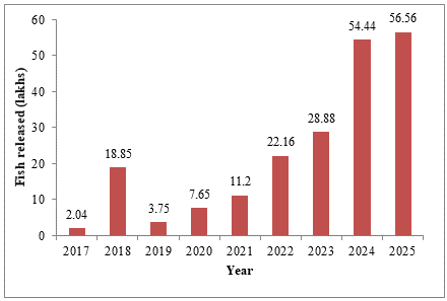
Under Namami Gange, ICAR-CIFRI released 205.5 lakh indigenous fish seeds via 169 ranching programmes (2017–2025) to restore Ganga’s biodiversity. This scientific approach increased fish landings by 41% in Varanasi and 24.7% in Prayagraj. Resultantly, India became the world’s top producer of inland capture fishes.
Significance of River Ganga.
The River Ganga is not merely a watercourse; for over a century, it has served as the lifeblood of India, sustaining a dense web of biodiversity and anchoring the livelihoods of millions. However, the river’s ecological integrity has faced a severe crisis, characterized by a sharp decline in indigenous fish biodiversity. This decline is a casualty of decades of habitat degradation, pollution, and unregulated fishing. In response, the Government of India, under the Namami Gange Programme, has adopted scientific river ranching as a pivotal, evidence-based strategy for restoration. Implemented by the ICAR-Central Inland Fisheries Research Institute (ICAR-CIFRI), this initiative represents a transition from mere restocking to a broader goal of ecological balance. Thesis: The success of Ganga’s rejuvenation lies in an integrated approach that harmonises scientific rigor with socio-economic sustainability and active community stewardship, ensuring the river remains a living ecosystem for future generations.
Status of Indigenous Fish Diversity in Ganga Basin
Historically, the Ganga basin has been home to a rich variety of native fish that supported food security and cultural practices. In recent decades, these populations have thinned significantly.
Key Causes of Decline: The sources identify habitat degradation, altered flow regimes, and pollution as primary drivers. Additionally, relentless and unregulated fishing pressure has further depleted stocks.
Impact: This biodiversity loss directly threatens the resilience of riverine ecosystems and the livelihoods of dependent fisher communities who rely on the river for their primary income and nutritional needs.
Scientific River Ranching
Scientific river ranching involves the planned release of fish seeds into natural water bodies to augment existing populations.
Breeding and Release: Between 2017 and 2025, 205.5 lakh indigenous fish seeds were released through 169 ranching programmes. To ensure survival, fingerlings (10–15 cm) were used instead of generic hatchery fish.
Genetic Stock Management: Crucially, seeds are bred from wild brooders collected directly from the Ganga to safeguard native genetic lines.
Monitoring and Technology: The programme utilizes advanced tools like GIS-based habitat mapping through the Indian Inland Fisheries Informatics (INNF) platform and Real-time monitoring via IoT for water quality. Tagging systems (e.g., 6,031 Hilsa tagged) are used to track movement and survival.
Institutional Framework under Namami Gange
The Namami Gange Programme provides the overarching framework for these interventions, with ICAR-CIFRI serving as the primary scientific body.
Collaboration: The initiative involves high-level policy support, evidenced by the participation of senior Union Ministers in ranching events to raise public awareness.
Policy Convergence: The development of the National Reservoir Fisheries Management Policy (2025) and the use of River Aqua Map to integrate pollution data with aquatic life suitability demonstrate a move toward unified, science-based governance.
Ecological Outcomes
The interventions have yielded measurable ecological gains:
Species Revival: Significant increases in Indian Major Carp (IMC) landings have been recorded, with Prayagraj seeing a 24.7% rise and Varanasi a 41% rise.
Trophic Balance: Ranching efforts focus on diverse species, including Mahseer, Catfishes, and Hilsa, to restore the natural food web.
Critical Analysis: While successful, the sources emphasize that restoration must be persistent rather than symbolic. Genetic dilution is mitigated by using wild-caught brooders, but long-term sustainability requires refining adaptive management and continuous monitoring.
Socio-Economic Dimensions
The programme views fisheries not just as a resource, but as a pillar of nutritional security and poverty alleviation.
Livelihood Support: By rebuilding fish populations, the initiative strengthens the economic base of fishing communities.
Productivity Gains: Guided by ICAR-CIFRI, reservoir productivity rose from 20 to 150 kg/ha/year, and wetland productivity reached 1,600 kg/ha/year.
Commercial Potential: India has become the world’s top producer of inland capture fishes (1.89 million tonnes), indicating the high economic stakes of successful river management. (Note: While the sources focus on broad community impact, specific details on SHGs or eco-tourism are less detailed; these are generally recognized in wider policy contexts).
Challenges and Limitations
Despite progress, several hurdles remain:
Environmental Pressures: Climate variability and altered flow regimes continue to challenge habitat stability.
Governance and Enforcement: The need for “unregulated fishing” control suggests gaps in enforcement.
Monitoring: While IoT and GIS are being deployed, the sources highlight the necessity of scaling these technologies for basin-wide tracking.
Invasive Species: While not explicitly detailed in the excerpts, the focus on “native species conservation” implies a strategic effort to counter the risks posed by non-native species.
Way Forward
The future of the Ganga depends on basin-level integrated management.
Technology Integration: Expanding AI and IoT-based technologies for real-time water quality and drone-based sampling will be critical.
Stakeholder Participation: Deepening community engagement and public awareness is essential for the longevity of conservation efforts.
Policy refinement: Continuous research and adaptive management are required to ensure that interventions keep pace with environmental changes.
Ethical and Sustainable Development Perspective
The approach has evolved from “production-oriented” to an ecosystem-based model. This reflects a shift toward ecological stewardship, where the river is treated as a living entity rather than a mere resource. This aligns with the principle of inter-generational justice, ensuring that the Ganga’s biological wealth is preserved for the future.
Conclusion
Prelims question:
Which of the following statements regarding the “Scientific River Ranching” programme under Namami Gange is/are correct?
1. It is primarily implemented by the ICAR-Central Inland Fisheries Research Institute (ICAR-CIFRI).
2. Fish seeds for ranching are exclusively sourced from generic commercial hatcheries to ensure high volume.
3. The programme uses the “River Aqua Map” to integrate water quality data with aquatic life suitability.
Select the correct answer:
A) 1 and 2 only
B) 1 and 3 only
C) 2 and 3 only
D) 1, 2, and 3
Answer – B
Mains Question:
“Scientific river ranching under the Namami Gange Programme represents a shift from mere pollution control to comprehensive ecological restoration.” Critically examine this statement with reference to its impact on biodiversity and the socio-economic conditions of riverine communities. (250 Words)

- Artemis II: Humanity’s Return to Lunar Space and India’s Place in the New Moon Race - April 2, 2026
- A Missed Opportunity to Guarantee Minimum Wages - March 31, 2026
- ‘India’s Growth Claims, A Clash with Data Reality’. - March 30, 2026

No Comments