


27 Feb India’s Trade Partnerships: Powering Global Integration and Economic Growth
This article covers “Daily Current Affairs” and From India’s Trade Partnerships: Powering Global Integration and Economic Growth
SYLLABUS MAPPING
GS-3-Economy- India’s Trade Partnerships: Powering Global Integration and Economic Growth
FOR PRELIMS
What is the objective of the Trade Connect e-Platform?
FOR MAINS
What is meant by “Mode 4” in trade in services under WTO classification?
Why in the News?
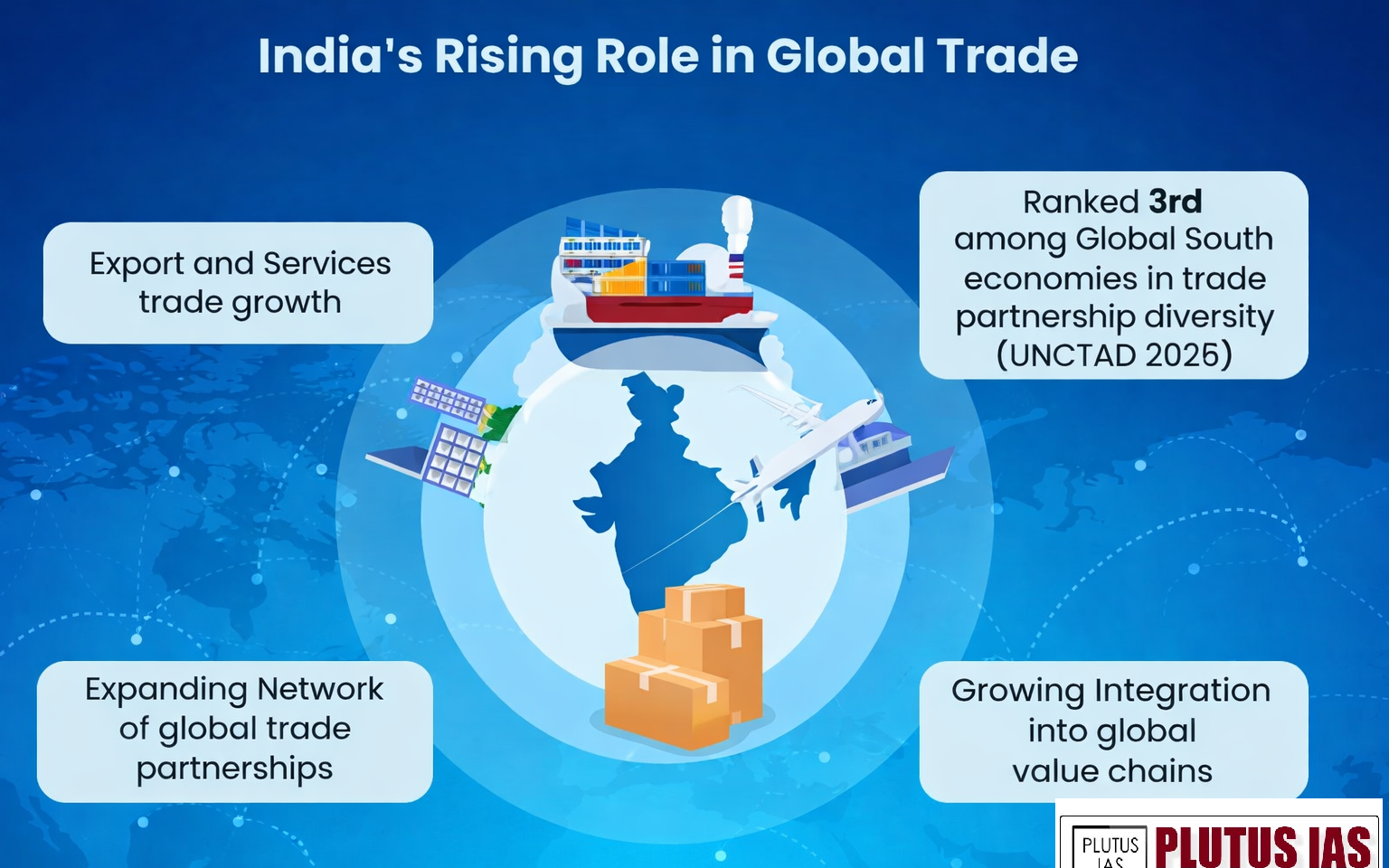
India stands at a pivotal moment in its economic rise, emerging as a major global trade force. The UNCTAD Trade and Development Report 2025 ranks India third among Global South economies in trade partnership diversity, reflecting strong global integration and resilience to tariff uncertainties. As India advances toward its Viksit Bharat vision, trade agreements—bilateral, regional, and multilateral—form the backbone of its growth and geopolitical strategy. In early 2026, India finalised the India-EU FTA and progressed negotiations with the US, GCC, and Israel. Agreements with the UK, Oman, and New Zealand are being implemented, while the EFTA pact secures $100 billion in long-term FDI commitments.
Evolution of India’s Trade Policy
The evolution of India’s trade policy represents a journey from a cautious, protectionist stance to one of calibrated globalisation. While the post-1991 liberalisation era opened India’s doors to the world, the current phase is marked by a more sophisticated and strategic engagement with the global trade architecture. India has long been an active participant in the World Trade Organization (WTO), but recent years have seen a shift toward concluding high-standard, modern bilateral agreements that address contemporary challenges.
A significant turning point in this evolution was the decision to pivot away from large regional blocs like the Regional Comprehensive Economic Partnership (RCEP)—which is not detailed in the sources but is a known historical context—in favour of selective, mutually beneficial FTAs. This “Act East” and “Look West” philosophy is reflected in the rapid conclusion of deals with partners ranging from Australia and the UAE to the European Union and Oman. These modern agreements move beyond simple tariff reductions to include provisions for services, investment, and regulatory cooperation, ensuring that India’s domestic industries, such as those under the Make in India initiative, are propelled rather than hindered by international competition.
Major Trade Partnerships Driving Integration
India’s trade network is expanding across diverse geographical regions, each serving a specific strategic purpose.
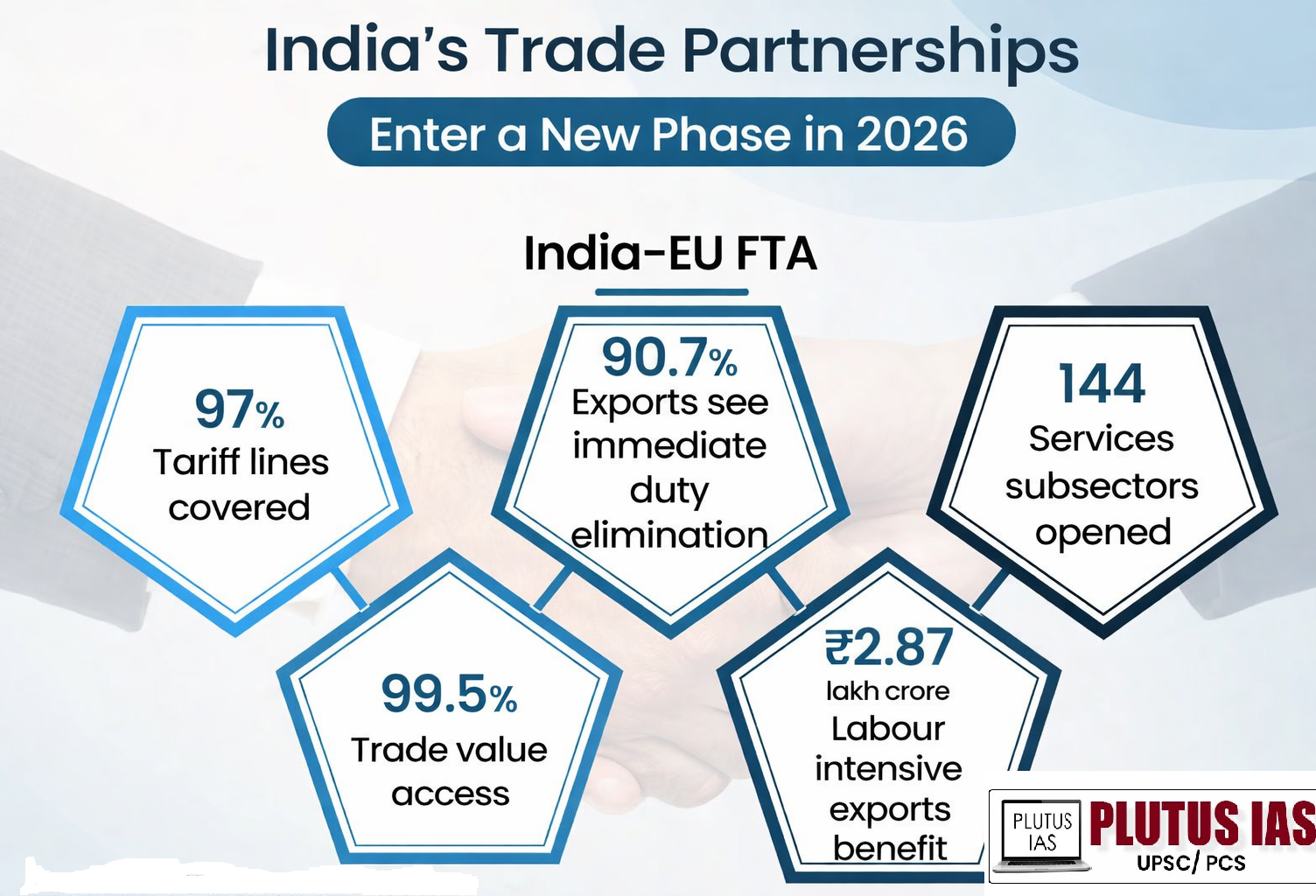
A. United States & Europe The relationship with the West has entered a historic phase. In January 2026, India concluded negotiations for the India-EU Free Trade Agreement, hailed as the “Mother of All Deals”. This landmark pact provides preferential access to 97% of EU tariff lines, covering nearly 99.5% of trade value, which will drastically benefit Indian textiles, leather, and gems. Simultaneously, India reached a framework understanding with the United States for an Interim Agreement in February 2026, aimed at fostering reciprocal trade and resilient supply chains. With the United Kingdom, the signed Comprehensive Economic and Trade Agreement (CETA) aims to double bilateral trade to USD 112 billion by 2030, offering duty-free access for 99% of Indian exports.
B. Middle East The Middle East serves as a vital pillar for energy security and remittances. The India-UAE CEPA, signed in 2022, has already seen bilateral trade surpass USD 100 billion in FY 2024-25, with a notable 25.6% growth in non-oil exports. Furthermore, India signed a CEPA with Oman in December 2025, granting zero-duty access to over 98% of Oman’s tariff lines. Negotiations are also formally underway with the Gulf Cooperation Council (GCC) to further elevate these deep economic ties. (Note: The “I2U2 grouping” mentioned in your query is a known geopolitical entity but is not explicitly named in these sources).
C. Indo-Pacific & East Asia In the Indo-Pacific, India is leveraging partnerships to strengthen supply chain resilience. The India-Australia ECTA provides zero-duty access for 100% of Indian tariff lines as of January 2026, benefiting labour-intensive sectors and securing raw materials like coal and mineral ores for Indian industry. Discussions for the ASEAN-India Trade in Goods Agreement (AITIGA) are also active to unleash the full economic potential of the region.
D. Oceania and Africa The India-New Zealand FTA, concluded in 2025, stands as one of the fastest-negotiated deals, including a USD 20 billion investment commitment over 15 years. In Africa, the CECPA with Mauritius acts as a strategic gateway, providing preferential access for over 300 Indian export products.
These agreements collectively boost exports, improve market access for farmers and MSMEs, and diversify trade dependence by creating “trusted” alternative supply routes.
How Trade Partnerships Power Economic Growth
Trade partnerships act as a multiplier for domestic economic growth by opening new avenues for diversification and value addition. One of the most significant impacts is on manufacturing, where FTAs complement the Production Linked Incentive (PLI) schemes (noted in the query) by ensuring that Indian-made goods have ready markets abroad. For example, the India-EFTA TEPA includes a ground breaking commitment to direct USD 100 billion in FDI into India over 15 years, which is projected to generate one million direct jobs.
The services sector also sees a massive boost; agreements with the UK, Australia, and the EU include commitments in IT, healthcare, and education, easing the mobility of Indian professionals through “Mode 4” categories. Furthermore, the government has integrated trade with the Atmanirbhar Bharat vision, emphasizing competitive integration rather than isolation. Domestic enablers like the Export Promotion Mission (EPM) and the Trade Connect ePlatform provide the infrastructure and regulatory clarity needed for MSMEs to integrate into Global Value Chains (GVCs).
Financial measures, such as the extension of the period for realisation of export proceeds to 15 months and the removal of value caps on courier exports in the 2026-27 Budget, further enhance the comparative advantage of Indian exporters by maintaining liquidity and reducing logistics costs.
Strategic & Geopolitical Dimensions
In the post-COVID era, trade has been redefined as a tool for strategic leverage and national security. India’s “trusted partner” status is essential to the “China+1” strategy (as referenced in your query), as global firms seek to diversify their manufacturing bases away from over-reliance on a single geography. India’s negotiations with Israel, concluded in its first round in February 2026, focus on high-tech sectors like AI, quantum computing, space, and defence, illustrating how trade is now tied to technology access.
Energy security remains paramount, with the Oman and UAE deals securing steady flows of resources while opening markets for Indian traditional medicine (AYUSH). Additionally, the EFTA agreement ensures long-term productive investments that build domestic capacity rather than just speculative portfolio flows. While the sources do not explicitly name the “Quadrilateral Security Dialogue” or “BRICS” in the text, they highlight that India’s expanding network of agreements positions it to shape the contemporary trade architecture based on strategic trust and mutual growth.
Challenges & Structural Constraints
Despite these successes, India faces several structural constraints that require careful management. The trade deficit, particularly with major manufacturing hubs, remains a concern, necessitating the “carefully calibrated liberalisation” mentioned in policy documents to protect sensitive sectors like agriculture, dairy, and poultry.
Non-tariff barriers and logistics bottlenecks continue to pose challenges to export competitiveness. While the 2026-27 Budget introduces measures like electronic sealing for direct factory-to-ship clearance to reduce time and costs, broader reforms are still needed. The withdrawal from RCEP (noted in the prompt) highlights the ongoing debate regarding domestic manufacturing competitiveness and the fear of being overwhelmed by cheaper imports. To truly excel, India must continue addressing the need for labor and land reforms (noted in the query) to ensure that the domestic ecosystem can keep pace with the opportunities provided by new FTAs.
Way Forward
The path toward Viksit Bharat @ 2047 requires a continued focus on deepening FTAs with robust safeguards for domestic industries. Policy suggestions for the future include:
Deepening MSME integration into GVCs through digital tools like the Trade Connect platform.
Expanding the negotiation agenda with countries like Canada and Mexico to reach new markets in the Americas.
Implementing logistics reforms to further reduce the “hidden costs” of trade.
Fostering skill development to ensure the Indian workforce can meet the “Mode 4” mobility opportunities in sectors like healthcare and engineering.
Anticipating global shifts toward green trade and carbon adjustments, ensuring Indian exports remain sustainable and compliant with international standards (this is a conceptual extension as the sources focus on current agreements).
Conclusion
India’s trade partnerships in 2026 represent more than just commercial contracts; they are a bridge between economic growth and global geopolitics. By balancing self-reliance (Atmanirbhar Bharat) with global integration, India is successfully positioning itself as a “trusted partner” in global supply chains. As the nation continues to conclude landmark deals with the EU, UK, and EFTA, it is clear that India has transitioned from being a mere participant in global trade to a rule-shaper, driving sustainable growth and shared prosperity on the world stage. Through a blend of domestic policy support and strategic international engagement, India is well on its way to becoming a central pillar of the 21st-century global economy
Prelims question:
Q. With reference to India’s recent trade agreements and partnerships, which of the following statements is correct?
A) The India-Australia ECTA, as of January 2026, provides India with zero-duty access across 70% of Australian tariff lines.
B) India ranks first among Global South economies in trade partnership diversity according to the UNCTAD 2025 report.
C) The India-EFTA TEPA includes a commitment to increase FDI into India by USD 100 billion over 15 years, excluding foreign portfolio investment (FPI).
D) The India-Oman CEPA is the first agreement where a partner country has extended commitments on traditional medicine across only two modes of supply.
Answer: C
Mains Question:
“Economic integration in the 21st century is no longer just about tariff reductions but also about securing investment commitments and professional mobility.” Discuss ( 250 words )

- Artemis II: Humanity’s Return to Lunar Space and India’s Place in the New Moon Race - April 2, 2026
- A Missed Opportunity to Guarantee Minimum Wages - March 31, 2026
- ‘India’s Growth Claims, A Clash with Data Reality’. - March 30, 2026

No Comments