


02 Mar Empowering the Rural Backbone: The Strategic Evolution of India’s Allied Sectors and Market Integration
This article covers “Daily Current Affairs” and From Empowering the Rural Backbone: The Strategic Evolution of India’s Allied Sectors and Market Integration
SYLLABUS MAPPING
GS-3 –Agriculture, Allied Sectors, Inclusive Growth, and Infrastructure – Empowering the Rural Backbone: The Strategic Evolution of India’s Allied Sectors and Market Integration
FOR PRELIMS
What is the significance of the Rules and Guidelines for Sustainable Harnessing of Fisheries (2025)?
FOR MAINS
How do recent fiscal allocations reflect a strategic shift in India’s agricultural policy?
Why in the news?
The focus on India’s allied agricultural sectors has gained significant momentum following the release of a comprehensive progress report on March 1, 2026, which detailed the transformative growth in livestock and fisheries. This renewed attention is further bolstered by the Union Budget 2026–27, which reflects a substantial commitment to the sector. Specifically, the Department of Animal Husbandry & Dairying received an allocation of ₹6,153.46 crore, a 16 percent increase from the previous fiscal year. Similarly, the fisheries sector saw a record allocation of ₹2,761.80 crore, aimed at consolidating India’s leadership in aquaculture and seafood exports. These fiscal measures, alongside the implementation of the Rules and Guidelines for Sustainable Harnessing of Fisheries (2025), signal a strategic shift toward formalising and modernising the allied sectors to ensure long-term livelihood resilience and national nutritional security.
India’s agricultural
India’s agricultural landscape is undergoing a profound transformation, moving beyond traditional crop cultivation to a more diversified and resilient model. Allied sectors—comprising livestock, dairy, poultry, and fisheries—have emerged as the new engines of rural growth, contributing significantly to the agricultural Gross Value Added (GVA) and providing a buffer against the uncertainties of traditional farming. Over the last decade, these sectors have maintained a steady Compound Annual Growth Rate (CAGR) of 3-5%, driven by robust domestic demand and targeted government interventions.
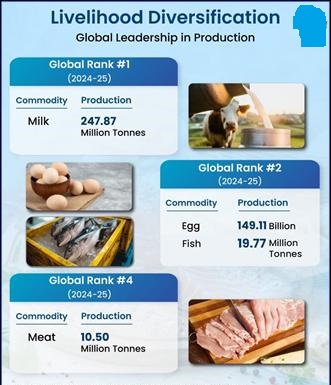
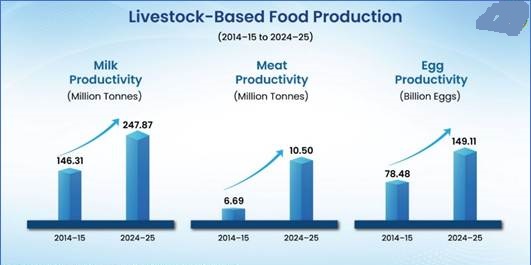
The statistics underscore India’s global dominance: the nation is the world’s largest producer of milk, accounting for approximately 25 percent of global output. It also holds the second-largest position in fish and egg production and ranks fourth globally in meat production. This shift is not merely statistical but reflects a strategic move by rural households to manage seasonal income fluctuations and climate variability by adopting multiple livelihood options.
However, for these sectors to reach their full potential estimated to triple by 2047 the focus must now shift toward next-generation reforms. While productivity has increased, the next frontier lies in strengthening market access and value chains. Connecting small-scale producers to organised markets and enhancing processing capabilities are crucial steps to ensure that the gains of the “Blue” and “White” revolutions are sustainable and inclusive.
Role of Livestock and Fisheries in the Indian Economy
The economic footprint of livestock and fisheries is vast and vital for rural stability. Between FY15 and FY24, the sector’s GVA increased by nearly 195 percent, showcasing its rapid expansion. Fisheries alone contribute 7.43 percent to the agricultural GVA, supporting over 30 million livelihoods. Unlike the seasonal nature of crops, livestock and fisheries provide regular and predictable cash flows; for instance, daily milk sales and multiple fish production cycles offer sustained employment and liquidity to rural families.
These sectors are central to the goal of doubling farmers’ income. By integrating livestock with crop cultivation, households benefit from a circular resource use (utilising crops for fodder and livestock waste for manure), which reduces dependence on expensive external inputs. Furthermore, they are pillars of nutritional security, providing essential protein through milk, eggs, and fish. Per capita milk availability in India has reached 485 grams per day, far exceeding the global average.
Socially, the sector is a powerful tool for women’s empowerment and the upliftment of marginal farmers. Approximately 150 million farmers are sustained by the dairy sector, many of whom are smallholders or women who gain bargaining power through cooperatives and Self-Help Groups (SHGs). Economically, the export potential is massive; seafood exports alone have more than doubled in the last decade, reaching ₹62,408 crore and touching over 130 countries. This reinforces the “Blue Economy” as a strategic priority for earning foreign exchange and ensuring inclusive growth.
Key Challenges in the Sector
Despite the growth, several hurdles prevent the sector from achieving its maximum efficiency.
A. Structural Challenges Production remains largely fragmented, with millions of small producers operating independently, making it difficult to achieve economies of scale. While productivity has risen, many indigenous breeds still show lower yields compared to global benchmarks, though recent genetic gains are narrowing this gap. Additionally, climate variability poses a significant threat, affecting land use and the availability of feed and fodder. Health risks remain a constant concern, with disease outbreaks such as Foot and Mouth Disease (FMD), Brucellosis, and avian flu capable of causing devastating productivity losses.
B. Infrastructure and Market Challenges The “last mile” remains the weakest link. There is a persistent inadequacy in cold chain networks, which leads to high post-harvest losses, particularly in the highly perishable fisheries sector. India’s processing capacity, while growing, still lags behind production; for example, current daily milk processing stands at 660 lakh litres, with a target to reach 100 million litres by 2028–29. Poor last-mile connectivity and a lack of rural storage facilities often leave farmers dependent on middlemen, resulting in poor price realisation and a disconnect from formal, organised markets.
C. Institutional and Policy Gaps Historically, livestock and fisheries have faced credit constraints, as traditional banking was often geared toward crop loans. While the extension of Kisan Credit Cards (KCC) has helped, a gap remains in reaching the most remote producers. Insurance penetration for livestock is still relatively low, leaving farmers vulnerable to sudden animal loss. Furthermore, the informal nature of livestock trade and the slow formation of organized farmer collectives in some regions hinder the ability of small producers to negotiate better prices or access modern technology.
Government Initiatives and Reforms
The Government of India has launched a suite of mission-mode projects to address these challenges.
Rashtriya Gokul Mission (RGM): Focuses on conserving indigenous breeds and enhancing productivity through artificial insemination. To date, 14.56 crore inseminations have been conducted, benefiting 5.62 crore farmers.
National Livestock Mission (NLM): Aims at boosting entrepreneurship and improving the production of meat, eggs, and fodder.
National Animal Disease Control Programme (NADCP): Targets 100% vaccination against FMD and Brucellosis. It has successfully reduced FMD outbreaks from 132 cases in 2019 to just 6 in 2025.
PM Matsya Sampada Yojana (PMMSY) & FIDF: These are the bedrocks of fisheries reform, funding over 27,000 transportation units and thousands of fish markets to bridge infrastructure gaps.
KCC Extension: The extension of the Kisan Credit Card to animal husbandry and fisheries has provided essential working capital, with over 39 lakh applications sanctioned in animal husbandry alone.
Critical Evaluation: These schemes have been highly effective in solving productivity and health issues, as evidenced by the 27% rise in average bovine productivity and the near-elimination of certain diseases. However, market access remains a work in progress. While the e-NAM and digital platforms are being integrated, the physical infrastructure (like cold storage) in remote areas still needs rapid scaling to keep pace with the massive production increases.
Strengthening Market Access: The Way Forward
To move toward a truly market-integrated model, a multi-pronged approach is required.
A. Value Chain Development Investing in integrated cold chain networks is non-negotiable to reduce waste. Expanding processing and branding efforts will allow farmers to capture a higher share of the consumer rupee. Developing export-oriented clusters for marine products and processed meat can further tap into global demand.
B. Digital and Institutional Reforms The formation of Farmer Producer Organizations (FPOs) and Fish Farmer Producer Organizations (FFPOs) is essential to aggregate produce and provide smallholders with bargaining power. Digital tools like Pashu Aadhaar (a 12-digit unique ID for livestock) and the National Fisheries Digital Platform (NFDP) will enhance traceability and transparency, making it easier for producers to access credit and insurance.
C. Infrastructure Push Priority must be given to rural storage and refrigerated transport to ensure that perishable goods reach urban centres in peak condition. For the fisheries sector, enhancing port infrastructure and deep-sea fishing capabilities will strengthen India’s position in the global seafood value chain.
D. Financial and Insurance Reforms Expanding livestock insurance penetration is vital for risk mitigation. Encouraging microfinance support for women’s SHGs can drive grassroots entrepreneurship in poultry and dairy.
E. Sustainability and Climate Resilience Adopting climate-smart livestock practices and sustainable aquaculture—such as the rules notified for the EEZ in 2025—will ensure long-term ecological balance. Continued investment in breed improvement and genetic technology will help develop animals that are more resilient to heat and disease.
Prelims question:
Q. Consider the following statements regarding the progress of India’s allied agricultural sectors by 2025–2026:
1.India accounts for approximately 25 percent of global milk production.
2.The National Animal Disease Control Programme (NADCP) successfully reduced Foot and Mouth Disease (FMD) outbreaks to zero by 2025.
3.Pashu Aadhaar is a 12-digit unique identification system used to record livestock health and breeding.
Which of the statements given above are correct?
(a) 1 and 2 only
(b) 2 and 3 only
(c) 1 and 3 only
(d) 1, 2, and 3
Answer: (c)
Mains Question:
“Evaluate the role of digital public infrastructure and institutional frameworks in transitioning India’s livestock and fisheries from subsistence to market-integrated models. What structural bottlenecks persist ? (250 words)

- Artemis II: Humanity’s Return to Lunar Space and India’s Place in the New Moon Race - April 2, 2026
- A Missed Opportunity to Guarantee Minimum Wages - March 31, 2026
- ‘India’s Growth Claims, A Clash with Data Reality’. - March 30, 2026

No Comments