


14 Mar SWAMIH: A Policy Lifeline for India’s Housing Sector
This article covers “Daily Current Affairs” and From SWAMIH: A Policy Lifeline for India’s Housing Sector
SYLLABUS MAPPING
GS-3 – Infrastructure – SWAMIH: A Policy Lifeline for India’s Housing Sector
FOR PRELIMS
What type of fund is SWAMIH, and who manages it?
FOR MAINS
Why was SWAMIH created? Name the main cause of stalled projects it addresses.
Why in the news ?
SWAMIH is in the news due to the announcement and upcoming rollout of SWAMIH Fund-2 in Budget 2025-26 and the milestone completion of thousands of stalled housing units, aimed at reviving stressed real estate projects and providing relief to homebuyers.
Introduction
India’s real estate sector, a major driver of economic growth and urbanisation, has faced persistent challenges from stalled housing projects. These unfinished developments have left millions of homebuyers in distress, tied up capital, and slowed allied industries. The Special Window for Affordable and Mid-Income Housing (SWAMIH) Investment Fund, launched in 2019, emerged as a targeted solution providing last-mile financing to revive viable stalled projects. Often hailed as a “policy lifeline,” SWAMIH has delivered thousands of homes, generated employment, and restored confidence in the sector.
Background of Stalled Housing Projects and Sector Challenges
The stalled housing crisis intensified post-2013 due to policy shifts and economic shocks. Pre-RERA (2016), developers often diverted buyer funds, leading to over-leveraging. Demonetisation (2016), GST rollout (2017), and RERA’s escrow and registration norms caused widespread liquidity issues. The 2018 IL&FS crisis further restricted NBFC lending, while bureaucratic delays, land disputes, cost escalations, and COVID-19 disruptions compounded problems.
Key challenges included:
Funding shortages for last-mile completion (projects 70–80% done but lacking final funds).
Project delays leading to insolvency under IBC.
Impact on homebuyers middle-class families paying EMIs while renting elsewhere, with estimates of 4–5 lakh affected buyers and ₹10+ lakh crore locked capital.
Economic fallout job losses in construction (a major employer), reduced demand for cement/steel, lower GST/stamp duty revenues, and dampened GDP contribution.
This crisis eroded trust in real estate, highlighting the need for focused financial rescue rather than broad subsidies.
Objectives, Structure, and Functioning of the SWAMIH Fund
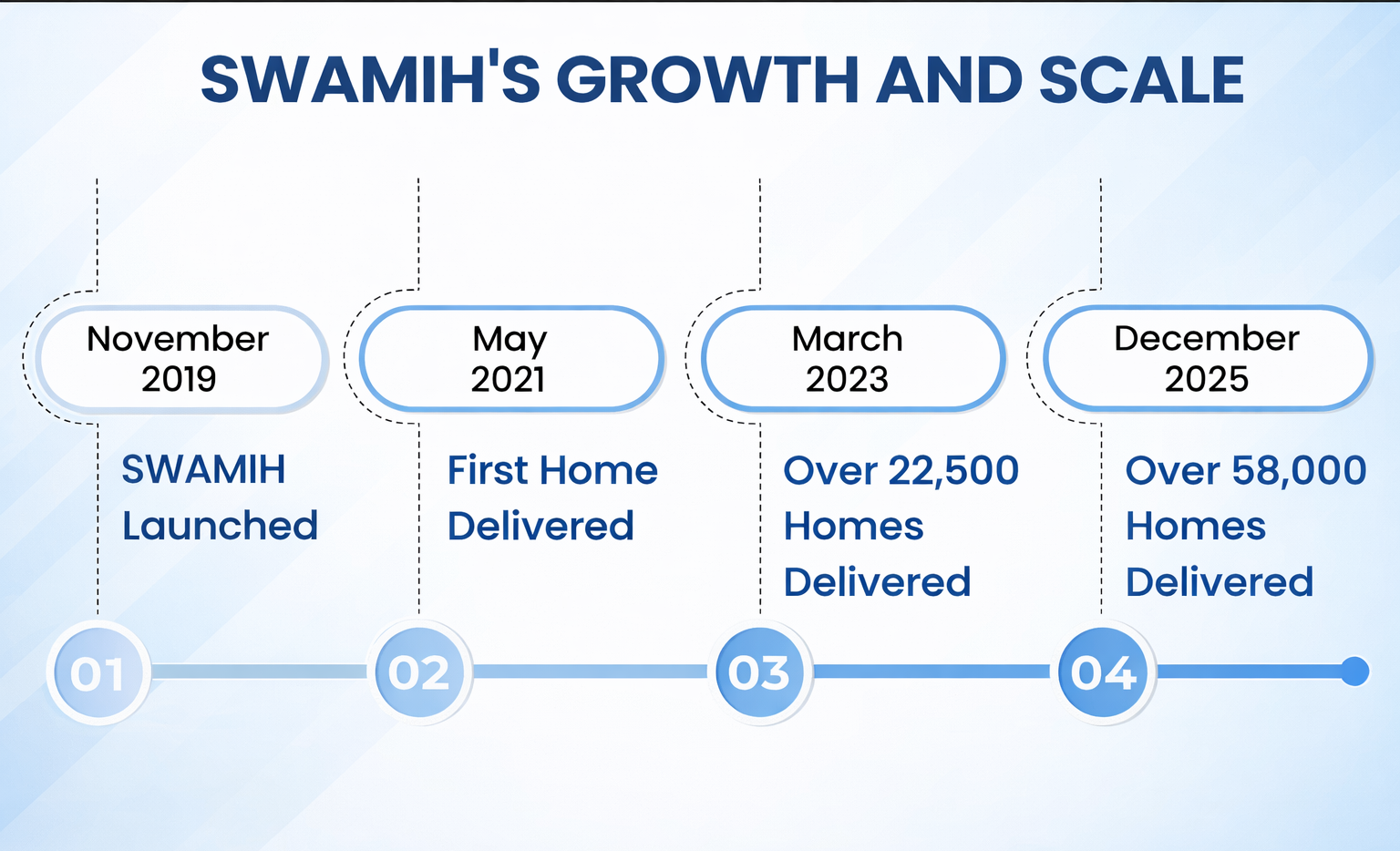
Launched in November 2019 after Union Cabinet approval, SWAMIH is an Alternative Investment Fund (AIF) Category II under SEBI, managed by SBI Ventures Limited (formerly SBICAP Ventures).
Objectives:
Launched in November 2019 after Union Cabinet approval, SWAMIH is an Alternative Investment Fund (AIF) Category II under SEBI, managed by SBI Ventures Limited (formerly SBICAP Ventures).
Objectives:
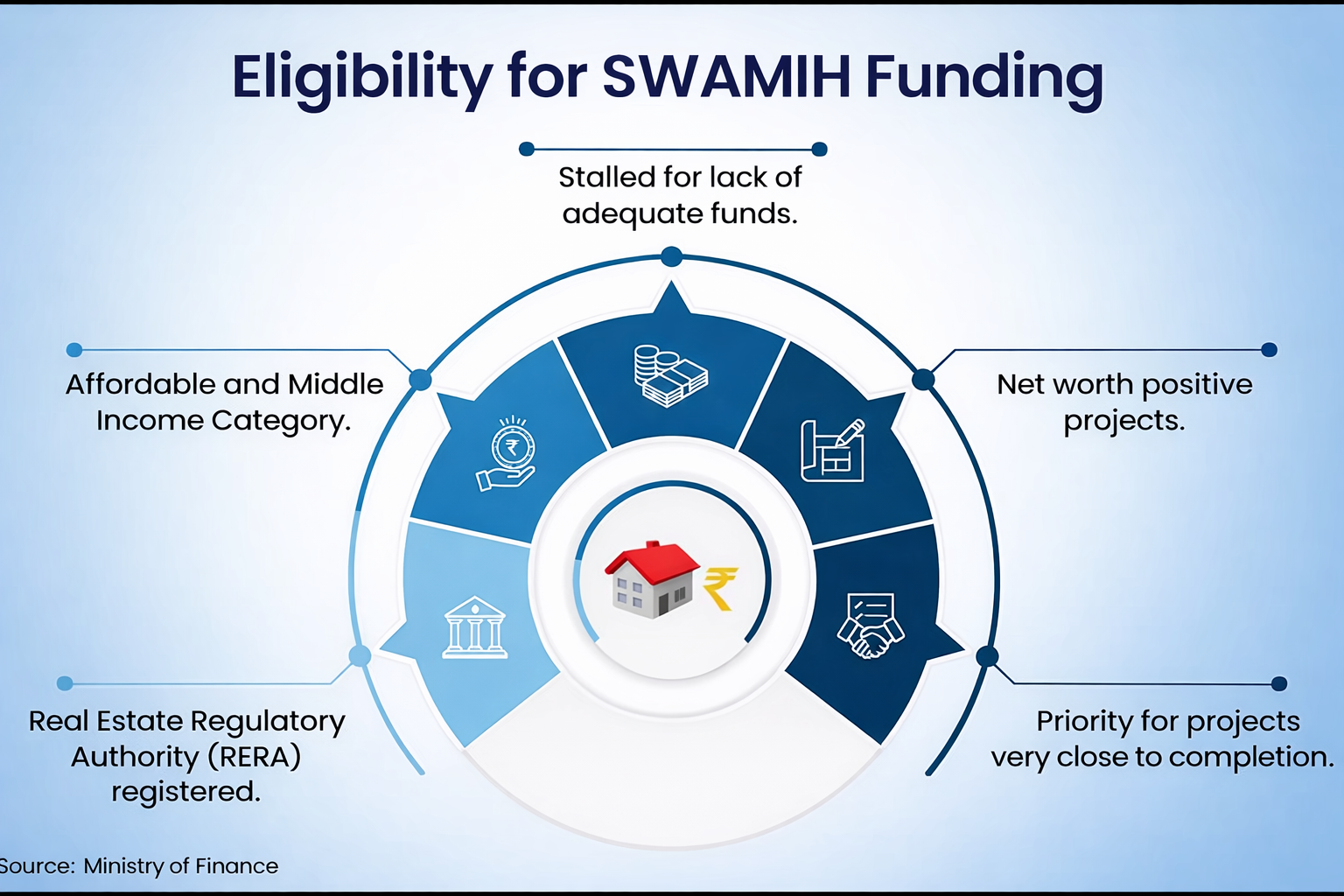
Provide last-mile debt financing to complete stalled, RERA-registered affordable/mid-income projects.
Deliver homes to distressed buyers without fiscal bailouts.
Revive construction, create jobs, and stimulate economic multipliers.
Restore sector confidence by prioritising completion.
Structure and Corpus The fund raised over ₹15,531 crore (exceeding the ₹12,500 crore target) from Government of India, PSU banks, and LIC. It functions as a debt vehicle offering priority financing (senior to other creditors) rather than equity.
Functioning Projects undergo rigorous due diligence for viability, net-worth positivity, and RERA compliance. Funds are disbursed in tranches tied to milestones, with strict escrow and monitoring. This blended finance model balances commercial returns with social impact, focusing on brownfield revival for faster, cost-effective delivery.
Achievements and Impact of the SWAMIH Fund
SWAMIH has achieved remarkable success. As of December 15, 2025 (latest detailed data; March 2026 PIB update notes continued progress):
Approximately 61,000 homes delivered across 110 projects (including over 7,000 EWS/rehabilitation units).
Over 58,596 homes completed in recent reports, with expectations exceeding 1 lakh homes total, benefiting over 2.38–4 lakh people.
Unlocked ₹37,400 crore+ capital across 127 projects (over 90 million sq ft, 44% LIG/MIG).
Generated over 36,000 jobs (skilled/unskilled, including 3,500 permanent).
Boosted allied industries: demand for 20+ lakh tonnes cement, 5.5+ lakh tonnes steel.
Contributed ₹6,900 crore+ in government revenues (GST, stamp duty).
Environmental gains: over 1.06 lakh trees added.
Full corpus commitment by December 5, 2025, with strong exits and partial capital returns (including to Government).
These outcomes highlight SWAMIH’s multiplier effect reviving projects sustains supply chains, local economies, and buyer trust.
SWAMIH within India’s Broader Housing Policy Ecosystem
SWAMIH complements flagship schemes under the Ministry of Housing and Urban Affairs:
Pradhan Mantri Awas Yojana–Urban (PMAY-U) (2015) focuses on new supply via four verticals: Beneficiary-Led Construction (BLC), Affordable Housing in Partnership (AHP), In-Situ Slum Redevelopment (ISSR), and Credit-Linked Subsidy Scheme (CLSS). It has sanctioned over 1.25 crore houses historically.
PMAY-U 2.0 (launched September 2024) targets 1 crore additional houses for urban poor/middle-class. Recent updates (February 2026 CSMC) approved 2.88 lakh+ houses (e.g., 1.66 lakh BLC, 1.09 lakh AHP, 12,846 ARH). It emphasises demand-driven delivery, women/underprivileged focus, and extensions to 2025+ for completions.
Affordable Rental Housing Complexes (ARHCs) (restructured as Affordable Rental Housing vertical under PMAY-U 2.0) addresses rental needs for migrants, EWS/LIG, workers, and women. Implemented via two models: converting vacant government houses (Model-1: 5,648+ units) and new PPP construction (Model-2: 82,000+ approved, thousands completed). Complexes offer single/double-bedroom units or dormitories for 25+ years at affordable rates near workplaces.
SWAMIH serves as the revival/completion arm, rescuing existing stalled inventory while PMAY-U/2.0 and ARHC create fresh ownership/rental supply. This integrated approach regulation (RERA/IBC), new builds (PMAY), rentals (ARHC), and revival (SWAMIH) advances “Housing for All” efficiently.
Announcement and Status of SWAMIH Fund-2 (Union Budget 2025–26)
Announced by Finance Minister Nirmala Sitharaman on February 1, 2025, SWAMIH Fund-2 features a ₹15,000 crore corpus as a blended finance facility (government, banks, private investors). It aims to complete another 1 lakh stalled units, accelerating relief for middle-class buyers facing dual EMIs/rents.
As of March 2026:
Contours finalised; seed capital (₹1,500 crore) allocated in 2025–26 Budget.
Discussions/webinars held (e.g., March 2025 MoHUA webinar, September 2025 stakeholder meetings).
Expected operationalisation soon, building on SWAMIH-1’s success (full commitment, strong execution).
Recent Budget 2026–27 mentions (e.g., ₹650 crore allocation to SWAMIH ecosystem) indicate continued support.
Recommended future measures:
Integrate technology (prefab, green building) for faster/sustainable completions.
Strengthen RERA enforcement and single-window approvals to prevent stalling.
Expand PPPs and institutional finance for ownership/rental segments.
Link housing with urban planning (transit-oriented development, Smart Cities) and skilling.
Address regional disparities via demand surveys and climate-resilient designs.
Balance ownership (PMAY) with rental growth (ARHC) while monitoring fiscal efficiency.
Conclusion
SWAMIH has transformed a deep crisis into tangible progress delivering homes, jobs, revenues, and confidence without moral hazard. By focusing on viable last-mile gaps, it exemplifies precise, outcome-driven governance and proves targeted intervention can unlock private capital and economic multipliers.
Its importance lies in restoring trust in real estate, protecting middle-class savings, and sustaining urban growth. SWAMIH Fund-2’s expansion will further scale this impact.
Best ias coaching in delhi Best ias coaching in chandigar
Prelims question:
Q. Consider the following statements regarding the Special Window for Affordable and Mid-Income Housing (SWAMIH) Investment Fund:
1.It was launched in 2019 to provide last-mile financing exclusively for completing viable stalled affordable and mid-income housing projects that are RERA-registered.
2.As of December 2025, the Fund has delivered approximately 61,000 homes across 110 projects and generated over 36,000 jobs.
3.SWAMIH Fund-2, announced in the Union Budget 2025-26 with a proposed corpus of ₹15,000 crore, aims to complete an additional 1 lakh housing units and is fully operational as of March 2026.
Which of the statements given above is/are correct?
(a) 1 only
(b) 1 and 2 only
(c) 2 and 3 only
(d) 1, 2 and 3
Answer: (b) 1 and 2 only
Mains Question:
Q. Discuss the background of the stalled housing crisis, the structure and key achievements of the SWAMIH Fund (as of early 2026), and evaluate the potential role of SWAMIH Fund-2 in sustaining the revival of the affordable and mid-income housing sector. Suggest measures to strengthen such initiatives for long-term urban housing security. (250 words)

- Artemis II: Humanity’s Return to Lunar Space and India’s Place in the New Moon Race - April 2, 2026
- A Missed Opportunity to Guarantee Minimum Wages - March 31, 2026
- ‘India’s Growth Claims, A Clash with Data Reality’. - March 30, 2026

No Comments