


26 Mar Empowering Women Farmers in Agriculture: Policies, Innovations, and Institutional Support
This article covers “Daily Current Affairs” and From Empowering Women Farmers in Agriculture: Policies, Innovations, and Institutional Support
SYLLABUS MAPPING
GS-3- Agriculture – Empowering Women Farmers in Agriculture: Policies, Innovations, and Institutional Support
FOR PRELIMS
how the Namo Drone Didi scheme and Sub-Mission on Agricultural Mechanisation (SMAM) are promoting technological empowerment
FOR MAINS
Discuss the role of Self-Help Groups (SHGs) and DAY-NRLM in empowering women farmers in India.
Why in the News?
Agriculture is vital to India’s economy, rural livelihoods, and food security. Rural women play a crucial but often overlooked role, with nearly 80% engaged in agriculture and allied sectors. The UN’s declaration of 2026 as the International Year of the Woman Farmer highlights the need to recognise and empower women farmers. Supporting them is essential for improving productivity, food and nutrition security, climate resilience, and sustainable rural development in India.
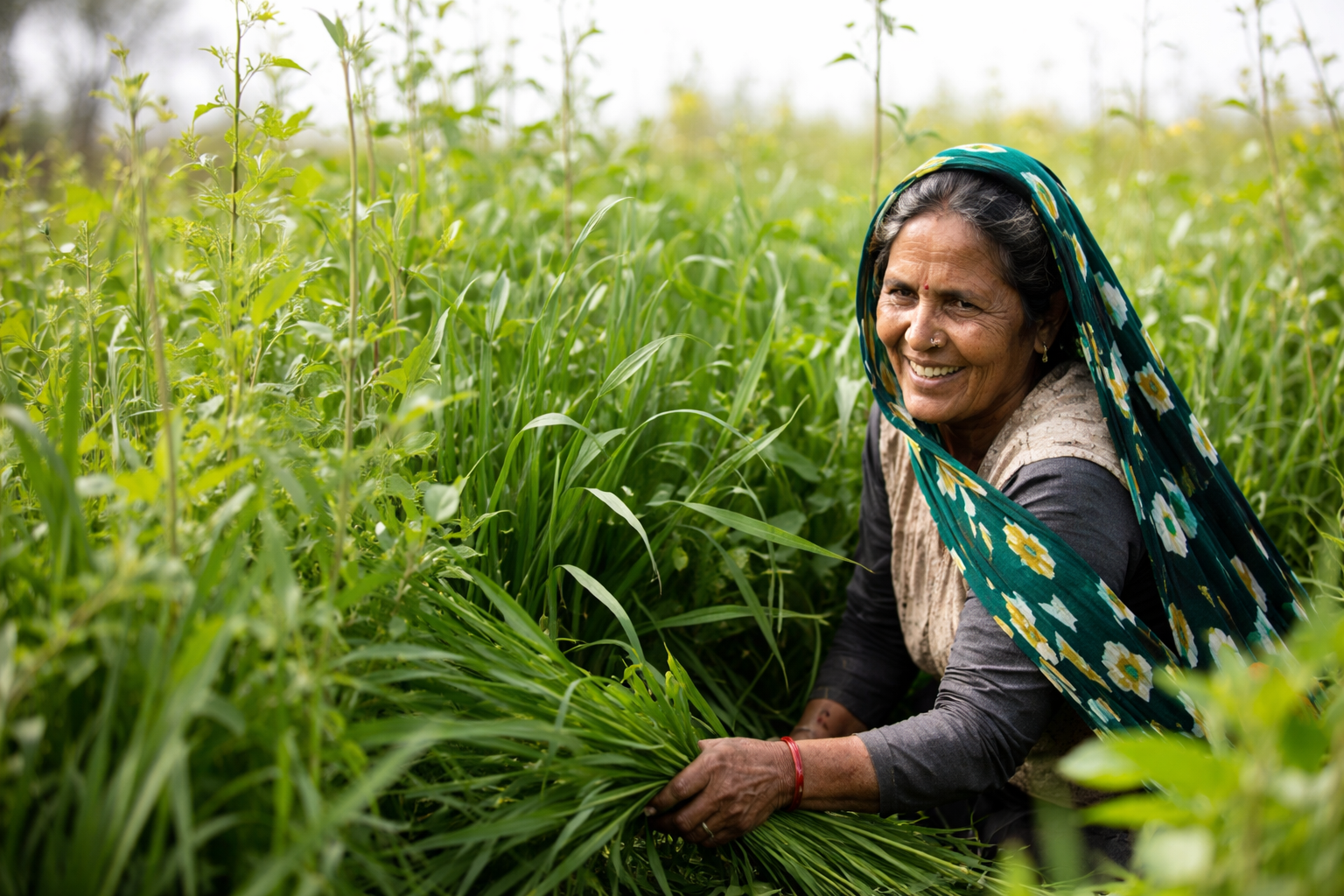
Why Women Farmers Matter in India’s Agrarian Economy
Women farmers contribute across crop production, livestock management, horticulture, fisheries, agroforestry, pre- and post-harvest operations, packaging, and marketing. They often manage livestock, kitchen gardens, and nutrient-sensitive farming, directly influencing household food and nutrition security. Their involvement in diversification—through backyard poultry, mushroom cultivation, beekeeping, or natural farming—enhances livelihood resilience and reduces risks associated with monocropping or climate shocks.
Beyond labour, women are central to sustainable agriculture. They frequently adopt resource-conserving practices and play key roles in seed preservation and community knowledge systems. Their economic empowerment strengthens rural demand, supports local markets, and fosters community resilience. Studies consistently show that closing the gender gap in agriculture could significantly boost yields and reduce hunger. In India, with feminisation of agriculture increasing due to male out-migration, women’s centrality to productivity, diversification, and resilience cannot be overstated.
Structural Challenges Faced by Women Farmers
Despite their substantial participation, women farmers encounter persistent barriers. Lack of formal land ownership and titles remains a core issue; without secure tenure, they face difficulties accessing credit, inputs, subsidies, and insurance. Institutional credit reach is limited, with many relying on informal sources at high interest rates. Access to extension services, quality inputs, and markets is often inadequate, compounded by a mechanisation gap that leaves women performing drudgery-intensive tasks like weeding, transplanting, and carrying head loads.
Low participation in decision-making bodies, a digital divide, and climate vulnerability further marginalise them. Women’s labour is frequently invisible in official statistics, leading to policies that treat them as “helpers” rather than primary farmers. This participation-recognition gap perpetuates inequality, constraining overall sectoral efficiency and inclusive growth.
Global and National Policy
The IYWF 2026 provides a global platform to advocate for equitable access to land, resources, technology, finance, and markets. It encourages governments, civil society, and the private sector to promote gender-responsive policies, raise awareness, and mobilise resources for women’s economic empowerment in agriculture.
In India, the Global Conference on Women in Agri-Food Systems (GCWAS-2026), held in New Delhi from 12-14 March 2026 at the ICAR Convention Centre under the theme “Driving Progress, Attaining New Heights,” exemplified this commitment. The conference brought together over 700 participants, including policymakers, scientists, women farmers, entrepreneurs, and students. It emphasised gender-responsive policies, women’s leadership, climate-smart and women-friendly innovations, technology adoption, and inclusive agri-food systems. Side events like the Women Farmers’ Forum and exhibitions of women-oriented technologies helped generate actionable recommendations and a roadmap for equitable agrifood systems.
Government Schemes Empowering Women Farmers
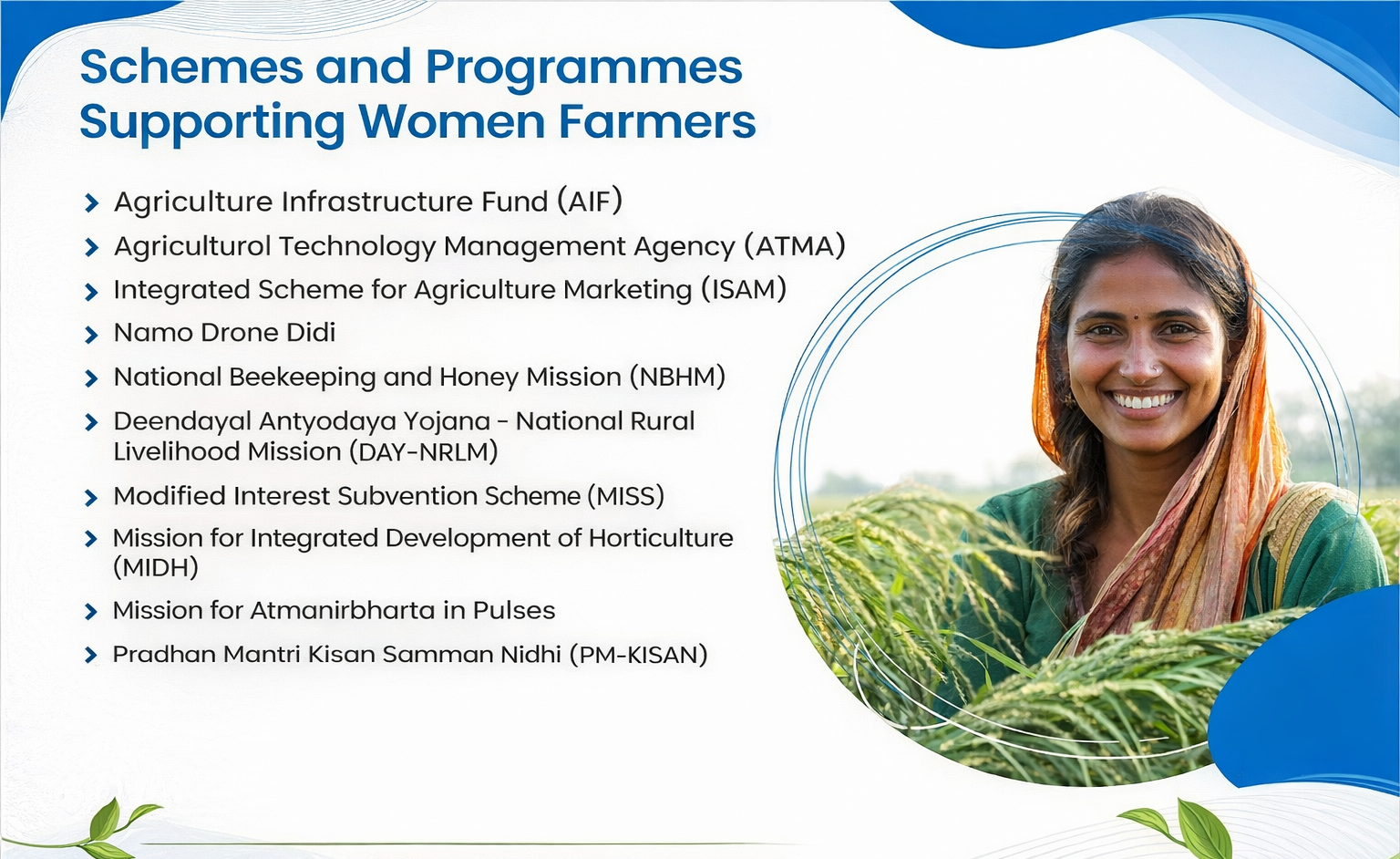
India has deployed a range of targeted schemes that address financial, infrastructural, technological, and institutional dimensions of women’s empowerment.
(a) Financial Support and Income Security: The Pradhan Mantri Kisan Samman Nidhi (PM-KISAN) provides ₹6,000 annually to landholding farmer families in three instalments via Direct Benefit Transfer (DBT). Around 25% of benefits reach women beneficiaries. In the 22nd instalment (as of March 2026), over 2.15 crore women received ₹4,309.46 crore. Cumulatively, more than ₹1.01 lakh crore has been disbursed to women since inception, offering direct income support and enhancing economic security.
(b) Credit and Affordable Finance: The Modified Interest Subvention Scheme (MISS) and Kisan Credit Card (KCC) facilitate short-term credit at subsidised rates (7% effective, with subvention). The collateral-free limit under KCC has been raised to ₹2 lakh from ₹1.6 lakh (effective January 2025). Awareness campaigns target women to improve institutional credit access, crucial for purchasing inputs and reducing dependence on moneylenders.
(c) Infrastructure and Market Access: The Agriculture Infrastructure Fund (AIF) offers interest subvention (3% on loans up to ₹2 crore) for post-harvest and farm assets. As of February 2025, 8,190 projects worth ₹2,377 crore were sanctioned to women farmers. The Integrated Scheme for Agricultural Marketing (ISAM)/Agricultural Marketing Infrastructure (AMI) provides higher subsidies (33.33% for women, SC/ST, and NE/hilly regions vs. 25% in plains). Under AMI, 10,631 storage projects by women beneficiaries created nearly 359.54 lakh MT capacity, with substantial subsidy release, improving storage, reducing losses, and strengthening market linkages.
(d) Horticulture and Crop Diversification: The Mission for Integrated Development of Horticulture (MIDH) supports post-harvest infrastructure for perishable produce. The Mission for Aatmanirbharta in Pulses (Dalhan Aatmanirbharta Mission), with ₹11,440 crore outlay (2025-26 to 2030-31), earmarks at least 20% funds for women farmers, promoting climate-resilient seeds, area expansion, and assured procurement. These schemes enhance diversification, income stability, and nutritional outcomes.
(e) Technology and Innovation: The Namo Drone Didi scheme aims to provide 15,000 drones to women SHGs (2023-24 to 2025-26, outlay ₹1,261 crore), offering 80% assistance (up to ₹8 lakh) plus training. In 2023-24, 1,094 drones were distributed (500 under the scheme). The Sub-Mission on Agricultural Mechanisation (SMAM) supports Custom Hiring Centres and drone purchases (50% assistance for women and marginal farmers). Such interventions reduce drudgery and improve efficiency.
(f) Livelihood Diversification and Allied Sectors: The National Beekeeping and Honey Mission (NBHM) promotes scientific beekeeping for income and employment, with focus on women. Allied activities like dairy, poultry, mushroom cultivation, and fisheries are vital as they require smaller landholdings and align with women’s roles.
(g) Community-Based Livelihoods and SHG-led Transformation: The Deendayal Antyodaya Yojana–National Rural Livelihoods Mission (DAY-NRLM), implemented through women, has disbursed over ₹11 lakh crore in credit to SHGs. Between 2022-23 and 2024-25, it trained 2.58 crore women in agro-ecology and livestock, promoted 800 women-led FPOs, and developed cadres like Krishi Sakhis and Pashu Sakhis. SHG collectivisation builds social capital, financial inclusion, and collective bargaining power.
Women-Led Collectivisation and Farmer Producer Organisations (FPOs)
Farmer Producer Organisations (FPOs) aggregate small, marginal, and landless farmers—especially women—into collectives for joint production, processing, marketing, and value addition. They deliver economies of scale, better bargaining, market access, and reduced intermediary dependence.
The Central Sector Scheme for 10,000 FPOs (launched 2020, outlay ₹6,865 crore till 2027-28) has released ₹481.38 crore as equity grants to 7,041 FPOs and provided ₹712.16 crore credit guarantee to 2,761 FPOs. Every FPO must have at least one woman on its Board; 1,175 are 100% women-owned, and 1,084 have 50-99% women members, with strong presence in states like Odisha, Jharkhand, Bihar, Maharashtra, and Telangana. Women-led FPOs can drive inclusive rural entrepreneurship by combining collective strength with gender-specific needs.
Institutional Support for Women in Agriculture
Key institutions provide sustained capacity building:
MANAGE, Hyderabad (Centre for Gender in Agriculture) trains extension professionals in gender mainstreaming, entrepreneurship, digital technologies, and value chains. Since 2020, 61,496 women have benefited.
National Gender Resource Centre in Agriculture (NGRCA) coordinates gender integration across policies and programmes.
ICAR–Central Institute for Women in Agriculture (CIWA), Bhubaneswar conducts research on gender issues, develops drudgery-reducing tools (e.g., pedal coconut dehusker, maize sheller, improved ridgers), and promotes models like GRIHA (homestead aqua-horticulture), JANANI Nutri-Garden, and climate-smart frameworks. It emphasises women-friendly, nutrition-sensitive, and agripreneurship-oriented technologies.
Farm Machinery Training and Testing Institutes (FMTTIs) offer skill training to women in mechanisation, reducing gender barriers in technology adoption.
These institutions underscore that technologies and policies must be deliberately gender-responsive.
Grassroots Capacity Building and Extension Systems
Community extension bridges schemes and outcomes:
Krishi Sakhis — trained women para-extension workers — deliver doorstep knowledge on natural farming and soil health. The government targets training 70,000 Krishi Sakhis.
Mahila Kisan Sashaktikaran Pariyojana (MKSP) under DAY-NRLM has supported 4.62 crore Mahila Kisans (including 2.09 crore in livestock) and built a cadre of Community Resource Persons (Pashu Sakhis, Van Sakhis, Matshya Sakhis).
Agricultural Technology Management Agency (ATMA) promotes Farm Women’s Food Security Groups and trained over 11.61 lakh women (2025-26).
Skill Training of Rural Youth (STRY) skilling programmes have benefited thousands of rural women and youth.
These initiatives create last-mile delivery and multiplier effects through peer learning.
Women-Friendly Technology and Climate-Resilient Agriculture
Innovations such as drudgery-reducing tools, drones, natural farming, nutri-gardens, integrated farming systems, and digital advisories are transforming practices. CIWA’s models demonstrate the value of gender-responsive design. Future policy must position women as innovators and agripreneurs rather than mere labourers, integrating climate-smart approaches with livelihood diversification.
Case Study: Transformational Journey of Smt. Kamini Nathsharma
Smt. Kamini Nathsharma from Dularpur village, Cuttack, Odisha, exemplifies convergence. With only 0.33 acres and seasonal rice income, her family struggled. Through ICAR-CIWA’s participatory project, she received training, seeds, saplings, duck farming support, poultry, and fodder improvements for existing cows. The integrated system (nutrition garden, livestock, vegetables) generated income from eggs, milk, and surplus produce. Return on investment reached 1.75 times, raising annual income to ₹96,000. Kamini became a village role model, showcasing how handholding, local adaptation, and women-centric support convert subsistence into sustainable, resilient livelihoods.
Critical Evaluation
While schemes are comprehensive, implementation gaps persist. Benefits often hinge on land titles, which many women lack. Credit and technology access do not automatically confer decision-making power. Mechanisation and digital tools require accompanying training to avoid exclusion. Women remain underrepresented in markets, leadership, and ownership. Empowerment must evolve from welfare measures to genuine agency, asset ownership, and leadership roles. Monitoring gender-disaggregated data and convergence across ministries are critical.
Way Forward
A robust roadmap includes:
Universal recognition of women as farmers through joint land titles and inheritance reforms.
Gender budgeting and targeted provisioning in agriculture.
Expanded women-focused extension, digital literacy, and skill programmes.
Scaling women-led FPOs and agri-enterprises with dedicated credit and market support.
Stronger convergence between agriculture, rural development, skill, and women & child development missions.
Investment in climate-resilient, drudgery-reducing, and nutrition-sensitive technologies.
Enhanced access to markets, insurance, and risk mitigation.
Institutionalising women’s representation in farmer bodies, cooperatives, and policy forums.
Conclusion
Women farmers are indispensable to India’s food systems, rural economy, and sustainable development. Their empowerment is not merely a question of social justice but an economic and strategic imperative for achieving food security, climate resilience, and inclusive growth. Initiatives under IYWF 2026 and schemes like PM-KISAN, DAY-NRLM, Namo Drone Didi, and FPO promotion mark important steps. However, realising full potential requires addressing structural barriers and shifting from viewing women as invisible labourers to recognising them as visible leaders, decision-makers, and agripreneurs.
By investing in their agency, innovation, and leadership, India can build more equitable, productive, and resilient agrifood systems. The success of this transformational journey will significantly determine the nation’s progress towards sustainable development and Atmanirbhar Bharat in agriculture.
Best ias coaching in delhi Best ias coaching in chandigarh
Prelims question:
Q. Consider the following statements regarding schemes for women farmers in India:
1.Under the Namo Drone Didi scheme, 15,000 drones are targeted to be provided to Women Self-Help Groups with 80% Central Financial Assistance.
2.The Mission for Aatmanirbharta in Pulses mandates at least 20% allocation of funds for women farmers.
3.As per the Pradhan Mantri Kisan Samman Nidhi (PM-KISAN), around 25% of the total benefits go to women beneficiaries.
Which of the statements given above is/are correct?
(a) 1 and 2 only
(b) 2 and 3 only
(c) 1 and 3 only
(d) 1, 2 and 3
Answer: (c) 1 and 3 only
“Empowering women farmers is crucial for achieving sustainable agricultural growth and rural transformation in India.” In the light of the International Year of the Woman Farmer (IYWF 2026) and recent government initiatives, discuss the major schemes and institutional mechanisms for women’s empowerment in agriculture. Also, suggest measures to address the structural challenges faced by women farmers in India. (250 Words)

- Artemis II: Humanity’s Return to Lunar Space and India’s Place in the New Moon Race - April 2, 2026
- A Missed Opportunity to Guarantee Minimum Wages - March 31, 2026
- ‘India’s Growth Claims, A Clash with Data Reality’. - March 30, 2026

No Comments