


25 Jul UPSC 2026: India’s Inland Waterways Revolution & Logistics Costs
Subject Relevance — Where This Topic Fits
- GS Paper II — Government Policies and Interventions for Development in various sectors | GS Paper III — Infrastructure: Energy, Ports, Roads, Airports, Railways and Waterways | GS Paper III — Effects of Liberalisation on the Economy
- Prelims: National Waterways, Inland Waterways Authority of India (IWAI), Maritime India Vision 2030, Maritime Amrit Kaal Vision 2047, PM Gati Shakti National Master Plan, PANI, Jal Samriddhi Portal, CAR-D, Digital Navigation Charts, Hydrographic Surveys, Tonnage Tax, National Waterways Act 2016, Jal Marg Vikas Project
- Essay: Sustainable infrastructure development and environmental stewardship in India’s logistics sector, The role of digitalisation in transforming India’s transport and logistics ecosystem
Quick Revision: Inland Water Transport (IWT) in India is a sustainable, cost-effective, and low-emission alternative to rail and road transport, with IWAI leading infrastructure and digital reforms to integrate it into the PM Gati Shakti National Master Plan.
Why is this in the news?
The Government of India has initiated a transformative campaign to develop inland water transport (IWT) as a key pillar of the country’s multimodal transport system, aligning with Maritime India Vision 2030 and Maritime Amrit Kaal Vision 2047. This initiative aims to create world-class waterway infrastructure through the development of national waterways, multimodal terminals, community jetties, river cruise terminals, regional excellence centres, digital navigation tools, and green ship technology, while ensuring seamless integration with the PM Gati Shakti National Master Plan. The recent press release by the Ministry of Ports, Shipping and Waterways highlights the progress and digital reforms undertaken by the Inland Waterways Authority of India (IWAI) to enhance ease of doing business and streamline approval processes.
Background
- Inland Water Transport (IWT) is a cost-effective and environmentally sustainable mode of freight transport compared to rail and road, significantly reducing congestion on existing transport networks.
- The Inland Waterways Authority of India (IWAI), established under the Ministry of Ports, Shipping and Waterways, regulates and develops national waterways (NWs) in India.
- The Maritime India Vision 2030 and Maritime Amrit Kaal Vision 2047 prioritise the development of IWT to enhance logistics efficiency, reduce carbon footprint, and promote green mobility.
- The PM Gati Shakti National Master Plan integrates infrastructure development across multiple modes to ensure seamless connectivity and reduce logistics costs.
- The National Waterways Act 2016 provides the legal framework for the development, regulation, and maintenance of national waterways in India.
What are Inland Waterways and their significance in India’s transport ecosystem?
- Inland Waterways (IWT) refer to navigable rivers, canals, backwaters, creeks, and estuaries used for the transportation of goods and passengers within a country.
- In India, IWT is governed by the Inland Waterways Authority of India (IWAI), which operates under the Ministry of Ports, Shipping and Waterways, established in 1986.
- IWT is recognised as a sustainable and cost-effective alternative to rail and road transport, with significantly lower emissions and logistics costs per tonne-kilometre.
- The development of IWT infrastructure includes the construction of multimodal terminals, community jetties, river cruise terminals, and regional excellence centres to enhance connectivity and economic activity.
- Digitalisation plays a critical role in modernising IWT, with initiatives such as PANI: Asset and Navigation Information Portal for Simple Navigation Plans, Jal Samriddhi Portal, CAR-D (Cargo Data Portal), and digital hydrographic charts improving navigation safety and operational efficiency.
- Green ship technology and sustainable practices are being integrated to reduce the environmental impact of IWT, aligning with India’s climate commitments.
- The integration of IWT with the PM Gati Shakti National Master Plan ensures seamless multimodal connectivity, reducing transit time and logistics costs.
- IWT supports inclusive economic growth by providing affordable transport solutions for rural and remote areas, particularly in the Ganga-Brahmaputra-Meghna basin.
Key Features
| Feature | Significance |
|---|---|
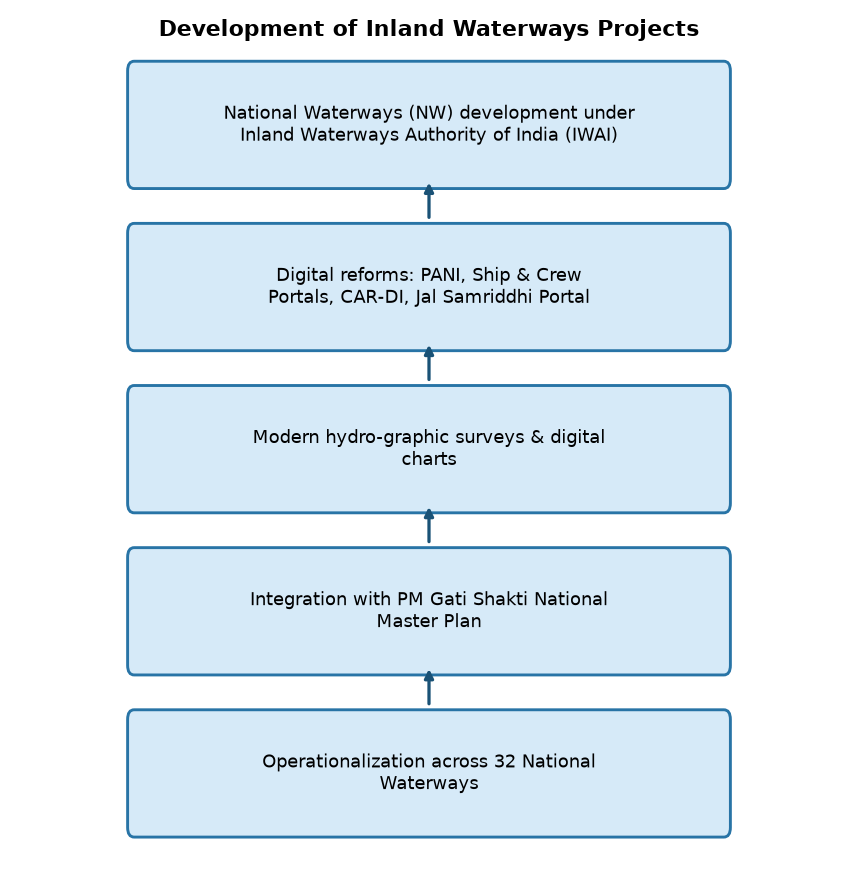
| National Waterways (NW) Development | Establishes 32 operational waterways under IWAI’s regulation, integrating them into PM Gati Shakti National Master Plan for seamless multimodal logistics. |
| Multimodal Terminals & Community Jetties | Enhances cargo handling efficiency and last-mile connectivity, reducing transit time and costs for hinterland regions. |
| Digital Navigation Tools (PANI, CAR-D, Jal Samriddhi Portal) | Facilitates real-time tracking, cargo data integration, and streamlined approvals, improving Ease of Doing Business for logistics operators. |
| Green Vessel Technology | Promotes low-emission vessels, reducing carbon footprint and aligning with India’s net-zero commitments under Maritime Amrit Kaal Vision 2047. |
| Hydrographic Surveys & Digital Charts | Ensures navigational safety by providing accurate, real-time bathymetric data and updated charts for pilots and operators. |
Why it Matters
Economic Efficiency
- Lowest freight cost: ₹1.06/tonne-km vs ₹1.36 (rail) and ₹2.50 (road), reducing logistics expenditure by ~40% for bulk cargo like coal and fertilizers.
- Reduces congestion on rail and road networks, optimizing asset utilization and lowering maintenance costs for national infrastructure.
- Enhances export competitiveness by enabling cost-effective movement of agricultural and industrial goods from hinterland to ports.
Environmental Sustainability
- Near-zero greenhouse gas emissions: 0.0006 ₹/tonne-km vs 0.0031 ₹/tonne-km for road transport, aligning with India’s Nationally Determined Contributions (NDCs).
- Minimal air, noise, and soil pollution compared to road transport, reducing externalities like respiratory diseases and soil degradation.
- Supports India’s commitment to the Paris Agreement by promoting low-carbon transport modes in the maritime sector.
Strategic Connectivity
- Strengthens inland water transport (IWT) as a resilient alternative during disruptions in rail/road networks, enhancing supply chain resilience.
- Facilitates cross-border trade via India-Bangladesh Protocol Routes (NW-1, NW-2, NW-16), reducing transit time for goods like jute and tea.
- Integrates with Sagarmala and Gati Shakti initiatives to create a unified, technology-driven transport ecosystem.
Social Inclusion & Regional Development
- Creates employment opportunities in terminal operations, vessel maintenance, and digital platforms, particularly in rural and coastal regions.
- Enhances connectivity for remote and tribal communities, reducing isolation and fostering inclusive economic growth.
- Supports the ‘Blue Economy’ vision by promoting sustainable inland waterways for tourism (e.g., river cruises) and fisheries.
Challenges
1. Limited Depth and Seasonal Variability
- Siltation and low water levels in monsoon/lean seasons reduce navigability, necessitating continuous dredging and hydraulic modeling.
- Inadequate depth in certain stretches (e.g., NW-1 between Haldia and Allahabad) limits vessel size and cargo capacity.
UPSC Link: Geography: River Systems, Monsoon Dynamics
2. High Initial Capital Expenditure (CAPEX)
- Infrastructure development (terminals, jetties, dredging) requires substantial public and private investment, posing fiscal constraints.
- Land acquisition and rehabilitation challenges delay project timelines, as seen in the NW-1 Sagarmala project.
UPSC Link: Economy: Public Investment, PPP Models
3. Fragmented Regulatory Framework
- Overlapping jurisdictions among IWAI, state governments, and local authorities create bottlenecks in approvals and compliance.
- Lack of uniform safety and environmental standards across states hampers inter-state waterway operations.
UPSC Link: Polity: Federalism, Regulatory Bodies
4. Skill Gaps and Technological Adoption
- Shortage of trained pilots, engineers, and digital specialists for modern navigation and terminal management systems.
- Resistance to adoption of green vessel technologies due to high upfront costs and lack of awareness among stakeholders.
UPSC Link: Human Resource: Skill Development, Technology Adoption
5. Competition from Rail and Road Transport
- Railways offer door-to-door connectivity for certain cargo types (e.g., containers), while IWT struggles with last-mile connectivity.
- Road transport dominates for high-value, time-sensitive goods, limiting IWT’s market share in logistics.
UPSC Link: Economy: Transport Sector, Modal Choice
6. Environmental and Ecological Concerns
- Dredging and construction activities may disrupt aquatic ecosystems, affecting biodiversity and fish migration patterns.
- Risk of water pollution from vessel discharges and terminal operations, requiring stringent monitoring and mitigation measures.
UPSC Link: Environment: Biodiversity, Pollution Control
Challenges — UPSC Perspective
| Issue | Concern |
|---|---|
| Siltation and Low Water Levels | Reduces vessel draft, limiting cargo capacity and increasing operational costs during lean seasons. |
| Land Acquisition Delays | Stalls terminal construction and dredging projects, leading to cost overruns and timeline extensions. |
| Fragmented Jurisdiction | Causes delays in approvals and compliance, increasing transaction costs for operators. |
| Skill Shortages | Hinders adoption of digital tools (e.g., PANI, CAR-D) and green technologies, reducing operational efficiency. |
| Modal Competition | Road and rail transport dominate high-value cargo, restricting IWT’s market penetration. |
| Environmental Degradation | Dredging and vessel operations may harm aquatic ecosystems, necessitating strict environmental safeguards. |
Government Initiatives — Must-Memorise for Prelims
- Gati Shakti National Master Plan (Multimodal Integration)
- National Waterways Act, 2016 (Designation of 111 waterways as National Waterways)
Way Forward
- Accelerate dredging and hydraulic modeling for depth augmentation in critical stretches (e.g., NW-1, NW-2) to ensure year-round navigability.
- Expand public-private partnerships (PPPs) for terminal development, leveraging viability gap funding under Sagarmala to attract private investment.
- Standardize safety and environmental regulations across states to eliminate jurisdictional bottlenecks and ensure uniform compliance.
- Launch skill development programs for pilots, engineers, and digital specialists in collaboration with maritime institutes (e.g., IMU, CIPET).
- Promote green vessel technologies through subsidies and tax incentives, aligning with Maritime India Vision 2030 and Amrit Kaal 2047.
- Enhance last-mile connectivity by integrating IWT with rail and road networks via multimodal hubs under PM Gati Shakti.
- Strengthen cross-border trade facilitation by operationalizing India-Bangladesh Protocol Routes (NW-1, NW-2, NW-16) with digital customs clearance.
- Establish a national-level monitoring framework for environmental impact assessments (EIAs) to mitigate ecological risks from dredging and terminal operations.
UPSC Value Addition
Keywords for Mains Answer-Writing
Inland Water Transport (IWT) · National Waterways (NW) · Maritime India Vision 2030 · Maritime Amrit Kaal Vision 2047 · PM Gati Shakti National Master Plan · Inland Waterways Authority of India (IWAI) · logistics cost reduction · green mobility · multimodal connectivity · digital navigation systems · hydrographic surveys · tonnage tax regime · Jalvahini Scheme · river cruise terminals · multimodal terminals · environmental sustainability in transport
Concept Flow
Identification of National Waterways under National Waterways Act, 2016 → Development of infrastructure (terminals, jetties, dredging) → Integration with PM Gati Shakti for multimodal connectivity → Adoption of digital tools (PANI, CAR-D) for efficiency → Promotion of green vessel technologies → Reduction in logistics costs and emissions → Enhanced economic competitiveness and environmental sustainability → Alignment with Maritime India Vision 2030 and Amrit Kaal 2047
Prelims Practice Questions
Q1. Which of the following is NOT a primary objective of the Maritime India Vision 2030 and Maritime Amrit Kaal Vision 2047 with respect to Inland Water Transport (IWT)?
- A. Development of multimodal terminals on national waterways
- B. Establishment of regional excellence centres for IWT
- C. Mandatory electrification of all inland vessels by 2030
- D. Integration of IWT with PM Gati Shakti National Master Plan
Answer: C. Mandatory electrification of all inland vessels by 2030 — While the visions emphasize green mobility and digital integration, there is no mandate for mandatory electrification of all inland vessels by 2030. The focus is on green vessel technology adoption, not universal electrification.
Q2. Consider the following statements regarding the tonnage tax regime for Inland Water Transport (IWT) in India: 1. The tax is calculated based on the net profit of the vessel. 2. The regime was extended to national waterways in February 2025. 3. The tax structure ensures predictable and lower tax burden for vessel operators. Which of the statements given above is/are correct?
- A. 1 and 2 only
- B. 2 and 3 only
- C. 1 and 3 only
- D. 1, 2 and 3
Answer: B. 2 and 3 only — Statement 1 is incorrect as the tonnage tax is calculated based on the size (tonnage) of the vessel, not net profit. Statements 2 and 3 are correct as the regime was extended in February 2025 and ensures predictable, lower tax burden.
Q3. The Jalvahini Scheme, launched by the Inland Waterways Authority of India (IWAI), primarily aims to:
- A. Subsidize the purchase of electric vessels for IWT
- B. Provide financial assistance to cargo owners and operators for freight on national waterways
- C. Establish new national waterways in the northeastern region
- D. Promote river cruise tourism in India
Answer: B. Provide financial assistance to cargo owners and operators for freight on national waterways — The Jalvahini Scheme provides 35% financial assistance to cargo owners and designated operators for freight movement on NW-1, NW-2, and NW-16 via the Indo-Bangladesh Protocol (IBP) route, with a budget of ₹95.42 crore for 3 years.
Mains Practice Question
✍ Analyze the role of Inland Water Transport (IWT) in India’s logistics and economic development. Discuss the key initiatives under Maritime India Vision 2030 and Maritime Amrit Kaal Vision 2047 that aim to enhance the competitiveness and sustainability of IWT. Also, evaluate the environmental and economic advantages of IWT over road and rail transport.
Approach: Begin by defining IWT and its significance in India’s transport sector, highlighting its cost-effectiveness and lower environmental impact compared to road and rail. Discuss the strategic vision documents—Maritime India Vision 2030 and Maritime Amrit Kaal Vision 2047—focusing on their objectives such as developing multimodal terminals, digital navigation systems, and green vessel technology. Examine the key initiatives like the Jalvahini Scheme, tonnage tax regime, and PM Gati Shakti integration. Conclude by assessing the economic (e.g., reduced logistics costs) and environmental benefits (e.g., lower emissions and pollution) of IWT, supported by comparative data from official sources.
Source: PIB (Press Information Bureau)
Generated by AanyaAi for educational purpose.


No Comments