


29 Jul Lok Sabha Introduces Bill to Tighten Delayed Birth & Death Registrations
Subject Relevance — Where This Topic Fits
- GS Paper II — Constitutional and Statutory Bodies (Role of District Magistrates and Judicial Magistrates) | GS Paper III — Human Development Indicators and Governance (Civil Registration and Vital Statistics Systems)
- Prelims: Registration of Births and Deaths Act, 1969, Civil Registration System (CRS), District Magistrate (DM), Sub-Divisional Magistrate (SDM), Judicial Magistrate, Vital Statistics, Demographic Data, Digital India
- Essay: The interplay between administrative efficiency and judicial oversight in governance, The role of data integrity in public policy formulation
Quick Revision: The Registration of Births and Deaths (Amendment) Bill, 2026, introduces stricter provisions for delayed registrations by shifting authority from executive magistrates to judicial magistrates for cases delayed beyond two years, ensuring greater scrutiny and data integrity.
Why is this in the news?
The Registration of Births and Deaths (Amendment) Bill, 2026, introduced in the Lok Sabha on 29 July 2026, seeks to amend the Registration of Births and Deaths Act, 1969 (as amended in 2023) to impose stricter provisions for delayed registration of births and deaths. The Bill introduces a two-tier approval mechanism, shifting authority from executive magistrates to judicial magistrates for registrations delayed beyond two years, thereby enhancing scrutiny and ensuring greater accuracy in vital statistics.
Background
- The Registration of Births and Deaths Act, 1969, is the primary legislation governing the registration of births and deaths in India, ensuring the systematic recording of vital events for demographic and administrative purposes.
- The Act was amended in 2023 to streamline the registration process and improve data accuracy, particularly for delayed registrations.
- The Civil Registration System (CRS) under the Act is a critical component of India’s governance framework, providing data for policy formulation, welfare schemes, and legal documentation.
- Delayed registration of births and deaths has historically posed challenges in maintaining accurate demographic records, leading to potential discrepancies in national statistics.
- The proposed amendment aligns with global best practices in civil registration, where stringent checks are imposed to prevent fraudulent or erroneous registrations.
- The Bill’s introduction coincides with broader discussions on data integrity, judicial oversight, and administrative efficiency in governance.
What is the Registration of Births and Deaths (Amendment) Bill, 2026?
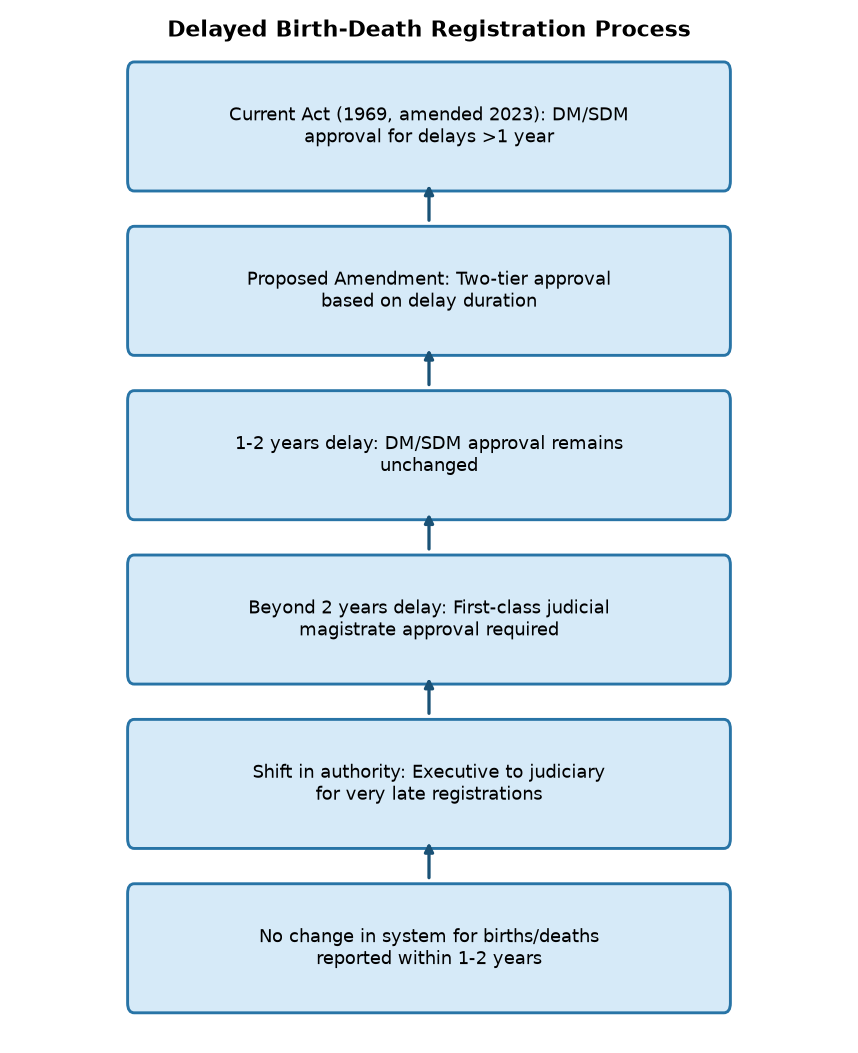
- The Bill seeks to amend Section 13(3) of the Registration of Births and Deaths Act, 1969, to introduce a two-tier approval mechanism for delayed registrations of births and deaths.
- For registrations delayed between one and two years, approval will continue to be granted by the District Magistrate (DM), Sub-Divisional Magistrate (SDM), or an Executive Magistrate, as per the existing provisions.
- For registrations delayed beyond two years, approval will be granted only on the orders of a first-class judicial magistrate, shifting the authority from the executive to the judiciary.
- The stricter scrutiny for very delayed registrations aims to prevent fraudulent registrations, ensure accuracy in vital statistics, and maintain the integrity of the Civil Registration System (CRS).
- The Bill does not alter the existing process for timely registrations (within one year of the event), which remain unaffected.
- The amendment is intended to strengthen the legal framework for civil registration, particularly in cases where delayed reporting may indicate procedural lapses or potential misuse.
- The Bill reflects a broader trend in governance towards enhancing accountability and reducing administrative discretion in critical public records.
- The proposed changes are expected to improve the reliability of demographic data, which is essential for policy planning and welfare scheme implementation.
Key Features
| Feature | Significance |
|---|---|
| Two-tier approval mechanism for delayed registrations | Introduces stricter scrutiny for registrations delayed beyond two years by shifting authority from executive magistrates to first-class judicial magistrates |
| Retention of existing process for 1-2 year delays | Maintains current system where District Magistrates (DM), Sub-Divisional Magistrates (SDM), or Executive Magistrates approve delayed registrations within one to two years |
| Judicial oversight for very late registrations (>2 years) | Ensures higher scrutiny and legal validation for registrations delayed beyond two years, reducing executive discretion |
| Amendment to Section 13(3) of the Registration of Births and Deaths Act, 1969 | Reinforces the legal framework for delayed registrations, aligning with the 2023 amendments to the Act |
| Procedural continuity for timely registrations | No change in the process for births or deaths reported within the stipulated time frame, ensuring administrative efficiency |
Why it Matters
Administrative and Governance
- Enhances the integrity of vital statistics by reducing fraudulent or delayed registrations, which are critical for policy planning and resource allocation
- Strengthens the accountability of executive authorities in approving delayed registrations, particularly within the 1-2 year window
- Introduces judicial oversight for extreme delays, ensuring checks and balances in the registration process
Legal and Judicial
- Shifts authority from executive to judicial magistrates for registrations delayed beyond two years, reinforcing the principle of separation of powers
- Aligns with the broader trend of judicialisation of administrative processes, particularly in matters affecting public records and legal validity
Data and Policy Implications
- Improves the accuracy of demographic data, which is essential for the implementation of welfare schemes, electoral rolls, and census operations
- Facilitates better targeting of developmental programs by ensuring that population estimates are based on reliable and timely data
- Supports evidence-based policymaking in sectors such as health, education, and social welfare
Public Trust and Transparency
- Increases public confidence in the registration system by reducing opportunities for manipulation or corruption in delayed registrations
- Ensures that legal and civil rights (e.g., inheritance, citizenship, or pension claims) are not compromised due to fraudulent or improper registrations
Constitutional and Democratic
- Upholds the right to dignity and equality by ensuring that all citizens have access to accurate and timely documentation of births and deaths
- Supports the functioning of democratic institutions by providing reliable data for electoral rolls and representation
Challenges
1. Implementation and Capacity Constraints
- Judicial magistrates may face increased workload due to the additional scrutiny required for registrations delayed beyond two years
- Delays in judicial approvals could lead to backlogs, particularly in districts with limited judicial infrastructure
- Executive magistrates may face challenges in transitioning to a more stringent approval process, requiring capacity-building and training
UPSC Link: GS-II: Governance, Judiciary
2. Public Awareness and Accessibility
- Rural and marginalised communities may face difficulties in accessing the registration system, particularly for delayed cases, due to lack of awareness or logistical barriers
- Language barriers and digital divide could exacerbate challenges in ensuring timely and accurate registrations
- Stigma or social barriers associated with reporting deaths or births (e.g., in cases of stillbirths or maternal mortality) may lead to underreporting
UPSC Link: GS-I: Social Justice, Welfare Schemes
3. Legal and Procedural Ambiguities
- Ambiguities in the definition of ‘delayed registration’ or the criteria for judicial approval may lead to inconsistent implementation across states
- Potential conflicts between the amended Act and state-specific laws governing registrations could create legal complications
- Lack of clear guidelines for appeals or grievance redressal in cases of rejected registrations
UPSC Link: GS-II: Constitutional Framework
4. Data Privacy and Security
- Increased scrutiny of delayed registrations may raise concerns about data privacy, particularly if sensitive information is involved
- Ensuring the security of digital records and preventing data breaches in the registration process
UPSC Link: GS-III: Technology, Security
5. Inter-State Coordination
- Delayed registrations involving individuals who migrate across states may face coordination challenges between different registration authorities
- Discrepancies in the implementation of the amended Act across states could lead to inconsistencies in vital statistics
UPSC Link: GS-II: Federalism, Centre-State Relations
Challenges — UPSC Perspective
| Issue | Concern |
|---|---|
| Judicial workload | Increased burden on first-class judicial magistrates due to stricter scrutiny for registrations delayed beyond two years |
| Executive transition | Need for capacity-building and training for executive magistrates to adapt to the amended approval process |
| Public awareness | Low awareness among rural and marginalised communities about the amended registration process and its implications |
| Legal ambiguities | Potential inconsistencies in the implementation of the amended Act due to unclear definitions or state-specific laws |
| Data privacy | Risk of data breaches or misuse of sensitive information in the registration process |
| Inter-state coordination | Challenges in handling delayed registrations for individuals who migrate across states |
Way Forward
- Conduct state-wise awareness campaigns to educate the public about the amended registration process, particularly in rural and tribal areas
- Provide capacity-building programs for executive and judicial magistrates to ensure smooth implementation of the amended Act
- Establish a grievance redressal mechanism for applicants whose registrations are rejected, with clear timelines and appeal processes
- Strengthen digital infrastructure for birth and death registration to reduce delays and improve accessibility, especially in remote areas
- Collaborate with state governments to harmonise the implementation of the amended Act with existing state-specific laws
- Monitor and evaluate the impact of the amendment on the accuracy of vital statistics and the functioning of registration authorities
- Ensure data privacy and security by implementing robust cybersecurity measures for digital registration systems
- Promote inter-state coordination mechanisms to address challenges in delayed registrations involving migrants
UPSC Value Addition
Keywords for Mains Answer-Writing
Registration of Births and Deaths Act, 1969 · delayed registration mechanism · District Magistrate · Sub-Divisional Magistrate · judicial magistrate · executive-judicial balance · civil registration system · demographic data integrity · Rule of Law · procedural justice · administrative accountability · constitutional governance · Lok Sabha legislative process · amendment to Section 13(3) · public interest litigation · demographic governance
Constitutional & Policy Linkages
- Article 246: Distribution of legislative powers between the Union and the States (Entry 30, List III: Vital statistics)
- Article 261: Public acts, records and judicial proceedings (recognition of birth and death certificates across states)
- Article 325: Electoral rolls and the preparation of electoral rolls on the basis of universal adult franchise
Concept Flow
Introduction of the Registration of Births and Deaths (Amendment) Bill, 2026 in Lok Sabha → Amendment to Section 13(3) of the Registration of Births and Deaths Act, 1969 to introduce a two-tier approval mechanism → Stricter scrutiny for registrations delayed beyond two years, with authority shifting to judicial magistrates → Retention of existing process for registrations delayed by 1-2 years, with approval from executive magistrates → Enhanced integrity of vital statistics, improving accuracy for policy planning and resource allocation → Judicial oversight ensures checks and balances, reinforcing separation of powers → Implementation challenges such as judicial workload, public awareness, and inter-state coordination
Prelims Practice Questions
Q1. Consider the following statements regarding the Registration of Births and Deaths (Amendment) Bill, 2026:
1. The Bill seeks to amend Section 13(3) of the Registration of Births and Deaths Act, 1969.
2. Under the proposed legislation, delayed registrations beyond two years require approval from a first-class judicial magistrate.
3. The Bill introduces a two-tier approval mechanism for delayed registrations based on the duration of the delay.
4. The Bill mandates that all delayed registrations must be approved by the Prime Minister’s Office.
How many of the above statements are correct?
- Only one
- Only two
- Only three
- All
Answer: Only three — Statements 1, 2, and 3 are correct as they align with the provisions of the Bill. Statement 4 is incorrect because the Bill does not mention any role for the Prime Minister’s Office in delayed registrations.
Q2. Assertion (A): The Registration of Births and Deaths (Amendment) Bill, 2026, seeks to shift the authority for very late registrations from the executive to the judiciary.
Reason (R): The Bill introduces a requirement for approval by a first-class judicial magistrate for registrations delayed beyond two years.
In the context of the above two statements, which one of the following is correct?
- Both A and R are true, and R is the correct explanation of A.
- Both A and R are true, but R is not the correct explanation of A.
- A is true, but R is false.
- A is false, but R is true.
Answer: Both A and R are true, and R is the correct explanation of A. — Both the assertion and reason are true, and the reason correctly explains the assertion. The Bill explicitly shifts authority for very late registrations to the judiciary by requiring judicial magistrate approval.
Q3. Match the following columns related to the Registration of Births and Deaths Act, 1969, and the proposed amendment:
Column I (Provision/Authority)
A. Approval for registrations delayed by 1–2 years
B. Approval for registrations delayed beyond 2 years
C. Current authority for delayed registrations
D. Proposed authority for very late registrations
Column II (Authority/Mechanism)
1. District Magistrate (DM)
2. First-class Judicial Magistrate
3. Sub-Divisional Magistrate (SDM)
4. Executive Magistrate
Select the correct match:
- A-1, B-2, C-3, D-4
- A-3, B-2, C-1, D-4
- A-3, B-2, C-4, D-1
- A-4, B-2, C-3, D-1
Answer: A-3, B-2, C-4, D-1 — A (1–2 years delay) matches with Sub-Divisional Magistrate (3); B (beyond 2 years) matches with First-class Judicial Magistrate (2); C (current authority) matches with Executive Magistrate (4); D (proposed authority for very late) matches with District Magistrate (1).
Mains Practice Question
✍ Critically examine the constitutional and administrative implications of shifting the authority for delayed registration of births and deaths from the executive to the judiciary under the Registration of Births and Deaths (Amendment) Bill, 2026. Also, analyse the potential impact on the civil registration system and demographic governance in India. (15 Marks)
Approach: MODEL-ANSWER SKELETON:
1. **Constitutional Framework and Separation of Powers**:
– Articulate the constitutional scheme of separation of powers (Art. 50, 74, 141) and its relevance to administrative vs. judicial functions.
– Discuss the role of the executive (DM, SDM, Executive Magistrate) in civil registration under the Registration of Births and Deaths Act, 1969.
– Analyse the shift to judicial magistrates as a move toward judicialisation of administrative functions, citing constitutional principles of Rule of Law (Art. 14) and procedural fairness.
2. **Administrative Accountability and Efficiency**:
– Evaluate the potential for increased judicial scrutiny to enhance transparency and reduce corruption in delayed registrations.
– Examine the risk of judicial overreach and the resultant administrative burden on courts, citing recent judicial trends in administrative law (e.g., recent Supreme Court judgments on executive-judicial balance).
– Discuss the impact on the speed and accessibility of registrations, particularly in rural and marginalised communities.
3. **Civil Registration System and Demographic Integrity**:
– Highlight the importance of accurate and timely civil registration for demographic data integrity, citing the UN Sustainable Development Goal 16.9 and India’s obligations under international conventions.
– Analyse how stricter delayed registration provisions may improve data reliability but could also lead to underreporting or exclusion of marginalised groups.
– Reference the National Population Register (NPR) and Census data linkages to underscore the systemic implications.
4. **Balancing Procedural Rigour and Access to Justice**:
– Discuss the tension between procedural rigour (to prevent fraud) and the right to identity and documentation (Art. 21).
– Cite examples from state-level practices (e.g., Kerala’s digital civil registration system) or judicial precedents (e.g., *State of Kerala v. N.M. Thomas*) to illustrate the balance.
5. **Conclusion**:
– Weigh the constitutional and administrative merits of the amendment against its potential challenges.
– Argue for a balanced approach that leverages technology (e.g., Aadhaar-linked registration) to reduce delays while maintaining judicial oversight for exceptional cases.
Source: The Hindu
Generated by AanyaAi for educational purpose.

- मेटा ने स्वीकारा: बाल यौन शोषण मामलों की रिपोर्ट पुलिस को करेगी - September 15, 2026
- Meta to Report Child Abuse Cases to Law Enforcement: Govt’s New Stance on Online Safety - September 15, 2026
- उत्तराखंड राज्यपाल के 5 वर्ष: पांच मिशन और AI क्रांति का लेखा-जोखा - September 15, 2026

No Comments