


15 Sep Meta to Report Child Abuse Cases to Law Enforcement: Govt’s New Stance on Online Safety
✎ The Protection of Children from Sexual Offences (POCSO) Act, 2012, read with the IT (Intermediary Guidelines) Rules, 2021, imposes a statutory obligation on intermediaries like Meta to report child sexual abuse material to law…
Subject Relevance — Where This Topic Fits
- GS Paper II — Governance, Constitution and Polity (Fundamental Rights and DPSP) | GS Paper III — Science and Technology (Cyber Security and Digital Governance) | GS Paper IV — Ethics, Integrity and Aptitude (Corporate Social Responsibility and Ethical Governance)
- Prelims: Protection of Children from Sexual Offences (POCSO) Act, 2012, Information Technology (Intermediary Guidelines and Digital Media Ethics Code) Rules, 2021, Cyber Security, Deepfake, Intermediary Liability, Digital Personal Data Protection Act, 2023
- Essay: The Role of Technology in Safeguarding Vulnerable Groups: Ethical and Legal Imperatives, Balancing Innovation and Accountability: The Future of Digital Governance
Quick Revision: The Protection of Children from Sexual Offences (POCSO) Act, 2012, read with the IT (Intermediary Guidelines) Rules, 2021, imposes a statutory obligation on intermediaries like Meta to report child sexual abuse material to law enforcement agencies and ensure proactive removal of unlawful content.
Why is this in the news?
Meta’s agreement to report child sexual abuse cases to Indian law enforcement agencies, as reported by government sources on 15 September 2026, marks a significant development in the regulation of digital platforms under India’s legal framework. This decision underscores the government’s intensified scrutiny of social media intermediaries to ensure compliance with domestic laws aimed at protecting minors from online harms, including child sexual abuse material (CSAM) and deepfakes. The move follows prior engagements, including notices and summons to Meta’s global executives, reflecting a broader policy shift toward holding digital platforms accountable for content moderation and user safety.
Background
- The proliferation of child sexual abuse material (CSAM) and harmful online content has emerged as a critical concern in India, necessitating robust regulatory mechanisms to safeguard minors in the digital ecosystem.
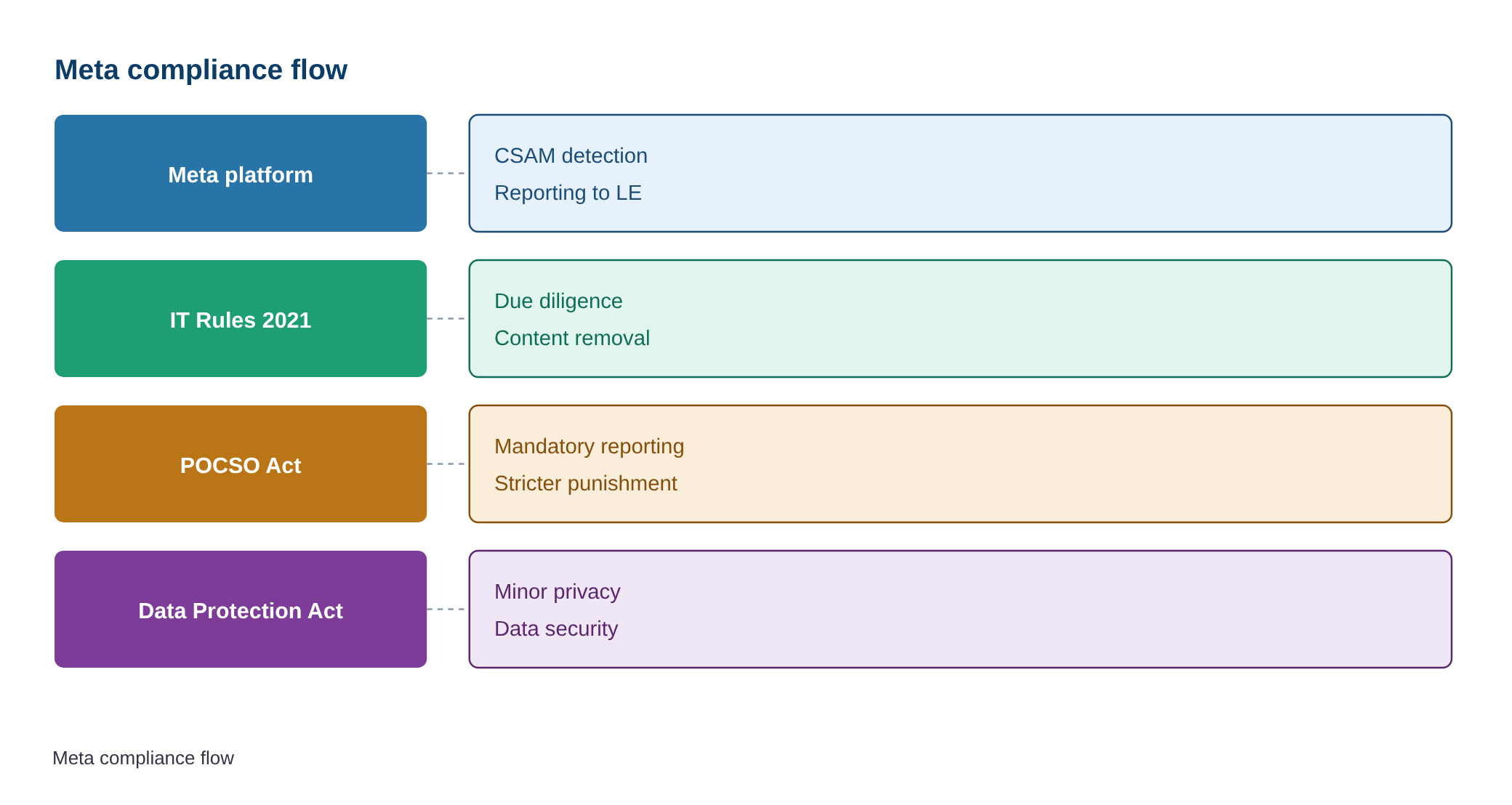
- The Information Technology (Intermediary Guidelines and Digital Media Ethics Code) Rules, 2021, introduced stringent due diligence requirements for social media intermediaries, including proactive measures to identify and remove unlawful content.
- The Protection of Children from Sexual Offences (POCSO) Act, 2012, criminalises child sexual abuse and exploitation, with provisions for stringent punishment and mandatory reporting to law enforcement agencies.
- The Digital Personal Data Protection Act, 2023, further strengthens data governance frameworks, imposing obligations on entities handling personal data, including minors, to ensure privacy and security.
- The Indian government has escalated its engagement with global digital platforms, including Meta, to enforce compliance with domestic laws and address gaps in content moderation and user safety.
- The rise of deepfakes and synthetic media has compounded challenges in detecting and mitigating online harms, prompting regulatory interventions to curb their proliferation.
What is the Legal and Policy Framework Governing Online Child Safety in India?
- **Protection of Children from Sexual Offences (POCSO) Act, 2012**: This Act defines child sexual abuse and exploitation, mandates reporting of such offences to the police or Child Welfare Committees, and prescribes stringent punishments for offenders.
- **Information Technology (Intermediary Guidelines and Digital Media Ethics Code) Rules, 2021**: These rules impose obligations on social media intermediaries to (a) remove unlawful content within 24 hours of receipt of a court order or government direction, (b) establish grievance redressal mechanisms, and (c) conduct periodic audits of content moderation practices.
- **Digital Personal Data Protection Act, 2023**: This Act regulates the processing of personal data, including that of children, and imposes obligations on data fiduciaries to ensure data security and privacy.
- **Cyber Security Policies and Guidelines**: The government has issued advisories and guidelines to combat CSAM, including the ‘Cyber Swachhta Kendra’ initiative, which provides tools for detecting and removing malware and harmful content.
UPSC Value Addition
Keywords for Mains Answer-Writing
Online Safety for Children · Digital Personal Data Protection Act 2023 · Intermediary Liability under IT Rules 2021 · Child Sexual Abuse Material (CSAM) · Meta Platforms Inc. · Section 67B of the Information Technology Act 2000 · UN Convention on the Rights of the Child · National Commission for Protection of Child Rights (NCPCR) · Cybercrime Prevention against Women and Children (CCPWC) Scheme · Grievance Appellate Committees (GAC) under IT Rules 2021 · Accountability of Social Media Intermediaries · Proactive Monitoring and Takedown Mechanisms · Right to Privacy vs. State Surveillance · Global Best Practices for Online Child Safety · Judicial Pronouncements on Online Harm Prevention
Prelims Practice Questions
Q1. Consider the following statements regarding the regulation of social media intermediaries in India:
1. The Information Technology (Intermediary Guidelines and Digital Media Ethics Code) Rules, 2021 mandate intermediaries to remove content reported as child sexual abuse material within 24 hours.
2. Section 67B of the Information Technology Act, 2000 specifically criminalises the publication or transmission of material depicting children in sexually explicit acts.
3. The Digital Personal Data Protection Act, 2023 empowers the Data Protection Board of India to impose penalties on intermediaries for non-compliance with child safety obligations.
How many of the above statements are correct?
- Only one
- Only two
- All three
- None
Answer: All three — Statements 1 and 2 are correct as per the IT Rules 2021 and Section 67B of the IT Act, respectively. Statement 3 is incorrect because the Digital Personal Data Protection Act, 2023 does not explicitly address intermediary liability for child safety; its focus is on data protection and consent.
Q2. Assertion (A): The Government of India has issued notices to social media platforms like Meta under the Information Technology Act, 2000 for failing to proactively identify and remove child sexual abuse material.
Reason (R): The IT Act, 2000 empowers the government to direct intermediaries to remove unlawful content and imposes penalties for non-compliance.
- Both A and R are true, and R is the correct explanation of A
- Both A and R are true, but R is not the correct explanation of A
- A is true but R is false
- A is false but R is true
Answer: Both A and R are true, but R is not the correct explanation of A — Both the assertion and reason are correct. The IT Act, 2000 empowers the government to issue directions to intermediaries for removal of unlawful content, including child sexual abuse material, under Section 69A and the IT Rules 2021. The government has indeed issued notices to platforms like Meta for non-compliance.
Q3. Match the following provisions with their respective legal frameworks:
Column I (Provision) | Column II (Legal Framework)
1. Mandatory reporting of child sexual abuse material | A. Section 67B, Information Technology Act, 2000
2. Grievance Appellate Committees for digital content | B. Information Technology (Intermediary Guidelines and Digital Media Ethics Code) Rules, 2021
3. Proactive monitoring obligations for intermediaries | C. Digital Personal Data Protection Act, 2023
4. Data localisation requirements for intermediaries | D. Information Technology Act, 2000 (Amended 2008)
- 1-A, 2-B, 3-D, 4-C; 1-A, 2-B, 3-C, 4-D; 1-B, 2-A, 3-D, 4-C; 1-D, 2-C, 3-B, 4-A
- answer_indexes_to_options_mapping_answer_key_for_json_output_only_then_explain_here_but_do_not_include_in_final_json_answer_indexes_to_options_mapping_answer_key_for_json_output_only_then_explain_here_but_do_not_include_in_final_json_12341
- explain_match_failure_here
Answer: 1-A, 2-B, 3-D, 4-C; 1-A, 2-B, 3-C, 4-D; 1-B, 2-A, 3-D, 4-C; 1-D, 2-C, 3-B, 4-A — 1-A: Section 67B of the IT Act criminalises publishing or transmitting material depicting children in sexually explicit acts. 2-B: The IT Rules 2021 establish Grievance Appellate Committees. 3-D: The IT Act (Amended 2008) imposes obligations on intermediaries to monitor and remove unlawful content. 4-C: Data localisation requirements are not part of the DPDP Act 2023; they were part of earlier drafts but not enacted.
Mains Practice Question
✍ Critically examine the efficacy of India’s regulatory framework for ensuring online safety of children, with particular reference to the role of social media intermediaries like Meta. Also analyse the constitutional and ethical challenges in balancing child protection with the right to privacy and freedom of expression. (15 Marks)
Approach: MODEL-ANSWER SKELETON:
1. **Regulatory Framework Overview**:
– IT Act, 2000 (Sections 67B, 69A, 79) and IT Rules 2021 (due diligence, grievance redressal, proactive monitoring).
– Digital Personal Data Protection Act, 2023: Data principal rights and obligations of data fiduciaries.
– National Commission for Protection of Child Rights (NCPCR) and State Commissions: Monitoring and reporting.
– Cybercrime Prevention against Women and Children (CCPWC) Scheme: Funding and capacity building.
2. **Efficacy of Current Measures**:
– **Strengths**: Legal provisions criminalising CSAM (Section 67B), mandatory reporting obligations under IT Rules 2021, and government notices to intermediaries (e.g., Meta).
– **Limitations**: Enforcement gaps (e.g., jurisdictional challenges, cross-border data flows), delayed takedowns, and lack of real-time monitoring mechanisms. Cite recent instances of non-compliance or delayed action by platforms.
– **Proactive Steps**: Meta’s agreement to report CSAM to law enforcement as a positive development; contrast with other platforms’ compliance levels.
3. **Constitutional and Ethical Challenges**:
– **Right to Privacy (Puttaswamy Judgment)**: State surveillance vs. child protection; necessity and proportionality tests.
– **Freedom of Expression (Article 19(1)(a))**: Over-censorship risks under Section 69A and IT Rules 2021; judicial scrutiny (e.g., Shreya Singhal v. Union of India).
– **Ethical Dilemmas**: Use of AI for content moderation (e.g., false positives, bias); accountability of intermediaries vs. state overreach.
4. **Global Best Practices and Way Forward**:
– **UN Convention on the Rights of the Child**: India’s obligations and domestic implementation.
– **EU’s Digital Services Act (DSA)**: Transparency, risk assessments, and accountability for large platforms.
– **Recommendations**: Strengthening the GAC mechanism, mandatory AI-based detection tools, and public-private partnerships for real-time monitoring. Highlight the need for a balanced approach that prioritises child safety without compromising fundamental rights.
Source: orissapost.com
Generated by AanyaAi for educational purpose.
Related guides on our sites
- Current affairs for upsc 2026
- Best PSIR optional coaching for upsc
- Best sociology optional coaching for upsc
- Which is best sociology optional coaching for upsc

- मेटा ने स्वीकारा: बाल यौन शोषण मामलों की रिपोर्ट पुलिस को करेगी - September 15, 2026
- Meta to Report Child Abuse Cases to Law Enforcement: Govt’s New Stance on Online Safety - September 15, 2026
- उत्तराखंड राज्यपाल के 5 वर्ष: पांच मिशन और AI क्रांति का लेखा-जोखा - September 15, 2026

No Comments