


06 Aug RBI’s Draft Credit Facilities Directions 2026: Key Changes for NBFCs Explained
✎ The draft RBI directions on credit facilities for NBFCs aim to enhance regulatory oversight, reduce systemic risks, and align the sector with global best practices, with a focus on transparency, liquidity management, and…
Subject Relevance — Where This Topic Fits
- GS Paper III — Indian Economy and issues relating to Planning, Mobilisation of Resources, Growth, Development and Employment | GS Paper III — Effects of Liberalisation on the Economy, Changes in Industrial Policy and their Effects on Industrial Growth
- Prelims: Non-Banking Financial Companies (NBFCs), Reserve Bank of India (RBI) Directions, Credit Facilities Regulations, Financial Stability, Regulatory Arbitrage, Systemically Important NBFCs (SINBFCs), Asset-Liability Management (ALM), Liquidity Coverage Ratio (LCR), Priority Sector Lending (PSL), Basel III Norms
- Essay: Role of Regulatory Bodies in Ensuring Financial Stability: A Case Study of RBI’s Approach to NBFC Sector, Balancing Innovation and Regulation: The Challenge of Governing Non-Banking Financial Entities
Quick Revision: The draft RBI directions on credit facilities for NBFCs aim to enhance regulatory oversight, reduce systemic risks, and align the sector with global best practices, with a focus on transparency, liquidity management, and prudential norms.
Why is this in the news?
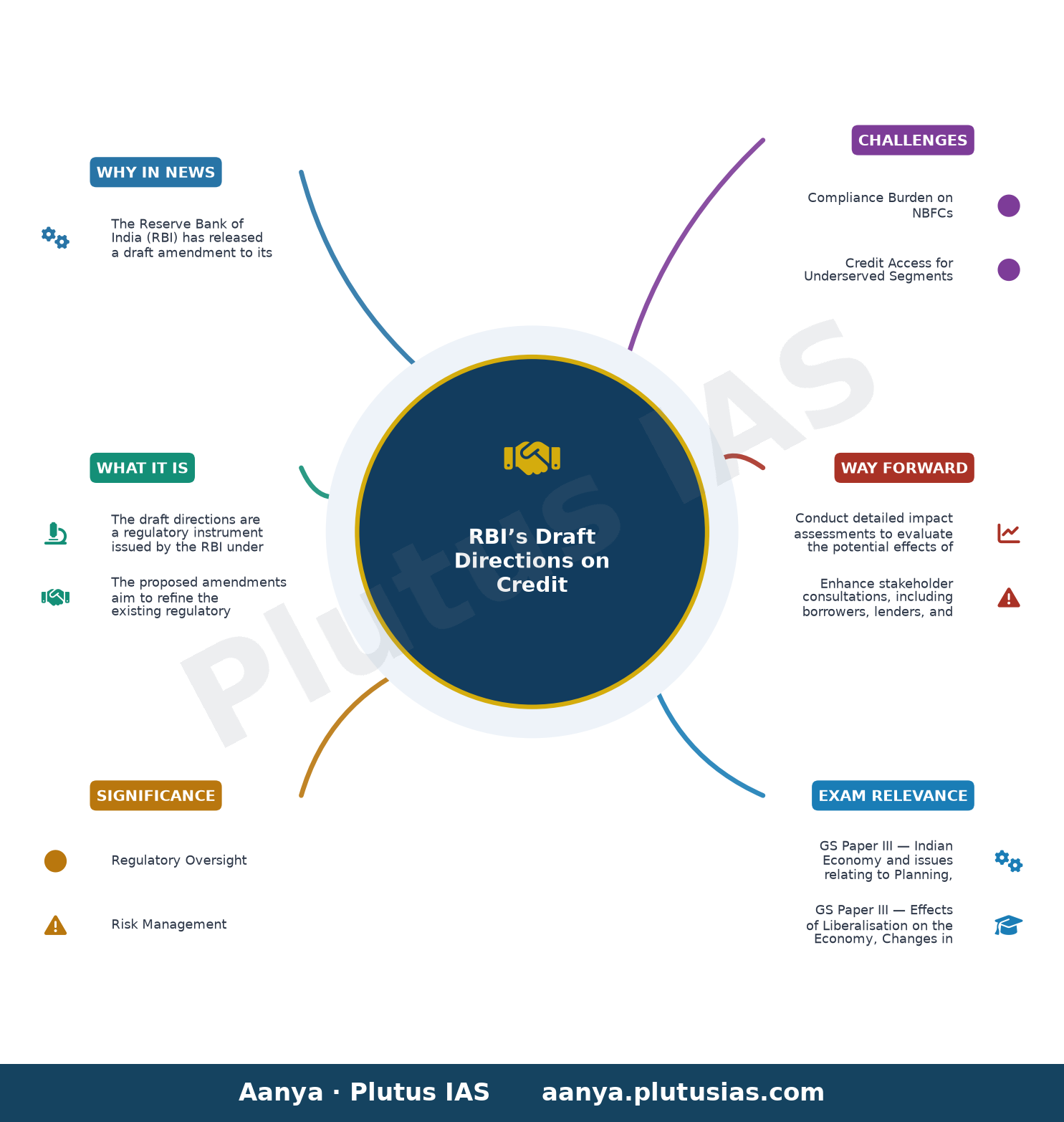
The Reserve Bank of India (RBI) has released a draft amendment to its directions governing credit facilities extended by Non-Banking Financial Companies (NBFCs), inviting public and stakeholder comments by 28 August 2026. This initiative underscores the RBI’s proactive stance in refining the regulatory framework for NBFCs, which play a critical role in India’s financial intermediation ecosystem, particularly in credit delivery to underserved sectors. The proposed amendments are expected to address evolving risks in credit intermediation, enhance transparency, and align NBFC regulations with global best practices, thereby contributing to systemic stability.
Background
- The NBFC sector in India has witnessed exponential growth over the past two decades, expanding from a niche segment to a significant contributor to the country’s financial system, with assets under management exceeding ₹30 lakh crore as of 2025.
- NBFCs complement banks by catering to credit demand in segments such as micro, small, and medium enterprises (MSMEs), retail borrowers, and infrastructure financing, often serving clients underserved by traditional banking channels.
- The RBI, as the sectoral regulator, has progressively strengthened the regulatory architecture for NBFCs through various directions, including the 2014 Framework for Revitalising Distressed Assets, 2016 Asset Classification and Income Recognition norms, and 2020 Scale-Based Regulation (SBR) framework.
- The 2020 SBR framework categorised NBFCs into four layers—Base Layer (NBFC-BL), Middle Layer (NBFC-ML), Upper Layer (NBFC-UL), and Top Layer—based on their systemic importance, risk profile, and interconnectedness.
- Post the IL&FS crisis (2018), the RBI has prioritised enhancing governance, liquidity risk management, and transparency in the NBFC sector to mitigate systemic risks.
- The draft directions of 2026 appear to build on these reforms, focusing specifically on credit facilities extended by NBFCs, which constitute a major portion of their asset portfolio.
What are the Reserve Bank of India (Non-Banking Financial Companies – Credit Facilities) Amendment Directions, 2026?
- The draft directions are a regulatory instrument issued by the RBI under the powers vested in it by the Reserve Bank of India Act, 1934, applicable to all NBFCs registered with the RBI.
- The proposed amendments aim to refine the existing regulatory framework governing credit facilities extended by NBFCs, including norms on disbursement, documentation, pricing, and monitoring of loans, to enhance transparency and reduce regulatory arbitrage.
- Key areas likely addressed in the draft include: (a) stricter due diligence requirements for borrowers, particularly in high-risk segments; (b) enhanced disclosure norms for credit terms and conditions; (c) alignment with international standards such as Basel III for liquidity and capital adequacy; and (d) measures to curb connected lending and related-party transactions.
- The directions may introduce prudential limits on single-borrower exposure and sectoral concentration norms to mitigate concentration risks, particularly for NBFCs classified in the Upper Layer under the SBR framework.
- The draft also appears to emphasise liquidity risk management, including the maintenance of liquidity buffers and adherence to Liquidity Coverage Ratio (LCR) norms, to ensure NBFCs can withstand liquidity shocks.
- Another focal point is the integration of technology-driven credit assessment mechanisms, such as the use of alternative data sources and AI/ML models, while ensuring compliance with data privacy and ethical standards.
- The RBI’s move is part of a broader strategy to harmonise NBFC regulations with those applicable to scheduled commercial banks, thereby reducing regulatory gaps and promoting a level playing field in the financial sector.
- The public consultation process, with a deadline of 28 August 2026, reflects the RBI’s commitment to inclusive policymaking, allowing stakeholders to provide feedback on the draft directions before their finalisation.
Key Features
| Feature | Significance |
|---|---|
| Draft Amendment Directions, 2026 | Proposes regulatory changes for credit facilities extended by Non-Banking Financial Companies (NBFCs), aiming to enhance oversight and risk management. |
| Public Consultation Process | Invites feedback from regulated entities and stakeholders by August 28, 2026, ensuring participatory governance in regulatory evolution. |
| Connect 2 Regulate Portal | Facilitates structured submission of feedback, streamlining the process of stakeholder engagement with the RBI. |
| Focus on Credit Facilities | Highlights the RBI’s intent to regulate the terms, conditions, and risk parameters of credit extended by NBFCs. |
| Regulatory Clarity | Seeks to address ambiguities in existing norms, reducing compliance arbitrage and promoting uniformity in the NBFC sector. |
Why it Matters
Regulatory Oversight
- Strengthens the RBI’s supervisory framework for NBFCs, addressing systemic risks arising from unregulated credit extensions.
- Enhances transparency in the credit ecosystem by standardising practices across NBFCs.
- Aligns with the RBI’s broader mandate to maintain financial stability and consumer protection.
Risk Management
- Introduces stricter norms for assessing creditworthiness, reducing the likelihood of defaults and financial contagion.
- Encourages NBFCs to adopt robust internal risk assessment frameworks, mitigating systemic vulnerabilities.
- Promotes early identification of stressed assets, enabling proactive intervention by regulators.
Consumer Protection
- Ensures fair lending practices by imposing limits on interest rates, fees, and other charges levied by NBFCs.
- Mandates disclosure of terms and conditions, empowering borrowers with informed decision-making.
- Reduces instances of predatory lending, particularly in the microfinance and unsecured credit segments.
Sectoral Impact
- May lead to consolidation in the NBFC sector, as smaller players struggle to comply with stricter norms.
- Could reduce credit availability for underserved segments, necessitating targeted interventions by the RBI.
- Enhances the credibility of NBFCs, potentially attracting greater institutional investments.
Macroeconomic Implications
- Supports the RBI’s objective of containing inflation by curbing excessive credit growth in certain sectors.
- Reduces the risk of financial imbalances, particularly in the housing and personal loan segments.
- Contributes to the stability of the broader financial system by preventing excessive leverage in the NBFC sector.
Challenges
1. Compliance Burden on NBFCs
- Stricter norms may increase operational costs for NBFCs, particularly smaller entities with limited resources.
- Requires significant investments in technology and human resources to meet regulatory expectations.
- May lead to temporary disruptions in credit flow as NBFCs adapt to new requirements.
UPSC Link: Regulatory Framework for NBFCs
2. Credit Access for Underserved Segments
- Tighter lending norms may disproportionately affect low-income borrowers and MSMEs.
- Risk of reduced credit penetration in rural and semi-urban areas, exacerbating financial exclusion.
- Necessitates targeted policy interventions, such as priority sector lending mandates or subsidies.
UPSC Link: Financial Inclusion Policy
3. Regulatory Arbitrage
- Potential for NBFCs to circumvent norms by shifting operations to unregulated entities or jurisdictions.
- Requires robust monitoring mechanisms to detect and penalise non-compliance.
UPSC Link: Regulatory Arbitrage in NBFCs
4. Systemic Risk Amplification
- Over-regulation may stifle innovation and competition in the NBFC sector.
- Risk of credit crunch if NBFCs curtail lending in response to stricter norms.
UPSC Link: Systemic Risk in Financial Sector
5. Stakeholder Engagement Gaps
- Ensuring meaningful participation from diverse stakeholders, including borrowers, lenders, and industry associations.
- Balancing the interests of regulated entities with the need for consumer protection.
UPSC Link: Regulatory Governance
6. Technological Adaptation
- NBFCs may struggle to integrate advanced risk assessment tools and compliance systems.
- Requires collaboration with fintech firms to leverage AI and data analytics for regulatory compliance.
UPSC Link: Fintech and NBFCs
Challenges — UPSC Perspective
| Issue | Concern |
|---|---|
| Operational Costs | Increased compliance costs may reduce profitability, particularly for small and medium-sized NBFCs. |
| Credit Rationing | Stricter norms may lead to reduced credit availability for borrowers with lower credit scores. |
| Regulatory Complexity | Frequent changes in norms may create confusion and operational challenges for NBFCs. |
| Monitoring Gaps | Limited RBI resources may hinder effective supervision of compliance across the NBFC sector. |
| Consumer Distrust | Past instances of mis-selling may erode trust in NBFCs, necessitating stronger consumer protection measures. |
| Sectoral Fragmentation | Differential impact on NBFCs based on size, ownership, and business model may lead to market distortions. |
Way Forward
- Conduct detailed impact assessments to evaluate the potential effects of the draft norms on credit availability and sectoral growth.
- Enhance stakeholder consultations, including borrowers, lenders, and industry associations, to refine the draft directions.
- Develop targeted policy measures to support credit access for underserved segments, such as MSMEs and rural borrowers.
- Strengthen the RBI’s supervisory capacity, including the use of data analytics and AI, to monitor compliance effectively.
- Introduce phased implementation of the norms to allow NBFCs sufficient time to adapt to new requirements.
- Promote financial literacy initiatives to educate borrowers about their rights and responsibilities under the new norms.
- Collaborate with fintech firms to develop cost-effective solutions for NBFCs to meet compliance requirements.
- Establish a grievance redressal mechanism to address consumer complaints and ensure timely resolution.
UPSC Value Addition
Keywords for Mains Answer-Writing
Non-Banking Financial Companies (NBFCs) · RBI Directions on Credit Facilities · NBFC Regulation Amendments · Credit Risk Management for NBFCs · Basel III Norms and NBFCs · Systemically Important NBFCs (SINBFCs) · Liquidity Coverage Ratio (LCR) for NBFCs · Corporate Governance in NBFCs · Financial Stability and NBFC Framework · RBI’s Regulatory Powers over NBFCs
Concept Flow
RBI identifies systemic risks in NBFC credit operations → Draft Amendment Directions, 2026 proposed → Public consultation initiated → Feedback collected and analysed → Final norms notified → NBFCs adapt compliance frameworks → Enhanced oversight and risk management → Improved financial stability and consumer protection
Prelims Practice Questions
Q1. Consider the following statements regarding the Reserve Bank of India (RBI) and Non-Banking Financial Companies (NBFCs):
1. The RBI has the authority to issue directions to NBFCs under Section 45L of the Reserve Bank of India Act, 1934.
2. NBFCs are required to maintain a Liquidity Coverage Ratio (LCR) as per the Basel III norms.
3. The RBI’s draft directions of 2026 aim to exempt all NBFCs from credit facility regulations.
How many of the above statements are correct?
- Only one
- Only two
- All three
- None
Answer: Only two — Statement 1 is correct as Section 45L empowers RBI to issue directions to NBFCs. Statement 2 is correct as RBI has progressively aligned NBFC regulations with Basel III norms. Statement 3 is incorrect as the draft directions aim to amend, not exempt, existing regulations.
Q2. Assertion (A): The Reserve Bank of India (RBI) has recently released draft directions to amend credit facility regulations for Non-Banking Financial Companies (NBFCs).
Reason (R): The amendments are intended to align NBFC regulations with global financial stability standards and address emerging risks in the financial sector.
Code:
- Both A and R are true, and R is the correct explanation of A.
- Both A and R are true, but R is not the correct explanation of A.
- A is true but R is false.
- A is false but R is true.
Answer: Both A and R are true, and R is the correct explanation of A. — Both Assertion (A) and Reason (R) are true. The RBI’s draft directions are indeed aimed at amending credit facility regulations for NBFCs, and the stated intent is to align with global standards and address emerging risks, making R the correct explanation of A.
Q3. Match the following terms with their correct descriptions:
Column I
A. NBFC
B. SINBFC
C. LCR
D. Basel III
Column II
1. A financial institution that offers banking services without meeting the legal definition of a bank.
2. A metric to assess a bank’s liquidity risk over a 30-day stress period.
3. A framework for strengthening bank capital requirements and introducing new regulatory requirements.
4. An NBFC whose failure could trigger a systemic crisis in the financial system.
Select the correct match:
- A-1, B-4, C-2, D-3
- A-2, B-1, C-4, D-3
- A-3, B-2, C-1, D-4
- A-4, B-3, C-1, D-2
Answer: A-1, B-4, C-2, D-3 — A (NBFC) matches with 1 as it is a financial institution offering banking services without being a bank. B (SINBFC) matches with 4 as it refers to NBFCs whose failure could have systemic implications. C (LCR) matches with 2 as it is a liquidity coverage ratio. D (Basel III) matches with 3 as it is a regulatory framework for bank capital requirements.
Mains Practice Question
✍ The Reserve Bank of India (RBI) has recently released draft directions to amend credit facility regulations for Non-Banking Financial Companies (NBFCs). Critically examine the significance of these amendments in the context of financial stability and systemic risk mitigation. Also, discuss the regulatory challenges faced by the RBI in ensuring compliance among NBFCs. (15 Marks)
Approach: MODEL-ANSWER SKELETON:
1. **Introduction (2 marks)**: Define NBFCs and their role in the Indian financial system. Briefly state the purpose of RBI’s draft directions (2026) and their context in global financial regulations.
2. **Significance of the Amendments (5 marks)**:
– **Financial Stability**: Explain how the amendments aim to address systemic risks posed by NBFCs, particularly SINBFCs (Systemically Important NBFCs).
– **Credit Risk Management**: Discuss the role of enhanced credit facility regulations in mitigating default risks and ensuring asset quality.
– **Alignment with Basel III**: Highlight how the amendments align with global standards like Basel III, focusing on Liquidity Coverage Ratio (LCR) and Net Stable Funding Ratio (NSFR).
– **Corporate Governance**: Emphasise the importance of stricter governance norms for NBFCs to prevent mismanagement and fraud.
3. **Regulatory Challenges (5 marks)**:
– **Compliance Monitoring**: Discuss the challenges in real-time monitoring of NBFCs, especially smaller entities with limited resources.
– **Data Gaps**: Highlight the need for robust data collection and reporting mechanisms to assess NBFC health accurately.
– **Interconnectedness Risks**: Explain the risks posed by the interconnectedness of NBFCs with banks and other financial institutions.
– **Balancing Growth and Regulation**: Address the challenge of ensuring growth in the NBFC sector while maintaining stringent regulatory oversight.
4. **Conclusion (3 marks)**: Summarise the critical role of RBI’s regulatory amendments in safeguarding financial stability. Provide a balanced view on the effectiveness of these measures, suggesting areas for further improvement.
Key Points to Include:
– Reference to Section 45L of the RBI Act, 1934 (powers of RBI to issue directions).
– Mention of the Liquidity Coverage Ratio (LCR) and its importance for NBFCs.
– Reference to the Financial Stability Report (RBI) for systemic risk assessment.
– Case studies or examples of NBFC failures (e.g., IL&FS crisis) to illustrate systemic risks.
– Comparison with global practices (e.g., Dodd-Frank Act in the US, EU’s CRD IV).
Source: RBI
Generated by AanyaAi for educational purpose.

- UPSC Alert: Govt Strengthens Deepfake Regulations for AI Content - August 6, 2026
- नमामि गंगे: सीवरेज परियोजनाओं से गंगा प्रदूषण नियंत्रण में प्रगति - August 6, 2026
- Namami Gange: 4,263 MLD Sewage Treatment Capacity Created by 2026 - August 6, 2026

No Comments