


06 Aug Namami Gange: 4,263 MLD Sewage Treatment Capacity Created by 2026
✎ The Namami Gange Programme integrates sewage treatment infrastructure development, pollution control, and biodiversity conservation to rejuvenate the Ganga River, with 4,263 MLD treatment capacity and significant strides in…
Subject Relevance — Where This Topic Fits
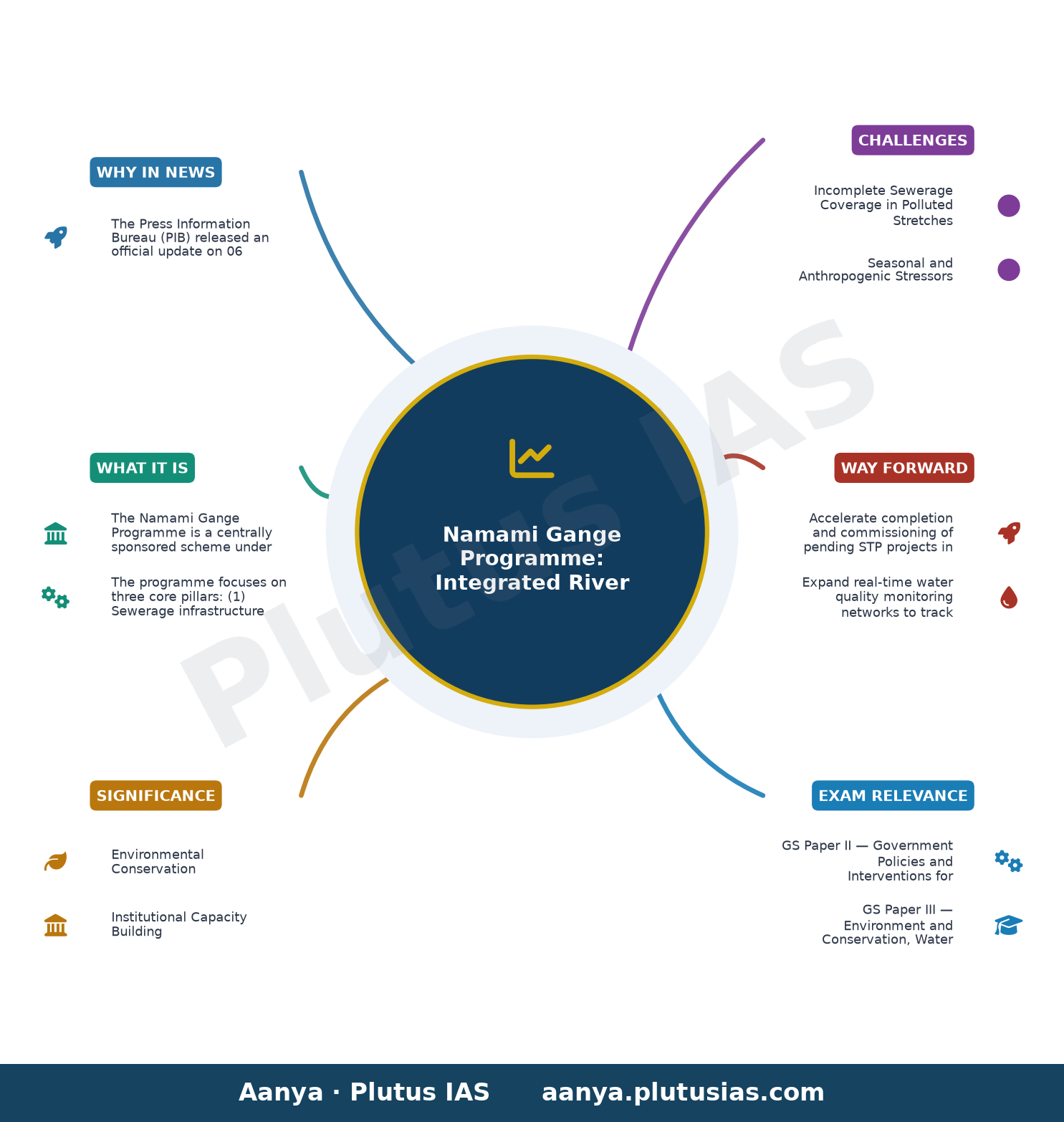
- GS Paper II — Government Policies and Interventions for Development in various sectors | GS Paper III — Environment and Conservation, Water Resources
- Prelims: Namami Gange, National Mission for Clean Ganga (NMCG), Sewage Treatment Plants (STPs), Biodiversity conservation, Gangetic dolphin, Wetland (Conservation and Management) Rules 2017
- Essay: Ecological restoration and sustainable development: Lessons from the Ganga rejuvenation initiative, Balancing developmental imperatives with environmental sustainability: The case of river basin management
Quick Revision: The Namami Gange Programme integrates sewage treatment infrastructure development, pollution control, and biodiversity conservation to rejuvenate the Ganga River, with 4,263 MLD treatment capacity and significant strides in aquatic species rescue and wetland restoration.
Why is this in the news?
The Press Information Bureau (PIB) released an official update on 06 August 2026 detailing the progress of the Namami Gange Programme (NMG-II) during 2025, highlighting the commissioning of 25 new Sewage Treatment Plants (STPs) under 70 sewerage infrastructure projects, the creation of 4,263 MLD sewage treatment capacity, and significant strides in biodiversity conservation, including the rescue and rehabilitation of aquatic species such as the Gangetic dolphin, turtles, and crocodiles. The report also underscores improvements in water quality across polluted river stretches and the ecological restoration of wetlands and riverine habitats.
Background
- The Ganga River, a transboundary river system, is the lifeline of over 40% of India’s population, supporting agriculture, industry, and cultural heritage across five states: Uttarakhand, Uttar Pradesh, Bihar, Jharkhand, and West Bengal.
- The Namami Gange Programme, launched in 2014 as a flagship initiative of the Government of India, is a comprehensive, integrated mission to clean and rejuvenate the Ganga River and its tributaries through a multi-sectoral approach.
- The programme operates under the National Mission for Clean Ganga (NMCG), an autonomous body under the Ministry of Jal Shakti.
- The programme’s objectives include reducing pollution, conserving and rejuvenating the Ganga’s ecosystem, and ensuring sustainable management of the river basin.
- The Central Pollution Control Board (CPCB) periodically monitors and reports on the status of polluted river stretches (PRS) in the Ganga basin, classifying them based on water quality parameters such as Dissolved Oxygen (DO), Biochemical Oxygen Demand (BOD), and faecal coliform levels.
- The programme integrates scientific research, community participation, and technological interventions to address both point and non-point sources of pollution in the Ganga basin.
What is the Namami Gange Programme?
- The Namami Gange Programme is a centrally sponsored scheme under the Ministry of Jal Shakti, Government of India, aimed at the comprehensive rejuvenation of the Ganga River and its tributaries through a multi-dimensional approach.
- The programme focuses on three core pillars: (1) Sewerage infrastructure development, (2) Industrial effluent monitoring and control, and (3) River surface cleaning and biodiversity conservation.
- Under the programme, 70 sewerage infrastructure projects were commissioned in 2025, including 25 new Sewage Treatment Plants (STPs), adding 4,263 MLD of sewage treatment capacity to the Ganga basin.
- The programme has established a robust monitoring framework, including the identification and prioritisation of polluted river stretches (PRS), with regular assessments by the CPCB to track improvements in water quality.
- Biodiversity conservation is a critical component, with initiatives such as the rescue and rehabilitation of aquatic species (e.g., Gangetic dolphins, turtles, and crocodiles), habitat restoration, and the establishment of biodiversity parks.
- The programme has documented 215 fish species in the Ganga River, including 206 native and 9 exotic species, and has undertaken ‘river ranching’ by releasing 2.05 crore fish seeds to enhance fish populations.
- The NMCG has collaborated with institutions such as the Wildlife Institute of India (WII) to establish the National River Research Centre in Dehradun and four aquatic animal rescue and rehabilitation centres, including India’s first dolphin rescue ambulance.
- The programme also prioritises the restoration and management of wetlands in the Ganga basin, aligning with the Wetland (Conservation and Management) Rules, 2017, to enhance ecological resilience and water purification services.
Key Features
| Feature | Significance |
|---|---|
| Sewerage Infrastructure Projects (STPs) | Enhances sewage treatment capacity (4,263 MLD by June 2026) to reduce organic pollution in the Ganga basin. |
| Biological Water Quality Monitoring | Assesses aquatic ecosystem health through benthic macro-invertebrates, classifying most sites as ‘Good’ to ‘Moderate’. |
| Biodiversity Conservation Initiatives | Includes habitat restoration, species conservation (e.g., 3,037 gharials documented), and reintroduction programs for critically endangered species. |
| River Ranching and Fish Seed Release | Releases 2.05 crore fish seeds (including Indian Major Carp and Hilsa) to restore native fish populations. |
| Wetland Restoration and Management | Identifies and prioritizes ecologically critical wetlands under the Wetlands (Conservation and Management) Rules, 2017. |
Why it Matters
Environmental Conservation
- Systematic reduction of polluted river stretches (PRS) in the Ganga mainstem from 2018 to 2025, with notable improvements in Uttarakhand and West Bengal.
- Documentation of 215 fish species (206 native) in the Ganga, indicating ecological recovery and biodiversity enhancement.
- Strengthening of aquatic biodiversity through conservation programs for gharials, turtles, and dolphins.
Institutional Capacity Building
- Establishment of the National River Research Centre in Dehradun and four aquatic life rescue centers to support rehabilitation efforts.
- Deployment of India’s first dolphin rescue ambulance to enhance emergency response for endangered species.
- Collaboration with scientific institutions (e.g., ICAR-CIFRI) for evidence-based conservation strategies.
Community and Ecological Integration
- Engagement of 5,500+ ‘Ganga Praharis’ across 113 districts for biodiversity monitoring and conservation awareness.
- Creation of 7 Ganga Biodiversity Parks in Uttar Pradesh and afforestation of 33,024 hectares using native species.
- Integration of traditional ecological knowledge with modern conservation practices.
Challenges
1. Incomplete Sewerage Coverage in Polluted Stretches
- Persistent pollution in segments like Bijnor to Tareghat (Uttar Pradesh) and Bhagalpur to Khagaria (Bihar), indicating uneven progress in sewage treatment infrastructure.
- Gap between planned and operational STP capacity, particularly in densely populated urban areas.
UPSC Link: Environmental Pollution (GS-III)
2. Seasonal and Anthropogenic Stressors
- Agricultural runoff, industrial effluents, and unregulated waste disposal continue to degrade water quality despite infrastructure improvements.
- Climate change-induced variability in river flow exacerbates dilution capacity and habitat fragmentation.
UPSC Link: Climate Change and Water Resources (GS-III)
3. Biodiversity Threats and Illegal Exploitation
- Illegal fishing, poaching of turtles (e.g., Red-crowned Roofed Turtle), and habitat destruction in critical zones remain unaddressed.
- Invasive species and microplastic pollution pose emerging threats to aquatic ecosystems.
UPSC Link: Biodiversity Conservation (GS-III)
4. Monitoring and Enforcement Gaps
- Limited real-time monitoring of non-point source pollution (e.g., agricultural runoff, rural wastewater).
- Inadequate coordination between state agencies and local bodies for sustained enforcement of environmental norms.
UPSC Link: Environmental Governance (GS-II)
5. Funding and Sustainability Constraints
- Dependence on central funds for long-term operations and maintenance of STPs and conservation programs.
- Need for innovative financing mechanisms (e.g., public-private partnerships) to ensure program longevity.
UPSC Link: Public Finance and Governance (GS-II)
Challenges — UPSC Perspective
| Issue | Concern |
|---|---|
| Polluted River Stretches (PRS) | Persistent organic and nutrient pollution in segments like Bijnor-Tareghat and Bhagalpur-Khagaria. |
| Sewerage Infrastructure Gaps | Insufficient operational STP capacity in high-pollution urban clusters. |
| Illegal Wildlife Trade | Poaching of endangered species (e.g., Red-crowned Roofed Turtle) despite conservation efforts. |
| Non-Point Source Pollution | Agricultural runoff and rural wastewater contributing to eutrophication. |
| Climate Variability | Altered river flow regimes affecting dilution and habitat stability. |
Government Initiatives — Must-Memorise for Prelims
- Namami Gange Programme (Phase-II)
Way Forward
- Accelerate completion and commissioning of pending STP projects in critical polluted stretches (e.g., Bijnor-Tareghat, Bhagalpur-Khagaria).
- Expand real-time water quality monitoring networks to track non-point source pollution and seasonal variations.
- Strengthen inter-state coordination mechanisms for integrated river basin management under NGRBA guidelines.
- Enhance enforcement of wildlife protection laws (e.g., Wildlife Protection Act, 1972) to curb illegal fishing and poaching.
- Promote community-led wetland restoration programs in collaboration with state forest departments.
- Invest in climate-resilient infrastructure for STPs and riverine habitats to mitigate future stress.
- Develop a dedicated fund for long-term maintenance of biodiversity parks and conservation centers.
- Integrate traditional knowledge systems with modern conservation science for sustainable river management.
UPSC Value Addition
Keywords for Mains Answer-Writing
Namami Gange Programme · Ganga Rejuvenation · Sewage Treatment Plants (STPs) · Polluted River Stretches (PRS) · Biodiversity Conservation in Ganga Basin · National Mission for Clean Ganga (NMCG) · Ganga Action Plan · Wetland Conservation · River Dolphin Conservation · Bio-monitoring of Rivers
Concept Flow
Urban and industrial wastewater discharge → Organic and nutrient pollution in Ganga basin → Degradation of aquatic ecosystems and biodiversity loss. → Implementation of Namami Gange Programme → Construction of STPs and habitat restoration → Partial reduction in polluted river stretches (PRS). → Biological monitoring and species conservation → Documentation of 215 fish species and 3,037 gharials → Evidence of ecological recovery. → Community engagement and institutional capacity building → Formation of Ganga Praharis and rescue centers → Enhanced conservation outcomes. → Persistent anthropogenic pressures (agricultural runoff, illegal exploitation) → Need for integrated governance and climate-resilient strategies. → Sustainable financing and enforcement gaps → Risk of reversal in conservation gains → Requires long-term policy commitment.
Prelims Practice Questions
Q1. Consider the following statements regarding the Namami Gange Programme: 1. It aims to create 4,263 MLD of sewage treatment capacity by June 2026. 2. It includes the restoration of wetlands and biodiversity conservation as key components. 3. The programme has documented 215 fish species in the Ganga river system. 4. It has established four aquatic animal rescue and rehabilitation centres across India. How many of the above statements are correct?
- Only one
- Only two
- Only three
- All four
Answer: All four — Statements 1, 2, and 3 are correct. Statement 4 is incorrect as only one Dolphin rescue ambulance and four aquatic animal rescue and rehabilitation centres have been established, not four centres across India.
Q2. Assertion (A): The Namami Gange Programme has significantly improved the water quality of the Ganga river system in Uttarakhand and Jharkhand. Reason (R): The programme has removed polluted river stretches (PRS) in these states by 2025.
- Both A and R are true, and R is the correct explanation of A
- Both A and R are true, but R is not the correct explanation of A
- A is true, but R is false
- A is false, but R is true
Answer: A is true, but R is false — The assertion is true as the programme has improved water quality in Uttarakhand and Jharkhand. However, the reason is false because no PRS existed in these states in 2018 or 2025, so the removal of PRS cannot explain the improvement.
Q3. Match the following polluted river stretches (PRS) in the Ganga basin with their respective states as per the CPCB report (2025):
Column I (State) | Column II (PRS)
A. Uttarakhand | 1. Buxar to Bhagalpur
B. Uttar Pradesh | 2. Haridwar to Sultanpur
C. Bihar | 3. Kanpur to Varanasi
D. West Bengal | 4. Baharampur to Diamond Harbour
Answer: ? — A-2, B-3, C-1, D-4. The correct matches are: Uttarakhand (Haridwar to Sultanpur), Uttar Pradesh (Kanpur to Varanasi), Bihar (Buxar to Bhagalpur), and West Bengal (Baharampur to Diamond Harbour).
Mains Practice Question
✍ Critically evaluate the role of the Namami Gange Programme in addressing the ecological and hydrological challenges of the Ganga river system. In your answer, substantiate your evaluation with reference to sewage management, biodiversity conservation, and community participation. (15 Marks)
Approach: MODEL-ANSWER SKELETON:
1. **Introduction** (2 Marks):
– Briefly introduce the Namami Gange Programme as a flagship initiative under the National Mission for Clean Ganga (NMCG) launched in 2014.
– State its twin objectives: reducing pollution and ensuring ecological rejuvenation of the Ganga river system.
2. **Sewage Management and Infrastructure Development** (4 Marks):
– Highlight the creation of 4,263 MLD sewage treatment capacity by June 2026 under the programme.
– Discuss the implementation of 70 sewage infrastructure projects, including 25 operational STPs in 2025.
– Mention the reduction of polluted river stretches (PRS) in states like Uttarakhand and Jharkhand, where no PRS existed by 2025.
– Cite partial improvements in Uttar Pradesh and Bihar, with specific examples (e.g., Bijnor to Tareeghat, Buxar to Bhagalpur).
3. **Biodiversity Conservation and Ecological Restoration** (5 Marks):
– Discuss the programme’s focus on biodiversity conservation, including the establishment of four aquatic animal rescue and rehabilitation centres and a Dolphin rescue ambulance.
– Highlight the rescue and rehabilitation of 6,800 aquatic animals, including 1,500 freshwater turtles and 893 gharials.
– Mention the documentation of 215 fish species (206 native, 9 exotic) and the release of 2.05 crore fish seeds in the Ganga and its tributaries.
– Explain the role of scientific surveys in identifying 3,037 gharials, leading to the formulation of the ‘National Gharial Conservation Action Plan’.
– Discuss the restoration of wetlands and the establishment of the National River Research Centre in Dehradun.
4. **Community Participation and Institutional Mechanisms** (3 Marks):
– Explain the programme’s emphasis on community participation through initiatives like the Ganga Prahari network (5,500+ members in 113 districts) and the establishment of seven Ganga Biodiversity Parks in Uttar Pradesh.
– Discuss the role of state forest departments and local species in afforestation efforts covering 33,024 hectares.
– Highlight the scientific identification and prioritization of ecologically significant wetlands in Ganga basin states.
5. **Critique and Challenges** (3 Marks):
– Acknowledge the programme’s achievements in sewage management and biodiversity conservation.
– Critically examine the partial improvements in states like Uttar Pradesh and Bihar, where some PRS still persist.
– Discuss the limitations in achieving uniform ecological restoration across all states in the Ganga basin.
6. **Conclusion** (2 Marks):
– Summarize the programme’s role in addressing ecological and hydrological challenges.
– Conclude with a balanced view, emphasizing the need for continued efforts in sewage management, biodiversity conservation, and community engagement to ensure the long-term sustainability of the Ganga river system.
Source: PIB (Press Information Bureau)
Generated by AanyaAi for educational purpose.

- राजस्थान पंचायत चुनाव 2026: सरपंच-वार्ड पदों की आरक्षण लॉटरी आज, जानिए आरक्षण तय करने की प्रक्रिया - September 24, 2026
- Rajasthan Panchayat Polls 2026: Reservation Lottery for Sarpanch & Ward Panch Seats Today - September 24, 2026
- यूपी में पहली बार तेंदुओं का बधियाकरण: मानव-वन्यजीव संघर्ष रोकेगा अभियान - September 24, 2026

No Comments