


07 Aug UPSC Alert: PLI Scheme for Pharma Sector – Key Updates & Challenges
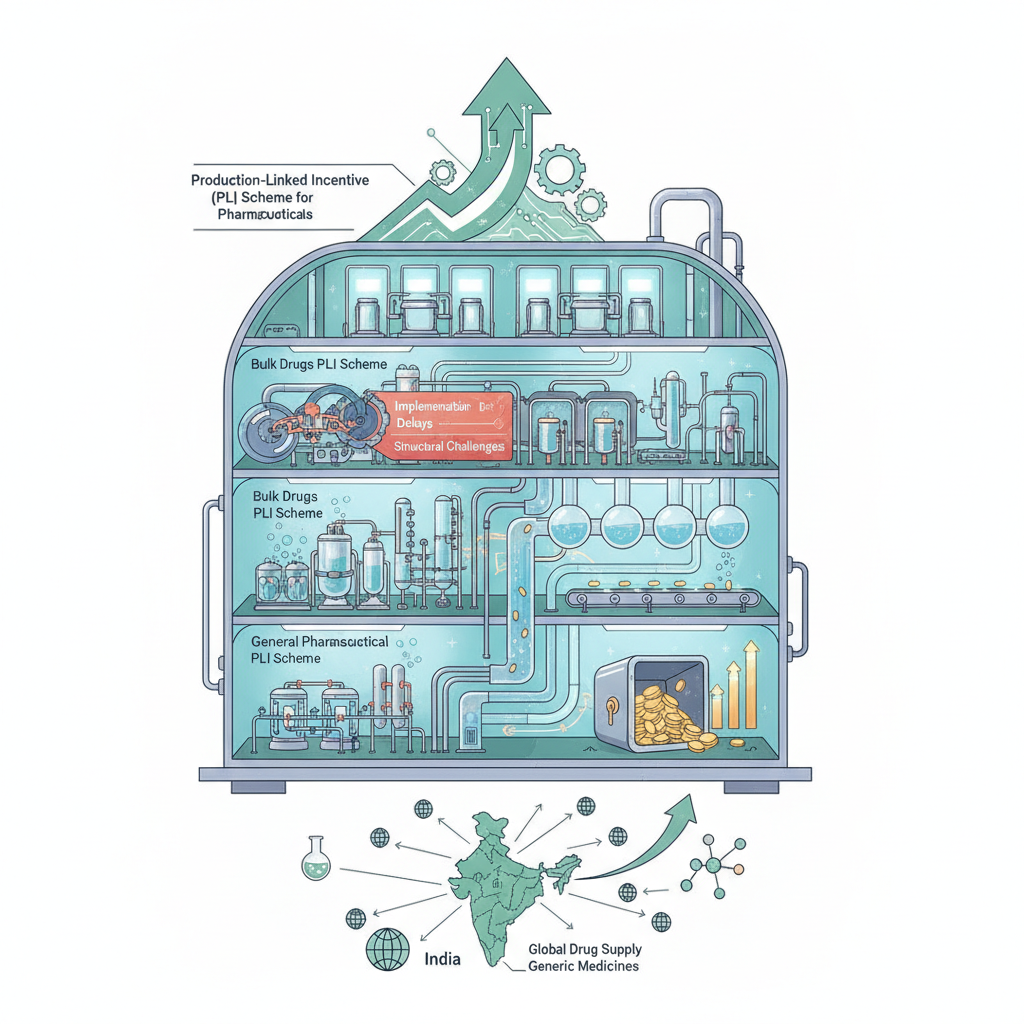
PLI schemeBulk drugs PLIGeneral pharmaceutical PLIFermentation-based productionDomestic manufacturing✎ The PLI scheme for pharmaceuticals is a performance-linked incentive mechanism with ₹15,000 crore outlay for general drugs and ₹6,940 crore for bulk drugs, but fermentation-based bulk drug projects face delays due to biological…
Subject Relevance — Where This Topic Fits
- GS Paper III — Indian Economy: Issues Relating to Planning, Mobilization of Resources, Growth, Development and Employment | GS Paper III — Effects of Liberalization on the Economy, Changes in Industrial Policy and their Effects on Industrial Growth | GS Paper III — Science and Technology- Developments and their Applications and Effects in Everyday Life
- Prelims: Production-Linked Incentive (PLI) Scheme, Pharmaceutical Sector, Self-Reliance in Pharmaceuticals (Atmanirbhar Bharat), Fermentation-based bulk drugs, Chemical synthesis vs fermentation, Department of Pharmaceuticals (DoP), Union Budget 2022-23
- Essay: India’s pharmaceutical sector: From global supplier to self-reliance, Balancing innovation and affordability in healthcare: The role of government incentives
Quick Revision: The PLI scheme for pharmaceuticals is a performance-linked incentive mechanism with ₹15,000 crore outlay for general drugs and ₹6,940 crore for bulk drugs, but fermentation-based bulk drug projects face delays due to biological process constraints and regulatory bottlenecks.
Why is this in the news?
The Union Minister of State for Chemicals and Fertilizers, in a written reply to the Lok Sabha on 7 August 2026, provided an update on the progress of the Production-Linked Incentive (PLI) scheme for the pharmaceutical sector. The data revealed significant disbursement under the general pharmaceutical PLI scheme, while the bulk drugs PLI scheme faced implementation delays due to structural challenges inherent to fermentation-based production. The disclosure underscores the policy’s evolving dynamics, sector-specific bottlenecks, and the government’s approach to incentivizing domestic manufacturing in critical healthcare segments.
Background
- The pharmaceutical sector is a key pillar of India’s healthcare ecosystem, contributing significantly to global drug supply, with India being the world’s largest provider of generic medicines.
- Bulk drugs (active pharmaceutical ingredients or APIs) are the foundational inputs for finished dosage forms, and their domestic production is critical for supply chain resilience, especially during global health crises.
- Fermentation-based bulk drug production relies on biological processes, which are inherently slower than chemical synthesis, leading to longer gestation periods for projects.
- Environmental clearances, land acquisition delays, and high utility costs have historically impeded large-scale industrial projects in India, including those in the pharmaceutical sector.
- The PLI scheme for pharmaceuticals aims to bridge the cost disadvantage faced by domestic manufacturers vis-à-vis global competitors, particularly in the wake of China’s dominance in API production.
What is the Production-Linked Incentive (PLI) Scheme for Pharmaceuticals?
- The PLI scheme for pharmaceuticals is a performance-based subsidy mechanism introduced by the Government of India to incentivize domestic manufacturing of pharmaceuticals and bulk drugs, thereby enhancing self-reliance in critical healthcare inputs.
- The scheme operates on a reimbursement model where incentives are disbursed based on incremental sales of eligible products over a base year, ensuring fiscal efficiency and outcome-based funding.
- For general pharmaceuticals, the scheme has a total financial outlay of ₹15,000 crore, with ₹6,659 crore disbursed as of March 2026, indicating robust uptake and execution.
- The bulk drugs PLI scheme, with a ₹6,940 crore outlay, has disbursed only ₹87.70 crore by March 2026, reflecting implementation challenges, particularly in fermentation-based production.
- Fermentation-based bulk drugs rely on microbial or cell culture processes, which are slower and more sensitive to environmental and regulatory conditions compared to chemically synthesized APIs.
- The scheme mandates compliance with environmental norms, land-use regulations, and quality standards, which, while necessary, introduce procedural delays in project execution.
Key Features
| Feature | Significance |
|---|---|
| Financial Outlay | A total outlay of ₹15,000 crore for the Pharmaceutical PLI scheme to incentivize domestic manufacturing of pharmaceuticals and bulk drugs. |
| Progressive Disbursement | ₹6,659 crore disbursed under the Pharmaceutical PLI scheme by March 2026, indicating partial but significant implementation. |
| Dual Scheme Structure | Separate PLI schemes for finished pharmaceuticals and bulk drugs, each with distinct financial allocations and disbursement patterns. |
| Incentive Mechanism | Disbursement tied to actual sales of products manufactured under the scheme, ensuring direct linkage to production outcomes. |
| Sectoral Coverage | Inclusion of medical devices under a separate PLI scheme with ₹266.64 crore disbursed by March 2026. |
Why it Matters
Economic Impact
- Enhances domestic pharmaceutical manufacturing capacity, reducing reliance on imports for critical drugs and bulk drugs.
- Promotes self-reliance (Atmanirbhar Bharat) in the pharmaceutical sector, aligning with national strategic priorities.
- Generates employment and fosters ancillary industries such as packaging, logistics, and R&D in the pharmaceutical ecosystem.
Strategic Importance
- Strengthens India’s position as a global pharmaceutical hub, particularly for generic medicines and bulk drug production.
- Reduces vulnerability to supply chain disruptions in critical pharmaceutical ingredients, as evidenced by global shortages during the COVID-19 pandemic.
- Supports the government’s vision of making India a ‘pharmacy of the world’ by incentivizing high-value production.
Policy Innovation
- Introduces a production-linked incentive model tailored for the pharmaceutical sector, distinct from traditional subsidies or tax breaks.
- Demonstrates a shift toward outcome-based fiscal incentives, ensuring accountability and efficiency in fund utilization.
- Highlights the need for sector-specific policy interventions to address unique challenges such as long gestation periods in fermentation-based production.
Challenges
1. Operational Delays in Bulk Drug Projects
- Land acquisition bottlenecks and prolonged environmental clearances delay project implementation, particularly for bulk drug manufacturing units.
- High utility costs, including energy and water, increase the cost of production, reducing the competitiveness of domestic manufacturers.
- Fermentation-based bulk drug production involves biological processes with inherently slow growth rates, extending project timelines and deferring incentive disbursements.
UPSC Link: Ease of Doing Business
2. Disbursement Lag Due to Sales-Linked Incentives
- Incentives are tied to the sale of manufactured products, creating a cash-flow gap for firms during the initial production phase.
- Delays in project completion postpone revenue generation, thereby deferring the disbursement of PLI funds to eligible firms.
- This structural issue disproportionately affects small and medium enterprises (SMEs) with limited financial buffers.
UPSC Link: Working Capital Management
3. Sector-Specific Production Constraints
- Fermentation-based production is capital-intensive and requires specialized infrastructure, limiting participation to large firms with adequate resources.
- Dependence on imported raw materials for certain bulk drugs increases production costs and exposes firms to foreign exchange volatility.
- Regulatory hurdles, including stringent Good Manufacturing Practices (GMP) compliance, add to compliance costs and operational complexities.
UPSC Link: Industrial Policy
4. Limited Incentive Structure for Medical Devices
- The PLI scheme for medical devices has disbursed only ₹266.64 crore by March 2026, indicating slower adoption compared to pharmaceuticals.
- The absence of a component-linked incentive (CLI) framework may limit the scheme’s attractiveness for firms engaged in high-value component manufacturing.
- Competition from established global players in the medical devices sector poses a challenge for domestic manufacturers.
UPSC Link: Technology Upgradation
Challenges — UPSC Perspective
| Issue | Concern |
|---|---|
| Land Acquisition | Prolonged delays due to regulatory and administrative hurdles, impacting project timelines. |
| Environmental Clearances | Stringent and time-consuming approval processes for industrial units, particularly in bulk drug manufacturing. |
| High Utility Costs | Escalating energy and water costs reduce the profitability of domestic pharmaceutical production. |
| Fermentation-Based Production | Biological constraints in growth rates lead to extended project gestation periods. |
| Sales-Linked Disbursement | Cash-flow gaps for firms due to deferred incentive payments during initial production phases. |
| Regulatory Compliance | Stringent GMP and quality standards increase compliance costs for manufacturers. |
Government Initiatives — Must-Memorise for Prelims
- Production-Linked Incentive (PLI) Scheme for Pharmaceuticals
- Production-Linked Incentive (PLI) Scheme for Bulk Drugs
- Production-Linked Incentive (PLI) Scheme for Medical Devices
Way Forward
- Streamline land acquisition and environmental clearance processes through single-window clearance mechanisms to expedite project implementation.
- Introduce partial upfront disbursement of PLI funds to address cash-flow constraints during the initial production phase.
- Expand the incentive structure to include component-linked incentives (CLI) for medical devices to attract high-value manufacturers.
- Enhance infrastructure support, including subsidized utility costs and specialized industrial parks for bulk drug production.
- Strengthen R&D incentives within the PLI framework to promote innovation in fermentation-based and high-value pharmaceutical production.
- Establish a dedicated grievance redressal mechanism for firms facing delays in incentive disbursement or regulatory approvals.
- Promote public-private partnerships (PPPs) to develop shared infrastructure for bulk drug manufacturing, reducing capital costs for individual firms.
- Conduct periodic reviews of the PLI schemes to identify bottlenecks and introduce corrective measures based on ground-level feedback.
UPSC Value Addition
Keywords for Mains Answer-Writing
Production Linked Incentive Scheme (PLI) · Pharmaceutical Sector PLI · Bulk Drugs PLI Scheme · Production-based incentives · Industrial Policy and Promotion · Pharmaceutical Manufacturing · Fermentation-based Pharmaceuticals · Land Acquisition and Environmental Clearances · Component-Linked Incentives (CLI) · Medical Devices PLI · Union Budget 2022-23 · Department of Pharmaceuticals · Ministry of Chemicals and Fertilizers · Public Sector Undertakings in Pharma · Atmanirbhar Bharat Abhiyaan
Concept Flow
Government announces PLI scheme for pharmaceuticals to boost domestic manufacturing. → Firms submit applications and commence projects, facing operational and regulatory challenges. → Delays in land acquisition, environmental clearances, and fermentation-based production timelines emerge. → Incentive disbursement is tied to sales, creating cash-flow gaps for firms during initial production. → Partial disbursement of ₹6,659 crore by March 2026 reflects the impact of these challenges. → Policy reforms are proposed to address bottlenecks and enhance the scheme’s effectiveness.
Prelims Practice Questions
Q1. Consider the following statements regarding the Production Linked Incentive (PLI) Scheme for the Pharmaceutical Sector:
1. The PLI Scheme for Pharmaceuticals was launched in the financial year 2022-23.
2. The total financial outlay for the PLI Scheme for Pharmaceuticals is ₹15,000 crore.
3. The PLI Scheme for Bulk Drugs has a financial outlay of ₹6,940 crore.
4. The PLI Scheme for Medical Devices follows a component-linked incentive model exclusively.
How many of the above statements are correct?
- Only one
- Only two
- Only three
- All four
Answer: Only three — Statements 1, 2, and 3 are correct. Statement 4 is incorrect as the PLI Scheme for Medical Devices does not follow an exclusive component-linked incentive model; it retains the PLI framework.
Q2. Assertion (A): Fermentation-based pharmaceutical manufacturing relies on the biological activity of living cells, which inherently limits the speed of production.
Reason (R): Unlike chemical synthesis, fermentation processes depend on the natural growth rate of microorganisms, making large-scale production time-consuming.
- (A) Both A and R are true, and R is the correct explanation of A.
- (B) Both A and R are true, but R is not the correct explanation of A.
- (C) A is true, but R is false.
- (D) A is false, but R is true.
Answer: (A) Both A and R are true, and R is the correct explanation of A. — Both the Assertion (A) and Reason (R) are true, and R correctly explains A, as fermentation-based production is constrained by the natural growth rate of cells.
Q3. Match the following PLI Schemes with their respective financial outlays:
Column I (Scheme) | Column II (Financial Outlay in ₹ Crore)
—————–|——————————-
A. PLI Scheme for Pharmaceuticals | 1. ₹6,940
B. PLI Scheme for Bulk Drugs | 2. ₹15,000
C. PLI Scheme for Medical Devices | 3. ₹5,000
- A-2, B-1, C-3
- A-1, B-2, C-3
- A-2, B-3, C-1
- A-3, B-1, C-2
Answer: A-2, B-1, C-3 — The PLI Scheme for Pharmaceuticals has a financial outlay of ₹15,000 crore, the PLI Scheme for Bulk Drugs has ₹6,940 crore, and the PLI Scheme for Medical Devices does not have a specified outlay in the given options (actual outlay is not mentioned in the provided data).
Mains Practice Question
✍ The Production Linked Incentive (PLI) Scheme for the Pharmaceutical Sector represents a strategic shift towards self-reliance in critical healthcare manufacturing. Critically examine the design, implementation challenges, and outcomes of the PLI Scheme for Pharmaceuticals and Bulk Drugs. Also, assess whether the current framework adequately addresses the bottlenecks in fermentation-based pharmaceutical production. (15 Marks)
Approach: MODEL-ANSWER SKELETON:
1. **Introduction (2 Marks)**:
– Define the PLI Scheme and its objectives under the Atmanirbhar Bharat Abhiyaan.
– Contextualise the Pharmaceutical PLI Scheme within the broader industrial policy framework.
2. **Design and Structure (3 Marks)**:
– Outline the financial outlay (₹15,000 crore for Pharmaceuticals, ₹6,940 crore for Bulk Drugs).
– Explain the incentive mechanism: production-based subsidies linked to incremental sales.
– Differentiate between the PLI frameworks for Pharmaceuticals, Bulk Drugs, and Medical Devices.
3. **Implementation Challenges (4 Marks)**:
– **Regulatory Bottlenecks**: Land acquisition delays, environmental clearances, and utility costs.
– **Technological Constraints**: Fermentation-based production requires longer gestation periods due to biological growth rates.
– **Market Dynamics**: Limited uptake of incentives due to slow project rollout and sales-based disbursement.
– **Data**: Cite the disparity in disbursement (₹6,659 crore for Pharmaceuticals vs. ₹87.70 crore for Bulk Drugs by March 2026).
4. **Outcomes and Critique (3 Marks)**:
– Evaluate the progress: High disbursement for Pharmaceuticals but low for Bulk Drugs.
– Assess whether the scheme has succeeded in reducing import dependence in critical APIs.
– Critique the adequacy of the current framework in addressing fermentation-based production constraints.
5. **Suggestions and Way Forward (3 Marks)**:
– Propose reforms: Streamline regulatory processes, introduce component-linked incentives for Bulk Drugs, and enhance monitoring mechanisms.
– Highlight the role of Public Sector Undertakings (PSUs) in bridging gaps.
– Emphasise the need for a balanced approach between financial incentives and structural reforms.
Source: PIB (Press Information Bureau)
Generated by AanyaAi for educational purpose.

- गगनयान: अंतरिक्ष यात्री अभ्यर्थी अंगद प्रताप बोले, ‘G1 परीक्षण उड़ान से रोमांचित हूँ’ - October 24, 2026
- Indigenous AIP System: Key Milestone for Indian Navy Submarines - October 24, 2026
- ‘मेरा भारत’ अभियान: ग्रामीण युवाओं ने नशामुक्त समाज के लिए खेल और सेवा का संगम किया - October 24, 2026

No Comments