


07 Aug National Beekeeping & Honey Mission (NBHM): UPSC-State PCS Governance Analysis
✎ NBHM is a central sector scheme under the National Bee Board to promote scientific beekeeping, enhance honey production, and strengthen rural livelihoods through institutional frameworks and quality infrastructure.
Subject Relevance — Where This Topic Fits
- GS Paper III — Agriculture, Food Processing and Related Industries | GS Paper III — Technology Missions and Schemes for Rural Development
- Prelims: National Beekeeping and Honey Mission (NBHM), Integrated Beekeeping Development Centres, Honey Testing Laboratories, Nucleus Stock Development Centres, Agricultural productivity enhancement through pollination
- Essay: Role of agro-based industries in doubling farmers’ income, Sustainable livelihoods and women empowerment through scientific beekeeping
Quick Revision: NBHM is a central sector scheme under the National Bee Board to promote scientific beekeeping, enhance honey production, and strengthen rural livelihoods through institutional frameworks and quality infrastructure.
Why is this in the news?
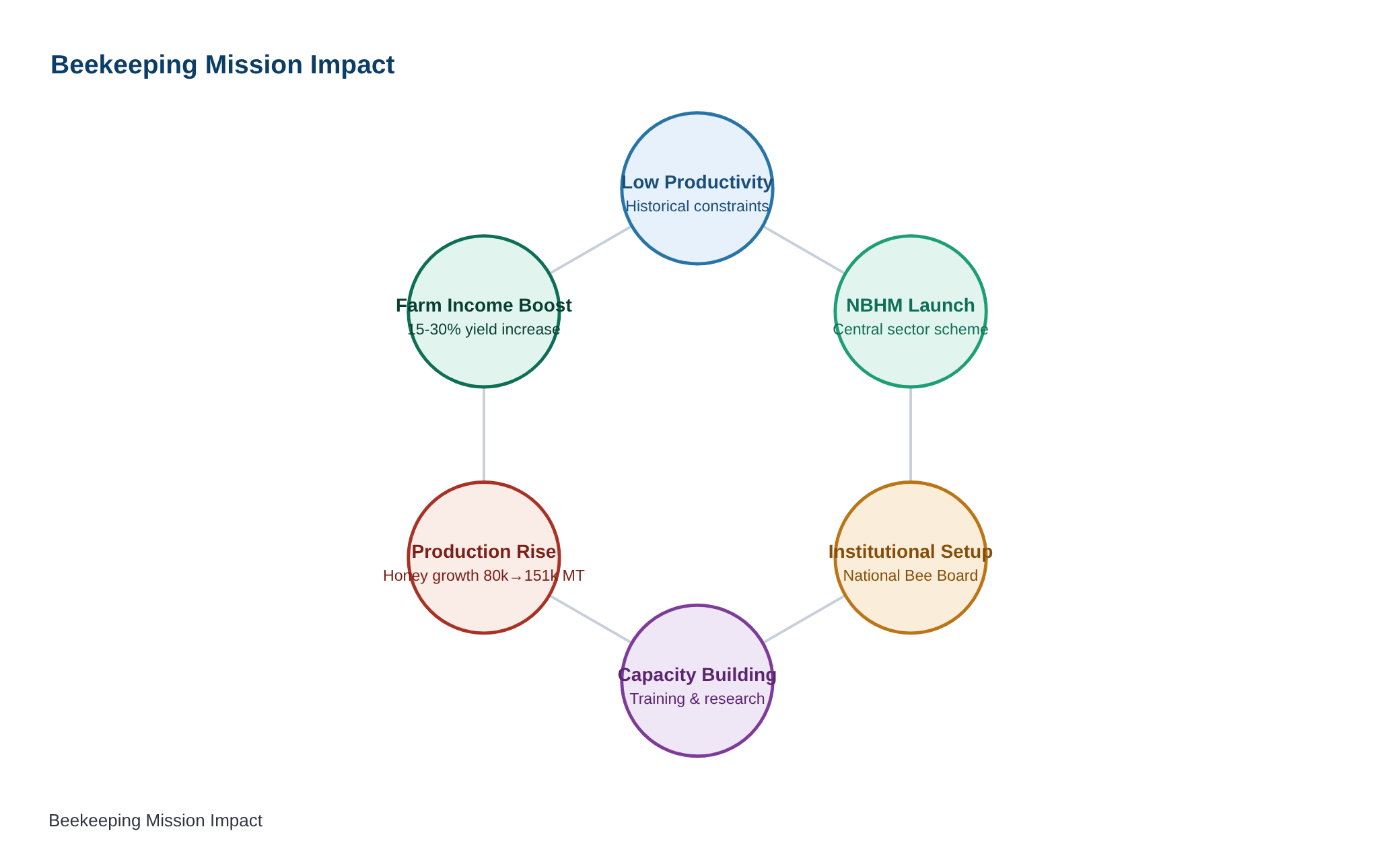
The National Beekeeping and Honey Mission (NBHM), implemented by the Department of Agriculture and Farmers’ Welfare through the National Bee Board, has achieved significant milestones in enhancing honey production, establishing quality testing infrastructure, and promoting scientific beekeeping practices. The scheme’s progress, as highlighted in a recent Parliamentary reply, underscores its role in augmenting agricultural productivity, creating rural livelihood opportunities, and empowering women through structured institutional frameworks. The data on honey production growth—from 80,530 metric tonnes in 2014-15 to 1,51,690 metric tonnes in 2025-26—reflects the tangible impact of NBHM’s interventions.
Background
- Beekeeping is a critical agro-based activity that supports pollination, thereby enhancing crop yields and biodiversity conservation.
- India’s honey production has historically been constrained by low productivity, lack of quality infrastructure, and limited adoption of scientific beekeeping practices.
- The National Beekeeping and Honey Mission (NBHM) was launched as a central sector scheme under the aegis of the National Bee Board to address these challenges.
- The mission aligns with the broader objectives of the Atmanirbhar Bharat Abhiyan and the goal of doubling farmers’ income by 2022-23.
- Pollination by honeybees is estimated to contribute to 30-35% of global food production, making beekeeping a vital link in agricultural value chains.
- The scheme integrates components of research, capacity building, market development, and infrastructure creation to create a holistic ecosystem for beekeeping.
What is the National Beekeeping and Honey Mission (NBHM)?
- A central sector scheme implemented by the Department of Agriculture and Farmers’ Welfare through the National Bee Board.
- Aims to promote scientific beekeeping, increase honey and bee-product production, and generate employment and livelihood opportunities for rural and agricultural households.
- Focuses on institutional strengthening by developing a network of Integrated Beekeeping Development Centres, quality testing laboratories, and Nucleus Stock Development Centres.
- Supports capacity building, technology demonstrations, and research & development to enhance productivity and quality standards in beekeeping.
- Encourages women’s empowerment by integrating gender-sensitive approaches in training, entrepreneurship, and institutional participation.
- Promotes market development through branding, value addition, and establishment of honey processing and packaging units.
- Operates on a project-based funding model, with financial assistance extended to eligible implementing agencies (IAs) via central/state nodal agencies.
- Aligns with global best practices in beekeeping, including the adoption of standards for honey testing, processing, and export promotion.
Key Features
| Feature of NBHM | Significance for UPSC Aspirants |
|---|---|
| Central Sector Scheme under the Department of Agriculture, Cooperation and Farmers Welfare | Demonstrates India’s commitment to diversifying agricultural income sources and promoting allied sector development. |
| Implementation through National Bee Board (NBB) | Highlights the institutional mechanism for policy execution and stakeholder coordination in agricultural schemes. |
| Establishment of Integrated Beekeeping Development Centres | Serves as hubs for training, research, and technology dissemination in beekeeping practices. |
| Setting up of Honey Testing Laboratories and Mini-Labs | Ensures quality control, prevents adulteration, and aligns with global standards for honey exports. |
| Development of Nucleus Stock Centres for Quality Queen Bees | Enhances genetic quality of bee colonies, improving productivity and disease resistance. |
| Capacity Building and Technology Demonstration | Focuses on skill development among farmers, particularly women, to adopt scientific beekeeping. |
| Market Linkages, Branding, and Value Addition | Strengthens the commercial viability of beekeeping by improving market access and premium pricing. |
Why it Matters
Economic Significance
- Augments farm income through diversification into high-value beekeeping, reducing dependency on staple crops.
- Contributes to the growth of the honey and allied products industry, estimated at ₹1,500 crore annually.
- Enhances export potential of Indian honey, meeting global demand for organic and natural products.
- Creates employment opportunities in rural areas, particularly for women and marginalised communities.
Agricultural Productivity
- Supports pollination services, directly enhancing yields of horticultural and oilseed crops by 15-30%.
- Promotes sustainable agriculture by reducing chemical inputs through natural pollination.
- Integrates with the Pradhan Mantri Kisan Samman Nidhi (PM-KISAN) and other subsidy schemes for allied sectors.
Environmental and Ecological
- Supports biodiversity conservation by maintaining healthy bee populations, critical for ecosystem stability.
- Reduces pressure on monoculture farming by diversifying agricultural practices.
Social Empowerment
- Empowers women through skill development and entrepreneurship in beekeeping, aligning with SDG 5.
- Provides livelihood support to tribal and forest-dependent communities.
Challenges
1. Quality Control and Adulteration
- Prevalence of adulterated honey in domestic and international markets undermines consumer trust.
- Need for stricter enforcement of FSSAI standards and traceability systems.
UPSC Link: FSSAI standards and food safety
2. Low Adoption of Scientific Beekeeping
- Traditional beekeeping practices limit productivity and honey quality.
- Lack of awareness among farmers about modern techniques and equipment.
UPSC Link: Agricultural extension services
3. Climate Change and Bee Health
- Changing weather patterns affect floral availability and bee colony health.
- Increased incidence of pests and diseases like Varroa mite.
UPSC Link: Climate change and agriculture
4. Market Access and Price Realisation
- Fragmented supply chains lead to low bargaining power for small beekeepers.
- Limited access to premium markets due to lack of branding and certification.
UPSC Link: Agricultural marketing reforms
5. Infrastructure Gaps
- Inadequate cold storage and processing facilities in rural areas.
- Limited number of honey testing laboratories despite recent expansions.
UPSC Link: Agricultural infrastructure
6. Policy Coordination and Stakeholder Engagement
- Need for better coordination between central and state agencies for effective implementation.
- Involvement of private sector and cooperatives for scaling up initiatives.
UPSC Link: Multi-level governance
Challenges — UPSC Perspective
| Challenge | Concern |
|---|---|
| Adulteration in Honey | Undermines consumer trust and export potential; requires stricter enforcement of quality standards. |
| Low Productivity | Traditional practices limit honey yields; adoption of scientific methods is low. |
| Climate Vulnerability | Changing weather patterns disrupt floral cycles and bee health. |
| Market Fragmentation | Small beekeepers face low price realisation due to fragmented supply chains. |
| Infrastructure Deficit | Inadequate storage and processing facilities hinder value addition and exports. |
| Policy Implementation Gaps | Coordination between central and state agencies needs strengthening for effective execution. |
Government Initiatives — Must-Memorise for Prelims
- National Bee Board (NBB) Schemes
- Mission for Integrated Development of Horticulture (MIDH) – Beekeeping Sub-Mission
- Agri-Infrastructure Fund (AIF) for setting up honey processing units
- Pradhan Mantri Formalisation of Micro Food Processing Enterprises (PMFME) Scheme
Way Forward
- Strengthen enforcement of FSSAI standards and establish a national honey traceability system to combat adulteration.
- Expand the network of honey testing laboratories and mini-labs in rural areas for decentralised quality control.
- Promote public-private partnerships to set up integrated beekeeping development centres and processing units.
- Launch targeted awareness campaigns to educate farmers on scientific beekeeping techniques and equipment.
- Integrate beekeeping with existing agricultural schemes like PM-KISAN and MIDH for synergistic benefits.
- Develop climate-resilient beekeeping practices to mitigate the impact of changing weather patterns.
- Facilitate market linkages for small beekeepers through cooperatives and e-commerce platforms.
- Encourage research and development in bee genetics and disease management to improve colony health.
UPSC Value Addition
Keywords for Mains Answer-Writing
National Beekeeping and Honey Mission (NBHM) · Scientific beekeeping · Honey production · Livelihood generation · Agricultural productivity · Women empowerment · Quality control in honey · Integrated Beekeeping Development Centres · Honey testing laboratories · Nucleus stock development · Mission-mode interventions · Agriculture diversification · Value addition in agriculture · Sustainable livelihoods · Agri-clinic and Agri-business Centres
Concept Flow
Decline in agricultural income → Diversification into allied sectors like beekeeping → Launch of NBHM as a central sector scheme → Establishment of institutional framework (NBB) → Capacity building and infrastructure development → Increase in honey production and pollination services → Enhancement of farm productivity and rural livelihoods → Strengthening of export potential and market linkages → Sustainable agricultural practices and biodiversity conservation
Prelims Practice Questions
Q1. Consider the following statements regarding the National Beekeeping and Honey Mission (NBHM):
1. It is implemented by the National Bee Board under the Ministry of Agriculture and Farmers’ Welfare.
2. The mission aims to enhance honey production and promote scientific beekeeping.
3. The mission includes the establishment of honey testing laboratories and processing units.
4. The mission does not address the empowerment of women through beekeeping.
How many of the above statements are correct?
- Only one
- Only two
- Only three
- All four
Answer: Only three — Statements 1, 2, and 3 are correct as per the NBHM objectives and implementation framework. Statement 4 is incorrect because the mission explicitly includes women empowerment through beekeeping.
Q2. Assertion (A): The National Beekeeping and Honey Mission (NBHM) focuses on increasing honey production through scientific beekeeping practices.
Reason (R): The mission provides financial assistance for establishing honey testing laboratories and processing units to ensure quality and market access.
Options:
A. Both A and R are true, and R is the correct explanation of A.
B. Both A and R are true, but R is not the correct explanation of A.
C. A is true, but R is false.
D. A is false, but R is true.
Answer: ? — Both Assertion (A) and Reason (R) are true, and R correctly explains A as the mission’s interventions directly support the goal of increasing honey production through quality control and processing infrastructure.
Q3. Match the following initiatives under the National Beekeeping and Honey Mission (NBHM) with their respective objectives:
Column I (Initiative) | Column II (Objective)
———————|———————-
1. Integrated Beekeeping Development Centres | A. Capacity building and technology demonstration
2. Honey testing laboratories | B. Quality assurance and adulteration control
3. Nucleus stock development centres | C. Production of high-quality queen bees and colony expansion
4. Capacity building programmes | D. Strengthening institutional framework for beekeepers
Options:
A. 1-D, 2-B, 3-C, 4-A
B. 1-A, 2-B, 3-C, 4-D
C. 1-D, 2-C, 3-B, 4-A
D. 1-B, 2-A, 3-D, 4-C
Answer: ? — 1 matches with D (Integrated Beekeeping Development Centres aim to strengthen institutional framework), 2 matches with B (Honey testing laboratories ensure quality assurance), 3 matches with C (Nucleus stock development centres produce high-quality queen bees), and 4 matches with A (Capacity building programmes focus on training and technology demonstration).
Mains Practice Question
✍ Critically examine the role of the National Beekeeping and Honey Mission (NBHM) in promoting scientific beekeeping, enhancing honey production, and improving agricultural productivity in India. Also, discuss the challenges in its implementation and suggest measures to overcome them. (15 Marks)
Approach: MODEL-ANSWER SKELETON:
1. **Introduction (2 Marks)**:
– Define the National Beekeeping and Honey Mission (NBHM) and its objectives as a central sector scheme under the Ministry of Agriculture and Farmers’ Welfare.
– Highlight its alignment with the goals of doubling farmers’ income and promoting sustainable livelihoods.
2. **Role in Promoting Scientific Beekeeping (4 Marks)**:
– Establishment of Integrated Beekeeping Development Centres for training and institutional support.
– Setting up of honey testing laboratories (7 world-class, 66 mini) and processing units (83) for quality control and value addition.
– Development of Nucleus Stock Centres (81) for producing high-quality queen bees and expanding bee colonies.
– Capacity building through technology demonstration and skill development programmes.
– Promotion of women empowerment by integrating them into beekeeping value chains.
3. **Enhancing Honey Production and Agricultural Productivity (4 Marks)**:
– Data on honey production growth from 80,530 metric tonnes (2014-15) to 1,51,690 metric tonnes (2025-26) as evidence of success.
– Role of beekeeping in cross-pollination, thereby increasing yields of horticultural and agricultural crops.
– Integration with schemes like PM-KISAN and Agri-clinics to diversify income sources for farmers.
– Contribution to the National Mission for Sustainable Agriculture (NMSA) and doubling farmers’ income goals.
4. **Challenges in Implementation (3 Marks)**:
– Limited awareness and adoption of scientific beekeeping practices among small and marginal farmers.
– Fragmented supply chains and lack of market linkages for honey and bee products.
– Climate change impacts on bee populations and floral diversity.
– Regulatory and quality control challenges in preventing honey adulteration.
5. **Measures to Overcome Challenges (2 Marks)**:
– Strengthening extension services through Krishi Vigyan Kendras (KVKs) and Agri-entrepreneurs.
– Promoting Farmer Producer Organisations (FPOs) for collective marketing and value addition.
– Integrating climate-resilient beekeeping practices and research on new floral sources.
– Enhancing public-private partnerships for technology adoption and market access.
6. **Conclusion (1 Mark)**:
– Summarise the significance of NBHM in achieving sustainable agricultural growth and rural livelihoods.
– Emphasise the need for continued policy support and multi-stakeholder collaboration.
Source: PIB (Press Information Bureau)
Generated by AanyaAi for educational purpose.

- Congress Whips MPs for FCRA Bill: Key Polity Issue for UPSC Mains - August 7, 2026
- तमिलनाडु विधानसभा में शराब बिक्री पर पर्यावरण एवं कल्याण उपकर विधेयक पेश - August 7, 2026
- Tamil Nadu’s New Cess on Liquor Sales: UPSC Exam Perspective - August 7, 2026

No Comments