


07 Aug Tamil Nadu’s New Cess on Liquor Sales: UPSC Exam Perspective
✎ The Environmental and Social Welfare Cess on liquor sales in Tamil Nadu is a fiscal policy tool aimed at addressing environmental pollution and alcohol-related social harms through earmarked revenue for sustainable development…
Subject Relevance — Where This Topic Fits
- GS Paper II — Functions and Responsibilities of the Union and the States, Issues and Challenges Pertaining to the Federal Structure | GS Paper III — Environment and Pollution Control, Social Sector/Social Services
- Prelims: Environmental Cess, Value Added Tax (VAT), TASMAC, De-addiction programmes, Extended Producer Responsibility (EPR), Public Health, Revenue Neutral Rate (RNR)
- Essay: The Role of Fiscal Policy in Addressing Societal Challenges, Balancing Economic Growth with Environmental Sustainability
Quick Revision: The Environmental and Social Welfare Cess on liquor sales in Tamil Nadu is a fiscal policy tool aimed at addressing environmental pollution and alcohol-related social harms through earmarked revenue for sustainable development and public health interventions.
Why is this in the news?
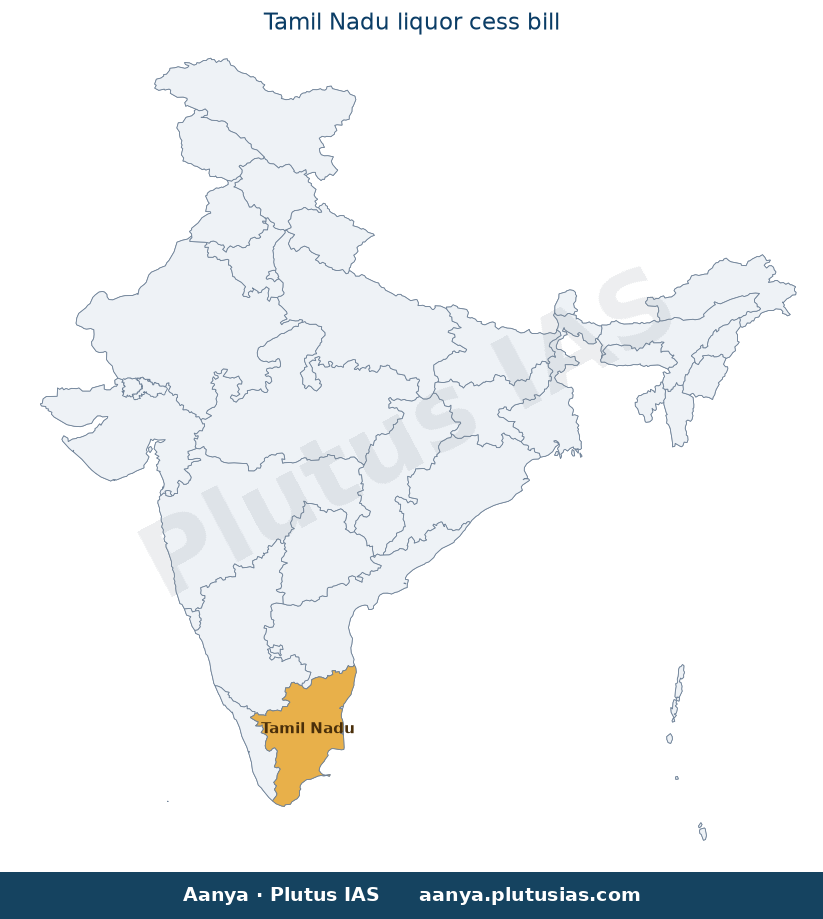
The Tamil Nadu government has introduced a legislative amendment to the Tamil Nadu Value Added Tax Act, 2006, proposing an Environmental and Social Welfare Cess on the sale of alcoholic liquor. This initiative, announced on August 7, 2026, aims to address the dual challenges of ecological degradation caused by improper disposal of liquor containers and the social burden of alcohol addiction. The policy represents a convergence of environmental governance and public health intervention, reflecting a growing trend among Indian states to utilise fiscal instruments for non-revenue objectives.
Background
- The consumption of alcoholic beverages in India has risen significantly over the past two decades, with Tamil Nadu being one of the states with high per capita alcohol consumption, facilitated by the state-run Tamil Nadu State Marketing Corporation (TASMAC).
- The disposal of liquor bottles—primarily made of glass and plastic—poses a substantial environmental challenge due to their non-biodegradable nature and the lack of structured recycling mechanisms in many regions.
- Unregulated waste from liquor bottles contributes to land and water pollution, posing risks to terrestrial and aquatic ecosystems, as well as public health through contamination of soil and groundwater.
- Alcohol addiction imposes a significant socio-economic burden, including healthcare costs, loss of productivity, and intergenerational transmission of poverty, necessitating state intervention in rehabilitation and prevention.
- Several Indian states have previously experimented with cess mechanisms for environmental and social welfare, such as the Kerala Flood Cess (2019) and the Delhi Environment Compensation Charge (ECC) on diesel vehicles, indicating a broader policy trend.
- The proposed cess aligns with the principles of Extended Producer Responsibility (EPR), which mandates producers and consumers to manage the end-of-life disposal of products, as outlined in the Solid Waste Management Rules, 2016.
What is the Environmental and Social Welfare Cess on Liquor Sales?
- The cess is a tax levied as a percentage of the sale price of alcoholic liquor, proposed to be collected under the Tamil Nadu Value Added Tax (TN VAT) Act, 2006, through an amendment introduced in the state assembly.
- The primary objective is to generate revenue for mitigating environmental damage caused by liquor bottle waste and funding social welfare programmes targeting alcohol addiction and its socio-economic impacts.
- The cess will finance programmes such as recycling and safe disposal of liquor bottles, rehabilitation and de-addiction services for individuals with alcohol use disorders, and public awareness campaigns on the harms of alcohol consumption.
- Additional allocations will support livelihood assistance for families affected by alcohol addiction, forest and wildlife conservation initiatives, and broader ecological restoration projects.
- The policy leverages fiscal federalism by utilising state-level taxation powers to address a cross-cutting issue (environmental degradation and public health) that transcends traditional revenue-generation objectives.
- The cess is distinct from excise duties, which are levied primarily for revenue purposes, as it is earmarked for specific environmental and social welfare outcomes.
- The proposal reflects a shift towards ‘polluter pays’ and ‘user pays’ principles, where the cost of environmental damage and social harm is internalised by the primary beneficiaries of the product (consumers).
- The implementation will require coordination between the Commercial Taxes Department, local bodies, and health departments to ensure effective utilisation of funds and monitoring of outcomes.
Key Features
| Feature | Significance |
|---|---|
| Environmental and Social Welfare Cess | A levy on liquor sales to fund ecological restoration and social welfare initiatives, aligning fiscal policy with public health and environmental goals. |
| Revenue earmarking | Proceeds are specifically directed toward recycling, safe disposal of liquor containers, de-addiction programs, and ecological protection, ensuring transparency in utilisation. |
| De-addiction and rehabilitation programs | Targeted funding for individuals and families affected by alcohol addiction, addressing a critical public health challenge. |
| Public awareness campaigns | Educational initiatives to inform citizens about the dual harms of alcohol consumption and improper liquor container disposal. |
| Forest and wildlife restoration | Allocation of funds for the protection and restoration of ecosystems, mitigating ecological degradation linked to alcohol-related waste. |
Why it Matters
Economic
- Introduces a novel revenue stream for Tamil Nadu, diversifying sources beyond traditional tax bases.
- Demonstrates the use of fiscal instruments to internalise externalities (environmental and social costs of alcohol consumption).
- Potential to reduce long-term healthcare and environmental remediation costs by addressing root causes.
Social
- Directly targets alcohol addiction, a significant public health issue with intergenerational impacts.
- Supports marginalised families affected by alcoholism, aligning with welfare objectives.
- Promotes behavioural change through awareness campaigns, fostering a culture of responsibility.
Environmental
- Addresses the ecological burden of improper disposal of liquor containers, particularly glass and plastic waste.
- Contributes to circular economy principles by funding recycling and reuse initiatives.
- Mitigates pollution of land, water bodies, and wildlife habitats linked to alcohol-related waste.
Governance
- Showcases state-level innovation in policy design, leveraging fiscal tools for multi-dimensional welfare.
- Enhances accountability by earmarking revenue for specific, measurable outcomes.
- Sets a precedent for other states to adopt similar measures, fostering policy diffusion.
Challenges
1. Implementation and Compliance
- Risk of tax evasion or underreporting of liquor sales to avoid the cess.
- Need for robust monitoring mechanisms to ensure accurate collection and utilisation of funds.
- Potential resistance from liquor industry stakeholders, including retailers and manufacturers.
UPSC Link: GS3: Taxation and Fiscal Policy
2. Equity and Regressivity
- The cess may disproportionately affect lower-income consumers, raising questions about its distributional impact.
- Balancing revenue generation with social equity requires careful policy design and exemptions.
UPSC Link: GS2: Social Justice and Welfare
3. Effectiveness of Utilisation
- Ensuring funds are utilised efficiently and transparently for intended purposes.
- Risk of diversion or mismanagement of funds without strong institutional oversight.
- Need for periodic audits and third-party evaluations to measure impact.
UPSC Link: GS4: Ethics in Governance
4. Public Acceptance and Behavioural Change
- Overcoming societal stigma and resistance to taxation on liquor, which may be perceived as punitive.
- Ensuring public awareness campaigns are credible and reach target audiences effectively.
UPSC Link: GS1: Social Empowerment
5. Inter-State Coordination
- Risk of tax arbitrage if neighbouring states do not adopt similar measures, leading to cross-border liquor sales.
- Need for harmonisation of cess rates and policies to prevent market distortions.
UPSC Link: GS3: Economic Integration
Challenges — UPSC Perspective
| Issue | Concern |
|---|---|
| Tax Evasion | Potential underreporting of liquor sales to avoid the cess, undermining revenue collection. |
| Industry Resistance | Opposition from liquor retailers, manufacturers, or distributors due to increased costs or regulatory burden. |
| Distributional Impact | Regressive nature of the cess may disproportionately burden lower-income consumers. |
| Fund Utilisation | Risk of mismanagement or diversion of funds without stringent oversight mechanisms. |
| Public Perception | Possible backlash from consumers or advocacy groups viewing the cess as punitive rather than welfare-oriented. |
| Cross-Border Sales | Potential for consumers to purchase liquor from neighbouring states to avoid the cess. |
Way Forward
- Conduct a pilot phase to test the cess implementation, monitor compliance, and refine collection mechanisms.
- Establish a dedicated fund management authority with transparent reporting and auditing protocols.
- Launch targeted public awareness campaigns in collaboration with NGOs and local bodies to ensure behavioural change.
- Introduce tax incentives or exemptions for small-scale liquor retailers to mitigate industry resistance.
- Develop inter-state coordination mechanisms to harmonise cess rates and prevent tax arbitrage.
- Integrate the cess with existing social welfare and environmental programs for synergy and efficiency.
- Conduct periodic impact assessments to evaluate the effectiveness of funded programs and adjust policies accordingly.
- Engage with civil society organisations to ensure community participation and accountability in fund utilisation.
UPSC Value Addition
Keywords for Mains Answer-Writing
Environmental and Social Welfare Cess · Tamil Nadu Value Added Tax Act, 2006 · Liquor taxation policy · Environmental degradation from liquor waste · Alcohol addiction rehabilitation · Public health governance · Fiscal federalism in India · State-level environmental levies · Social welfare initiatives · Sustainable waste management
Concept Flow
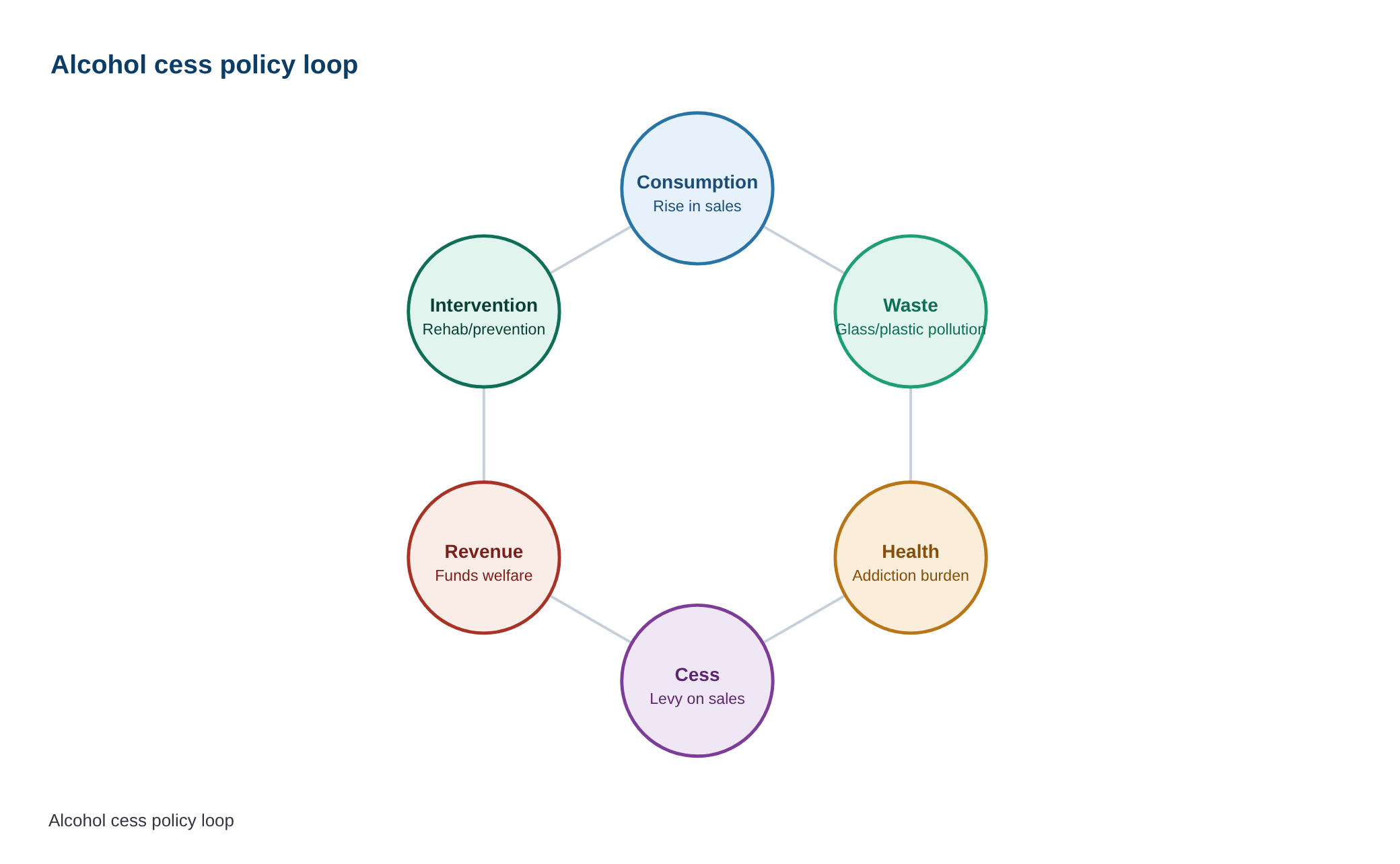
Alcohol consumption → Environmental degradation (littering, improper disposal of liquor containers) → Public health burden (addiction, family welfare impacts) → Tamil Nadu government introduces cess on liquor sales → Revenue generation for ecological restoration and social welfare programs → Implementation challenges (compliance, equity, utilisation) → Long-term outcomes (reduced pollution, improved public health, sustainable livelihoods)
Prelims Practice Questions
Q1. Consider the following statements regarding the Environmental and Social Welfare Cess proposed in Tamil Nadu:
1. The cess is levied under the Tamil Nadu Value Added Tax Act, 2006.
2. The primary objective is to fund alcohol de-addiction programmes and rehabilitation.
3. The revenue will exclusively be used for forest conservation and wildlife protection.
4. The cess aims to address ecological degradation caused by improper disposal of liquor containers.
How many of the above statements are correct?
- Only one
- Only two
- Only three
- All four
Answer: Only three — Statements 1, 2, and 4 are correct. Statement 3 is incorrect as the revenue will also support public awareness campaigns, livelihood assistance, and other social welfare measures beyond forest conservation.
Q2. Assertion (A): The Environmental and Social Welfare Cess is a fiscal measure aimed at mitigating the social and environmental harms of alcohol consumption.
Reason (R): The cess funds rehabilitation programmes for individuals affected by alcohol addiction and supports sustainable waste management practices.
Options:
A. Both A and R are true, and R is the correct explanation of A.
B. Both A and R are true, but R is NOT the correct explanation of A.
C. A is true, but R is false.
D. A is false, but R is true.
- A
- B
- C
- D
Answer: A — Both the assertion and reason are true, and the reason correctly explains the assertion. The cess is designed to address social harms (e.g., addiction) and environmental harms (e.g., waste disposal) through targeted funding.
Q3. Which of the following is NOT a stated objective of the Environmental and Social Welfare Cess proposed in Tamil Nadu?
- Funding rehabilitation and de-addiction programmes for alcohol addiction
- Supporting public awareness campaigns on the harmful effects of alcohol
- Promoting the sale and distribution of alcoholic beverages
- Financing the safe disposal and recycling of liquor containers
Answer: Promoting the sale and distribution of alcoholic beverages — The cess is designed to discourage alcohol consumption and mitigate its harms, not promote its sale and distribution.
Mains Practice Question
✍ The Tamil Nadu government has introduced a Bill to levy an Environmental and Social Welfare Cess on the sale of alcoholic liquor, citing social and environmental consequences. Critically examine the constitutional and fiscal dimensions of such state-level levies in India. Also, analyse their potential impact on public health governance and environmental sustainability. (15 Marks)
Approach: MODEL-ANSWER SKELETON:
1. **Constitutional Basis**:
– Entry 54 (State List, Seventh Schedule): Taxes on the sale of goods, including alcoholic beverages.
– Article 246(3): State legislature’s exclusive power to legislate on matters in the State List.
– Article 265: No tax shall be levied except by authority of law.
– **Case Reference**: *State of Madras v. Gannon Dunkerley & Co.* (1958) on the scope of ‘sale of goods’ under Entry 54.
2. **Fiscal Federalism**:
– **Cooperative Federalism**: State autonomy in fiscal matters vs. Centre’s role in harmonising taxation (e.g., GST Council).
– **Earmarking of Cess**: Distinguish between general tax revenue and cess (e.g., GST compensation cess).
– **Revenue Utilisation**: Legal constraints on the use of cess proceeds (e.g., *Kerala Infrastructure Investment Fund Board v. Union of India*, 2021 on non-diversion of cess funds).
3. **Public Health Governance**:
– **WHO Framework**: Alcohol taxation as a ‘best buy’ for reducing alcohol-related harm (Global Strategy to Reduce the Harmful Use of Alcohol, 2010).
– **State Initiatives**: Examples of state-level alcohol taxation policies (e.g., Kerala’s ‘Abkari Policy’ reforms).
– **Critique**: Potential regressive impact on lower-income groups and effectiveness in reducing consumption.
4. **Environmental Sustainability**:
– **Polluter Pays Principle**: Justification for levying cess on liquor sales to internalise environmental costs.
– **Waste Management**: Link to Solid Waste Management Rules, 2016 and Extended Producer Responsibility (EPR) frameworks.
– **Challenges**: Implementation gaps in recycling infrastructure and enforcement.
5. **Balanced View**:
– **Merits**: Targeted funding for social welfare, environmental restoration, and public awareness.
– **Demerits**: Risk of over-taxation, black market proliferation, and administrative burden.
– **Way Forward**: Need for inter-state coordination, data-driven policy design, and periodic review of cess utilisation.
Source: The Hindu
Generated by AanyaAi for educational purpose.

- आंध्र प्रदेश सरकार ने बुजुर्ग पेंशनरों को वापस दी अतिरिक्त पेंशन राशि: मुख्यमंत्री चंद्रबाबू नायडू का फैसला - September 22, 2026
- Andhra Pradesh Restores Additional Pension for Elderly Pensioners: Key Details for UPSC - September 22, 2026
- उत्तर तमिलनाडु में विस्तारित स्कूल ब्रेकफास्ट योजना का शुभारंभ, जानें लाभ - September 22, 2026

No Comments