


07 Aug Congress Whips MPs for FCRA Bill: Key Polity Issue for UPSC Mains
✎ The Foreign Contribution (Regulation) Act, 2010, regulates foreign funding to NGOs in India, and its Amendment Bill seeks to further restrict administrative expenses, expand prohibited activities, and enhance government…
Subject Relevance — Where This Topic Fits
- GS Paper II — Polity and Governance (Fundamental Rights, DPSP, Role of Parliament) | GS Paper III — Economy (Regulation of NGOs, Foreign Funding, Economic Impact of CSR)
- Prelims: Foreign Contribution (Regulation) Act, 2010, FCRA Amendment Bill, 2026, Parliamentary Whip System, Delimitation Commission, Article 19(1)(c) of the Constitution, Money Bill vs Financial Bill, Article 368 (Constitutional Amendment)
- Essay: The delicate balance between national security and civil liberties in regulating foreign contributions, The role of Parliament in democratic oversight versus executive discretion in financial legislation
Quick Revision: The Foreign Contribution (Regulation) Act, 2010, regulates foreign funding to NGOs in India, and its Amendment Bill seeks to further restrict administrative expenses, expand prohibited activities, and enhance government discretion, raising concerns about civil liberties and regulatory overreach.
Why is this in the news?
The Congress party has issued a three-day whip to its MPs in both Houses of Parliament, directing their presence for the discussion on the FCRA Amendment Bill, scheduled for August 10–12, 2026. This legislative move, amid broader parliamentary proceedings during the Monsoon Session, has triggered political mobilization and raises critical questions about the Bill’s implications for non-governmental organisations (NGOs), civil society, and India’s regulatory framework governing foreign contributions.
Background
- The Foreign Contribution (Regulation) Act (FCRA), 2010, governs the acceptance and utilisation of foreign contributions by individuals, associations, and companies in India, with the stated objective of ensuring transparency and preventing foreign interference in domestic affairs.
- The FCRA has been amended multiple times since 2010, including in 2020, which introduced stricter provisions such as mandatory opening of FCRA accounts in the State Bank of India (SBI), Delhi, and reduced administrative expenses to 20% of the total foreign contribution.
- The Bill’s introduction coincides with broader parliamentary discussions on constitutional amendments, including a potential delimitation exercise, which has historically been a contentious issue due to its demographic and political implications.
- The Congress party’s whip reflects its intent to scrutinise the Bill, likely on grounds of potential overreach, curtailment of civil society space, or violation of constitutional rights such as Article 19(1)(c) (freedom to form associations).
- The timing of the Bill’s introduction during the Monsoon Session, a period traditionally marked by legislative activity, suggests an attempt by the executive to push through significant regulatory changes with limited parliamentary debate.
What is the FCRA Amendment Bill?
- Key provisions under consideration (based on prior amendments and public discourse) may include: (i) further reduction in the permissible administrative expenditure from foreign contributions; (ii) expansion of the list of prohibited activities under foreign contribution; (iii) enhanced powers for the government to suspend or cancel FCRA registrations; and (iv) stricter reporting and audit requirements for NGOs receiving foreign funds.
- The Bill is expected to align with the government’s broader policy objectives of ensuring transparency, preventing money laundering, and safeguarding national security, though critics argue it may disproportionately target legitimate civil society organisations.
- The FCRA operates under the aegis of the Ministry of Home Affairs (MHA), which has historically justified amendments on grounds of preventing misuse of foreign funds for activities detrimental to India’s sovereignty and public order.
- The Bill’s passage would require approval in both Houses of Parliament, with potential implications for the functioning of NGOs, think tanks, and grassroots organisations that rely on foreign funding for developmental and advocacy work.
- Constitutional challenges may arise under Article 19(1)(c) (freedom to form associations) and Article 21 (right to livelihood), particularly if the Bill is perceived as imposing unreasonable restrictions on civil society.
- The Bill’s introduction during the Monsoon Session underscores its legislative urgency, with political parties likely to debate its merits and demerits in the context of broader governance and democratic principles.
Key Features
| Feature | Significance |
|---|---|
| Issue of a parliamentary whip by the Congress party | Ensures party discipline and collective voting alignment in Parliament, particularly on contentious legislative items. |
| Timing of the whip (August 10–12, 2026) | Aligns with the Monsoon Session of Parliament, indicating high-priority legislative business, likely including the FCRA Amendment Bill. |
| Coordination with INDIA bloc allies | Highlights intra-opposition unity on legislative strategy, potentially influencing the outcome of the Bill’s discussion. |
| Government’s tentative legislative agenda | Includes the FCRA Amendment Bill, which has implications for foreign funding regulations and civil society operations. |
| Absence of explicit mention in government business list | Raises questions about the Bill’s prioritisation or potential procedural delays in its introduction. |
Why it Matters
Political
- The issuance of a whip underscores the opposition’s intent to present a united front against the FCRA Amendment Bill, potentially framing it as a matter of ideological or policy opposition.
- The Congress party’s directive to allies reflects efforts to consolidate opposition votes, particularly within the INDIA bloc, to challenge the government’s legislative agenda.
- The timing of the whip coincides with a critical phase of the Monsoon Session, where legislative outcomes can influence public perception ahead of state elections or national polls.
- The Bill’s discussion may become a flashpoint for debates on governance, transparency, and the role of civil society in policy-making.
Legislative
- The FCRA Amendment Bill, if passed, could alter the regulatory framework governing foreign contributions to non-governmental organisations (NGOs) and other entities, impacting their operational autonomy.
- The Bill’s consideration reflects ongoing tensions between regulatory oversight and the need for civil society participation in democratic processes.
- The absence of explicit mention in the government’s business list may indicate procedural ambiguity or strategic delay, potentially affecting the Bill’s passage.
- The Bill’s reintroduction or discussion could trigger procedural debates, including the need for select committees or joint sittings, depending on its content.
Constitutional and Legal
- The FCRA operates under the Foreign Contribution (Regulation) Act, 2010, which aims to regulate foreign funding to ensure national security and sovereignty, but its provisions often intersect with fundamental rights under Articles 19(1)(c) and 19(1)(g).
- Any amendment to the FCRA must balance regulatory objectives with constitutional guarantees of freedom of association and expression, as interpreted by judicial precedents.
- The Bill’s discussion may revisit judicial interpretations, such as those in *Common Cause v. Union of India* (2014), which upheld the FCRA’s validity but emphasised proportionality in restrictions.
Societal and Governance
- The FCRA Amendment Bill could impact the operational freedom of NGOs, particularly those engaged in advocacy, human rights, or environmental work, by imposing stricter compliance requirements.
- The Bill’s discussion may reignite debates on the role of civil society in governance, with stakeholders arguing for either greater transparency or reduced regulatory burden.
- The timing of the Bill’s consideration during the Monsoon Session suggests a strategic move by the government to address perceived gaps in foreign funding regulations, particularly in light of geopolitical sensitivities.
Challenges
1. Regulatory Overreach vs. Operational Autonomy
- The FCRA Amendment Bill risks imposing disproportionate restrictions on NGOs, potentially stifling legitimate advocacy and developmental work.
- Balancing national security concerns with the need for civil society participation in democratic processes remains a persistent challenge.
- The Bill’s provisions may face judicial scrutiny if perceived as violating constitutional rights to freedom of association or expression.
UPSC Link: GS-II: Role of NGOs in governance; Fundamental Rights (Articles 19, 21)
2. Parliamentary Procedural Challenges
- The absence of explicit mention in the government’s business list may lead to procedural delays or confusion, affecting the Bill’s timely passage.
- Opposition unity, as signalled by the whip, could result in prolonged debates or filibustering, delaying legislative outcomes.
- The Bill’s consideration may require extensive scrutiny by parliamentary committees, further extending the legislative process.
UPSC Link: GS-II: Parliamentary procedures; Role of Whips
3. Political Polarisation and Legislative Gridlock
- The opposition’s united stance on the Bill could exacerbate political polarisation, making consensus on other legislative items difficult.
- The Bill’s discussion may become a symbolic issue, with both sides using it to rally their respective bases ahead of elections.
- Procedural manoeuvres by either side could undermine the legislative process, eroding public trust in Parliament’s functioning.
UPSC Link: GS-II: Parliamentary ethics; Role of Opposition
4. Constitutional Validity and Judicial Review
- Any amendment to the FCRA must withstand judicial scrutiny, particularly in light of past rulings that have struck down provisions deemed excessive.
- The Bill’s provisions may be challenged on grounds of violating Articles 14 (equality) or 21 (right to livelihood), depending on their content.
- The judiciary’s role in interpreting the Bill’s provisions could set precedents for future regulatory frameworks governing civil society.
UPSC Link: GS-II: Judicial review; Fundamental Rights
5. Impact on Civil Society and Democratic Participation
- Stricter FCRA provisions could deter foreign funding for NGOs, particularly those working in contentious areas like human rights or environmental activism.
- The Bill may disproportionately affect smaller NGOs with limited resources, reducing their ability to participate in policy debates.
- A chilling effect on civil society could undermine participatory democracy, limiting avenues for public engagement in governance.
UPSC Link: GS-II: Role of Civil Society; Democratic Participation
Challenges — UPSC Perspective
| Issue | Concern |
|---|---|
| Regulatory Overreach | Risk of disproportionate restrictions on NGOs, stifling advocacy and developmental work. |
| Parliamentary Procedural Delays | Absence of explicit mention in government business list may lead to confusion or delays in Bill passage. |
| Political Polarisation | Opposition unity on the Bill could exacerbate tensions, hindering consensus on other legislative items. |
| Constitutional Validity | Amendment may face judicial scrutiny, risking provisions being struck down as unconstitutional. |
| Impact on Civil Society | Stricter FCRA provisions could reduce operational freedom and participation of NGOs in governance. |
Way Forward
- Parliamentary scrutiny of the FCRA Amendment Bill must ensure that any amendments to the FCRA are proportionate and do not infringe upon constitutional rights.
- The government should engage in pre-legislative consultations with stakeholders, including NGOs, civil society groups, and legal experts, to address concerns about operational autonomy.
- Parliamentary committees, such as the Standing Committee on Home Affairs, should conduct detailed examinations of the Bill to identify potential overreach or ambiguities.
- Opposition parties should prioritise constructive debate over procedural obstruction, ensuring that legislative outcomes reflect broader public interest.
- Judicial review mechanisms should be strengthened to allow for timely challenges to any provisions deemed unconstitutional.
- Civil society organisations should proactively document the impact of the FCRA on their operations, providing evidence-based inputs to policymakers.
- Public awareness campaigns should be launched to educate stakeholders about the implications of the FCRA Amendment Bill, fostering informed discourse.
UPSC Value Addition
Keywords for Mains Answer-Writing
Foreign Contribution Regulation Act (FCRA) Amendment Bill 2026 · Parliamentary Whip · Monsoon Session of Parliament · INDIA bloc · Constitution Amendment Bill on Delimitation · Parliamentary Procedures · Role of Chief Whip · Government Legislation Process · Opposition Strategy in Parliament · Legislative Business
Constitutional & Policy Linkages
- [‘Article 19(1)(c) – Freedom of Association’, ‘Guarantees the right to form associations, including NGOs.’]
- [‘Article 19(1)(g) – Right to Practice Profession’, ‘Protects the right to engage in lawful professions, including advocacy and developmental work.’]
- [‘Article 21 – Right to Livelihood’, ‘May be invoked if FCRA restrictions disproportionately affect livelihoods of NGO workers.’]
- [‘Article 14 – Equality Before Law’, ‘Ensures that FCRA provisions are applied uniformly and without arbitrariness.’]
Concept Flow
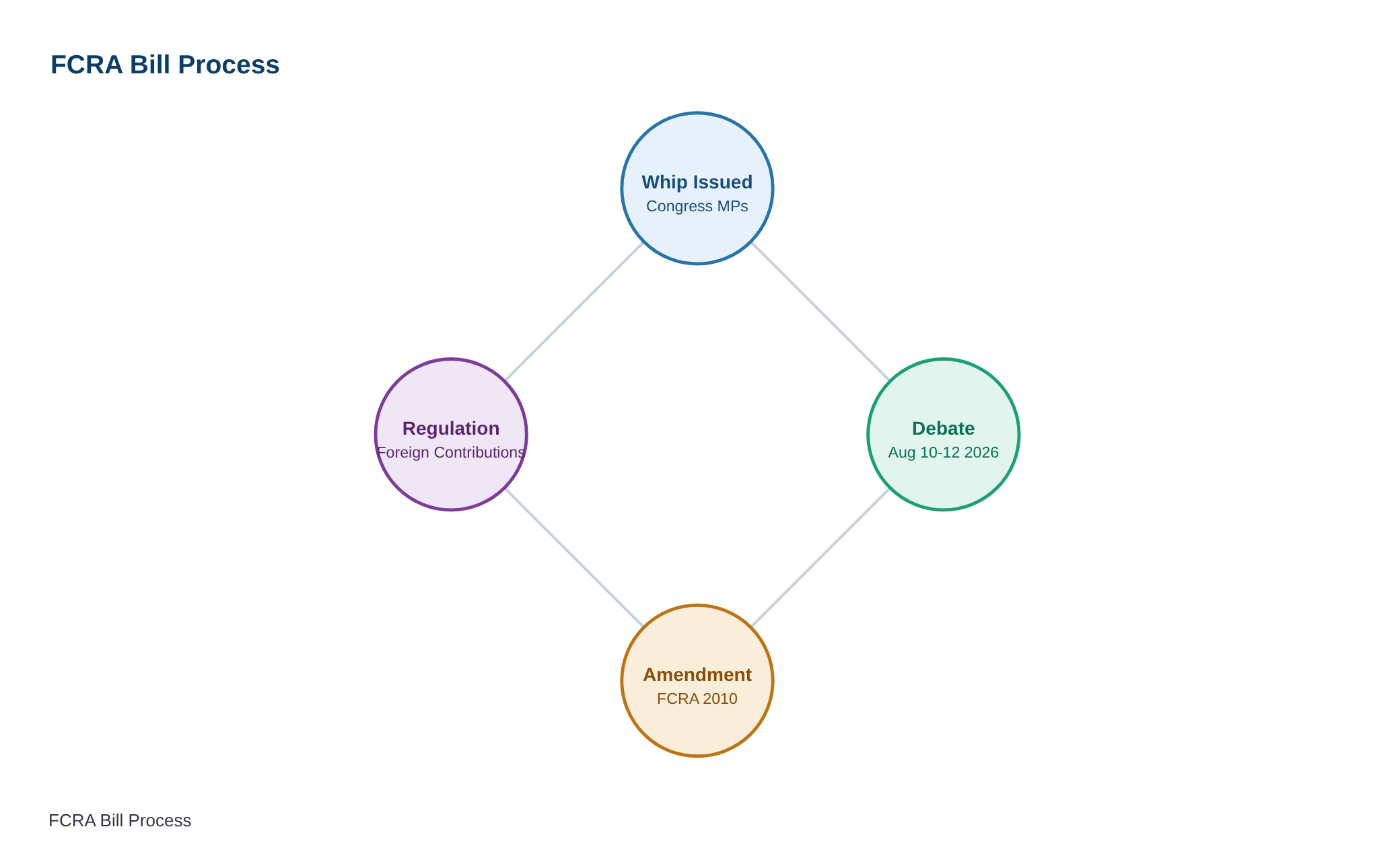
Introduction of FCRA Amendment Bill in Parliament → → Congress issues whip to MPs to ensure party discipline and opposition unity → → Government’s tentative legislative agenda includes the Bill, but its explicit mention is absent → → Debate and discussion in Parliament, with potential procedural delays or filibustering → → Judicial scrutiny of the Bill’s provisions, particularly regarding constitutional validity → → Implementation of the Bill, with potential impact on civil society operations and democratic participation → → Public discourse and civil society responses shape future amendments or judicial interpretations.
Prelims Practice Questions
Q1. Consider the following statements regarding the Foreign Contribution Regulation Act (FCRA), 2010:
1. The Act regulates the acceptance and utilisation of foreign contributions by individuals, associations, and companies.
2. The Act mandates registration with the Ministry of Home Affairs for receiving foreign contributions.
3. The Act prohibits foreign contributions to political parties.
4. The Act allows the central government to suspend the registration of an organisation receiving foreign contributions.
How many of the above statements are correct?
- Only one
- Only two
- Only three
- All four
Answer: All four — Statements 1, 2, and 4 are correct as per the FCRA, 2010. Statement 3 is incorrect because the Act does not explicitly prohibit foreign contributions to political parties; however, the Election Commission of India has imposed restrictions on such contributions.
Q2. Assertion (A): The issuance of a whip by a political party in Parliament is a directive to its members to vote in a particular manner on a bill.
Reason (R): Whips are issued under the provisions of the Constitution of India, specifically Article 102(2), which empowers the Speaker to regulate the conduct of members.
In the context of the above two statements, which one of the following is correct?
- Both A and R are true, and R is the correct explanation of A.
- Both A and R are true, but R is not the correct explanation of A.
- A is true, but R is false.
- A is false, but R is true.
Answer: A is true, but R is false. — Assertion (A) is true: a whip directs members to vote in a specific manner. Reason (R) is true but incorrect as a whip is issued under the party’s internal rules, not Article 102(2), which pertains to disqualification of members.
Q3. Match the following parliamentary terms with their correct descriptions:
Column I
A. Adjournment Motion
B. No-Confidence Motion
C. Calling Attention Notice
D. Short Duration Discussion
Column II
1. A motion to draw the attention of the House to a matter of urgent public importance.
2. A motion to discuss a matter of public importance for a short duration without voting.
3. A motion to test the confidence of the House in the Council of Ministers.
4. A motion to propose the next sitting of the House be adjourned to a future date.
Select the correct match:
- A-4, B-3, C-1, D-2
- A-2, B-1, C-3, D-4
- A-1, B-2, C-4, D-3
- A-3, B-4, C-2, D-1
Answer: A-4, B-3, C-1, D-2 — Correct matches: A-4 (Adjournment Motion), B-3 (No-Confidence Motion), C-1 (Calling Attention Notice), D-2 (Short Duration Discussion).
Mains Practice Question
✍ The issuance of a whip by a political party to its members during legislative discussions reflects the tension between party discipline and individual conscience. Critically analyse the constitutional and parliamentary implications of this practice, with reference to the recent issuance of a whip by the Congress party ahead of the discussion on the FCRA Amendment Bill during the Monsoon Session of Parliament. (15 Marks)
Approach: MODEL-ANSWER SKELETON:
1. **Introduction (2 marks):** Define the concept of a whip in parliamentary democracy, its constitutional basis (Article 102(2) and Rules of Procedure and Conduct of Business in Parliament), and its role in maintaining party discipline.
2. **Constitutional and Legal Framework (3 marks):**
– Article 102(2): Disqualification of members for defying party whip.
– Rules of Procedure and Conduct of Business in Parliament (Rule 373): Speaker’s power to direct members to vote as per party whip.
– Doctrine of Collective Responsibility: Link to parliamentary governance.
3. **Parliamentary Implications (4 marks):**
– Ensures stability and predictability in legislative outcomes.
– Potential erosion of individual conscience and deliberative democracy.
– Impact on opposition strategy and legislative scrutiny (e.g., FCRA Amendment Bill).
– Role of the Speaker in enforcing or relaxing whip compliance.
4. **Recent Context: FCRA Amendment Bill and Congress Whip (3 marks):**
– Nature of the FCRA Amendment Bill: Key provisions (e.g., restrictions on foreign funding, Aadhaar linkage).
– Congress’s stance and whip issuance to ensure party cohesion.
– Broader implications for civil society organisations and democratic pluralism.
5. **Critique and Balanced View (3 marks):**
– Arguments for party discipline: Ensures coherent governance and accountability.
– Arguments against: Suppression of dissent, undermining of democratic debate.
– Comparative perspective: Whip systems in other parliamentary democracies (e.g., UK, Canada).
6. **Conclusion (2 marks):** Summarise the need for a balanced approach that respects both party discipline and individual conscience, with a forward-looking note on reforming whip practices to enhance democratic deliberation.
Source: Times of India
Generated by AanyaAi for educational purpose.

- Congress Whips MPs for FCRA Bill: Key Polity Issue for UPSC Mains - August 7, 2026
- तमिलनाडु विधानसभा में शराब बिक्री पर पर्यावरण एवं कल्याण उपकर विधेयक पेश - August 7, 2026
- Tamil Nadu’s New Cess on Liquor Sales: UPSC Exam Perspective - August 7, 2026

No Comments