


07 Aug DMK’s Key Conditions for Supporting Delimitation Bill in Lok Sabha
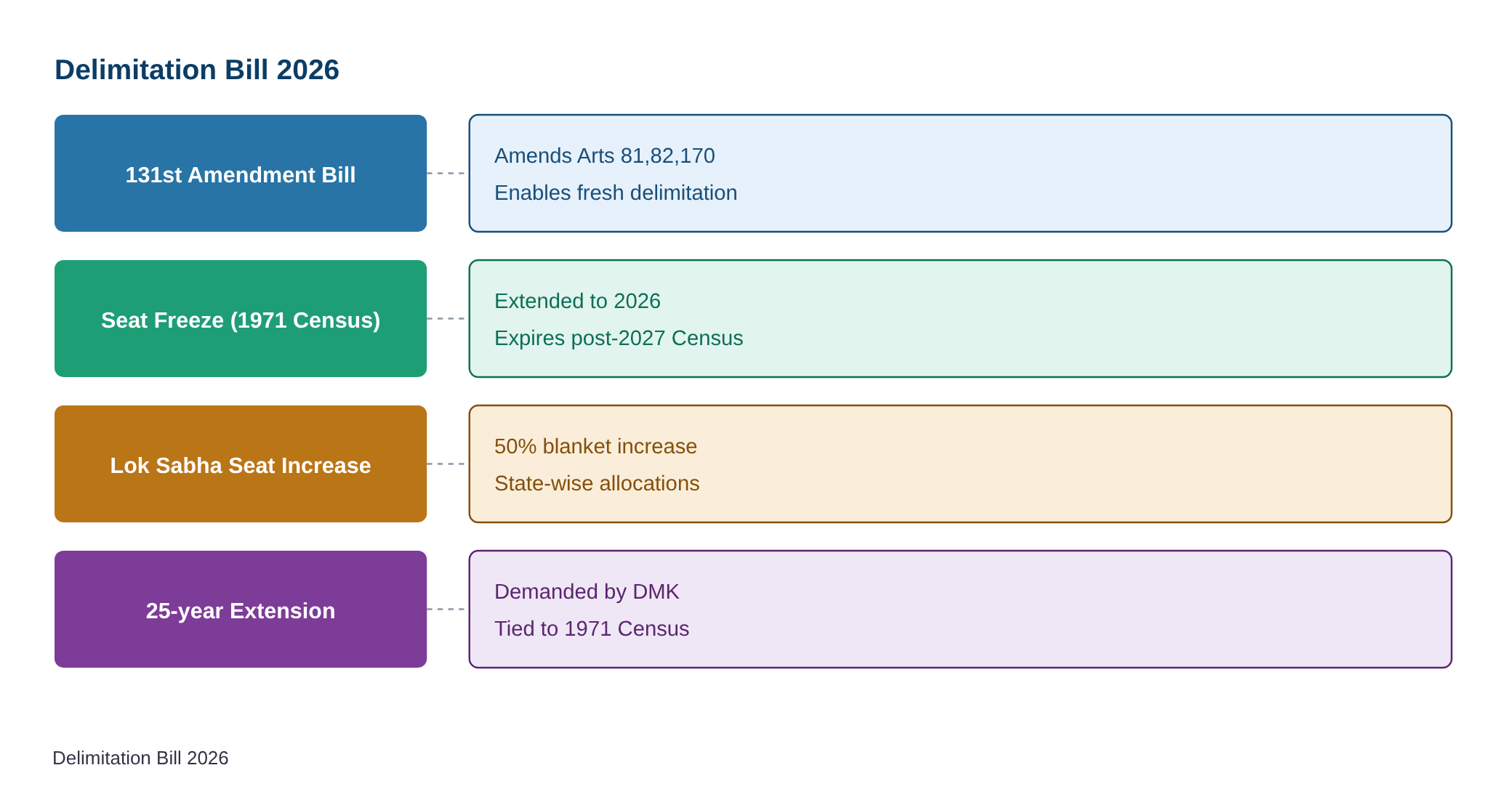
✎ The Constitution (131st Amendment) Bill, 2026, proposes delimitation with a 50% increase in Lok Sabha seats and a 25-year extension of the 1971 Census-based seat freeze, but its passage hinges on Opposition support and…
Subject Relevance — Where This Topic Fits
- GS Paper II — Parliament and State Legislatures — Structure, Functioning, Conduct of Business, Powers & Privileges and Issues Arising out of these | GS Paper II — Federalism: Issues and Challenges | GS Paper III — Constitutional and Non-Constitutional Bodies
- Prelims: Delimitation Commission, Constitution (131st Amendment) Bill, 1971 Census freeze on seat allocation, Lok Sabha seat increase, Two-thirds majority in Parliament, INDIA bloc, Parliamentary Affairs Minister, Rajya Sabha vs Lok Sabha majority thresholds
- Essay: Federalism and Centre-State Relations in India: Balancing Equity and Representation, The Imperative of Electoral Reforms: Delimitation, Population Dynamics, and Democratic Governance
Quick Revision: The Constitution (131st Amendment) Bill, 2026, proposes delimitation with a 50% increase in Lok Sabha seats and a 25-year extension of the 1971 Census-based seat freeze, but its passage hinges on Opposition support and constitutional ratification.
Why is this in the news?
The Dravida Munnetra Kazhagam (DMK) has publicly articulated conditional support for the Constitution (131st Amendment) Bill, 2026, which proposes a fresh delimitation exercise in India. The party’s stance introduces critical political and constitutional considerations, including demands for a 25-year extension of the 1971 Census-based seat freeze, a 50% blanket increase in Lok Sabha seats, and a published schedule of state-wise seat allocations. These conditions emerge as the Union government intensifies efforts to secure Opposition backing amid evolving parliamentary arithmetic, particularly following the INDIA bloc’s strengthened numerical position.
Background
- The Constitution of India originally envisaged delimitation of parliamentary and assembly constituencies based on the first Census conducted in 1951, with subsequent exercises conducted periodically to reflect demographic changes.
- The 42nd Constitutional Amendment Act, 1976, froze the allocation of Lok Sabha and State Assembly seats based on the 1971 Census until after the 2001 Census. This freeze was later extended to the 2026 Census through the 84th Amendment Act, 2001.
- The 87th Amendment Act, 2003, further extended the freeze until the first Census after 2026, effectively postponing delimitation until at least 2031.
- The current freeze is set to expire after the Census of 2027, necessitating a constitutional amendment to either extend it or proceed with delimitation based on updated demographic data.
- The Constitution (131st Amendment) Bill, 2026, seeks to amend Articles 81, 82, and 170 of the Constitution to enable a fresh delimitation exercise, including a potential increase in the total number of Lok Sabha seats.
- Political parties have historically debated delimitation due to its implications for electoral representation, with southern states advocating for safeguards against perceived loss of political weight in Parliament.
What is Delimitation and the Constitution (131st Amendment) Bill, 2026?
- Delimitation is the process of redrawing the boundaries of parliamentary and assembly constituencies to reflect changes in population distribution, as mandated by the Constitution.
- The Constitution (131st Amendment) Bill, 2026, proposes to amend Articles 81 (composition of the Lok Sabha), 82 (readjustment after each Census), and 170 (composition of State Legislative Assemblies) to enable a fresh delimitation exercise.
- The Bill seeks to introduce a 50% blanket increase in the total number of Lok Sabha seats, which, if implemented, would raise the current strength from 543 to approximately 815 seats, pending state-wise allocation.
- The DMK’s primary condition is the extension of the 1971 Census-based seat freeze for another 25 years, ensuring that the current allocation of seats among states remains unchanged until at least 2051.
- The party also demands a schedule specifying the number of seats allocated to each state in the delimitation exercise, addressing concerns over potential reductions in southern states’ representation.
- The Bill’s passage requires a two-thirds majority in both Houses of Parliament and ratification by at least half of the state legislatures, as per Article 368 of the Constitution.
- The Union government’s outreach to Opposition parties, including the Congress and DMK, reflects the Bill’s uncertain passage given the numerical strength of the INDIA bloc in the current Lok Sabha.
- The Rajya Sabha’s role is critical, as a two-thirds majority there is easier to achieve due to the absence of direct elections and the presence of nominated members, which often align with the government’s stance.
Key Features
| Feature | Significance |
|---|---|
| DMK’s conditional support to Delimitation Bill | Signals strategic bargaining by a key regional party in the Opposition, potentially altering the Bill’s trajectory in Parliament. |
| Freeze on seat allocation based on 1971 Census | Ensures stability in representation but may delay necessary adjustments in light of demographic changes. |
| Proposal for 50% blanket increase in Lok Sabha seats | Aims to accommodate population growth and regional aspirations, though its feasibility remains debated. |
| DMK’s demand for a published State-wise seat schedule | Seeks transparency and predictability in the delimitation process, reducing uncertainty for stakeholders. |
| Government’s outreach to Opposition parties | Indicates a pragmatic shift in legislative strategy to secure necessary numbers for constitutional amendments. |
Why it Matters
Political Significance
- The DMK’s conditional support introduces a critical variable in the government’s efforts to pass the Delimitation Bill, which requires a two-thirds majority in Parliament.
- A potential DMK support of 22 seats could bring the government closer to the required 360-seat threshold, though abstentions may further complicate the process.
- The INDIA bloc’s evolving numerical strength post-April 17 defeat of the Bill underscores the fluidity of Opposition unity and the government’s need for cross-party consensus.
- The DMK’s stance reflects regional aspirations, particularly in South India, where demographic shifts may not align with current seat allocations.
Constitutional and Legal Significance
- The Delimitation Bill involves a constitutional amendment, necessitating a two-thirds majority in both Houses of Parliament, as per Article 368 of the Constitution.
- The freeze on seat allocation based on the 1971 Census is rooted in the 42nd Amendment Act, 1976, which extended the freeze until the first census after 2000.
- Any amendment to the freeze period or seat allocation requires a constitutional amendment, highlighting the Bill’s legal complexity.
- The demand for a 50% blanket increase in Lok Sabha seats raises questions about the balance between population growth and equitable representation.
Administrative Significance
- The delimitation process is a critical administrative function, ensuring fair and equitable representation in the Lok Sabha based on the latest census data.
- A delayed or amended delimitation could impact electoral rolls, constituency boundaries, and the conduct of future elections, necessitating meticulous planning.
- The government’s outreach to Opposition parties suggests an attempt to align administrative reforms with political realities, reducing the risk of legislative gridlock.
Challenges
1. Political Fragmentation and Opposition Unity
- The government lacks the requisite two-thirds majority to pass the Delimitation Bill unilaterally, making Opposition support indispensable.
- The INDIA bloc’s shifting numerical strength complicates the government’s calculations, as abstentions or defections could alter the outcome.
- Regional parties like the DMK may prioritize state-specific interests over national consensus, creating hurdles in the legislative process.
- The Congress’s opposition to any constitutional amendment for delimitation further narrows the government’s options for securing numbers.
UPSC Link: GS-II: Parliament and State Legislatures
2. Constitutional and Legal Hurdles
- A constitutional amendment requires a two-thirds majority in both Houses, which the government currently lacks, necessitating Opposition cooperation.
- The freeze on seat allocation based on the 1971 Census is constitutionally entrenched, requiring a formal amendment to extend or modify it.
- The demand for a 50% blanket increase in Lok Sabha seats raises legal questions about the method of seat allocation and its fairness across states.
- Any amendment must comply with the basic structure doctrine, as established by the Supreme Court, to avoid judicial scrutiny.
UPSC Link: GS-II: Constitutional Amendments
3. Demographic and Representational Challenges
- Population growth and migration patterns may not align with existing seat allocations, necessitating a data-driven and equitable delimitation process.
- A blanket 50% increase in seats could disproportionately benefit certain states, raising concerns about representational equity and federal balance.
- The delay in conducting the 2021 Census (expected to be completed in 2027) complicates the delimitation timeline, as the freeze on seat allocation is tied to the census data.
UPSC Link: GS-II: Federalism and State Representation
4. Administrative and Logistical Challenges
- Conducting a delimitation exercise requires extensive data collection, boundary delineation, and consultation with stakeholders, which is time-consuming and resource-intensive.
- The government’s outreach to Opposition parties, while pragmatic, may not guarantee consensus, leading to prolonged negotiations and potential legislative delays.
- The delimitation process must balance the need for timely reforms with the imperative of ensuring fairness and transparency in seat allocation.
UPSC Link: GS-II: Constitutional and Non-Constitutional Bodies
Challenges — UPSC Perspective
| Issue | Concern |
|---|---|
| Lack of two-thirds majority | Government requires Opposition support to pass the constitutional amendment, which is currently unavailable. |
| Regional party bargaining | DMK’s conditional support introduces uncertainty, as the party may prioritize state-specific interests over national consensus. |
| Constitutional freeze on seat allocation | The 1971 Census-based freeze is constitutionally entrenched, requiring a formal amendment to extend or modify it. |
| Demographic imbalances | Population growth and migration patterns may not align with existing seat allocations, necessitating a data-driven delimitation process. |
| Congress opposition to constitutional amendment | The Congress’s stance against any constitutional amendment for delimitation narrows the government’s options for securing numbers. |
| Delayed Census data | The 2021 Census (expected to be completed in 2027) complicates the delimitation timeline, as the freeze is tied to census data. |
Way Forward
- The government must intensify bipartisan consultations with the DMK and other Opposition parties to address their concerns and secure conditional support for the Bill.
- A detailed, State-wise seat allocation schedule should be prepared and shared with stakeholders to enhance transparency and reduce uncertainty.
- The government should consider phasing the delimitation process to align with the completion of the 2021 Census, ensuring data accuracy and fairness.
- Parliamentary Affairs Minister should continue engaging with the Congress and other Opposition leaders to explore common ground on the delimitation process.
- A constitutional amendment to extend the freeze on seat allocation should be drafted with clear timelines and safeguards to prevent arbitrary delays.
- The government must ensure that any blanket increase in Lok Sabha seats is based on a transparent and equitable formula, addressing concerns of representational equity.
- Stakeholders, including regional parties and civil society, should be consulted to build consensus on the delimitation process, reducing the risk of judicial challenges.
- The government should prepare contingency plans in case the Delimitation Bill fails to secure the required majority, including alternative legislative strategies.
UPSC Value Addition
Keywords for Mains Answer-Writing
Delimitation Commission · Constitution (131st Amendment) Bill 2026 · Lok Sabha seat allocation · Freeze on delimitation based on 1971 Census · DMK political conditions for support · 50% blanket increase in Lok Sabha seats · Parliamentary form of government · Constitutional amendment process · Federalism and Centre-State relations · Opposition unity and INDIA bloc
Constitutional & Policy Linkages
- {‘Article 81’: ‘Determination of total seats in the Lok Sabha.’}
- {‘Article 82’: ‘Readjustment of seats after each Census.’}
- {‘Article 368’: ‘Procedure for constitutional amendments.’}
- {’42nd Amendment Act, 1976′: ‘Extended freeze on seat allocation based on 1971 Census.’}
Concept Flow
Government introduces Delimitation Bill in Parliament (April 2026) → Requires two-thirds majority under Article 368 → Opposition, including DMK, raises concerns → DMK demands freeze extension and 50% seat increase → Government lacks requisite numbers → Government intensifies Opposition outreach → DMK conditions support on revised Bill → Political negotiations commence → Final Bill debated and voted upon in Parliament → Constitutional amendment passed or rejected based on consensus.
Prelims Practice Questions
Q1. Consider the following statements regarding the delimitation process in India:
1. The current freeze on Lok Sabha seat allocation is based on the 1971 Census.
2. The DMK has demanded a further 25-year freeze on delimitation.
3. The Constitution (131st Amendment) Bill 2026 seeks to introduce a 50% blanket increase in Lok Sabha seats.
4. The delimitation process is conducted by the Election Commission of India.
How many of the above statements are correct?
- Only one
- Only two
- Only three
- All
Answer: Only three — Statements 1, 2, and 3 are correct. Statement 4 is incorrect as delimitation is conducted by the Delimitation Commission, not the Election Commission of India.
Q2. Assertion (A): The DMK has demanded a Schedule of the number of seats each State will have in the delimitation Bill.
Reason (R): The DMK seeks to ensure transparency and prevent arbitrary seat allocation.
In the context of the above statements, which of the following is correct?
- Both A and R are true, and R is the correct explanation of A
- Both A and R are true, but R is not the correct explanation of A
- A is true, but R is false
- A is false, but R is true
Answer: Both A and R are true, but R is not the correct explanation of A — Both A and R are true, and R correctly explains A. The DMK’s demand for a Schedule aligns with its objective of transparency in seat allocation.
Q3. Which of the following is NOT a condition laid down by the DMK for supporting the delimitation Bill?
- Freeze on delimitation based on the 1971 Census for another 25 years
- Introduction of a 50% blanket increase in Lok Sabha seats for all States
- Publication of a Schedule specifying the number of seats for each State
- Abolition of the Delimitation Commission
Answer: Abolition of the Delimitation Commission — The DMK has demanded a Schedule of seats for each State, not its abolition. The other options are explicitly mentioned in the report.
Mains Practice Question
✍ Critically examine the constitutional and political implications of the DMK’s conditions for supporting the Constitution (131st Amendment) Bill 2026 aimed at delimitation. Also, assess the challenges this poses to the federal structure and the parliamentary form of government in India. (15 Marks)
Approach: MODEL-ANSWER SKELETON:
1. **Constitutional Implications**:
– Article 82 of the Constitution empowers Parliament to readjust seat allocation after each Census.
– The freeze on delimitation since 1976 (based on 1971 Census) is a constitutional convention, not a statutory provision.
– The DMK’s demand for a 25-year extension challenges the periodic review mechanism envisaged under the Constitution.
– The 50% blanket increase in seats requires a constitutional amendment, which must be ratified by at least half the State legislatures (Art. 368).
2. **Political Implications**:
– The DMK’s conditions reflect regional parties’ concerns over seat allocation, particularly in southern States.
– The demand for a Schedule of seats aims to institutionalize transparency but risks politicizing the delimitation process.
– The opposition from the INDIA bloc (including Congress) highlights the challenge of securing a two-thirds majority in Parliament.
3. **Federalism and Centre-State Relations**:
– Delimitation is a concurrent subject, but the Centre’s unilateral approach risks undermining cooperative federalism.
– The DMK’s stance underscores the need for consensus-building in federal governance.
4. **Parliamentary Form of Government**:
– The delimitation process, if mishandled, could distort the principle of proportional representation in Parliament.
– The parliamentary form of government relies on a balance between executive dominance and legislative accountability; arbitrary seat changes may disrupt this balance.
5. **Challenges**:
– Lack of consensus among political parties may lead to legislative gridlock.
– The Delimitation Commission’s independence could be compromised if the process becomes politicized.
6. **Conclusion**:
– The DMK’s conditions highlight the tension between constitutional provisions and political exigencies.
– A collaborative approach involving all stakeholders is essential to uphold federalism and the parliamentary system.
Source: The Hindu
Generated by AanyaAi for educational purpose.

- विशेष अभियान 6: जल संसाधन विभाग की उपलब्धियाँ, गंगा पुनरुद्धार सहित - October 23, 2026
- Shivraj Singh Chouhan launches ‘Khet Bachao Abhiyan’ to save farmland - October 23, 2026
- उत्तराखंड राज्यपाल की पीएम मोदी से महत्वपूर्ण बैठक: जानिए मुख्य बिंदु - October 23, 2026

No Comments