


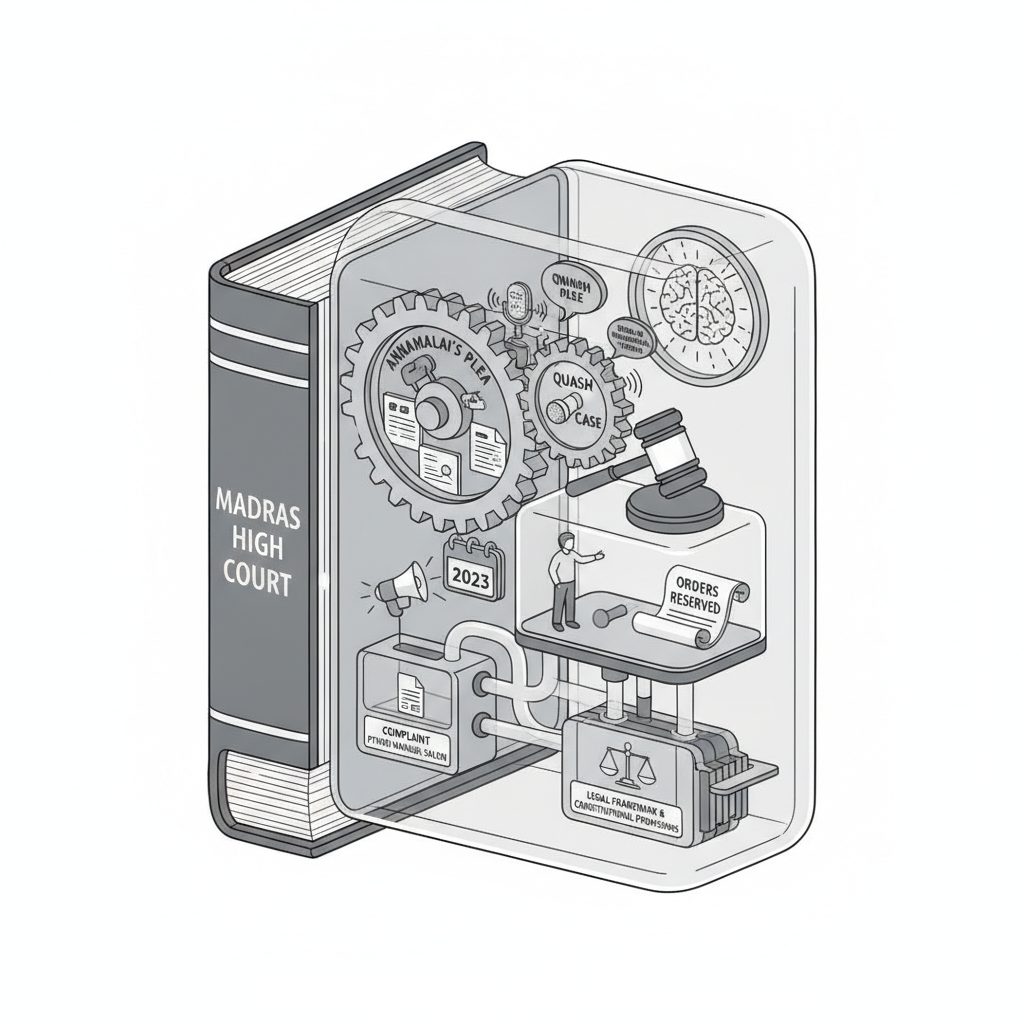
31 Aug Madras HC reserves verdict on Annamalai’s plea to quash case over 1956 remarks
✎ The legality of speech under Article 19(1)(a) is subject to reasonable restrictions under Article 19(2), particularly when such speech threatens public order or promotes enmity between groups, as governed by Sections 153A and…
Subject Relevance — Where This Topic Fits
- GS Paper II — Polity and Governance: Fundamental Rights, Freedom of Speech and Expression, and Public Order | GS Paper II — Polity and Governance: Role of Judiciary in Safeguarding Constitutional Values
- Prelims: Freedom of Speech and Expression (Article 19(1)(a)), Reasonable Restrictions (Article 19(2)), Section 196 of the Code of Criminal Procedure (CrPC), Cognisance of Offences by Magistrates, Communal Harmony and Public Order, Sanction for Prosecution
- Essay: Balancing Freedom of Expression with Public Order: A Constitutional Imperative, Historical Narratives, Speech, and the Limits of Democratic Discourse
Quick Revision: The legality of speech under Article 19(1)(a) is subject to reasonable restrictions under Article 19(2), particularly when such speech threatens public order or promotes enmity between groups, as governed by Sections 153A and 295A IPC and Section 196 CrPC.
Why is this in the news?
The Madras High Court has reserved orders on a plea filed by K. Annamalai to quash a criminal case registered against him for allegedly making provocative remarks during a 2023 press conference. The remarks referenced a 1956 event involving Pasumpon Muthuramalinga Thevar and C.N. Annadurai, raising questions about the intersection of historical speech, freedom of expression, and the legal framework governing provocative statements that may incite communal disharmony. The case underscores the judiciary’s role in adjudicating the boundaries of permissible speech under constitutional and statutory provisions.
Background
- The case stems from a private complaint filed in November 2023 by activist Piyush Manush before a judicial magistrate court in Salem, Tamil Nadu, alleging that K. Annamalai’s remarks during a 2023 press meet were provocative and intended to incite communal disharmony.
- The State Government of Tamil Nadu granted sanction under Section 196 of the Code of Criminal Procedure (CrPC) on April 28, 2024, for the prosecution of Annamalai under various sections of the Indian Penal Code (IPC), including those related to promoting enmity between groups (Section 153A) and insulting religious beliefs (Section 295A).
- The Magistrate took cognisance of the offences in February 2026 and issued summons, prompting Annamalai to file a plea before the Madras High Court seeking quashment of the case.
- The plea argues that Annamalai’s remarks were a response to a political statement by a DMK leader and did not constitute an attempt to create communal divide, as no identifiable communities were targeted.
- The complainant’s counsel contends that the remarks were provocative and intended to incite communal disharmony, relying on judicial precedents to support the Magistrate’s decision to take cognisance.
- The case highlights the procedural safeguards under Section 196 CrPC, which mandates prior sanction from the government before prosecuting offences under Sections 153A and 295A IPC.
Legal and Constitutional Framework Governing Speech and Communal Harmony
- **Freedom of Speech and Expression (Article 19(1)(a))**: The Constitution of India guarantees freedom of speech and expression as a fundamental right, subject to reasonable restrictions imposed by law in the interests of sovereignty and integrity of India, security of the State, friendly relations with foreign States, public order, decency, or morality, or in relation to contempt of court, defamation, or incitement to an offence.
- The **reasonable restrictions** under Article 19(2) are critical in determining the legality of speech that may incite communal disharmony. Courts have consistently held that speech which threatens public order or promotes enmity between groups falls outside the protective ambit of Article 19(1)(a).
- **Section 196 of the Code of Criminal Procedure (CrPC)**: This provision mandates prior sanction from the government or competent authority before taking cognisance of offences under Sections 153A (promoting enmity between groups) and 295A (deliberate and malicious acts intended to outrage religious feelings) of the IPC. This safeguard is designed to prevent frivolous or politically motivated prosecutions.
- **Cognisance of Offences by Magistrates**: Magistrates are empowered to take cognisance of offences based on the complaint or police report, but must ensure that the allegations prima facie disclose the commission of an offence. The Magistrate’s decision to take cognisance is subject to judicial review.
- **Promoting Enmity Between Groups (Section 153A IPC)**: This offence criminalises acts that promote or attempt to promote disharmony or feelings of enmity, hatred, or ill-will between different religious, racial, language, or regional groups or castes or communities. The offence requires a clear intent to disrupt communal harmony.
- **Outraging Religious Feelings (Section 295A IPC)**: This provision punishes deliberate and malicious acts intended to outrage the religious feelings of any class by insulting its religion or religious beliefs. The offence is cognisable only with prior sanction under Section 196 CrPC.
- **Judicial Precedents on Provocative Speech**: Courts have consistently ruled that speech which is likely to incite violence or public disorder cannot be protected under Article 19(1)(a). The test for determining the legality of speech involves assessing the intent, the likely impact on public order, and the presence of a clear and proximate danger.
- **Historical Narratives and Speech**: The case raises questions about the use of historical events in contemporary political discourse. While historical references are not inherently illegal, their use in a manner that incites communal disharmony or promotes enmity between groups may attract legal consequences under IPC provisions.
Key Features
| Feature | Significance |
|---|---|
| Criminal Procedure Code, 1973, Section 196 | Mandates prior sanction from the State government for prosecution of offences under Sections 153A (promoting enmity) and 295A (deliberate and malicious acts to outrage religious feelings) of the Indian Penal Code, ensuring executive scrutiny before judicial proceedings. |
| Judicial Cognisance by Magistrate | The Magistrate’s decision to take cognisance of the offence and issue summons is a critical procedural step that triggers legal accountability for statements alleged to incite communal disharmony. |
| Quash Plea Mechanism | Allows accused individuals to seek dismissal of criminal proceedings at the pre-trial stage if grounds such as lack of prima facie case or procedural lapses are established. |
| Historical Contextualisation | The case hinges on the interpretation of a 1956 historical event involving political leaders, demonstrating the intersection of historical narratives with contemporary legal discourse. |
| Freedom of Speech vs. Communal Harmony | The case exemplifies the constitutional tension between Article 19(1)(a) (freedom of speech) and the reasonable restrictions under Article 19(2) (public order and morality). |
Why it Matters
Legal-Prudential
- Reinforces the principle that historical references in political discourse must be evaluated for their potential to incite communal disharmony, balancing free expression with societal cohesion.
- Highlights the procedural safeguards in criminal law to prevent frivolous prosecutions while ensuring accountability for provocative statements.
Institutional
- Demonstrates the role of the judiciary in adjudicating cases involving historical narratives and contemporary political speech, ensuring constitutional adherence.
- Showcases the Magistrate’s responsibility in assessing prima facie evidence before issuing summons, a check against arbitrary litigation.
Societal
- Underscores the need for responsible political communication, particularly in a pluralistic society where historical and religious sentiments are deeply intertwined.
- Raises awareness about the legal consequences of statements that could be perceived as inflammatory, even if rooted in historical events.
Challenges
1. Balancing Free Speech and Communal Harmony
- Determining the threshold at which historical references in political speech cross the line into incitement under IPC Section 153A or 295A.
- Avoiding subjective interpretations of historical events that may lead to selective prosecutions or acquittals based on ideological perspectives.
UPSC Link: GS Paper 2: Fundamental Rights
2. Procedural Delays in Criminal Justice System
- Lengthy judicial processes, including the reservation of orders and potential appeals, may delay justice and erode public trust in the legal system.
- The Magistrate’s failure to conduct a preliminary inquiry or afford an opportunity of hearing to the accused before issuing summons could lead to procedural injustices.
UPSC Link: GS Paper 2: Judiciary
3. Interpretation of Historical Events in Legal Context
- The reliance on historical narratives in legal proceedings raises challenges in verifying facts, given the multiplicity of sources and potential biases.
- Courts must distinguish between factual reporting of historical events and their use as a tool to provoke communal sentiments.
UPSC Link: GS Paper 1: Indian Culture
4. Executive Discretion in Granting Sanction
- The requirement of State government sanction under Section 196 CrPC introduces a layer of executive discretion that may be influenced by political considerations.
- Ensuring objectivity and transparency in the sanctioning process to prevent misuse of power.
UPSC Link: GS Paper 2: Executive
5. Public Perception and Political Narratives
- The case may be perceived through the lens of political affiliations, complicating the public’s understanding of the legal merits versus ideological narratives.
- Media coverage and public discourse could amplify divisions, necessitating responsible reporting to avoid further polarisation.
UPSC Link: GS Paper 4: Ethics
Challenges — UPSC Perspective
| Issue | Concern |
|---|---|
| Subjective interpretation of historical events | Risk of misrepresenting facts to serve political or ideological agendas in legal proceedings. |
| Delay in judicial process | Prolonged litigation may undermine the deterrent effect of criminal law and delay justice for complainants. |
| Executive discretion in sanctioning prosecutions | Potential for political interference or bias in decisions to grant or deny sanction under Section 196 CrPC. |
| Balancing free speech with communal harmony | Difficulty in defining the boundaries of permissible political speech without infringing on constitutional rights. |
| Public perception and polarisation | Media and political narratives may distort the legal merits of the case, exacerbating societal divisions. |
Way Forward
- Clarify judicial guidelines on the use of historical references in political speech to prevent arbitrary prosecutions or acquittals.
- Strengthen the Magistrate’s role in conducting preliminary inquiries to ensure procedural fairness before issuing summons.
- Enhance transparency in the executive’s decision-making process for granting sanction under Section 196 CrPC to minimise political influence.
- Promote media literacy and responsible reporting to mitigate the risk of polarisation arising from legal disputes involving historical narratives.
- Encourage interdisciplinary research on historical events cited in legal cases to ensure factual accuracy and reduce subjective interpretations.
- Develop capacity-building programmes for judicial officers to handle cases involving historical and religious sensitivities with nuance.
- Establish a mechanism for pre-litigation mediation in cases involving provocative statements to resolve disputes amicably.
- Review and update legal frameworks to address emerging challenges in digital communication, where historical narratives can be amplified rapidly.
UPSC Value Addition
Keywords for Mains Answer-Writing
Freedom of speech and expression · Reasonable restrictions under Article 19(2) · Hate speech and public order · Criminal defamation and Section 499 IPC · Code of Criminal Procedure, Section 196 · Sanction for prosecution · Judicial review of criminal proceedings · Constitutional morality and secularism · Historical incidents and public discourse · Judicial magistrate’s cognisance powers · Balancing free speech and communal harmony · Madras High Court jurisdiction · Pasumpon Muthuramalinga Thevar · C.N. Annadurai · Sanatana Dharma and public debate
Constitutional & Policy Linkages
- [‘Article 19(1)(a)’, ‘Freedom of speech and expression’]
- [‘Article 19(2)’, ‘Reasonable restrictions on free speech’]
- [‘Article 25’, ‘Freedom of conscience and religion’]
- [‘Article 26’, ‘Freedom to manage religious affairs’]
Concept Flow
Political statement referencing a 1956 historical event → Allegation of incitement under IPC Sections 153A/295A → Lodging of private complaint → Magistrate’s cognisance and issuance of summons → State government’s sanction under Section 196 CrPC → Quash plea filed in High Court → Judicial scrutiny of procedural and substantive aspects → Reservation of orders on quash plea.
Prelims Practice Questions
Q1. Consider the following statements regarding the constitutional provisions related to freedom of speech and expression in India:
1. Article 19(1)(a) guarantees the right to freedom of speech and expression.
2. Reasonable restrictions on this right can be imposed under Article 19(2) on grounds including public order, decency or morality.
3. The Supreme Court of India has held that hate speech is protected under Article 19(1)(a) as it falls within the ambit of free speech.
4. The term ‘reasonable restrictions’ in Article 19(2) is subject to judicial review.
How many of the above statements are correct?
- Only one
- Only two
- Only three
- All
Answer: All — Statements 1, 2, and 4 are correct. Statement 3 is incorrect as the Supreme Court has consistently held that hate speech is not protected under Article 19(1)(a) and can be restricted under Article 19(2).
Q2. Assertion (A): The Code of Criminal Procedure, 1973, mandates that no court shall take cognisance of an offence punishable under Section 153A (promoting enmity between different groups) or Section 295A (deliberate and malicious acts intended to outrage religious feelings) of the Indian Penal Code without the previous sanction of the Central Government or the State Government, as the case may be.
Reason (R): Such a provision is intended to prevent frivolous prosecutions and to ensure that only genuine cases are pursued, thereby safeguarding the right to freedom of speech and expression.
In the context of the above two statements, which one of the following is correct?
- Both A and R are true, and R is the correct explanation of A.
- Both A and R are true, but R is not the correct explanation of A.
- A is true, but R is false.
- A is false, but R is true.
Answer: Both A and R are true, but R is not the correct explanation of A. — Both Assertion (A) and Reason (R) are true. The requirement of sanction under Section 196 CrPC is designed to prevent frivolous prosecutions and ensure that only cases with sufficient merit are pursued, thereby balancing free speech with the need to maintain public order and communal harmony.
Q3. Match the following provisions of the Indian Penal Code with their corresponding descriptions:
Column I (Provision)
A. Section 153A
B. Section 295A
C. Section 499
D. Section 500
Column II (Description)
1. Defamation
2. Deliberate and malicious acts intended to outrage religious feelings
3. Promoting enmity between different groups on grounds of religion, race, place of birth, residence, language, etc.
4. Punishment for defamation
Select the correct match:
- A-3, B-2, C-1, D-4
- A-2, B-3, C-1, D-4
- A-1, B-3, C-2, D-4
- A-4, B-2, C-3, D-1
Answer: A-3, B-2, C-1, D-4 — The correct match is: A-3 (Section 153A: Promoting enmity between different groups), B-2 (Section 295A: Deliberate and malicious acts intended to outrage religious feelings), C-1 (Section 499: Defamation), D-4 (Section 500: Punishment for defamation).
Mains Practice Question
✍ The invocation of criminal defamation and hate speech laws in cases involving historical references or public discourse raises critical questions about the balance between freedom of speech and the maintenance of public order and communal harmony. Critically examine this proposition with reference to the recent Madras High Court proceedings in the case involving remarks on Pasumpon Muthuramalinga Thevar and Sanatana Dharma. Also, outline the constitutional and statutory framework governing such restrictions. (15 Marks)
Approach: MODEL-ANSWER SKELETON:
1. Introduction (2 marks):
– Briefly state the core issue: balancing free speech (Article 19(1)(a)) with reasonable restrictions (Article 19(2)).
– Mention the specific context: the Madras High Court’s proceedings in the case involving remarks on Pasumpon Muthuramalinga Thevar and Sanatana Dharma.
2. Constitutional and Statutory Framework (5 marks):
– Article 19(1)(a): Freedom of speech and expression.
– Article 19(2): Reasonable restrictions on grounds of sovereignty and integrity of India, security of the State, friendly relations with foreign States, public order, decency or morality, contempt of court, defamation, or incitement to an offence.
– Key IPC provisions: Section 153A (promoting enmity between groups), Section 295A (outraging religious feelings), Section 499/500 (defamation).
– Section 196 CrPC: Requirement of sanction for prosecution under Sections 153A, 295A, and 505.
– Judicial precedents: Landmark cases such as Romesh Thappar v. State of Madras (1950), Shreya Singhal v. Union of India (2015), and Subramanian Swamy v. Union of India (2016).
3. Analysis of the Balance (5 marks):
– Free speech vs. public order: The need to prevent hate speech and communal tension without stifling legitimate debate.
– Historical references and public discourse: Whether invoking criminal defamation or hate speech laws in such contexts is justified or amounts to overreach.
– Role of judicial magistrates: The discretionary power of magistrates to take cognisance and the requirement of sanction under Section 196 CrPC.
– Judicial review: The role of the judiciary in ensuring that prosecutions do not become tools for political or ideological censorship.
4. Conclusion and Way Forward (3 marks):
– Reiterate the importance of striking a balance between free speech and societal harmony.
– Suggest measures such as clearer guidelines for magistrates, stricter adherence to the requirement of sanction, and greater emphasis on civil remedies for defamation.
– Highlight the need for public discourse to be guided by constitutional morality and secularism.
Source: The Hindu
Generated by AanyaAi for educational purpose.
Related guides on our sites
- Anthropology VS PSIR
- Best PSIR optional coaching
- Best PSIR optional coaching online
- Best PSIR optional teacher

- Indian Navy to Host Indo-Pacific Dialogue 2026: Security - October 23, 2026
- विशेष अभियान 6: जल संसाधन विभाग की उपलब्धियाँ, गंगा पुनरुद्धार सहित - October 23, 2026
- Shivraj Singh Chouhan launches ‘Khet Bachao Abhiyan’ to save farmland - October 23, 2026

No Comments