


01 Sep Tamil Nadu Bill: No Collector’s NOC Needed for Wetland Development in Non-Planning Areas
✎ The Tamil Nadu Town and Country Planning (Amendment) Bill, 2026, aims to expedite wetland development in non-planning areas by replacing the District Collector’s concurrence with the Director’s prior permission, while…
Subject Relevance — Where This Topic Fits
- GS Paper II — Functions and Responsibilities of the Union and the States, Devolution of Powers and Finances up to Local Levels and Challenges Therein | GS Paper III — Conservation, Environmental Pollution and Degradation, Environmental Impact Assessment
- Prelims: Tamil Nadu Town and Country Planning Act, 1971, District Collector’s concurrence, Urban Development Authority, Wetland conservation, Non-planning areas, Section 47-A of the Tamil Nadu Act 35 of 1972, Spatial planning, Prior permission for development
- Essay: The role of statutory authorities in balancing developmental imperatives and environmental conservation, Institutional reforms for sustainable urban governance in India
Quick Revision: The Tamil Nadu Town and Country Planning (Amendment) Bill, 2026, aims to expedite wetland development in non-planning areas by replacing the District Collector’s concurrence with the Director’s prior permission, while strengthening the Urban Development Authority through full-time leadership roles.
Why is this in the news?
The Tamil Nadu Legislative Assembly introduced a Bill on 1 September 2026 to amend the Tamil Nadu Town and Country Planning Act, 1971, with the objective of streamlining the process for wetland development in non-planning areas by removing the requirement of prior concurrence from the District Collector. This legislative move is significant as it seeks to address procedural delays in urban planning while ensuring that wetland conservation measures remain effective through alternative institutional mechanisms.
Background
- The Tamil Nadu Town and Country Planning Act, 1971, governs land use regulation and urban development across the state, including provisions for planning and non-planning areas.
- Sub-section (2) of Section 47-A of the Tamil Nadu Act 35 of 1972 mandates that a local authority obtain the prior concurrence of the Director before granting permission for the development of land in areas other than p
- The requirement for District Collector’s concurrence has been cited as a source of administrative delays in processing development applications, particularly in rapidly urbanising regions.
- Wetlands in Tamil Nadu, such as the Pallikaranai marshland, are ecologically critical but face developmental pressures, necessitating a balance between conservation and urbanisation.
- Institutional reforms in urban governance, including the proposed appointment of a full-time Chairman and Member-Secretary for the Urban Development Authority, aim to enhance efficiency and accountability in spatial planning and infrastructure development.
- The Bill reflects a broader trend in state-level legislative amendments to align urban development policies with contemporary governance needs while adhering to environmental norms.
What is the Tamil Nadu Town and Country Planning (Amendment) Bill, 2026?
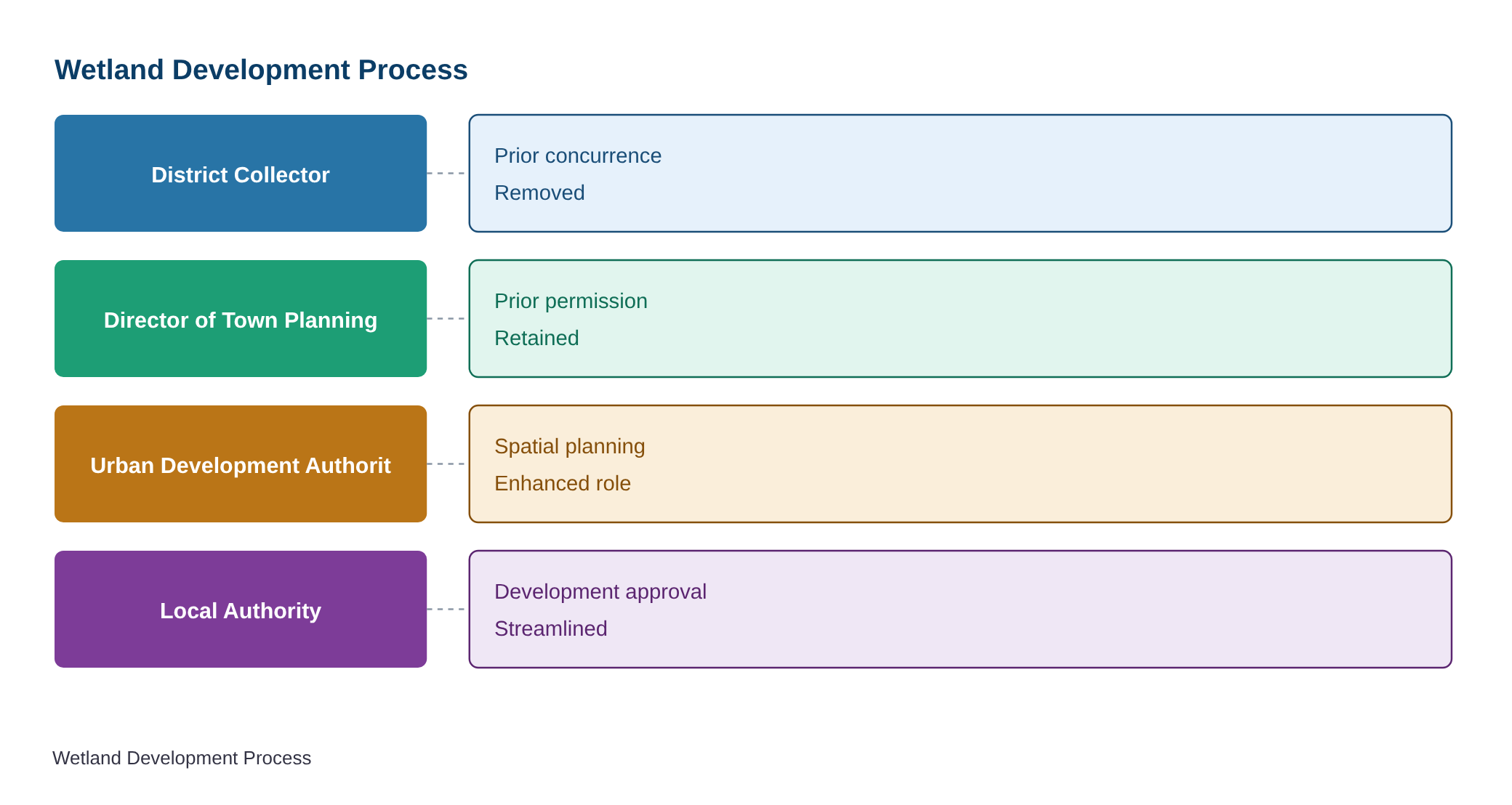
- The Bill seeks to amend the Tamil Nadu Town and Country Planning Act, 1971, to remove the requirement of prior concurrence from the District Collector for wetland development in non-planning areas.
- It empowers the Director of Town and Country Planning to grant prior permission for such developments, thereby centralising regulatory authority and reducing inter-departmental delays.
- The Bill introduces provisions for the appointment of a full-time Chairman and a full-time Member-Secretary to the Urban Development Authority to ensure dedicated focus on spatial planning and infrastructure development.
- The District Collector will continue to be a member of the Urban Development Authority to maintain coordination with district administration, ensuring that local governance remains integrated with developmental planning.
- The amendment is designed to expedite the processing of development applications while maintaining environmental safeguards through the oversight of the Director and the Urban Development Authority.
- The Bill does not propose to deregulate wetland development entirely but seeks to streamline procedures by consolidating regulatory authority within a specialised institutional framework.
- The proposed changes are part of a broader effort to modernise urban governance in Tamil Nadu, aligning it with the demands of rapid urbanisation and environmental sustainability.
- The legislative move is situated within the context of ongoing debates on wetland conservation, particularly in ecologically sensitive areas like the Pallikaranai marshland.
Key Features
| Feature | Significance |
|---|---|
| Amendment to Tamil Nadu Town and Country Planning Act, 1971 | Introduces procedural simplification by removing the requirement of District Collector’s concurrence for wetland development in non-planning areas, thereby expediting approvals. |
| Empowerment of Director, Town and Country Planning | Authorised to grant prior permission for wetland development in non-planning areas, centralising regulatory authority to reduce inter-departmental delays. |
| Appointment of full-time Chairman and Member-Secretary for Urban Development Authority | Ensures sustained focus, continuity, and accountability in spatial planning and infrastructure development by dedicated leadership. |
| Retention of District Collector as member of Urban Development Authority | Maintains coordination between urban planning authorities and district administration for effective implementation of development policies. |
| Streamlining of Section 47-A(2) of Tamil Nadu Act 35 of 1972 | Removes redundant concurrence requirement, aligning with the need for timely decision-making in land-use regulation. |
Why it Matters
Governance and Efficiency
- Reduces bureaucratic delays in wetland development approvals by eliminating the District Collector’s concurrence requirement, thereby enhancing ease of doing business in non-planning areas.
- Centralises regulatory authority under the Director of Town and Country Planning, improving procedural clarity and reducing inter-departmental conflicts.
- Strengthens institutional capacity of the Urban Development Authority through full-time leadership, ensuring sustained attention to urban planning and infrastructure development.
Environmental Regulation
- Maintains regulatory oversight on wetland development through the Director’s prior permission, ensuring that ecological considerations are not entirely bypassed despite procedural simplification.
- Balances developmental imperatives with environmental sustainability by retaining the Urban Development Authority’s role in spatial planning and land-use regulation.
Urban Planning and Development
- Facilitates faster implementation of urban development projects in non-planning areas by streamlining approval processes, particularly for wetlands.
- Enhances the Urban Development Authority’s functional autonomy, enabling better alignment with state-level spatial planning objectives.
Challenges
1. Ecological Oversight and Wetland Degradation
- Risk of unchecked wetland development due to reduced regulatory layers, potentially leading to loss of biodiversity and ecosystem services.
- Need for robust post-development monitoring mechanisms to ensure compliance with environmental safeguards despite streamlined approvals.
UPSC Link: GS-III: Environmental Impact Assessment
2. Institutional Coordination Gaps
- Potential friction between the Director of Town and Country Planning and local authorities in interpreting development norms for wetlands.
- Ensuring that the Urban Development Authority’s full-time leadership does not lead to bureaucratic insulation from local governance realities.
UPSC Link: GS-II: Centre-State Relations
3. Legal and Procedural Ambiguities
- Clarification required on the definition of ‘non-planning areas’ and the scope of wetlands covered under the amended provisions.
- Need for clear guidelines to prevent misuse of the streamlined process for environmentally sensitive or ecologically critical wetlands.
UPSC Link: GS-II: Constitutional Provisions
4. Public Participation and Transparency
- Ensuring that the removal of Collector’s concurrence does not marginalise public consultation or environmental impact assessment in wetland development projects.
- Transparency in the Director’s decision-making process to maintain public trust and accountability.
UPSC Link: GS-IV: Governance and Transparency
Challenges — UPSC Perspective
| Issue | Concern |
|---|---|
| Ecological Degradation | Streamlined approvals may lead to unchecked wetland development, threatening biodiversity and ecosystem services. |
| Regulatory Arbitrage | Reduced oversight layers could create loopholes for environmentally harmful projects under the guise of developmental necessity. |
| Institutional Fragmentation | Centralisation of authority may weaken local governance participation in land-use decisions. |
| Legal Ambiguity | Lack of clarity on the scope of ‘non-planning areas’ and wetlands could lead to inconsistent enforcement. |
| Public Accountability | Reduced procedural layers may diminish opportunities for public scrutiny and environmental impact assessment. |
Way Forward
- Formulate detailed guidelines for the Director of Town and Country Planning to define criteria for wetland development permissions in non-planning areas.
- Establish a multi-stakeholder monitoring committee to oversee post-development compliance with environmental safeguards.
- Conduct periodic audits of the Urban Development Authority’s functioning to ensure alignment with state-level spatial planning goals.
- Strengthen public participation mechanisms, including mandatory environmental impact assessments for wetland development projects.
- Develop a state-specific wetland inventory and classification framework to delineate protected and permissible development zones.
- Enhance inter-departmental coordination between the Town and Country Planning Department and district administrations to address implementation challenges.
- Institute a grievance redressal mechanism for stakeholders affected by wetland development decisions under the amended provisions.
UPSC Value Addition
Keywords for Mains Answer-Writing
Wetland conservation · Town and Country Planning Act, 1971 · District Collector’s concurrence · Urban Development Authority · Spatial planning · Non-planning areas · Urban local bodies · District administration coordination · Land-use regulation · Environmental governance · Tamil Nadu Town and Country Planning Act amendments · Wetland development regulations · Urban governance reforms · Land development permissions · Sustainable urbanisation
Concept Flow
State-level amendment to the Tamil Nadu Town and Country Planning Act, 1971 → Removal of District Collector’s concurrence requirement for wetland development in non-planning areas → Centralisation of regulatory authority under the Director of Town and Country Planning → Appointment of full-time leadership for the Urban Development Authority → Potential reduction in bureaucratic delays but heightened risk of ecological oversight gaps → Need for robust environmental safeguards and public participation mechanisms → Long-term impact on urban planning, biodiversity conservation, and governance efficiency
Prelims Practice Questions
Q1. Consider the following statements regarding the Tamil Nadu Town and Country Planning Act, 1971:
1. The Act mandates prior concurrence of the District Collector for development in non-planning areas.
2. The Act empowers the Director to grant prior permission for wetland development in non-planning areas.
3. The Act requires the Urban Development Authority to have a full-time Chairman and Member-Secretary.
4. The Act does not retain the District Collector as a member of the Urban Development Authority.
How many of the above statements are correct?
- Only one
- Only two
- Only three
- All four
Answer: Only three — Statement 1 is correct as Section 47-A(2) mandates prior concurrence of the Director for development in non-planning areas. Statement 2 is correct as the Bill seeks to empower the Director to grant prior permission for wetland development in non-planning areas. Statement 3 is correct as the Bill proposes the appointment of a full-time Chairman and Member-Secretary. Statement 4 is incorrect as the Bill retains the District Collector as a member of the Urban Development Authority.
Q2. Assertion (A): The Tamil Nadu Town and Country Planning Act, 1971, requires prior concurrence of the District Collector for wetland development in non-planning areas.
Reason (R): The requirement aims to ensure coordination between urban local bodies and district administration for sustainable land-use planning.
- Both A and R are true, and R is the correct explanation of A
- Both A and R are true, but R is not the correct explanation of A
- A is true, but R is false
- A is false, but R is true
Answer: Both A and R are true, but R is not the correct explanation of A — Assertion (A) is true as the Act mandates prior concurrence of the District Collector for wetland development in non-planning areas. Reason (R) is also true and correctly explains the rationale behind the requirement, which is to ensure coordination between urban local bodies and district administration for sustainable land-use planning.
Q3. Match the following provisions of the Tamil Nadu Town and Country Planning Act, 1971 with their respective authorities:
Column I (Provision)
A. Prior concurrence for development in non-planning areas
B. Appointment of full-time Chairman and Member-Secretary
C. Retention of District Collector as a member
D. Wetland development regulations
Column II (Authority)
1. Director
2. Urban Development Authority
3. District Collector
4. State Government
- {‘A’: 1, ‘B’: 2, ‘C’: 3, ‘D’: 2}
- {‘A’: 1, ‘B’: 2, ‘C’: 3, ‘D’: 4}
- {‘A’: 3, ‘B’: 2, ‘C’: 1, ‘D’: 4}
- {‘A’: 1, ‘B’: 4, ‘C’: 3, ‘D’: 2}
Answer: {‘A’: 1, ‘B’: 2, ‘C’: 3, ‘D’: 4} — Provision A (Prior concurrence for development in non-planning areas) is under the authority of the Director (1). Provision B (Appointment of full-time Chairman and Member-Secretary) is under the authority of the Urban Development Authority (2). Provision C (Retention of District Collector as a member) is under the authority of the District Collector (3). Provision D (Wetland development regulations) is also under the authority of the Urban Development Authority (2).
Mains Practice Question
✍ Critically examine the constitutional and statutory framework governing wetland conservation in India, with particular reference to the recent Tamil Nadu Town and Country Planning (Amendment) Bill, 2026. How does the Bill seek to balance the imperatives of urban development and environmental governance? (15 Marks)
Approach: MODEL-ANSWER SKELETON:
1. **Constitutional Framework**:
– Article 48A (Directive Principles of State Policy) and Article 51A(g) (Fundamental Duties) mandate state protection of the environment and wildlife.
– Entry 17 (Land) and Entry 18 (Forests) in the State List (List II, Seventh Schedule) empower states to legislate on land-use and wetland conservation.
– The 73rd and 74th Constitutional Amendments empower urban local bodies (ULBs) to regulate land-use in their jurisdictions.
2. **Statutory Framework**:
– **National Wetland Conservation Programme (NWCP)**: Launched in 1985, it provides guidelines for wetland conservation but is non-binding.
– **Wetlands (Conservation and Management) Rules, 2017**: Regulate activities in wetlands under the Environment (Protection) Act, 1986, but exclude certain categories like riverine wetlands.
– **Tamil Nadu Town and Country Planning Act, 1971**: Governs land-use planning, including wetlands in non-planning areas. The 2026 Amendment Bill seeks to:
– Remove the requirement for District Collector’s concurrence for wetland development in non-planning areas.
– Empower the Director to grant prior permission for such developments.
– Appoint a full-time Chairman and Member-Secretary for the Urban Development Authority to enhance accountability.
3. **Balancing Urban Development and Environmental Governance**:
– **Arguments for Reform**:
– Reduces bureaucratic delays in wetland development approvals, potentially accelerating urban infrastructure projects.
– Streamlines decision-making by centralising authority with the Director, ensuring consistency in wetland development regulations.
– **Arguments Against Reform**:
– Weakens inter-institutional coordination, particularly with district administration, risking unchecked wetland encroachment.
– May dilute environmental safeguards, as the District Collector’s concurrence often acts as a check against unsustainable development.
– Raises concerns about the adequacy of the Urban Development Authority’s capacity to balance development and conservation.
4. **Judicial Precedents and Best Practices**:
– **Madras High Court’s Order in TNSWA vs. State of Tamil Nadu (2021)**: Highlighted the need for strict regulation of construction around wetlands like Pallikaranai Marshland.
– **National Green Tribunal (NGT) Orders**: Emphasised the importance of wetland conservation in urban planning (e.g., NGT Order in 2018 on encroachments in wetlands).
– **International Best Practices**: The Ramsar Convention (1971) advocates for integrated wetland management, balancing ecological and developmental needs.
5. **Way Forward**:
– Strengthen the role of ULBs in wetland conservation through capacity-building and resource allocation.
– Establish a multi-stakeholder Wetland Management Authority at the district level to oversee development and conservation.
– Mandate Environmental Impact Assessments (EIAs) for all wetland development projects, even in non-planning areas.
– Align state-level amendments with the Wetlands (Conservation and Management) Rules, 2017, to ensure uniformity and compliance with national standards.
Source: The Hindu
Tamil Nadu PCS (TNPSC) — State PCS Practice
Prelims: Which of the following is the primary objective of the Tamil Nadu government’s recent Bill to amend wetland development regulations in non-planning areas?
- To streamline wetland development by removing the requirement of Collector’s concurrence in non-planning areas
- To impose stricter penalties on unauthorized wetland encroachments across Tamil Nadu
- To transfer all wetland management responsibilities to municipal corporations
- To declare all wetlands in Tamil Nadu as protected areas under the Forest Rights Act
Answer: To streamline wetland development by removing the requirement of Collector’s concurrence in non-planning areas — The Bill aims to simplify the wetland development process in non-planning areas by eliminating the need for Collector’s approval, thereby accelerating projects while maintaining environmental safeguards.
Mains: Critically examine the potential environmental and administrative implications of the Tamil Nadu government’s proposal to remove the Collector’s concurrence requirement for wetland development in non-planning areas. Suggest measures to balance developmental needs with ecological conservation.
Generated by AanyaAi for educational purpose.
Related guides on our sites
- Anthropology VS PSIR
- Best PSIR optional coaching
- Best PSIR optional coaching online
- Best PSIR optional teacher

- Kerala HC Refuses Stay on Waqf Board Reconstitution: Key Facts - October 23, 2026
- तेलंगाना पेंशनरों के PAN और आधार विवरण होंगे सत्यापित, जानिए पूरा मामला - October 23, 2026
- Marathwada Turns Hotter; Konkan Wetter in 70 Years: IMD-IITM Study - October 23, 2026

No Comments