


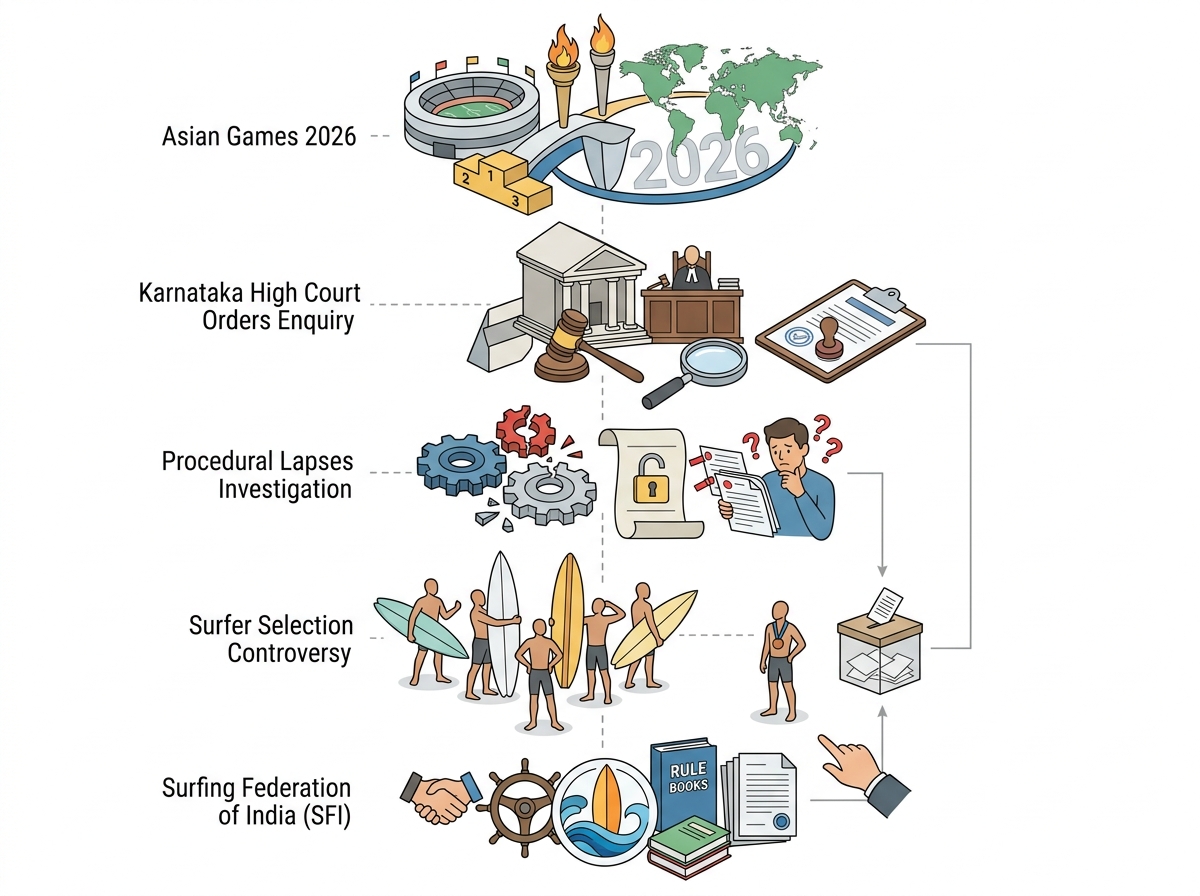
01 Sep Karnataka HC probes surfing selection lapses for Asian Games 2026
✎ The Karnataka High Court’s appointment of a former Supreme Court judge to investigate procedural lapses in surfer selection for the Asian Games 2026 exemplifies the judiciary’s role in ensuring transparency and accountability in…
Subject Relevance — Where This Topic Fits
- GS Paper II — Governance, Transparency and Accountability | GS Paper III — Sports Governance and Institutional Reforms
- Prelims: Sports Code 2011, National Sports Development Code, Karnataka High Court, Supreme Court of India, Surfing Federation of India, Athlete Selection Norms, Procedural Fairness, Judicial Review in Sports Governance
- Essay: The Role of Institutions in Upholding Public Trust: A Case Study of Sports Federations, Balancing Competitive Excellence and Procedural Integrity in Sports
Quick Revision: The Karnataka High Court’s appointment of a former Supreme Court judge to investigate procedural lapses in surfer selection for the Asian Games 2026 exemplifies the judiciary’s role in ensuring transparency and accountability in sports governance, while balancing competitive participation needs.
Why is this in the news?
The Karnataka High Court’s intervention in the selection process for surfers for the Asian Games 2026, following allegations of procedural lapses by the Surfing Federation of India (SFI), underscores the critical intersection of sports governance, institutional accountability, and judicial oversight. The Court’s decision to appoint a former Supreme Court judge to investigate violations of selection norms, while refraining from altering the final team composition to avoid prejudicing India’s participation, highlights the delicate balance between procedural rectitude and competitive exigency in high-stakes sporting events.
Background
- The dispute originated from the exclusion of surfer Ramesh Budihal from the main contingent for the Asian Games 2026, despite his bronze medal at the Asian Surfing Championship 2025.
- The Surfing Federation of India (SFI) initially constituted a selection committee that was later set aside by an Appeals Panel on 16 June 2026 for violating prescribed norms.
- A Special Selection Committee (SSC) was subsequently formed, which selected two surfers but failed to reach unanimity on the placement of Budihal and Sivaraj Babu, leading to procedural ambiguity.
- The SSC recommended a surf-off between the two surfers, but this proposal was contested by a member, further complicating the selection process.
- The SFI’s selection norms, which the Court identified as containing 45 points for examination, were alleged to have been deviated from in the final selection.
- The Court’s refusal to order a fresh selection at this late stage was justified on the grounds that it could prejudice India’s participation in the surfing events at the Asian Games 2026.
What are the Key Governance Issues in Athlete Selection?
- Athlete selection for international sporting events is governed by federations under the aegis of the National Sports Development Code, which mandate transparency, fairness, and adherence to predefined norms.
- Procedural lapses in selection, such as arbitrary committee formation, non-compliance with selection criteria, or lack of unanimity in decision-making, can lead to disputes and undermine institutional credibility.
- Judicial review of sports governance decisions, as seen in this case, serves as a check on arbitrary or biased actions by federations, ensuring that selection processes are legally sound and procedurally fair.
- The role of an independent commission, such as the one appointed by the Karnataka High Court, is to investigate deviations from norms without determining athletic merit, thereby maintaining the separation of governance and performance evaluation.
- The Court’s emphasis on not disturbing the final selection at this stage reflects the principle of ‘procedural justice’—balancing the need for fairness with the exigencies of competitive participation.
- Institutional reforms, such as amending selection norms or bylaws, can be recommended by such commissions to prevent future disputes and enhance the robustness of governance structures in sports federations.
UPSC Value Addition
Keywords for Mains Answer-Writing
Sports governance in India · Procedural fairness in selection · Judicial review of sports federations · Constitutional remedies in sports disputes · Administrative law in sports administration · Right to fair trial in sports selection · Role of High Courts in sports governance · Institutional integrity of sports bodies · Natural justice in selection processes · Judicial activism in sports federations
Prelims Practice Questions
Q1. Consider the following statements regarding the jurisdiction of the High Court of Karnataka in the matter of sports governance:
1. The High Court can directly interfere in the selection process of national teams.
2. The High Court can appoint a commission of inquiry to investigate procedural lapses in sports federations.
3. The High Court can order a fresh selection process if it finds violations of norms, even at the last stage of competition preparation.
How many of the above statements are correct?
- Only one
- Only two
- All three
- None
Answer: Only two — Statement 1 is incorrect because the High Court did not directly interfere in the selection process but appointed an inquiry commission. Statement 2 is correct as the High Court appointed a former Supreme Court judge to inquire into procedural lapses. Statement 3 is incorrect because the Court declined to order a fresh selection process to avoid prejudicing India’s participation in the Asian Games.
Q2. Assertion (A): The High Court of Karnataka, in the surfing selection case, declined to order a fresh selection process despite finding procedural lapses.
Reason (R): The Court held that altering the selection list at the last stage could prejudice India’s participation in the Asian Games.
In the context of the above statements, which of the following is correct?
- Both A and R are true, and R is the correct explanation of A.
- Both A and R are true, but R is not the correct explanation of A.
- A is true, but R is false.
- A is false, but R is true.
Answer: Both A and R are true, and R is the correct explanation of A. — The Assertion (A) is true as the High Court declined to order a fresh selection process. The Reason (R) is also true and correctly explains why the Court took this decision—namely, to avoid prejudicing India’s participation in the Asian Games.
Q3. Match the following pairs related to sports governance in India:
Column I (Institution/Body) | Column II (Function)
— | —
A. Surfing Federation of India (SFI) | 1. Appointed a commission to inquire into procedural lapses in selection
B. High Court of Karnataka | 2. Conducted a surf-off to resolve a selection dispute
C. Supreme Court of India | 3. Oversees the selection of athletes for national teams
D. Appeals Panel of SFI | 4. Set aside an initial selection due to procedural violations
Select the correct match:
- A-3, B-1, C-2, D-4
- A-3, B-1, C-4, D-2
- A-1, B-3, C-2, D-4
- A-4, B-2, C-1, D-3
Answer: A-3, B-1, C-2, D-4 — A-3: SFI oversees selection of athletes for national teams. B-1: High Court appointed a commission (R.V. Raveendran) to inquire into procedural lapses. C-2: The Supreme Court (via its retired judge) did not directly conduct a surf-off but the Appeals Panel did. D-4: The Appeals Panel set aside the initial selection due to procedural violations.
Mains Practice Question
✍ The High Court of Karnataka has recently intervened in a dispute concerning the selection of surfers for the Asian Games 2026 by appointing a former Supreme Court judge to inquire into procedural lapses in the selection process. Critically examine the role of judicial review in ensuring procedural fairness in sports governance in India. (15 Marks)
Approach: MODEL-ANSWER SKELETON:
1. **Introduction (2 Marks)**
– Define judicial review in the context of sports governance.
– Briefly describe the incident: procedural lapses in SFI’s selection process, appointment of R.V. Raveendran commission, and the High Court’s refusal to order a fresh selection at the last stage.
2. **Judicial Review as a Mechanism for Procedural Fairness (5 Marks)**
– Explain the constitutional basis for judicial review (Art. 226, 32, and 142).
– Discuss how judicial review ensures adherence to principles of natural justice (audi alteram partem, reasoned decisions, transparency).
– Cite the Supreme Court’s stance in *Zee Telefilms Ltd. v. Union of India* (2005) and *Bodousa v. Union of India* (2011) on judicial review of sports federations.
3. **Balancing Judicial Intervention and Institutional Autonomy (4 Marks)**
– Argue that while judicial review ensures fairness, excessive interference may undermine the autonomy of sports federations.
– Discuss the principle of non-interference in purely technical or sporting matters (e.g., *Ajay Jadeja v. Union of India*, 2001).
– Highlight the Court’s restraint in this case: refusal to order a fresh selection to avoid prejudicing India’s participation.
4. **Challenges and Recommendations (4 Marks)**
– Identify challenges: lack of statutory backing for sports federations, ad-hoc selection committees, and delays in dispute resolution.
– Suggest reforms: codification of selection norms, establishment of an independent sports tribunal (as recommended by the *Lodha Committee* for BCCI), and mandatory adherence to transparency guidelines.
5. **Conclusion (1 Mark)**
– Summarise: Judicial review is essential for procedural fairness but must be balanced with institutional autonomy to preserve the integrity of sports governance.
Source: The Hindu
Karnataka PCS (KPSC) — State PCS Practice
Prelims: Which of the following is the primary reason for the Karnataka High Court ordering an enquiry into the selection of surfers for the Asian Games 2026?
- Procedural lapses in the selection process
- Lack of representation from Karnataka surfers
- Financial irregularities in funding
- Political interference in sports administration
Answer: Procedural lapses in the selection process — The Karnataka High Court ordered an enquiry due to procedural lapses identified in the selection of surfers for the Asian Games 2026.
Mains: Analyze the role of judicial intervention in ensuring transparency and fairness in the selection of athletes for national and international sports events, with specific reference to the Karnataka High Court’s directive regarding the Asian Games 2026 surfers’ selection process. Discuss the implications for Karnataka’s sports governance and athlete development.
Generated by AanyaAi for educational purpose.
Related guides on our sites
- Anthropology VS PSIR
- Best PSIR optional coaching
- Best PSIR optional coaching online
- Best PSIR optional teacher

- Shivraj Singh Chouhan launches ‘Khet Bachao Abhiyan’ to save farmland - October 23, 2026
- उत्तराखंड राज्यपाल की पीएम मोदी से महत्वपूर्ण बैठक: जानिए मुख्य बिंदु - October 23, 2026
- How India’s Rs 20,000 Cr CCUS Budget Can Drive Net-Zero Goals - October 23, 2026

No Comments