


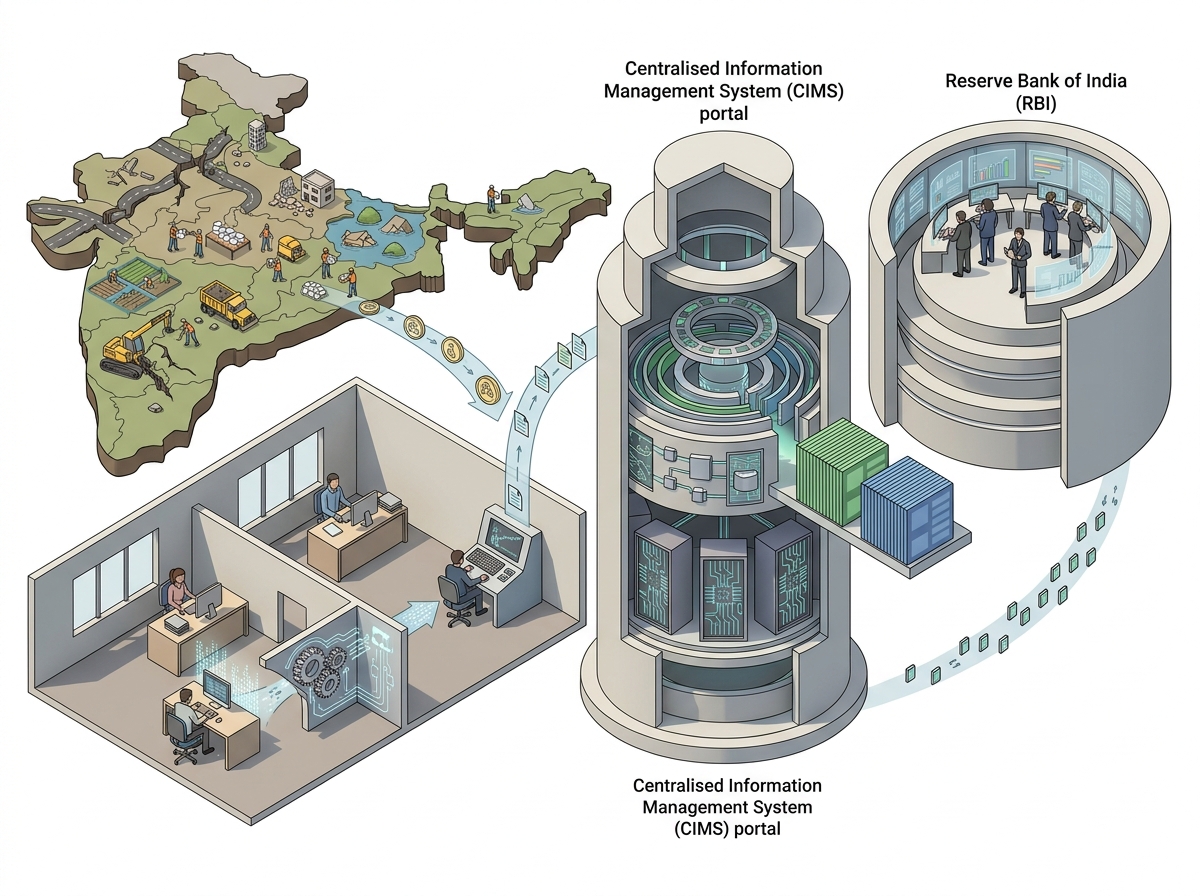
02 Sep UPSC Alert: RBI’s Half-Yearly Reporting for Natural Calamity Relief Measures via CIMS Portal
✎ Regulated Entities must submit half-yearly returns on relief measures in calamity-affected areas via the CIMS portal within 30 days of the half-year’s end, replacing the erstwhile monthly reporting requirement.
Subject Relevance — Where This Topic Fits
- GS Paper III — Indian Economy: Banking, Financial Institutions and their Regulation | GS Paper III — Disaster Management
- Prelims: Centralised Information Management System (CIMS), Regulated Entities (REs), Resolution of Stressed Assets, Half-Yearly Return, Natural Calamity Relief Measures, RBI Directions, Stress Asset Resolution Framework
- Essay: The Role of Technology in Governance: Enhancing Transparency and Efficiency in Public Service Delivery, Disaster Resilience and Sustainable Development: Balancing Immediate Relief with Long-Term Preparedness
Quick Revision: Regulated Entities must submit half-yearly returns on relief measures in calamity-affected areas via the CIMS portal within 30 days of the half-year’s end, replacing the erstwhile monthly reporting requirement.
Why is this in the news?
The Reserve Bank of India (RBI), vide notification RBI/2026-27/250 dated September 2, 2026, has revised the regulatory framework governing relief measures extended by Regulated Entities (REs) in areas affected by natural calamities. This revision introduces a half-yearly reporting requirement via the Centralised Information Management System (CIMS) portal, replacing the erstwhile monthly return mechanism. The change, effective from July 1, 2026, underscores the RBI’s emphasis on streamlined, data-driven governance in disaster management while ensuring compliance and accountability among financial institutions.
Background
- The Reserve Bank of India (RBI) is the central regulatory authority for the banking and financial sector in India, empowered under the Reserve Bank of India Act, 1934, and the Banking Regulation Act, 1949.
- Natural calamities, including floods, cyclones, droughts, and earthquakes, frequently disrupt economic activities and financial stability in affected regions, necessitating targeted relief measures by financial institutions.
- The RBI has historically issued directives to ensure continuity of financial services and relief measures, such as moratoriums on loan repayments, restructuring of loans, and concessional credit, in calamity-affected areas.
- The erstwhile framework required Scheduled Commercial Banks (excluding Regional Rural Banks) to submit monthly returns on relief measures extended in calamity-affected areas, which was perceived as administratively cumbersome.
- The amendment directions on Resolution of Stressed Assets dated April 29, 2026, introduced a broader regulatory overhaul, including provisions for reporting relief measures via the CIMS portal.
- The CIMS portal, developed by the RBI, serves as a centralised platform for regulatory reporting, enhancing transparency, data integrity, and real-time monitoring of financial sector activities.
What is the Centralised Information Management System (CIMS) Portal and the Half-Yearly Return Mechanism?
- The CIMS portal is a digital platform introduced by the RBI to centralise and streamline regulatory reporting by Regulated Entities (REs), including banks, cooperative banks, and non-banking financial companies (NBFCs).
- The portal facilitates real-time data submission, validation, and monitoring, reducing administrative burdens and enhancing compliance efficiency.
- The half-yearly return mechanism replaces the previous monthly reporting requirement, reducing the frequency of submissions from 12 to 2 times a year (by October 30 for the half-year ending September 30 and by April 30 for the half-year ending March 31).
- The revised reporting format aligns with the RBI’s broader framework for resolution of stressed assets, ensuring consistency in data collection and analysis across sectors.
- REs are required to ensure accuracy, completeness, and validation of the data submitted, with internal systems established for timely collection, verification, and consolidation of information.
- The discontinuation of the monthly return for Scheduled Commercial Banks (excluding Regional Rural Banks) simplifies compliance while maintaining the RBI’s oversight on relief measures in calamity-affected areas.
- The transition to half-yearly reporting reflects the RBI’s focus on reducing procedural complexities while strengthening data-driven governance in disaster management.
- The mechanism underscores the RBI’s role in balancing regulatory oversight with operational efficiency, particularly in the context of natural disasters and their economic fallout.
Key Features
| Feature | Significance |
|---|---|
| Centralised Information Management System (CIMS) Portal | Facilitates unified, real-time tracking and reporting of relief measures extended by Regulated Entities (REs) in disaster-affected regions, ensuring transparency and accountability. |
| Half-Yearly Return Requirement | Replaces the monthly reporting mechanism, reducing compliance burden on REs while maintaining regulatory oversight over relief disbursement. |
| Discontinuation of Monthly Return | Monthly returns for Scheduled Commercial Banks (excluding Regional Rural Banks) on relief measures are discontinued from July 1, 2026, streamlining reporting processes. |
| Timeline for Submission | Returns must be submitted within 30 days of the half-year end: October 30 (for September 30) and April 30 (for March 31), ensuring timely data availability for policy formulation. |
| Validation and Accuracy Mandate | REs are required to ensure accuracy, completeness, and validation of submitted data, necessitating robust internal systems for data collection and verification. |
Why it Matters
Regulatory Governance
- Enhances the Reserve Bank of India’s (RBI) ability to monitor and evaluate the effectiveness of relief measures extended by financial institutions in disaster-stricken areas.
- Aligns reporting mechanisms with the amended Resolution of Stressed Assets framework, ensuring consistency in regulatory oversight.
- Reduces regulatory fragmentation by consolidating reporting through a single portal, improving data integrity and comparability.
Financial Sector Stability
- Ensures that financial institutions extend timely and adequate relief to borrowers in disaster-affected regions, mitigating systemic risks associated with asset quality deterioration.
- Facilitates evidence-based policy interventions by providing granular data on the quantum and distribution of relief measures.
- Promotes financial inclusion by ensuring that relief measures reach vulnerable segments, including rural and cooperative banking sectors.
Disaster Risk Management
- Strengthens the integration of financial sector responses with broader disaster risk reduction and management strategies.
- Enables the RBI and other stakeholders to assess the adequacy of relief measures in relation to the scale of natural calamities.
- Supports post-disaster recovery by ensuring liquidity and credit access to affected borrowers, thereby stabilising local economies.
Operational Efficiency
- Reduces compliance costs for Regulated Entities by replacing monthly reporting with a half-yearly format, without compromising regulatory oversight.
- Improves the RBI’s ability to aggregate and analyse data across regions and institutions, enhancing policy responsiveness.
- Encourages REs to develop internal systems for efficient data collection, validation, and submission, fostering better governance practices.
Challenges
1. Data Accuracy and Validation
- Risk of incomplete or inaccurate reporting by REs due to gaps in internal systems or lack of awareness about reporting requirements.
- Challenges in validating data submitted through the CIMS portal, particularly in regions with limited digital infrastructure.
- Potential delays in data submission if REs fail to establish robust internal processes for data collection and verification.
UPSC Link: GS-III: Disaster Management
2. Digital Divide and Inclusivity
- Regional Rural Banks, Urban Cooperative Banks, and Small Finance Banks may face difficulties in adapting to the digital CIMS portal due to limited technological capabilities.
- Borrowers in remote or disaster-affected areas may lack access to digital platforms, complicating the disbursement and tracking of relief measures.
- Ensuring equitable access to relief measures across diverse geographical and socio-economic segments remains a persistent challenge.
UPSC Link: GS-II: Social Justice
3. Regulatory Compliance Burden
- The transition from monthly to half-yearly reporting may initially pose compliance challenges for REs accustomed to more frequent submissions.
- Ensuring uniformity in reporting formats and data definitions across diverse types of Regulated Entities (e.g., banks, NBFCs, cooperative banks) is critical but potentially complex.
- The discontinuation of monthly returns for certain banks may require adjustments in internal reporting systems, leading to temporary operational disruptions.
UPSC Link: GS-III: Economic Development
4. Resource Allocation for Disaster Relief
- The effectiveness of relief measures depends on the availability of adequate financial resources, which may be constrained in the aftermath of large-scale natural calamities.
- Balancing the need for immediate relief with long-term recovery and rehabilitation efforts requires careful resource allocation and prioritisation.
- Coordination between financial institutions, government agencies, and disaster management authorities is essential to ensure seamless disbursement and utilisation of relief funds.
UPSC Link: GS-III: Disaster Management
5. Monitoring and Enforcement
- Ensuring strict adherence to reporting requirements across all REs, including those with limited regulatory oversight, poses a significant monitoring challenge for the RBI.
- The RBI must balance the need for stringent enforcement with the operational realities faced by smaller financial institutions, particularly in rural areas.
- Lack of timely corrective actions for non-compliance may undermine the credibility and effectiveness of the reporting framework.
UPSC Link: GS-III: Economic Development
Challenges — UPSC Perspective
| Issue | Concern |
|---|---|
| Data Accuracy | Risk of incomplete or erroneous reporting due to inadequate internal systems or lack of awareness among REs. |
| Digital Infrastructure | Limited access to digital platforms in remote or disaster-affected areas may hinder effective reporting and relief disbursement. |
| Compliance Transition | Adjusting from monthly to half-yearly reporting may initially pose operational challenges for REs. |
| Resource Constraints | Insufficient financial resources in the aftermath of natural calamities may limit the scope of relief measures. |
| Regulatory Oversight | Monitoring compliance across diverse REs, including cooperative banks, requires robust enforcement mechanisms. |
| Inter-Agency Coordination | Effective disaster relief requires seamless coordination between financial institutions, government agencies, and disaster management authorities. |
Way Forward
- Regulated Entities should expedite the establishment of internal systems for data collection, validation, and submission to the CIMS portal, ensuring compliance with the half-yearly timeline.
- The Reserve Bank of India should conduct awareness programmes and capacity-building initiatives for REs, particularly Regional Rural Banks, Urban Cooperative Banks, and Small Finance Banks, to facilitate smooth transition to the new reporting framework.
- Enhance digital infrastructure in rural and disaster-prone areas to ensure equitable access to relief measures and reporting platforms.
- Strengthen inter-agency coordination between the RBI, Ministry of Finance, National Disaster Management Authority (NDMA), and state-level disaster management authorities to streamline relief disbursement and monitoring.
- Develop a robust grievance redressal mechanism to address discrepancies in reported data and ensure accountability among REs.
- Conduct periodic audits and reviews of the CIMS portal to assess its functionality, user-friendliness, and effectiveness in data aggregation and analysis.
- Promote research and data-driven policy interventions by leveraging the granular data available through the CIMS portal to identify trends and gaps in relief measures.
- Encourage financial institutions to adopt innovative technologies, such as blockchain or AI-driven analytics, to improve the accuracy and efficiency of reporting and relief disbursement.
UPSC Value Addition
Keywords for Mains Answer-Writing
Centralised Information Management System (CIMS) · Regulated Entities (REs) · Reporting of relief measures · Natural calamities · Half-yearly return · Stressed Assets Resolution Framework · Compliance and governance in banking · Regulatory reporting mechanisms · Disaster management and financial sector · Data validation and accuracy in financial reporting
Concept Flow
Natural calamity occurs → Relief measures initiated by Regulated Entities (REs) → Data collection and validation by REs → Submission to CIMS portal on half-yearly basis → RBI aggregates and analyses data → Policy formulation and resource allocation → Enhanced relief and recovery efforts.
Prelims Practice Questions
Q1. Consider the following statements regarding the Centralised Information Management System (CIMS) Portal introduced by the Reserve Bank of India (RBI):
1. The CIMS portal is used for reporting relief measures extended by Regulated Entities (REs) in areas affected by natural calamities.
2. The reporting under CIMS is done on a half-yearly basis.
3. The existing monthly return for relief measures has been discontinued with effect from July 1, 2026.
4. The CIMS portal is mandatory only for Scheduled Commercial Banks and excludes Regional Rural Banks.
How many of the above statements are correct?
- Only one
- Only two
- Only three
- All
Answer: Only three — Statements 1, 2, and 3 are correct. Statement 4 is incorrect as the CIMS portal applies to all Regulated Entities (REs), including Regional Rural Banks.
Q2. Assertion (A): The Reserve Bank of India (RBI) has introduced a half-yearly return for reporting relief measures extended by Regulated Entities (REs) in areas affected by natural calamities.
Reason (R): This change aligns with the revised regulatory framework governing the resolution of stressed assets, which came into effect from July 1, 2026.
Options:
A. Both A and R are true, and R is the correct explanation of A.
B. Both A and R are true, but R is not the correct explanation of A.
C. A is true, but R is false.
D. A is false, but R is true.
Answer: ? — Both the Assertion (A) and Reason (R) are true, and R correctly explains A as the half-yearly return was introduced to align with the revised regulatory framework on stressed assets resolution.
Q3. Match the following columns related to the reporting of relief measures by Regulated Entities (REs) in areas affected by natural calamities:
Column I (Reporting Mechanism) | Column II (Frequency)
1. Monthly Return | A. Discontinued from July 1, 2026
2. Half-Yearly Return | B. Submitted within 30 days from the end of each half-year
3. CIMS Portal | C. Used for reporting relief measures
Options:
A. 1-A, 2-B, 3-C
B. 1-B, 2-A, 3-C
C. 1-C, 2-B, 3-A
D. 1-A, 2-C, 3-B
Answer: ? — 1-A: The monthly return was discontinued from July 1, 2026. 2-B: The half-yearly return is submitted within 30 days from the end of each half-year. 3-C: The CIMS portal is used for reporting relief measures.
Mains Practice Question
✍ The Reserve Bank of India (RBI) has revised the regulatory framework governing relief measures extended by Regulated Entities (REs) in areas affected by natural calamities, introducing a half-yearly return through the Centralised Information Management System (CIMS) portal. Examine the rationale behind this reform and its implications for governance, compliance, and disaster management in the financial sector. (15 Marks)
Approach: MODEL-ANSWER SKELETON:
1. **Rationale for Reform** (4 marks):
– Align with the revised framework on Resolution of Stressed Assets (April 29, 2026) to ensure consistency in reporting.
– Shift from monthly to half-yearly reporting to reduce compliance burden on REs while maintaining oversight.
– Enhance data accuracy and validation through the CIMS portal, which integrates multiple stakeholders.
– Discontinuation of monthly returns to streamline processes and reduce redundancy.
2. **Governance and Compliance Implications** (5 marks):
– Strengthening of internal systems and processes within REs for timely data collection, verification, and submission.
– Role of the RBI in ensuring adherence to reporting standards and penalising non-compliance.
– Alignment with global best practices in financial sector governance and disaster risk management.
– Enhancing transparency and accountability in the utilisation of relief measures.
3. **Disaster Management and Financial Sector Impact** (6 marks):
– Facilitating real-time assessment of relief measures extended by REs in disaster-affected regions.
– Enabling evidence-based policymaking for future disaster preparedness and response strategies.
– Ensuring equitable distribution of financial relief by tracking REs’ contributions.
– Potential challenges: Data accuracy, technological readiness of REs, and ensuring inclusivity for smaller banks and NBFCs.
Source: RBI
Generated by AanyaAi for educational purpose.
Related guides on our sites
- Best PSIR optional coaching for upsc
- Best PSIR optional teacher for upsc
- Best teacher of PSIR optional for upsc
- Best PSIR optional coaching in delhi for UPSC

- 342 अधिकारियों को मिला भारतीय सेना में कमीशन: जानिए पूरी कहानी - September 6, 2026
- 342 Officers Commissioned at OTA: UPSC Security Analysis & Trends - September 6, 2026
- छत्तीसगढ़ विधानसभा में 14 मंत्रियों की नियुक्ति पर हाईकोर्ट में सुनवाई शुरू, जानिए संवैधानिक सीमा और विवाद - September 5, 2026

No Comments