


03 Sep Monsoon Bird Census 2026 at Bhitarkanika: Key Facts for UPSC & State PCS
✎ The Bhitarkanika Monsoon Bird Census is a critical biodiversity monitoring tool that assesses population trends, nesting success, and ecological health of resident and migratory bird species in one of India’s most significant…
Subject Relevance — Where This Topic Fits
- GS Paper III — Environment, Ecology, Biodiversity and Climate Change | GS Paper I — Salient Features of World’s Physical Geography
- Prelims: Bhitarkanika National Park, monsoon bird census, heronries, mangrove ecosystems, wetland conservation, ornithological surveys, IUCN Red List species, Ramsar Convention, wildlife census protocols, Odisha Forest Department
- Essay: The interplay between climate variability and biodiversity conservation: Lessons from monsoon-dependent ecosystems, Wetlands as critical ecological infrastructure: Balancing conservation and developmental pressures
Quick Revision: The Bhitarkanika Monsoon Bird Census is a critical biodiversity monitoring tool that assesses population trends, nesting success, and ecological health of resident and migratory bird species in one of India’s most significant mangrove-wetland ecosystems, informing conservation planning and policy under national and international frameworks.
Why is this in the news?
The initiation of the three-day monsoon bird census at Bhitarkanika National Park in Odisha has drawn attention to the park’s role as a vital habitat for over ten resident bird species, including globally significant heronries. Conducted annually during the monsoonal period, the census serves as a critical tool for assessing population trends, nesting success, and ecological health of the region’s avian fauna, particularly in the context of delayed monsoon impacts and anthropogenic pressures on wetland ecosystems.
Background
- Bhitarkanika National Park, located in Odisha’s Kendrapara district, is a designated Ramsar site, recognised for its biodiversity richness, particularly its mangrove ecosystems and associated wetlands.
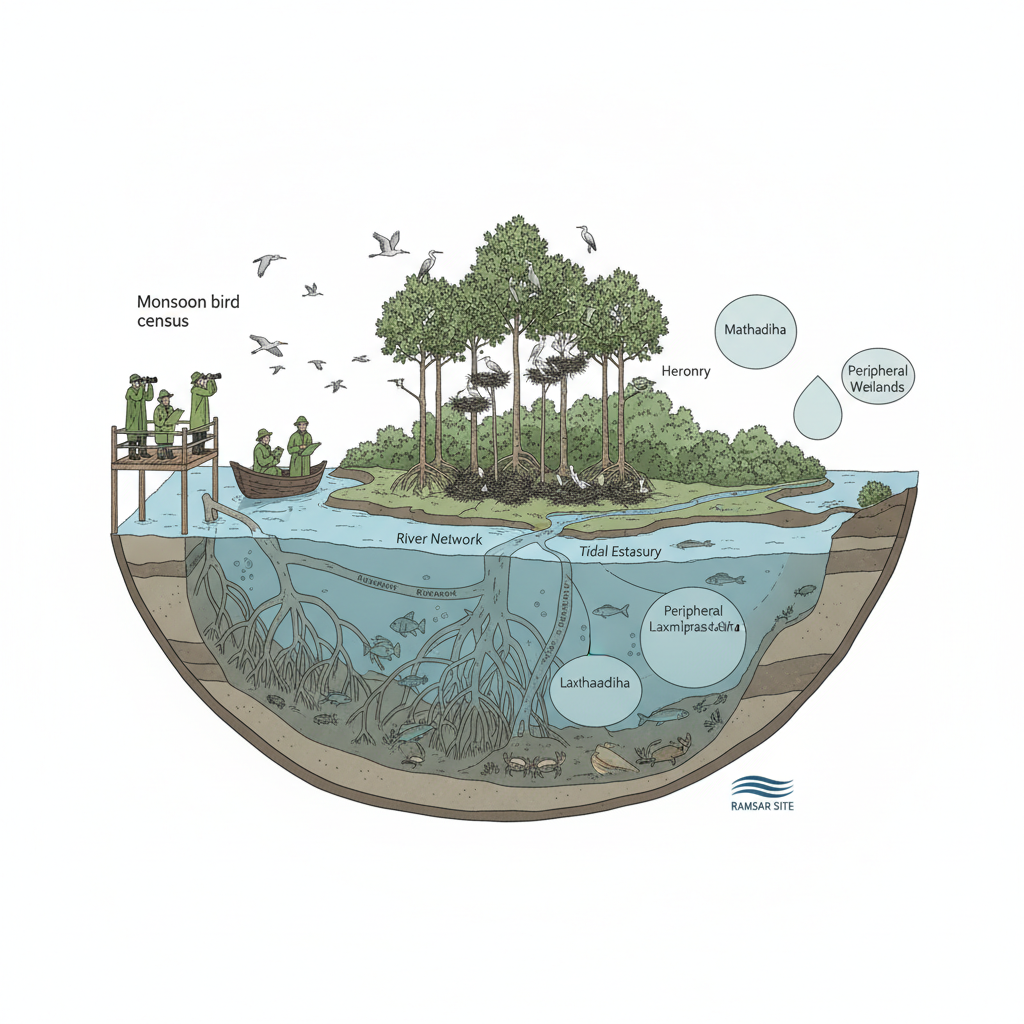
- The park’s extensive river network, tidal estuaries, and peripheral wetlands (e.g., Mathadiha, Laxmiprasaddiha, Durgaprasaddiha) provide critical habitats for migratory and resident bird species, especially during the breeding season coinciding with the southwest monsoon.
- Monsoon-dependent ecosystems in India, including mangroves and wetlands, are highly sensitive to climatic variability, with delayed or erratic rainfall patterns influencing species congregation, nesting timelines, and breeding success.
- The annual bird census at Bhitarkanika is part of India’s broader wildlife monitoring framework, aligned with the National Wildlife Action Plan (2017–2031) and the Convention on Biological Diversity (CBD) targets for biodiversity monitoring.
- Odisha’s Forest Department, in collaboration with ornithologists, wildlife personnel, and local volunteers, conducts the census to generate data for conservation planning and policy interventions.
- The census also supports India’s commitments under international conventions such as the Ramsar Convention, which emphasises the conservation and wise use of wetlands.
What is the Bhitarkanika Monsoon Bird Census?
- A systematic, multi-day survey conducted annually during the southwest monsoon season (typically August–September) to monitor resident and migratory bird populations in Bhitarkanika National Park and its peripheral wetlands.
- The census employs a stratified sampling approach, with four dedicated teams covering core areas of the national park and peripheral sites such as Mathadiha, Laxmiprasaddiha, and Durgaprasaddiha to ensure comprehensive coverage of bird congregation zones.
- The exercise focuses on heronries—colonies where colonial waterbirds, including storks, egrets, herons, ibises, and cormorants, nest and breed—providing critical data on population dynamics, nesting success, and habitat utilisation.
- Species monitored include the openbill stork (*Anastomus oscitans*), little cormorant (*Microcarbo niger*), intermediate egret (*Mesophoyx intermedia*), large egret (*Ardea alba*), little egret (*Egretta garzetta*), purple heron (*Ardea purpurea*), grey heron (*Ardea cinerea*), night heron (*Nycticorax nycticorax*), darter (*Anhinga melanogaster*), white ibis (*Threskiornis melanocephalus*), and cattle egret (*Bubulcus ibis*).
- The census methodology involves visual counts, nest enumeration, and habitat assessments, with data collected being used to update species inventories and assess the ecological health of the mangrove-wetland complex.
- Findings from the census inform conservation strategies, including habitat restoration, protection of nesting sites, and mitigation of anthropogenic threats such as pollution, encroachment, and climate change impacts.
- The exercise also serves as a capacity-building initiative, engaging local volunteers and wildlife personnel in systematic biodiversity monitoring, fostering community participation in conservation efforts.
- Data generated from the census contributes to India’s national biodiversity databases and supports reporting under international frameworks such as the Ramsar Convention and the Convention on Migratory Species (CMS).
Key Features
| Feature | Significance |
|---|---|
| Three-day monsoon bird census | Systematic enumeration of avian species to assess population trends, breeding success, and habitat health in Bhitarkanika National Park. |
| Multi-stakeholder teams | Involvement of wildlife personnel, ornithologists, and local volunteers ensures scientific rigour and community participation in conservation efforts. |
| Extended coverage beyond core area | Inclusion of peripheral wetlands (Mathadiha, Laxmiprasaddiha, Durgaprasaddiha) captures the full ecological range of bird congregation sites. |
| Focus on resident and migratory species | Monitoring of over 10 species (e.g., openbill stork, little cormorant, egrets) provides data on nesting, breeding, and migration patterns. |
| Mangrove and wetland ecosystems | Bhitarkanika’s riverine and mangrove habitats offer critical ecological services, including flood regulation and carbon sequestration. |
Why it Matters
Ecological Importance
- Bhitarkanika is a Ramsar Convention-designated wetland of international importance, supporting biodiversity hotspots and migratory bird routes.
- The census data aids in evaluating the health of mangrove ecosystems, which act as natural barriers against cyclones and coastal erosion.
- Long-term population trends inform conservation strategies for globally threatened species such as the Asian openbill stork.
Scientific and Research Value
- Provides baseline data for ornithological research, including species distribution, phenology, and habitat preferences.
- Enables comparative analysis with historical census data to detect changes in avian populations and migration timings.
- Supports studies on climate change impacts, particularly the delayed monsoon’s influence on bird congregation patterns.
Governance and Policy Relevance
- Informs the implementation of the National Wildlife Action Plan (2021–2031) and Odisha’s State Action Plan for Climate Change.
- Contributes to the monitoring of Sustainable Development Goal (SDG) 15: Life on Land, particularly Target 15.5 on halting biodiversity loss.
- Assists in the enforcement of the Wildlife Protection Act (1972) by identifying critical habitats requiring protection.
Community and Local Engagement
- Fosters citizen science through volunteer participation, enhancing public awareness of wetland conservation.
- Strengthens local livelihoods by promoting eco-tourism and nature-based enterprises in the Bhitarkanika region.
- Encourages collaboration between forest departments, research institutions, and civil society for sustainable management.
Challenges
1. Climate Variability and Habitat Degradation
- Erratic monsoon patterns disrupt bird migration and nesting cycles, as evidenced by delayed congregation this year.
- Coastal erosion and rising sea levels threaten mangrove habitats, reducing available nesting grounds.
- Human-wildlife conflict in peripheral areas may lead to disturbance of bird colonies.
UPSC Link: GS3: Environmental Conservation
2. Data Gaps and Monitoring Limitations
- Incomplete historical datasets hinder robust trend analysis for long-term conservation planning.
- Limited technological adoption (e.g., remote sensing, citizen science apps) in census methodologies.
- Seasonal fluctuations in bird populations require sustained, multi-year monitoring for accurate assessment.
UPSC Link: GS3: Science & Technology
3. Policy Enforcement and Institutional Coordination
- Fragmented governance between forest, revenue, and pollution control departments complicates wetland management.
- Inadequate funding for conservation programmes and research initiatives in protected areas.
- Weak enforcement of environmental laws, including illegal fishing and encroachment in buffer zones.
UPSC Link: GS2: Governance
4. Public Awareness and Economic Pressures
- Low public awareness about the ecological value of wetlands reduces support for conservation efforts.
- Economic activities such as aquaculture and agriculture in peripheral areas may degrade wetland ecosystems.
- Tourism pressure, if unregulated, can lead to habitat disturbance and pollution.
UPSC Link: GS3: Economic Development
Challenges — UPSC Perspective
| Issue | Concern |
|---|---|
| Delayed monsoon | Disrupts bird migration and nesting cycles, affecting population dynamics. |
| Mangrove degradation | Reduces critical habitat for nesting and breeding, increasing species vulnerability. |
| Illegal encroachment | Threatens peripheral wetlands, fragmenting bird congregation sites. |
| Data scarcity | Limits evidence-based policy-making for wetland conservation. |
| Funding constraints | Hampers long-term monitoring and research initiatives. |
| Tourism pressure | May lead to habitat disturbance and pollution in sensitive areas. |
Way Forward
- Strengthen multi-institutional collaboration between forest departments, research bodies, and local communities for integrated wetland management.
- Adopt advanced technologies such as GIS mapping, drone surveillance, and citizen science apps to enhance census accuracy and monitoring.
- Develop climate-resilient conservation strategies, including mangrove restoration and adaptive management plans for erratic monsoon patterns.
- Enhance public awareness campaigns to highlight the ecological and economic value of Bhitarkanika’s wetlands.
- Improve inter-departmental coordination to enforce environmental laws and address illegal activities in protected areas.
- Expand funding for long-term ornithological research and habitat restoration programmes.
- Integrate census data into national biodiversity databases for policy formulation and SDG reporting.
- Promote sustainable eco-tourism models that balance conservation with local livelihoods.
UPSC Value Addition
Keywords for Mains Answer-Writing
Bhitarkanika National Park · monsoon bird census · wetland conservation · mangrove ecosystems · heronries · ornithological surveys · wildlife monitoring protocols · species population assessment · ecological indicators · Odisha biodiversity · protected area management · conservation governance · Avifauna monitoring · ecosystem services of wetlands
Constitutional & Policy Linkages
- [‘Article 48A’, ‘Directive Principle on protection of wildlife and forests’]
- [‘Article 51A(g)’, ‘Fundamental Duty to protect and improve the natural environment’]
Concept Flow
Monsoon arrival triggers bird migration and nesting in Bhitarkanika’s wetlands → Bhitarkanika’s mangrove ecosystems provide critical habitat for avian species → Three-day census conducted by multi-stakeholder teams to assess population trends → Data collected informs conservation strategies and policy interventions → Climate variability and habitat degradation pose threats to long-term sustainability → Sustainable management requires integration of scientific, governance, and community efforts
Prelims Practice Questions
Q1. Consider the following statements about Bhitarkanika National Park:
1. It is a Ramsar site designated for its mangrove ecosystems.
2. The park hosts over 10 species of resident birds for nesting and breeding.
3. The census of monsoon birds is conducted annually by the Forest Survey of India.
How many of the above statements are correct?
- Only one
- Only two
- All three
- None
Answer: Only two — Statement 1 is correct as Bhitarkanika is a Ramsar site. Statement 2 is correct as the park hosts more than 10 resident bird species. Statement 3 is incorrect as the census is conducted by wildlife personnel, ornithologists, and local volunteers, not the Forest Survey of India.
Q2. Assertion (A): Wetlands are critical habitats for migratory and resident bird species.
Reason (R): The monsoon bird census at Bhitarkanika National Park is conducted to assess population trends and breeding patterns of resident birds.
In the context of the above statements, which of the following is correct?
- Both A and R are true, and R is the correct explanation of A
- Both A and R are true, but R is not the correct explanation of A
- A is true, but R is false
- A is false, but R is true
Answer: Both A and R are true, but R is not the correct explanation of A — Assertion A is true as wetlands are indeed critical habitats for birds. Reason R is also true and correctly explains the purpose of the census, which is to monitor population trends and breeding patterns of resident birds.
Q3. Match the following bird species with their respective taxonomic groups:
Column I (Bird Species)
A. Openbill Stork
B. Little Cormorant
C. Purple Heron
D. White Ibis
Column II (Taxonomic Group)
1. Ardeidae (Herons and Egrets)
2. Ciconiidae (Storks)
3. Threskiornithidae (Ibises and Spoonbills)
4. Phalacrocoracidae (Cormorants)
- A-2, B-4, C-1, D-3; A-1, B-2, C-3, D-4; A-3, B-1, C-2, D-4; A-4, B-3, C-1, D-2
- answer_ixs_ordered_array_of_letters_or_numbers_for_matching_questions_are_not_supported_in_this_schema
- explain_placeholder_for_matching_questions
- format_match
Answer: ? — Openbill Stork belongs to Ciconiidae, Little Cormorant to Phalacrocoracidae, Purple Heron to Ardeidae, and White Ibis to Threskiornithidae.
Mains Practice Question
✍ The annual monsoon bird census at Bhitarkanika National Park serves as a critical tool for biodiversity monitoring and conservation governance. Critically examine the significance of such ornithological surveys in India’s protected area network, with reference to their role in ecological assessment, policy formulation, and community engagement. (15 Marks)
Approach: MODEL-ANSWER SKELETON:
1. **Ecological Assessment**: Explain how bird censuses act as bioindicators for ecosystem health, citing Bhitarkanika’s mangrove-wetland interface and its role in supporting resident and migratory avifauna. Reference the IUCN Red List and CMS (Convention on Migratory Species) frameworks for species conservation.
2. **Policy Formulation**: Discuss the integration of census data into India’s biodiversity action plans, such as the National Wildlife Action Plan (2017-2031) and the Wetlands (Conservation and Management) Rules, 2017. Highlight how such data informs protected area management plans under the Wildlife (Protection) Act, 1972.
3. **Community Engagement**: Examine the role of local volunteers and ornithologists in data collection, linking to India’s National Biodiversity Strategy and Action Plan (NBSAP) and the participatory governance model under the Biological Diversity Act, 2002.
4. **Challenges and Limitations**: Critically assess constraints such as uneven monsoon patterns, data standardization issues, and the need for long-term monitoring protocols. Reference the State of India’s Birds (SoIB) 2023 report for national-level insights.
5. **Comparative Perspective**: Contrast Bhitarkanika’s census with similar initiatives like the Asian Waterbird Census or the Indian Bird Conservation Network (IBCN) to highlight best practices in ornithological monitoring.
6. **Conclusion**: Summarize the need for institutionalizing such surveys to strengthen India’s commitments under international conventions like the Ramsar Convention and the Convention on Biological Diversity (CBD).
Source: orissapost.com
Generated by AanyaAi for educational purpose.
Related guides on our sites
- Current affairs for upsc 2026
- How to prepare for GS paper 1 for UPSC CSE mains exam
- Best UPSC coaching for IFOS exam
- Best geography optional coaching

- स्ट्रेट ऑफ होर्मुज में भारतीयों से भरे तेल टैंकर पर प्रक्षेपास्त्र हमला, चालक दल सुरक्षित - October 22, 2026
- Rajya Sabha Bypoll on November 12: Key Dates & Process Explained - October 22, 2026
- सिम्बेक्स-2026: भारत-सिंगापुर नौसैनिक अभ्यास विशाखापत्तनम में शुरू, जानिए महत्वपूर्ण बिंदु - October 22, 2026

No Comments