


10 Sep NHRC directs Telangana DGP to explain FIR delay in Harish Rao case
✎ The NHRC, under the Protection of Human Rights Act, 1993, can direct state authorities to submit Action Taken Reports (ATRs) for alleged human rights violations, including procedural lapses by police in registering FIRs under…
Subject Relevance — Where This Topic Fits
- GS Paper II — Polity and Governance — Statutory, Regulatory and various Quasi-judicial Bodies | GS Paper IV — Ethics, Integrity and Aptitude — Human Rights and Accountability
- Prelims: NHRC, FIR, DGP, Right to Constitutional Remedies, Article 32, Article 226, Section 154 CrPC, Public Order, Human Rights, Police Accountability
- Essay: The Role of Institutions in Upholding Constitutional Rights
Quick Revision: The NHRC, under the Protection of Human Rights Act, 1993, can direct state authorities to submit Action Taken Reports (ATRs) for alleged human rights violations, including procedural lapses by police in registering FIRs under Section 154 CrPC.
Why is this in the news?
The National Human Rights Commission (NHRC) has issued a directive to the Director General of Police (DGP), Telangana, seeking an Action Taken Report (ATR) within four weeks regarding the non-registration of an FIR in response to public allegations of occult practices against a public representative. This case underscores the procedural obligations of police authorities under the Code of Criminal Procedure, 1973, and the NHRC’s role as a constitutional watchdog for human rights violations.
Background
- The NHRC functions under the Protection of Human Rights Act, 1993, and serves as a statutory body to investigate complaints of human rights violations by government agencies or private actors.
- Police authorities are mandated under Section 154 of the Code of Criminal Procedure, 1973 (CrPC) to register an FIR upon receiving information about the commission of a cognizable offence, failing which they may be held accountable for dereliction of duty.
- Public allegations of occult practices or black magic may fall under Sections 295A (deliberate and malicious acts intended to outrage religious feelings) or 505 (statements conducing to public mischief) of the Indian Penal Code, 1860, if they incite communal disharmony or public disorder.
- The complaint alleges that no evidence (e.g., temple records, priest statements) was made public to substantiate the allegations, raising questions about the evidentiary standards required for FIR registration.
- The NHRC’s intervention follows a representation to the DGP’s office on August 17, 2026, after police stations in Osmania University and Vanasthalipuram failed to register an FIR despite prior complaints on August 4, 2026.
- This case highlights the tension between freedom of speech (Article 19(1)(a)) and the legal consequences of making unsubstantiated allegations that may disrupt public order or defame individuals.
What is the National Human Rights Commission (NHRC)?
- Established under the Protection of Human Rights Act, 1993, the NHRC is a statutory body tasked with the protection and promotion of human rights in India, defined as rights relating to life, liberty, equality, and dignity of the individual.
- The NHRC comprises a Chairperson (a former Chief Justice of India) and members, including judicial and non-judicial members, appointed by the President of India on the recommendation of a committee headed by the Prime Minister.
- The Commission’s functions include inquiring into complaints of human rights violations, intervening in court proceedings, reviewing constitutional and legal safeguards, and recommending remedial measures to the government.
- The NHRC can take suo motu cognisance of human rights violations or act upon complaints received from victims, their representatives, or any person or organisation, including NGOs.
- The Commission’s recommendations are advisory and not binding, but they carry significant moral and institutional weight, often prompting state governments to act.
- The NHRC’s jurisdiction extends to matters involving the Union government, state governments, and local authorities, but excludes the Armed Forces under certain conditions.
- The NHRC is empowered to summon witnesses, requisition documents, and visit prisons or detention centres to investigate human rights violations.
- The Commission submits an annual report to the Parliament and the state legislatures, detailing its activities and recommendations.
Key Features
| Feature | Significance |
|---|---|
| National Human Rights Commission (NHRC) | Constitutional body mandated to protect and promote human rights; suo motu cognisance of complaints ensures accountability in governance and law enforcement. |
| Suo Motu Cognisance | NHRC’s power to initiate action without a formal complaint, ensuring prompt redressal of grave human rights violations or procedural lapses. |
| Failure to Register FIR | Violation of Section 154 of the Code of Criminal Procedure, 1973, which mandates registration of FIRs upon receipt of information about cognisable offences. |
| Action Taken Report (ATR) | Documented response from authorities to NHRC’s directives, ensuring transparency and compliance with legal and institutional norms. |
| Public Order and Religious Practices | Allegations involving religious or occult practices intersect with public order and constitutional freedoms under Articles 25-28, requiring impartial investigation. |
Why it Matters
Legal and Procedural
- Reinforces the principle that no complaint, irrespective of the complainant’s identity, shall be ignored by law enforcement agencies under the Code of Criminal Procedure, 1973.
- Demonstrates the NHRC’s role as an independent oversight mechanism to ensure adherence to constitutional and statutory rights.
- Highlights the need for timely and reasoned communication from police authorities when FIRs are not registered, as mandated by judicial precedents.
Institutional Accountability
- Exposes potential lacunae in the internal grievance redressal mechanism of state police forces, necessitating systemic reforms in complaint tracking and response.
- Underscores the importance of inter-institutional coordination between the NHRC and state police forces to uphold rule of law.
- Emphasises the role of the NHRC in maintaining public trust in institutions by addressing allegations of procedural impropriety.
Constitutional and Human Rights
- Raises questions about the balance between freedom of religion (Article 25) and public order (Article 19(2)) when allegations involve religious practices.
- Illustrates the NHRC’s function in safeguarding the right to equality (Article 14) and dignity (Article 21) against arbitrary or discriminatory actions.
- Demonstrates the application of the Protection of Human Rights Act, 1993, in ensuring accountability for violations of human rights by state actors.
Challenges
1. Procedural Delays in FIR Registration
- Non-registration of FIRs despite prima facie evidence of cognisable offences undermines the criminal justice system.
- Lack of transparent reasoning for non-registration fosters perceptions of institutional bias or inefficiency.
- Delays in redressal exacerbate public distrust in law enforcement and human rights institutions.
UPSC Link: Code of Criminal Procedure, 1973: Section 154
2. Allegations of Superstitious Practices
- Public allegations involving occult or tantric rituals intersect with religious freedoms, requiring delicate handling to avoid communal tensions.
- Absence of verifiable evidence in complaints complicates the investigation process, risking misinformation or misuse of allegations.
- Need for impartial forensic and expert evaluation to distinguish between legitimate religious practices and malfeasance.
UPSC Link: Constitution of India: Articles 25-28
3. Institutional Coordination Gaps
- Lack of seamless communication between complainants, police stations, and oversight bodies (e.g., NHRC) leads to procedural gaps.
- Inconsistent application of guidelines for FIR registration across jurisdictions hampers uniformity in law enforcement.
- Need for standardised protocols for recording, tracking, and responding to complaints involving public figures or sensitive matters.
UPSC Link: Protection of Human Rights Act, 1993
4. Perception of Selective Enforcement
- Allegations of selective non-registration of FIRs, regardless of merit, can erode public confidence in the neutrality of law enforcement.
- Media amplification of such allegations may distort public discourse, necessitating fact-based investigations.
- Risk of political or social polarisation if complaints are framed within partisan narratives rather than legal or institutional concerns.
UPSC Link: Constitution of India: Article 14
5. Evidentiary Challenges
- Absence of temple records, priest statements, or receipts complicates the verification of allegations, delaying or derailing investigations.
- Need for digital forensics and expert testimony to corroborate or refute claims involving occult practices.
- Balancing the right to privacy of individuals with the necessity of public disclosure in sensitive cases.
UPSC Link: Indian Evidence Act, 1872: Sections 45-51
Challenges — UPSC Perspective
| Issue | Concern |
|---|---|
| Non-registration of FIR | Violation of statutory rights and erosion of public trust in law enforcement. |
| Lack of Transparent Reasoning | Fosters perceptions of institutional bias or inefficiency in complaint redressal. |
| Allegations Involving Religious Practices | Risk of communal tensions and misinterpretation of constitutional freedoms. |
| Inconsistent Institutional Coordination | Leads to procedural gaps and delayed redressal of complaints. |
| Absence of Verifiable Evidence | Complicates investigations and risks misinformation or misuse of allegations. |
| Perception of Selective Enforcement | Undermines neutrality of law enforcement and fuels public distrust. |
Way Forward
- Direct the Telangana Police to conduct a time-bound, impartial investigation into the allegations, with a focus on gathering verifiable evidence.
- Ensure compliance with Section 154 of the CrPC by mandating reasoned written communication for non-registration of FIRs, including reference to legal provisions.
- Strengthen the NHRC’s monitoring mechanism by establishing a digital dashboard for tracking complaints and ATRs to enhance transparency.
- Conduct capacity-building programmes for police personnel on handling complaints involving sensitive matters, including religious and occult practices.
- Encourage the use of forensic tools and expert consultations to verify allegations, particularly in cases involving superstitious practices.
- Promote public awareness campaigns on the rights of complainants and the procedures for filing FIRs, to reduce misinformation and procedural gaps.
- Review and standardise protocols across states for handling complaints against public figures to ensure uniformity and neutrality in law enforcement.
UPSC Value Addition
Keywords for Mains Answer-Writing
National Human Rights Commission · NHRC · Fundamental Rights · Article 21 · Right to Equality · Right to Life · Police Reforms · FIR Registration · Action Taken Report · Human Rights Violations · Constitutional Provisions · Judicial Accountability
Constitutional & Policy Linkages
- Article 21: Right to Life and Personal Liberty (procedural fairness in investigations)
- Article 14: Right to Equality (non-discriminatory application of law)
- Article 25: Freedom of Religion (balance with public order)
- Article 32: Right to Constitutional Remedies (NHRC’s role in redressal)
Concept Flow
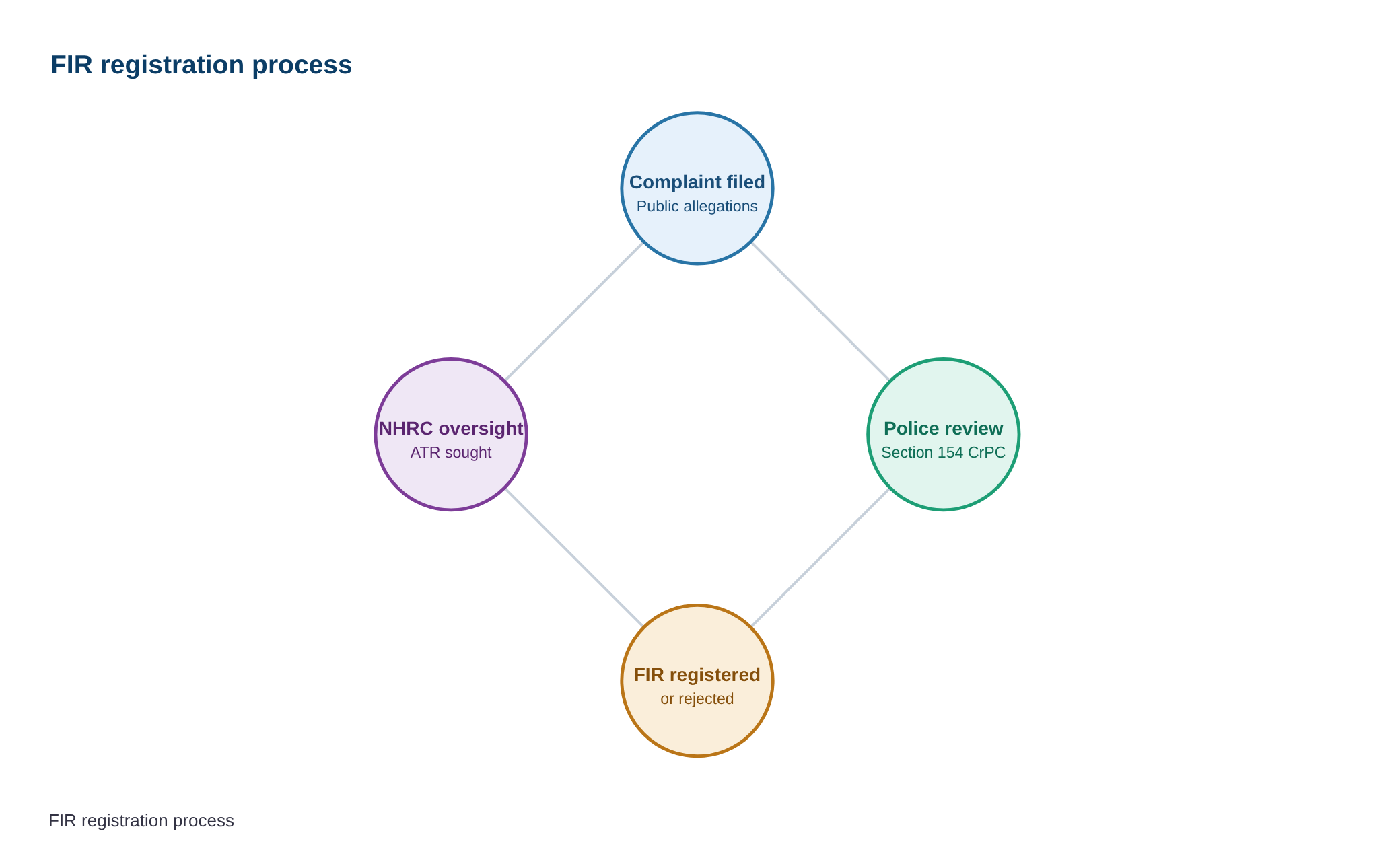
Public allegations of occult practices → Complainant files complaint with police stations → Failure to register FIR despite prima facie evidence → Complainant approaches NHRC → NHRC takes suo motu cognisance → Directs DGP to submit ATR → Institutional accountability and legal scrutiny → Systemic reforms in complaint redressal mechanisms.
Prelims Practice Questions
Q1. Consider the following statements regarding the National Human Rights Commission (NHRC) of India: 1. The NHRC is a constitutional body established under Article 338 of the Constitution. 2. The NHRC can inquire into complaints regarding violations of human rights either suo motu or on a petition presented to it. 3. The NHRC has the power to enforce its recommendations through judicial orders. 4. The Chairperson of the NHRC is appointed by the President of India on the recommendation of a committee headed by the Prime Minister. How many of the above statements are correct?
- Only one
- Only two
- Only three
- All
Answer: Only two — Statement 1 is incorrect: The NHRC is a statutory body established under the Protection of Human Rights Act, 1993, not a constitutional body. Statement 2 is correct: The NHRC can inquire into complaints suo motu or on a petition. Statement 3 is incorrect: The NHRC cannot enforce its recommendations through judicial orders; it can only recommend actions. Statement 4 is correct: The Chairperson is appointed by the President on the recommendation of a committee headed by the Prime Minister.
Q2. Assertion (A): The registration of an FIR is mandatory under the Code of Criminal Procedure (CrPC), 1973, if the information discloses the commission of a cognizable offence. Reason (R): The refusal to register an FIR violates the fundamental right to equality before the law and equal protection of the laws under Article 14 of the Constitution.
- Both A and R are true, and R is the correct explanation of A
- Both A and R are true, but R is not the correct explanation of A
- A is true, but R is false
- A is false, but R is true
Answer: A is true, but R is false — Assertion (A) is true: Section 154 of the CrPC mandates the registration of an FIR for cognizable offences. Reason (R) is true but not the correct explanation: While refusal to register an FIR may violate Article 14, the primary legal basis for mandatory FIR registration is Section 154 of the CrPC, not Article 14.
Q3. Match the following bodies with their respective constitutional or statutory provisions:
Column I:
1. National Human Rights Commission
2. Election Commission of India
3. Union Public Service Commission
4. Comptroller and Auditor General of India
Column II:
A. Article 324
B. Article 338
C. Article 315
D. Article 148
- 1-B, 2-A, 3-C, 4-D; 1-A, 2-B, 3-C, 4-D; 1-D, 2-A, 3-B, 4-C; 1-C, 2-D, 3-A, 4-B
- answer_letter_combo_indexes_to_match_answer_key_indexes_in_order_above_1B2A3C4D
- explain_using_indexes_only
- match
- 1. National Human Rights Commission is established under the Protection of Human Rights Act, 1993, which is linked to Article 338 (National Commission for Scheduled Castes). 2. Election Commission of India is established under Article 324. 3. Union Public Service Commission is established under Article 315. 4. Comptroller and Auditor General of India is established under Article 148.
Answer: 1-B, 2-A, 3-C, 4-D; 1-A, 2-B, 3-C, 4-D; 1-D, 2-A, 3-B, 4-C; 1-C, 2-D, 3-A, 4-B —
Mains Practice Question
✍ The refusal to register an FIR in cases involving allegations of human rights violations undermines the constitutional guarantees enshrined in Articles 14, 21, and 32 of the Constitution. Critically examine this proposition with reference to the role of the National Human Rights Commission (NHRC) and the legal framework governing police accountability. (15 Marks)
Approach: MODEL-ANSWER SKELETON:
1. **Constitutional Provisions**:
– Article 14: Right to equality before law and equal protection of laws.
– Article 21: Right to life and personal liberty, including the right to a fair investigation.
– Article 32: Right to constitutional remedies for enforcement of fundamental rights.
2. **Legal Framework on FIR Registration**:
– Section 154 of the Code of Criminal Procedure (CrPC), 1973: Mandates registration of FIR for cognizable offences.
– Judicial precedents (e.g., Lalita Kumari v. Government of Uttar Pradesh, 2014): Supreme Court ruling that FIR must be registered if the information discloses a cognizable offence.
– Police accountability mechanisms: Duty of the police to register FIR and failure to do so amounts to dereliction of duty.
3. **Role of NHRC**:
– NHRC’s mandate under the Protection of Human Rights Act, 1993: Can inquire into complaints of human rights violations suo motu or on petition.
– Power to recommend actions to the government and police authorities (Section 12(d)).
– NHRC’s direction to the DGP in the instant case: Seeking an Action Taken Report (ATR) within four weeks.
4. **Police Reforms and Accountability**:
– Prakash Singh v. Union of India (2006): Supreme Court directives on police reforms, including separation of investigation and law-and-order functions.
– Need for transparent and accountable policing to ensure public trust.
5. **Critical Examination**:
– **Strengths**: Legal framework and judicial precedents provide robust safeguards against arbitrary refusal to register FIRs.
– **Weaknesses**: Ground realities of delayed or denied FIR registrations, especially in cases involving influential individuals.
– **Balancing Views**: While the law is clear, implementation gaps persist due to systemic issues like political interference, lack of accountability, and inadequate training.
6. **Conclusion**:
– The refusal to register an FIR in cases of human rights violations is a violation of constitutional guarantees and undermines the rule of law.
– Strengthening NHRC’s powers, ensuring strict adherence to judicial directives, and implementing police reforms are essential to address this issue.
Source: The Hindu
Generated by AanyaAi for educational purpose.
Related guides on our sites
- Best economics services coaching
- Anthropology VS PSIR
- Best PSIR optional coaching
- Best PSIR optional coaching online

- KWML’s Feasibility Reports for Water Metro in 18 Cities: UPSC & PCS Insights - October 3, 2026
- ओडिशा में वन्यजीव अनुसंधान अनुदान कार्यक्रम शुरू, सिमिलिपाल में 300 कैमरे और बढ़ेंगे - October 3, 2026
- India Summons Pakistan High Commission Official Over Violation - October 3, 2026

No Comments